Which States Restrict Early Generation Bengal Cats
The world of Bengal cats is absolutely captivating, isn't it? Their stunning patterns and vivacious personalities draw so many of us in. But before you get too swept up in the dream of bringing one of these magnificent felines home, there's a real and often frustrating hurdle many prospective owners face: understanding the complex web of state and local laws, especially when it comes to early generation Bengal cats. It’s not as simple as just choosing your kitten; you have to ensure your state and even your city permit the specific generation you’re interested in. This guide is here to untangle that knotty issue, helping you understand which states might restrict early generation Bengal cats and why, so you can make informed decisions and avoid heartbreaking legal trouble down the line.
Understanding Bengal Cat Generations
Before we dive into the legalities, it's crucial to understand what "generation" actually means for a Bengal cat. This isn't just a fancy breeder term; it's the fundamental element that dictates where your Bengal can legally live and how it might behave. Many states and cities have specific regulations tied directly to this "F-number."
What Do F1, F2, F3 Mean for Bengals?
When you see a Bengal cat described as F1, F2, F3, or even SBT (Stud Book Traditional), you're looking at its filial generation, which tells you how many generations removed it is from its wild ancestor, the Asian Leopard Cat (ALC).
- F1 Bengals: These are the direct offspring of a domestic cat and a wild Asian Leopard Cat. "F1" stands for "first filial generation." Because they are half-wild, they often retain many strong wild instincts and traits. They can be incredibly challenging to manage, often requiring specialized care and housing.
- F2 Bengals: These cats have an F1 parent and a domestic Bengal or other approved domestic cat parent. They are one generation further removed from the ALC, making them about 25% wild. While still possessing strong wild traits, they are generally a bit more manageable than F1s.
- F3 Bengals: An F3 Bengal has an F2 parent and a domestic Bengal or approved domestic cat parent, making them approximately 12.5% wild. The wild instincts are further diluted, but they can still be quite intense and demanding compared to a typical housecat.
- F4 and Beyond (SBT): Once you reach the F4 generation, the cat is considered "Stud Book Traditional" (SBT) by many registries like TICA. This means they are at least four generations removed from their ALC ancestor, and both their parents, grandparents, and great-grandparents were all Bengals. These cats are generally considered fully domestic and are much more predictable in temperament, though they still carry the high energy and intelligence characteristic of the breed. For a deeper dive into the costs associated with these different generations, you might find "What an F1 Bengal Cat Costs" and "What an SBT Bengal Cat Costs" quite enlightening.
Why Early Generations Are Different Legally
The legal distinction between generations primarily stems from the perceived wildness and temperament of the cat. Early generation Bengals (F1, F2, F3) are often seen by lawmakers as possessing more characteristics of their wild ancestors. This can include anything from heightened prey drive and territoriality to a greater difficulty in litter box training or a reluctance to be handled.
The concern is often around public safety, the potential for escape, and the welfare of the animal itself if placed in an unsuitable home. Legislators worry that these cats, which are still very much hybrids, could pose a risk to local wildlife or even people, or that owners might not be equipped to provide the specialized environment and care they need. This isn't about judging owners; it's about a blanket caution often applied to any animal with recent wild lineage. It's a source of real frustration for responsible owners who understand their cats, but the laws are designed for the lowest common denominator, unfortunately.
The Landscape of State Restrictions
Navigating the various state laws concerning Bengal cats can feel like trying to solve a puzzle with missing pieces. The rules aren't uniform, and what's perfectly legal in one state might land you in hot water in another. This patchwork of regulations often catches prospective owners by surprise.
States with Outright Bans
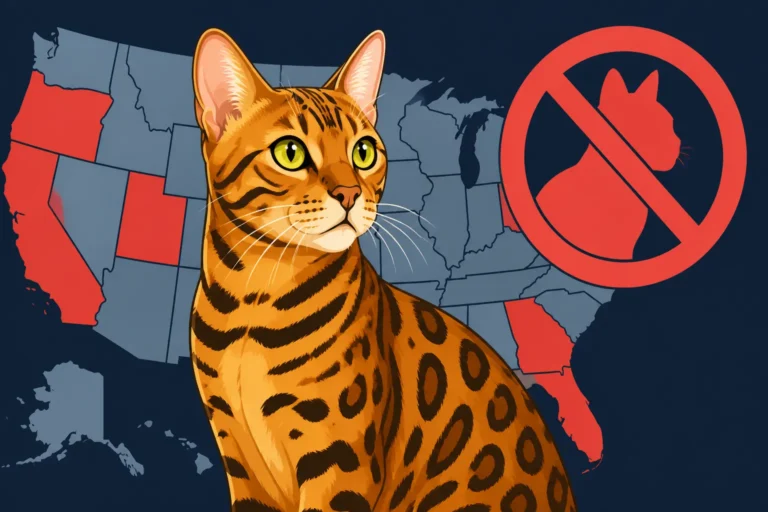
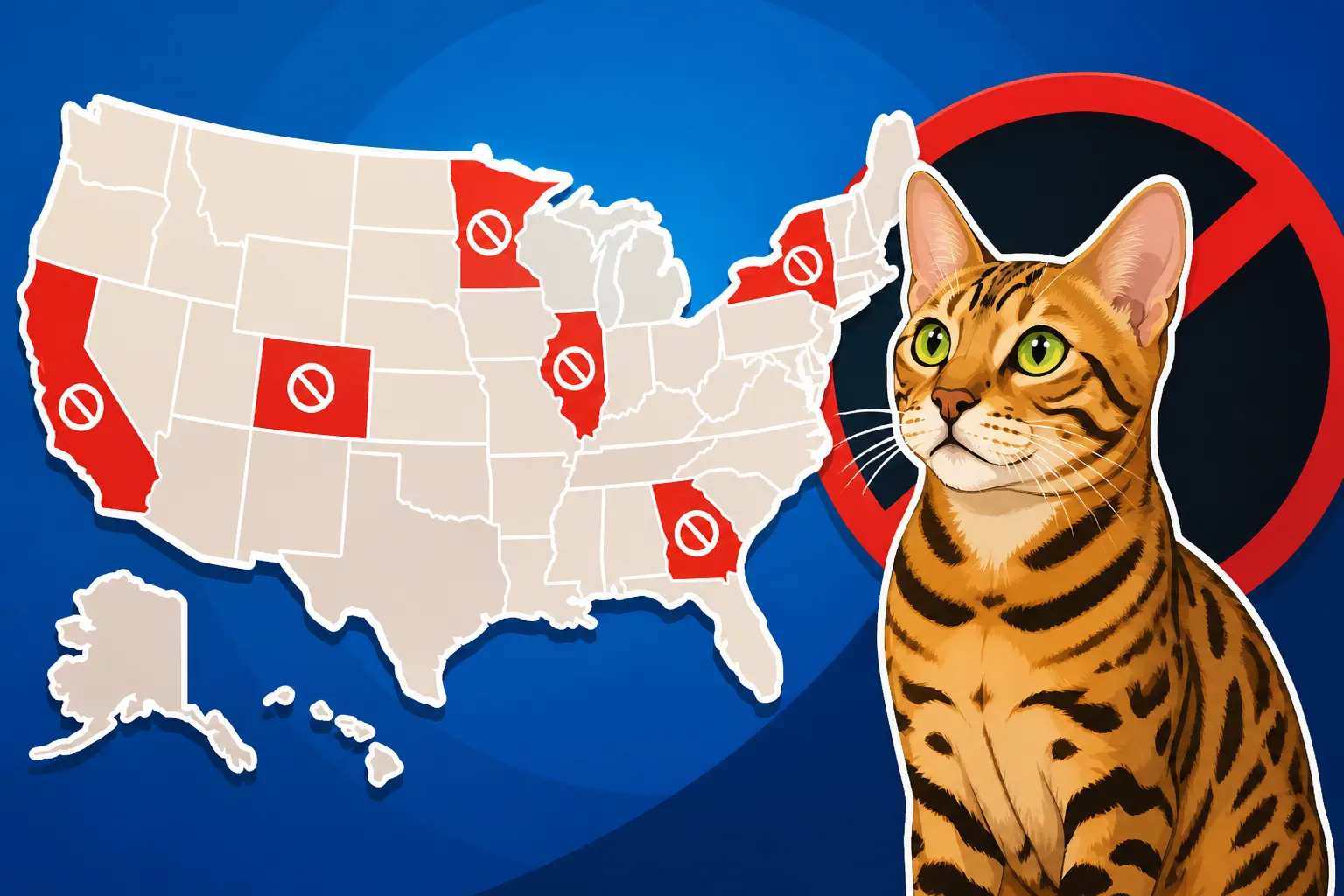
While not many states outright ban all Bengal cats (SBT generations are widely accepted), some have very strict rules that essentially eliminate the possibility of owning any early generation Bengal. The most notable example of an outright ban, regardless of generation, is Hawaii. If you're wondering "Hawaii Bans Every Bengal Cat, Whatever the Generation", it's true – the state's strict biosecurity laws prevent the import of any Bengal cat, fearing they could become an invasive species or pose other ecological risks.
Beyond state lines, it's also critical to remember that cities and counties can impose their own, even stricter, regulations. For instance, while New York State generally allows Bengals after a certain generation, "New York City Bans the Bengal Cat the State Allows". This means you could technically own an F4 Bengal just outside the city limits, but owning the exact same cat within the five boroughs would be illegal. This local variation is why simply checking your state's law isn't enough; you must verify your specific city and county ordinances too.
States Restricting Specific Early Generations
Most states that restrict Bengal cats do so by generation, drawing a line at F1, F2, F3, or F4. The vast majority of these restrictions aim to prevent the ownership of those Bengals closest to their wild ancestors.
Here's a general overview of how some states approach these restrictions, though remember, laws can change, and always verify with current local authorities:
- F1-F3 Restrictions: Many states restrict F1, F2, and F3 Bengals, classifying them as "wild animals" or "dangerous animals" due to their proximity to the Asian Leopard Cat. These states typically allow F4 generation and beyond. This is the most common form of restriction you'll encounter.
- F1-F4 Restrictions: A smaller number of states extend the restriction to F4 Bengals, meaning only SBT (Stud Book Traditional) Bengals, which are technically F5 and higher, are legally permitted without special permits or licenses. These states consider even F4s to retain too many wild traits for general pet ownership.
- Permit Requirements: Some states don't outright ban certain generations but require special permits, licenses, or specific caging requirements for early generation Bengals. This often involves an application process, fees, and inspections to ensure the owner can adequately care for and contain the animal. This is common for states that try to walk a middle line, acknowledging the breed's unique nature without completely prohibiting it. It's really vital to research "Which States Restrict Early Generation Bengal Cats" by consulting official government resources for your specific location.
Common Generational Divides
The way different jurisdictions interpret and regulate Bengal cats often boils down to a key distinction in generations. It's where the perceived "wildness" ends and "domestication" begins, at least in the eyes of the law. This can feel arbitrary, but it's the reality we face as Bengal enthusiasts.
The F1 to F4 Line: Where Most Laws Draw the Line
The F1 to F4 lineage is where the legal rubber meets the road for Bengal cat ownership. As we discussed, F1 Bengals are direct hybrids, and by F4, the cat is at least four generations removed from its Asian Leopard Cat ancestor. Most state and local laws use this generational divide to determine legality.
Think of it as a spectrum of wildness. An F1 Bengal is literally half wild, with half of its genetic makeup coming from a wild animal. This means behaviors like marking territory, a strong prey drive, and a general wariness of humans can be profoundly ingrained. As you move to F2 and F3, these traits become diluted, but they are often still significantly present, requiring an owner with a deep understanding of feline behavior and a very specific environment. When you read about "How an Early Generation Bengal Cat Behaves Differently", you'll get a clearer picture of just how distinct these cats can be from your average domestic kitty. The general consensus among many legislative bodies is that these early generations require expertise and resources that most pet owners simply don't possess. This is why you often see outright bans or stringent permit requirements for F1 through F3 (and sometimes F4) Bengals.
SBT Bengals: Generally Accepted, But Always Check
SBT stands for "Stud Book Traditional," and it designates a Bengal cat that is at least four generations removed from its Asian Leopard Cat ancestor, with all preceding generations also being Bengals. These cats are considered fully domestic. For a detailed breakdown of "How a Bengal Cat's Generation Is Counted" and "Why the Generation Number Decides Whether You Can Own a Bengal Cat", these linked articles are invaluable.
The good news is that SBT Bengals are generally accepted as domestic cats in most states and cities across the United States. This means that if your heart is set on a Bengal, an SBT is usually your safest and most legally straightforward bet. They possess the striking appearance, intelligence, and energetic personality that Bengal owners adore, but without the extreme wild instincts that concern regulators.
However, even with SBT Bengals, the golden rule remains: always check your specific local ordinances. While "Whether an SBT Bengal Cat Is Legal Everywhere" usually gets a "yes," some highly restrictive areas, like Hawaii or New York City, maintain a blanket ban on all Bengals, regardless of generation. It's a tiny percentage, but it’s enough to necessitate a quick call to your local animal control or city clerk's office. You don't want to find yourself in a situation where you've invested emotionally and financially in a cat, only to discover you can't legally keep it. Taking the time for due diligence upfront saves a lot of heartache.
| Bengal Generation | Proximity to ALC | General Temperament | Common Legal Status |
|---|---|---|---|
| F1 | Direct offspring | Very wild, challenging | Highly restricted/Banned |
| F2 | 2nd generation | Still wild, demanding | Restricted/Permit required |
| F3 | 3rd generation | Wild traits, active | Restricted/Permit required |
| F4 | 4th generation | More domestic, active | Sometimes restricted, often allowed with SBT |
| SBT (F5+) | 5th generation+ | Fully domestic, active | Generally permitted |
Why These Restrictions Exist
It’s easy to feel frustrated by restrictive laws, especially when you feel confident in your ability to provide a loving home for any animal. However, understanding the reasoning behind these regulations can help put them into perspective, even if you don't fully agree. Most laws are enacted out of concern for either public safety, animal welfare, or environmental protection.
Concerns Over Wild Traits and Temperament
The primary driver behind restricting early generation Bengal cats is the inherent wildness derived from their Asian Leopard Cat ancestry. Unlike generations of selective breeding that have shaped typical domestic cats into adaptable companions, F1, F2, and F3 Bengals are only a few steps removed from a truly wild animal. This proximity means they can display behaviors that are simply not suited for typical household environments.
For example, an early generation Bengal might have an exceptionally strong prey drive, making them a danger to smaller household pets like hamsters, birds, or even small dogs. Their instincts might compel them to mark territory with urine or feces, a behavior that is deeply ingrained and incredibly difficult to train away. They can be more wary of strangers, less tolerant of handling, and possess an energy level that far exceeds what most homes can provide adequate outlets for. Imagine the chaos of a creature with the agility and instincts of a wild cat, even if significantly smaller, let loose in a standard living room. They might climb curtains to the ceiling, scale bookcases, or incessantly try to escape any perceived enclosure. The goal of these laws is to prevent situations where these cats end up neglected or rehomed because an owner underestimated their needs, or worse, cause harm to themselves, people, or other animals.
Public Safety and Wildlife Preservation
Beyond individual temperament, authorities also consider the broader implications of owning animals with wild lineage. One major concern is public safety. While a well-socialized F4 or SBT Bengal is generally no more a threat than a large domestic cat, early generations can be unpredictable. Their powerful jaws, sharp claws, and potential for aggressive responses when startled or threatened are factors that lawmakers consider. They want to avoid scenarios where a hybrid cat might injure a child, a neighbor, or even a visiting service person.
Another significant concern is wildlife preservation. If an early generation Bengal were to escape, its strong hunting instincts and formidable skills could pose a serious threat to local bird populations, small mammals, and other vulnerable wildlife. The idea is to prevent a situation where an escaped hybrid cat could establish itself in the wild, potentially impacting native ecosystems. Some even worry about the possibility of these hybrids breeding with feral domestic cat populations, introducing wild genes into a population that already struggles with overpopulation and ecological impact. Therefore, the restrictions are often a preventative measure, designed to protect both human communities and the natural environment. These are the kinds of worries that also lead to discussions around why some places might have "Where a Bengal Cat Is Illegal in the United States."
How to Navigate State Laws
The best way to avoid stress and potential legal trouble is to be proactive and informed. Don't rely on hearsay or what a breeder says is allowed. Verify everything yourself. This is your responsibility as a potential Bengal cat owner.
Checking Your Specific State and Local Ordinances
The absolute first step you must take is to research the specific laws in your state, county, and city. This isn't just a suggestion; it's a non-negotiable requirement. State laws might outline broad prohibitions or requirements, but county and city ordinances can often be more restrictive. For example, a state might permit F4 Bengals, but your city might only allow SBTs, or might have specific enclosure requirements for any cat deemed "exotic."
- Start with your State's Wildlife or Agricultural Department: These agencies often have lists or regulations pertaining to exotic or hybrid animals. Their websites are usually a good starting point. Look for terms like "hybrid cats," "wild animal ownership," or "exotic pet regulations."
- Contact your County Animal Control or Clerk's Office: Once you have a general idea of state law, reach out to your county. They can clarify local nuances and confirm any additional permits or restrictions specific to your area.
- Call your City Clerk or Animal Control: This is the most crucial step. City ordinances can be surprisingly different from county or state laws. A quick, polite phone call explaining you're interested in owning a Bengal cat (specify the generation, e.g., "SBT Bengal cat") and asking about any local restrictions or permit requirements will save you immense trouble. They can also tell you how to verify "How to Prove Your Bengal Cat's Generation" if required. It’s always better to get this information directly from the source rather than relying on an interpretation.
Proving Your Bengal Cat's Generation
If you live in an area that restricts certain generations but allows others, you might need to be prepared to prove your Bengal cat's generation. This is especially true if you ever move, travel, or if a local authority questions your cat's legality.
- Pedigree Papers: The most common and widely accepted method of proving a Bengal cat's generation is through its TICA (The International Cat Association) pedigree papers. Reputable breeders will always provide these. The pedigree will clearly list the cat's lineage, showing its parents, grandparents, and so on, along with their filial generations. An SBT Bengal's pedigree will confirm that it's at least four generations removed from the Asian Leopard Cat.
- Breeder Contract/Health Guarantees: While not a substitute for official pedigree papers, a detailed breeder contract that specifies the cat's generation and health guarantees can support your claim. These documents often include registration numbers that link back to the official pedigrees.
- Veterinarian Records: Your veterinarian's records may also document the cat's breed and generation, especially if they are familiar with Bengal cats and have reviewed the pedigree.
- DNA Testing: In some rare cases, or if there's significant doubt, a DNA test might be used to confirm ancestry, though standard DNA panels primarily focus on health markers. It's more about proving parentage than a specific filial generation.
Always keep these documents in a safe, accessible place. If you ever find yourself needing to demonstrate that your cat is, for example, an SBT Bengal, having these papers readily available will make the process much smoother. This also ties into important discussions like "What the DNA Panel a Bengal Cat Breeder Runs Costs" as well as "Which Health Results a Bengal Cat Breeder Must Show" to ensure you're getting a healthy, properly documented feline companion. And seriously, think about "What Happens If You Move With an Illegal Bengal Cat" before you make any big decisions, because it can be a real headache.
Disclaimer
This article is for general informational purposes only and does not constitute professional advice. Laws, prices and regulations vary by location and change over time. Consult a qualified professional for guidance on your specific situation.