How to Teach a Bengal Cat to Come
It’s a common frustration for Bengal cat owners: you want your incredibly intelligent and active feline friend to respond to a simple command like "come," but they often act like they’re too busy scaling the curtains or investigating a fascinating dust bunny to bother. Unlike dogs, cats aren't inherently driven by a desire to please us, and Bengals, with their wild ancestry and independent spirit, can be particularly challenging. This guide will walk you through a positive, step-by-step approach to teaching your Bengal cat to come when called, transforming a casual request into a reliable response.
Why "Come" Can Be a Challenge for Your Bengal Cat
Let’s be honest, teaching a cat to "come" doesn't always feel intuitive, especially when you compare it to a dog who often bounds over at the mere whisper of their name. Bengal cats, in particular, come with a unique set of traits that can make this seemingly simple command a bit more complex. Their wild roots, specifically from the Asian Leopard Cat, mean they possess an innate independence and a strong sense of self-preservation that doesn't necessarily align with immediate obedience. They're more inclined to follow their own curiosity than yours, which is part of their charm, but also their challenge!
Your Bengal isn't ignoring you out of spite, but rather because their world is filled with a million fascinating things to explore. They have incredibly keen senses, and a tiny rustle in the next room or a bird at the window can be far more captivating than your voice. Understanding that this isn't a personal affront, but rather a manifestation of their natural instincts, is the first step towards successful training. We're not trying to break their spirit, but rather to communicate in a way they understand and find rewarding. Their high energy levels also mean they're often in motion, pursuing their next adventure, and interrupting that flow requires a significant incentive. If you've ever wondered How Intelligent a Bengal Cat Is, you'll know they're certainly smart enough to learn, but they need to want to.
Furthermore, Bengal cats are incredibly clever problem-solvers. They observe, learn, and adapt, often surprising their owners with their ingenuity, whether it's opening cabinets or figuring out complex puzzle toys. This intelligence means they quickly grasp patterns and consequences. If "come" is sometimes associated with something they don't like (like being picked up when they're not in the mood, or bath time), they'll quickly make that association and choose to ignore the command. Our job is to make "come" synonymous with only good things.
Getting Started: The Essentials of Teaching "Come"
Before you even begin saying the word "come," you need to lay a strong foundation built on trust, high-value rewards, and a consistent environment. This isn't just about repetition; it's about creating a positive association that your Bengal simply can't resist.
Choosing High-Value Rewards
This is perhaps the most critical element when training a Bengal cat. Their motivation isn't usually intrinsic; it's external, and it needs to be really good. Forget the dry kibble they get every day; you need something that makes their eyes light up and their tail twitch with anticipation. Think about what your Bengal absolutely adores. Is it a specific type of moist, smelly treat? Churu tubes are often a huge hit, as are small pieces of cooked chicken, salmon, or even tuna flakes. Many owners find freeze-dried chicken or salmon treats from brands found on Amazon to be irresistible. These treats should be small, easy to swallow, and something they only get during training sessions. This exclusivity makes them even more desirable.
Beyond food, consider other motivators. Some Bengals are highly toy-motivated. If your cat goes wild for a specific wand toy, like one with feathers or crinkly material, that can be a fantastic reward. A quick, energetic play session immediately after they come to you can be just as powerful as a tasty treat. For Bengals who love a good cuddle, a few minutes of attentive petting, especially in their favorite spot, can also serve as a reward. The key is to find what truly excites your cat, as every Bengal is an individual.
Selecting a Calm, Distraction-Free Environment
Starting your training sessions in a chaotic environment is a recipe for frustration. Bengals are easily distracted by sights, sounds, and smells. Begin in a quiet room with minimal distractions. This might be a bedroom with the door closed, or a quiet corner of your living room when the house is calm. Make sure there are no other pets, loud noises, or interesting new objects that could pull their attention away. As they become more proficient, you can gradually introduce more distractions, but for the initial stages, keep it as simple as possible.
Imagine trying to concentrate on a new task while a parade is going by outside your window – that's often what it feels like for a Bengal in a busy household. By eliminating these competing stimuli, you increase the likelihood that your cat will focus on you and the task at hand. This also allows you to have their full attention for administering the reward promptly, which is crucial for them to make the correct association.
Introducing the Clicker (Optional but Recommended)
While not strictly necessary, a clicker can be an incredibly powerful tool for training a Bengal cat, or any cat for that matter. A clicker provides a precise marker for the exact moment your cat performs the desired behavior. Unlike your voice, which can vary in tone and emotion, the clicker sound is always consistent. This clarity helps your Bengal understand exactly what they did to earn the reward.
To "charge" the clicker, simply click, then immediately give a high-value treat. Do this 10-20 times in a short session, several times a day, without asking for any behavior. Your cat will quickly learn that the click means a treat is coming, creating a strong positive association. You'll notice them looking at you expectantly after the click. Many reputable clickers are available on Amazon, often bundled with training guides. Once the clicker is charged, it acts as a bridge between the action and the reward, making your training much more effective. How to Clicker Train a Bengal Cat can provide even more detail on this method.
Step-by-Step Training Guide for the "Come" Command
Now that you have your high-value rewards and a quiet space, it's time to start the actual training. Remember, patience is paramount, and short, frequent sessions are far more effective than long, drawn-out ones.
Phase 1: The Lure and Reward Method
This is where you start building the association between the word "come" and the positive outcome.
- Start Close: Begin with your Bengal cat just a few feet away from you. Have your high-value treats ready in one hand.
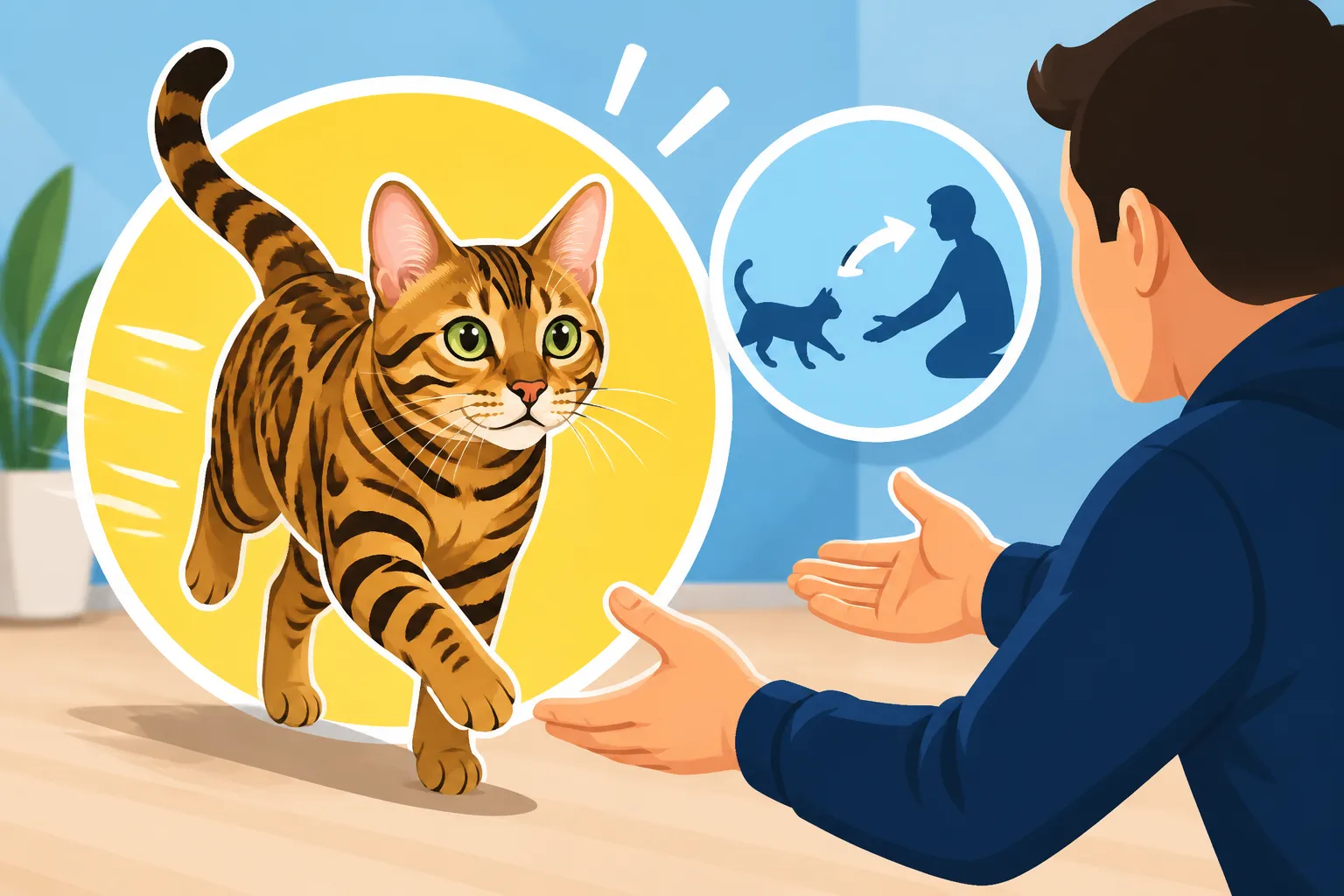
- Say "Come" and Lure: Say your Bengal’s name clearly, followed by "come" in an upbeat, happy tone. Immediately, show them a treat or crinkle the bag to get their attention, and perhaps even move it slightly towards you to encourage them to take a step.
- Reward Instantly: The moment your Bengal takes even one step towards you, or makes eye contact and turns in your direction, click (if using a clicker) and immediately give them the treat.
- Repeat and Increase Distance: Repeat this process several times. Once your cat consistently takes a step or two, gradually increase the distance. Don’t rush this. If they stop responding, go back to a closer distance where they were successful. You want every interaction with "come" to be a positive success.
It’s crucial that the reward is given as they are coming, or the very second they reach you, not after they've settled or done something else. This precise timing reinforces the act of moving towards you. If your Bengal is particularly food-motivated, a treat pouch can be helpful to ensure rewards are always at hand, which you can easily find on Amazon.
Phase 2: Adding Environmental Factors
Once your Bengal is reliably coming to you from a few feet away in a quiet room, it's time to slowly introduce more realistic scenarios.
- Vary Locations: Move your training sessions to different rooms in your house. Start in a slightly different part of the same quiet room, then move to another calm room. Each new location is a new challenge for your Bengal, as they need to generalize the command.
- Introduce Mild Distractions: Once they are consistent in various calm rooms, begin to add very mild distractions. This might be a quiet TV in the background, another family member quietly moving in the distance, or a favorite toy nearby but out of immediate reach. Again, if they falter, reduce the distraction level.
- Use Different Tones/Contexts: While consistency in command is key, you can vary your tone slightly (always upbeat) or call them from different positions (sitting, standing, kneeling). This helps them understand that "come" means "come to me" regardless of your posture or a slight vocal shift.
Remember to keep sessions short – five to ten minutes, a few times a day, is ideal. Bengals have short attention spans for formal training, but they learn rapidly through these frequent, positive interactions. You'll be surprised Which Commands a Bengal Cat Learns Fastest if you keep the motivation high.
Phase 3: Making "Come" a Lifelong Habit
The goal isn't just to get them to come during a training session; it's to make it a reliable command in everyday life.
- Random Reinforcement: Once your Bengal is consistently responding to "come," start to randomly call them throughout the day, even when you don't need them to come. Call them for a treat, a quick play session, or a cuddle. This prevents them from associating "come" only with formal training or, worse, with something unpleasant like vet visits or nail trims.
- Never Use "Come" for Punishment: This is critical. If "come" ever leads to a negative experience, your Bengal will learn to avoid it. The command should always be associated with positive reinforcement. If you need to give medication or trim nails, simply go to your cat and retrieve them without using the "come" command, or use a different, neutral cue.
- Call Them Before Feeding: Before putting down their meal, call your Bengal. When they come, immediately place their food bowl down. This links "come" with the highly anticipated reward of food, making it incredibly powerful. This can be especially effective for active Bengals who burn a lot of calories throughout the day, as detailed in How Many Calories a Cat as Active as a Bengal Burns.
| Training Phase | Distance/Distraction Level | Reward Type | Key Focus |
|---|---|---|---|
| Phase 1: Lure | Close (2-3 feet), No Dists. | High-value, immediate (food/clicker) | Building initial positive association and movement. |
| Phase 2: Generalize | Increasing, Mild Dists. | High-value, immediate (food/clicker, play) | Practicing in different environments, adding small challenges. |
| Phase 3: Habit | Anywhere, Any Dists. | Varied (food, play, cuddles), random, before meals | Integrating into daily life, maintaining positive reinforcement. |
Troubleshooting and Maintaining Your Bengal's "Come"
Even with the best intentions, you might hit a few bumps in the road. Bengals are complex creatures, and sometimes their wild instincts take over.
What to Do If Your Bengal Ignores You
It happens. You call, and they just stare, or worse, completely pretend they didn't hear you. Don't get discouraged, and absolutely do not punish them. Punishment will only teach them to fear you or the command.
- Re-evaluate Rewards: Is your reward truly high-value? Maybe your cat has gotten bored of that particular treat. Try something new and even more enticing. Sometimes, a new flavor of Churu or a different type of freeze-dried meat can rekindle their enthusiasm.
- Reduce Distractions: If they're ignoring you, the environment might be too distracting. Go back to a quieter, less stimulating setting. Sometimes, the allure of The Bengal Cat Is the Most Active Cat You Can Own and all the climbing and investigating that entails is just too strong.
- Shorten the Distance: If you've been practicing from across the house, try calling them when they're just a few feet away. Rebuild that success rate.
- Check Your Tone: Are you sounding frustrated or stern? Cats are highly sensitive to tone. Keep your voice light, happy, and inviting.
- Be Patient: Sometimes, they just need a moment to process or decide if it's worth their while. Give them a few seconds, rather than immediately repeating the command or giving up.
Dealing with Stubbornness and Distraction
Bengals can be incredibly focused when they want to be, which means pulling them away from something they're deeply engrossed in can be a monumental task. If your Bengal is obsessed with a bird outside the window or a tiny critter under the sofa, "come" might fall on deaf ears.
For these situations, you might need an even higher value reward, or a distinct sound to cut through the noise. A specific whistle or a very unique sound from a toy can sometimes grab their attention more effectively than just your voice. Another strategy is to not call them when they are at their most distracted. Instead, wait for a moment when their attention is slightly less engaged, then use the command. It's about setting them up for success.
Remember, a Bengal's natural temperament is one of intense curiosity and high energy. While you want them to come, you also respect that they are cats, not robots. If they're deep in play, you might need to combine the "come" with a shake of the treat bag or a jingle of a favorite toy to break their concentration. This isn't failing; it's adapting your training to their unique personality.
Maintaining the Command Over Time
Consistency is not just for initial training; it's for life. To keep "come" a strong command:
- Continue Random Reinforcement: As mentioned, keep calling them for good things throughout their life. It solidifies the positive association.
- Vary Rewards: Don't always use the same treat. Keep them guessing and excited by rotating through a few favorites. Maybe one day it's a churu, the next it's a tiny piece of cheese, then a five-minute laser pointer session. This keeps their motivation fresh.
- Practice in New Places: If you move, or if your Bengal goes to a pet sitter's house, do a few short "come" sessions in the new environment to re-establish the command.
- Short & Sweet: Keep your daily check-in sessions brief. A quick "come," a treat, and a little praise is all it takes to keep the skill sharp.
Teaching your Bengal cat to come when called can be a deeply rewarding experience, strengthening your bond and providing practical benefits, like quickly getting them out of a risky situation or simply rounding them up for cuddle time. It requires understanding their unique nature, boundless patience, and a constant supply of their favorite treats from places like Amazon. But the sight of your magnificent Bengal bounding towards you, eager for their reward, makes every moment of effort worthwhile.
Disclaimer
This article is for general informational purposes only and does not constitute professional advice. Laws, prices and regulations vary by location and change over time. Consult a qualified professional for guidance on your specific situation.