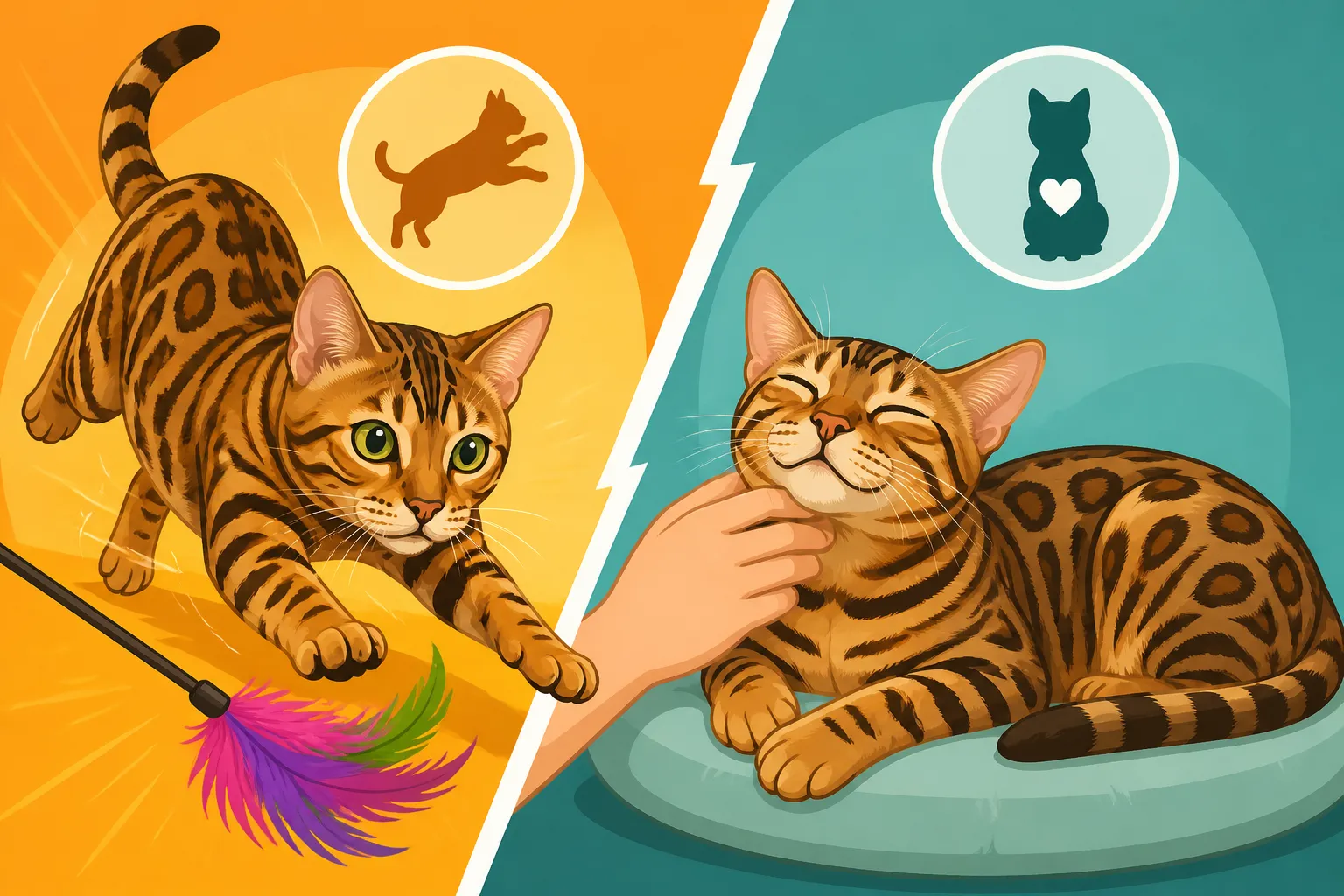
How an Early Generation Bengal Cat Behaves Differently
An early generation Bengal can be strikingly different from the confident, people-oriented companion many prospective owners imagine. F1, F2 and F3 cats may have stronger instincts, be more cautious with unfamiliar people, and need far more structure than a typical pet cat. This guide explains what those differences can look like at home, what daily care involves, and how to decide whether one suits your household.
What an early generation Bengal means
The F number describes ancestry, not a guaranteed personality
An F number refers to a Bengal’s distance in its pedigree from the Asian leopard cat, the wild ancestor used in the breed’s development. An F1 is one generation removed from that ancestor, an F2 is two generations removed, and an F3 is three. These labels describe family history; they do not tell you exactly how a particular cat will behave. For a clearer breakdown, see What F1 Means in a Bengal Cat and What F2 and F3 Mean in a Bengal Cat.
In general conversation, “early generation” usually means F1 through F3. The boundary may be used differently in particular settings, so check the exact definition being used by a breeder, registry, landlord, or local authority. Generation can matter for ownership rules as well as for expectations about behavior. If you are considering an early-generation cat, check local and national requirements before making plans; Which Countries Restrict the Bengal Cat offers a starting point for understanding why rules can vary.
An F number is not a personality test. Two cats with the same generation label may respond quite differently to household life, and temperament is shaped by more than ancestry: early handling, socialization, health, individual character, and the living environment all matter. Ask about the specific cat’s behavior and upbringing rather than assuming the number predicts whether it will be cuddly, vocal, confident, or comfortable with visitors.
Why early generations can differ from later-generation Bengals
Bengals farther removed from the Asian leopard cat have generally had more generations of selection for life as domestic companions. That does not make every later-generation Bengal easygoing, nor does it mean an early-generation cat cannot bond closely with people. It does mean early-generation cats may be less predictable in a busy home and may retain stronger responses to novelty, movement, confinement, or unfamiliar handling.
Early-generation males are also often infertile, and breeding arrangements can be complicated. If you are evaluating a breeder or a cat’s pedigree, ask for clear documentation rather than relying on a verbal description. Registration paperwork can help explain pedigree, but it does not tell you whether the cat has been raised to settle comfortably in a home.
It helps to think of generation as one consideration among several, not a shortcut to a behavior forecast. Ask how the cat reacts to ordinary household sounds, visitors, being picked up, carriers, and routine care. The breeder or current caregiver should be able to describe real examples, including situations the cat finds difficult.
How early-generation Bengal behavior may differ
Activity and hunting instincts can take more management
Bengals are often energetic, curious cats, but an early-generation cat may require especially thoughtful outlets for stalking, chasing, climbing, and exploring. A cat that has no safe way to use those instincts may invent its own activities: jumping at moving feet, raiding shelves, shredding household items, or persistently investigating doors and windows.
That does not mean every energetic behavior is a sign of a problem. It does mean a quick play session after work may not be enough. Build predictable opportunities for interactive play into the day, using toys that let the cat chase and catch rather than relying only on a laser or a toy left out unattended. Rotate toys, add food puzzles, and provide stable climbing options. The broader principles in How Much Enrichment a Bengal Cat Actually Needs can help you plan a routine.
A practical example: if a cat repeatedly launches itself at a hallway door around dawn, simply scolding it is unlikely to meet the underlying need. A vigorous play-and-food routine before bed, plus safe independent enrichment overnight, may make the behavior easier to manage. Track when the cat gets restless so you can adjust the schedule instead of responding only after something is knocked over.
Caution around people and new situations may be more noticeable
Some early-generation Bengals are reserved with visitors or take longer to trust new people. A cat may hide when the doorbell rings, watch a visitor from a high perch, or avoid being touched even while choosing to stay in the same room. That is not necessarily hostility. It may be a sign that the cat needs distance and control over how an introduction unfolds.
Let the cat approach rather than carrying it toward guests or insisting that it be petted. Set up a quiet retreat with water, litter, and a place to hide, and ask visitors not to stare, reach over the cat, or follow it. A confident cat can still dislike being restrained; allowing choice often makes everyday interactions calmer.
Some early-generation cats become strongly attached to familiar people, while remaining wary of others. That can be rewarding, but it also calls for patience and realistic expectations. If you want a cat that routinely welcomes strangers or is comfortable being handled by anyone, ask detailed questions about the individual’s temperament and consider whether those expectations fit the cat. For a broader temperament overview, see What a Bengal Cat's Temperament Is Really Like.
Litter habits and territory need careful attention
Litter-box use should never be treated as guaranteed simply because a cat is a Bengal. A cat’s habits depend on its prior experience, stress level, health, access to suitable boxes, and the cleanliness and location of those boxes. Moving to a new home can temporarily disrupt even a cat that previously used a box reliably. For more detail on that specific concern, see Whether an F1 Bengal Cat Uses a Litter Box.
Make the transition as easy as possible: start with the litter and box style the cat already knows, place boxes somewhere quiet and accessible, and avoid sudden changes while the cat is settling in. If urination or defecation outside the box begins, do not assume it is deliberate misbehavior. A veterinary check is important, particularly if the change is sudden or the cat seems uncomfortable.
Territorial behavior may also be challenging, especially when a cat feels crowded or has limited ways to retreat. Introductions to other animals should be gradual, with separate spaces and controlled access rather than a face-to-face meeting on the first day. For more on this issue, see How Territorial a Bengal Cat Is.
| Situation | What you might notice | Helpful first response |
|---|---|---|
| Visitors arrive | Hiding, watching from a distance, or avoiding contact | Give the cat a quiet retreat and let it approach in its own time |
| Energy builds up | Climbing, chasing, vocalizing, or exploring cupboards | Add regular interactive play, climbing space, and food-based enrichment |
| A move disrupts routines | Hiding or changes in litter habits | Keep familiar resources and routines; contact a vet if toileting changes persist |
| Another pet is introduced | Staring, avoidance, tension, or chasing | Separate the animals and use a gradual, supervised introduction |
What daily life with an early-generation Bengal requires
A secure, stimulating home matters more than novelty
A suitable home is not necessarily a large house. It is a home where the cat can move, climb, hide, play, and retreat without being repeatedly cornered or exposed to hazards. Tall, secure climbing structures, sturdy scratching surfaces, hiding places, and window perches can make an ordinary room more useful to a high-energy cat. Check that shelves and cat furniture are firmly installed; a startled cat should not have to choose between a fall and staying put.
Security also means taking escape risks seriously. Use reliable screens, be thoughtful around exterior doors, and make sure every household member knows the routine for entry and exit. An early-generation Bengal should not be assumed to be safe roaming freely outdoors. A secure enclosure or properly supervised outdoor time may be appropriate for some cats, but the cat’s temperament and local rules matter.
Enrichment does not need to mean expensive gadgets. Cardboard boxes, rotated toys, short training sessions, and puzzle feeders can create variety, provided they are safe and suitable for that cat. If you are shopping for food puzzles or replacement toys, a retailer such as Chewy may be one place to compare options; choose based on durability, size, and ease of cleaning rather than novelty alone.
Introductions to children and other pets should be gradual
An early-generation cat may be a poor match for a household that expects it to tolerate constant handling, loud play, or frequent visitors. Children need clear guidance: let the cat leave, avoid chasing it, and do not disturb it while eating, sleeping, or hiding. Even a gentle cat may scratch or bite if it feels trapped, so supervision and safe retreat spaces are essential.
The same care applies to dogs and resident cats. Begin with separate areas, exchange familiar scents, and allow controlled visual contact only when both animals are calm. A quick introduction can create fear that takes much longer to undo. The process should move at the pace of the more cautious animal, not according to a calendar.
Before choosing a cat, be honest about the household’s daily rhythm. A home with predictable routines and adults who can supervise introductions may be easier for some early-generation cats than one with frequent visitors, young children, and long periods of unsupervised activity. For help thinking through a family match, read Which Bengal Cat Generation Suits a Family.
Plan for company, routine, and practical care
Some cats cope poorly with long stretches alone, especially when they are highly active or strongly attached to a familiar person. That does not mean a second cat is automatically the answer: compatibility, space, and careful introductions all matter. Consider how the cat currently behaves when left alone, what support you can provide, and whether your schedule allows for regular attention. How Long a Bengal Cat Can Be Left Alone discusses the question in more detail.
Routine can make a real difference. Predictable meal times, interactive play, quiet rest periods, and consistent handling give a cat a clearer sense of what to expect. Keep essential resources distributed so the cat does not have to cross a busy or contested area to reach food, water, litter, or a resting spot.
Plan for ordinary care, too. Nail trimming, veterinary visits, carrier training, and medication may be harder if a cat is uncomfortable with restraint. Introduce handling gradually, reward calm behavior, and work with a veterinarian on a low-stress approach rather than waiting until an urgent appointment. When comparing supplies such as carriers or enrichment equipment, Chewy can be one option for browsing product types, but the right choice is the one that fits the individual cat and your home.
How to decide whether an early-generation Bengal is right for you
Ask about the individual cat, not only its generation
A useful conversation with a breeder or current caregiver should cover the cat’s everyday behavior in concrete terms. Ask how it reacts to unfamiliar people, household noise, being handled, a carrier, closed doors, and changes to routine. Ask what the cat does when bored and whether it has used a litter box consistently. Answers such as “very smart” or “full of personality” are not enough to help you prepare.
If possible, observe the cat in a familiar setting. Notice whether it recovers after a startling noise, explores cautiously, seeks interaction, or prefers to watch from a distance. No single reaction proves that a cat will or will not thrive in your home, but repeated patterns and the caregiver’s detailed examples can help you understand its needs.
Also ask about health history, socialization, documentation, and support if the placement becomes difficult. A responsible placement should give you room to ask practical questions, not pressure you to decide based on appearance or urgency. Consider whether the cat’s observed behavior matches the household you can actually offer.
Check legal rules and home constraints before committing
Rules for early-generation Bengals can differ by location, and the generation that is permitted may depend on local definitions and documentation. Check relevant state, provincial, national, and municipal requirements before bringing a cat home. Also check lease terms, insurance conditions, and any rules that apply to your building. Do not rely on a general claim that “Bengals are legal” without confirming how the rule applies to this particular generation.
Think through the practical setup in advance: where the litter boxes will go, how you will keep the cat secure near exterior doors, who will provide daily play, and where the cat can retreat when the home is busy. If you already have pets, plan for a slow introduction and have enough space to keep them apart while they adjust.
Early-generation Bengals can be intelligent, engaging companions, but their needs may be less predictable and more demanding than a prospective owner expects. A careful match depends on the individual cat, the household, and a realistic plan for exercise, security, socialization, and routine. Chewy may help you browse basic supplies, but equipment alone cannot replace time, patience, and a suitable environment.
Disclaimer
This article is for general informational purposes only and does not constitute professional advice. Laws, prices and regulations vary by location and change over time. Consult a qualified professional for guidance on your specific situation.