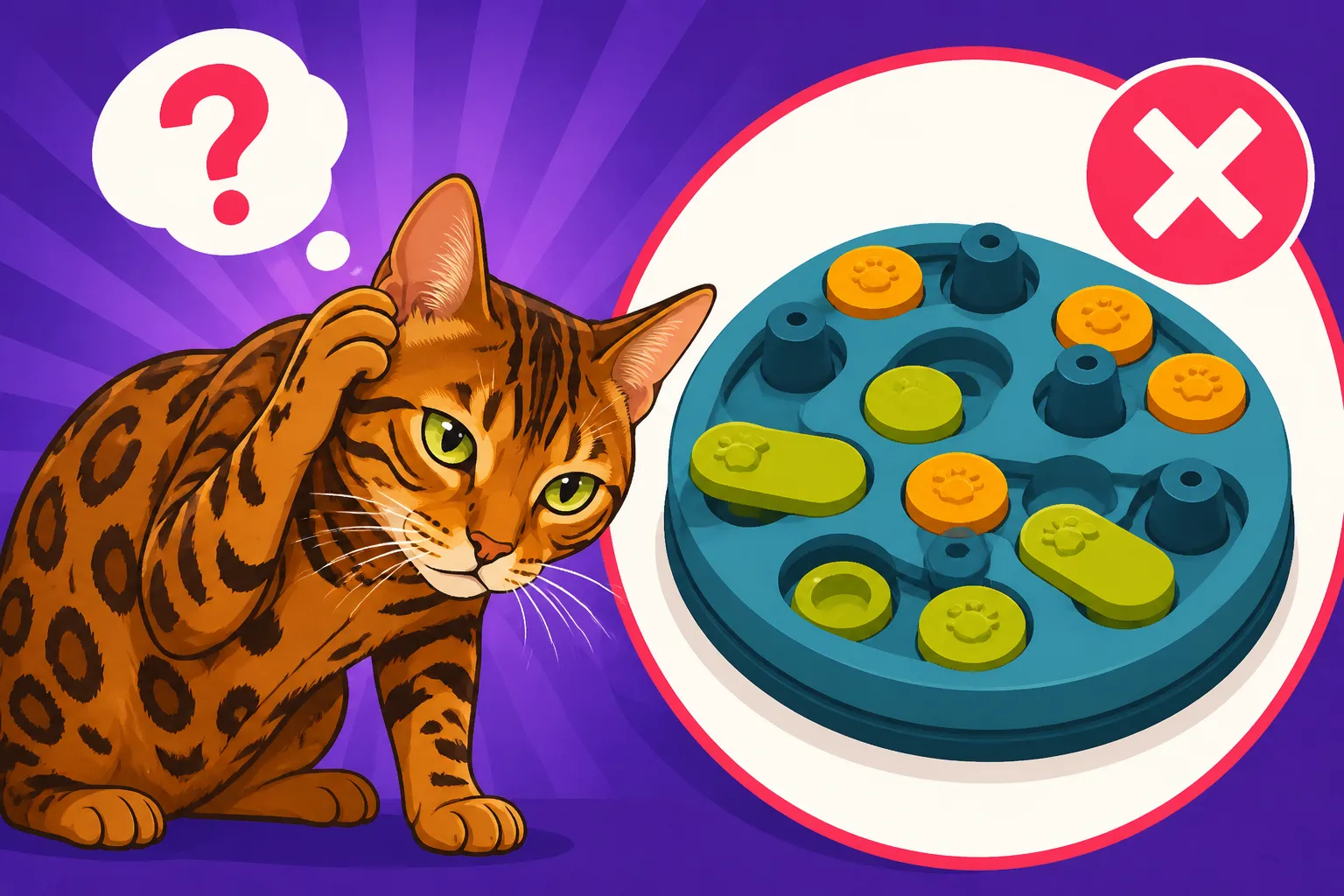
Which Puzzle Feeder a Bengal Cat Cannot Solve
If you're a Bengal cat parent, you know the unique blend of joy and absolute bewilderment that comes with trying to keep these intelligent, energetic felines entertained. You invest in what promises to be the "ultimate brain game," only to find your brilliant Bengal has solved it in under ten minutes, often with a dismissive flick of a paw, leaving you wondering if they're actually smarter than you are. The quest for a truly challenging puzzle feeder, one that actually slows them down and provides lasting mental stimulation, often feels like a losing battle against a furry genius. This guide is dedicated to exploring the depths of Bengal cat intelligence when it comes to puzzle feeders and offering strategies to keep their sharp minds engaged for more than a fleeting moment.
The Bengal Cat's Puzzle-Solving Prowess and Why It's a Challenge
Let's be honest, Bengal cats aren't your average couch potatoes. They're a breed that constantly pushes the boundaries of what you thought a domestic cat could do. This incredible intelligence and boundless energy are part of their charm, but they also mean that keeping them mentally stimulated is a full-time job.
Why Bengal Cats Are So Smart and Hungry
Bengal cats carry the legacy of their wild ancestors, the Asian Leopard Cat, in their DNA. This isn't just about their stunning coat patterns; it's deeply ingrained in their behavior and cognitive abilities. These cats are natural hunters, problem-solvers, and explorers. When you put a puzzle feeder in front of a Bengal, you're not just offering a meal; you're presenting a challenge that taps into their innate drive to forage and "work" for their food. Their brains are wired for complexity, for figuring out how things operate, and for persistent exploration.
This inherent intelligence means they learn incredibly fast. What might take another cat days or even weeks to understand, a Bengal often deciphers in minutes. They quickly observe patterns, remember sequences, and experiment with different methods until they achieve their goal. It's truly fascinating to watch, but it certainly makes our job as enrichment providers a bit tougher! They also have a seemingly bottomless pit of energy, which means they're constantly seeking an outlet for both their physical prowess and their mental faculties. If they're not challenged, boredom can quickly lead to undesirable behaviors. Think about it: if a sophisticated puzzle is solved in moments, what kind of lasting mental workout are they really getting? We delve more into their cognitive abilities in How Intelligent a Bengal Cat Is.
Common Puzzle Feeder Fails for Bengals
Many puzzle feeders on the market, while perfectly adequate for a typical domestic cat, simply don't stand a chance against a determined Bengal. You know the ones I mean: the treat balls with one opening that just needs a good swat, the simple slider puzzles where a paw just pushes a few pieces around to reveal the kibble. These might provide a minute or two of entertainment, but a Bengal cat often quickly masters them.
I've seen it countless times – owners excitedly bring home a new, brightly colored puzzle feeder, convinced this will be the one. They set it up, only to return a few minutes later to find all the treats gone, the feeder lying innocently on its side, and their Bengal looking at them with an expression that clearly says, "Is that all you've got?" It's not that these feeders are inherently bad; it's that they simply aren't designed for the advanced problem-solving capabilities of a Bengal. They might briefly engage their interest, but they rarely offer the sustained mental effort required to truly tire out their active minds. The frustration is real when you feel like you're constantly buying new toys that are quickly defeated.
The "Unsolvable" Quest: What Makes a Puzzle Feeder Bengal-Proof?
The truth is, no puzzle feeder is truly "unsolvable" for a Bengal cat forever. Their intelligence and persistence mean they will eventually figure out almost anything you put in front of them. However, the goal isn't to find something they can never solve, but rather to find feeders that take them significantly longer to master, offer multiple layers of challenge, and provide sustained engagement. We want to extend that "solve time" from minutes to a respectable chunk of their day.
Key Design Elements to Look For
When hunting for a puzzle feeder that might actually challenge your Bengal, you need to think beyond the basics. Look for designs that require more than just a single, repeated action.
- Complexity: This is paramount. Seek feeders that involve multiple steps, different types of mechanisms, and varied problem-solving techniques. Can your Bengal push, pull, lift, slide, and rotate different components to get to the food? The more diverse the actions required, the longer it will take them to decipher the whole sequence. A feeder that requires a paw to lift a lid, then slide a cover, then fish out a treat, for example, is far more engaging than one that just needs a roll.
- Durability and Stability: Bengals are not delicate creatures when they're on a mission. A flimsy plastic toy will quickly become a scattered mess, or worse, damaged. Look for feeders made from robust materials, ideally with a non-slip base, so it stays put while they're working on it. Heavy, stable designs prevent them from simply batting the entire thing over to spill the contents. You want something that can withstand enthusiastic pawing, biting, and even attempts to pick it up and shake it.
- Variety of Challenges: The best puzzle feeders don't just have one type of obstacle. They combine different elements, meaning your cat can't rely on a single learned trick. Some might have deep wells that require careful pawing, while others have tight slots for specific movements. This keeps their brains working in different ways, preventing quick mastery.
- Adjustable Difficulty: This is a fantastic feature. Some feeders come with inserts or adjustable openings that allow you to increase the difficulty as your cat becomes more proficient. You can start with easier settings to build confidence and then slowly ramp up the challenge. This means the feeder grows with your cat's abilities, extending its useful life considerably. While no feeder is truly "unsolvable," these features offer the best chance for sustained mental workout.
Types of Advanced Puzzle Feeders That Stand a Chance
Given their intelligence, you'll need to look for puzzle feeders that go beyond the usual. Here are a few categories that tend to fare better with Bengals:
- Multi-Stage Feeders: These are the real heavy hitters. They typically involve several distinct steps or compartments that must be manipulated in a specific order. Imagine a feeder where your cat has to push a button to release a lever, which then opens a door to reveal a smaller treat compartment, which then requires them to bat a treat through a maze. These sequential puzzles force more complex thinking and extend the engagement period. They can be found from various pet supply retailers, and it's worth checking customer reviews on sites like Chewy to see what other Bengal owners say about their longevity.
- Feeders Requiring Precision and Dexterity: Some puzzle feeders have smaller, more intricate compartments or channels that demand a finer motor skill than just a broad swipe. Your Bengal might have to use a single claw to hook a treat, or guide it through a narrow path. This adds a layer of finesse to the challenge, slowing down even the most adept paws. Look for designs that have small, deep wells or complex patterns that prevent easy access to the food.
- Interactive Electronic Feeders: While often pricier, some electronic puzzle feeders can offer randomized challenges or timed releases that keep things unpredictable. They might light up, make sounds, or dispense food at irregular intervals, preventing your cat from learning a single, repeatable solution. The unpredictability can add a lot to the challenge, as your Bengal can't anticipate the next step. Just be sure to pick one that is sturdy enough to handle their enthusiasm! You might find a wider selection of these unique options on Amazon, often with user videos showcasing how they work.
Remember, the goal isn't to stump them indefinitely, but to provide a prolonged, satisfying mental workout. No single puzzle will remain "unsolvable" for your Bengal forever, but these advanced types offer a much better chance at sustained enrichment than simpler designs.
Here's a quick comparison of general puzzle feeder types and their suitability for your clever Bengal:
| Puzzle Feeder Type | Complexity Level | Bengal Cat Suitability | Key Advantages | Potential Drawbacks |
|---|---|---|---|---|
| Simple Treat Ball | Low | Low | Easy introduction to foraging, encourages movement | Solved almost instantly, quickly loses interest |
| Flat Slider/Maze Puzzles | Medium | Medium-Low | Introduces basic problem-solving, good for beginners | Quick to master, can be too easy for advanced Bengals |
| Vertical/Tower Feeders | Medium-High | Medium | Challenges gravity, requires pawing skills | Can be tipped over, limited long-term engagement |
| Multi-Stage Combination | High | High | Varied challenges, extended engagement, sequential tasks | Can be more expensive, might be too complex initially |
| Precision/Dexterity Feeders | High | High | Requires fine motor skills, slows down consumption | Some can be frustrating if too small, may not hold much food |
| Electronic/Randomized | High | Medium-High | Unpredictable, can offer varied stimuli | Requires batteries/charging, may not be robust enough |
Strategies to Extend the Life of Any Puzzle Feeder
Even with the most advanced puzzle feeder, your Bengal's keen mind will eventually figure it out. The trick is to keep them guessing and to introduce variety into their routine. Think of yourself as their personal game designer, constantly tweaking the rules to keep the challenge fresh.
Introducing New Challenges Gradually
One common mistake is to present a brand-new, highly complex puzzle feeder and expect instant engagement. While Bengals are smart, they can still get frustrated if a task seems impossible. Start by making the puzzle feeder easy to "win" the first few times. Leave some treats easily accessible, or don't set all the intricate mechanisms. This builds confidence and teaches them the basic concept. Once they've got the hang of the easy version, gradually increase the difficulty. Add more steps, tighten the mechanisms, or reduce the visible treats. This progressive challenge keeps them motivated and feeling successful, rather than defeated.
Another crucial strategy is rotation. Don't leave the same puzzle feeder out day after day. Just like humans get bored with the same crossword puzzle, your Bengal will get bored once they've mastered a feeder. Instead, have a few different types and rotate them every few days or even week. This keeps their brain active as they have to recall different solutions for different puzzles. You can also vary the treats you use; sometimes a high-value, novel treat can reignite interest in an old puzzle. Combining different types of challenges can also be highly effective. Perhaps a session with a multi-stage feeder, followed by a lighter session with a simple treat ball. This variety ensures they're always thinking and adapting. How Many Play Sessions a Bengal Cat Needs will give you an idea of their daily enrichment requirements beyond just puzzle feeders.
DIY and Human-Assisted Puzzles
Sometimes, the most challenging "puzzle" for a Bengal cat isn't a commercially produced toy at all – it's one created by their clever human! DIY puzzles are fantastic because they're infinitely customizable, can be changed frequently, and often cost very little.
Think simple:
- Paper towel rolls: Fold the ends, cut small holes, and tuck treats inside. Your cat has to tear, paw, and roll to get the reward.
- Muffin tins with ping pong balls: Place treats in a few cups of a muffin tin and cover them with ping pong balls. Your cat has to lift or swat the balls away.
- Boxes within boxes: Create a "Russian doll" effect with progressively smaller boxes, each with a treat inside.
- Hidden treats: Simply hide small portions of their kibble or favorite treats around the house, in different locations and at different heights. This turns mealtime into a scavenger hunt, engaging their powerful sense of smell and their natural instinct to explore and forage.
The real secret weapon here is human interaction. Sometimes, the "unsolvable" part of the puzzle is that you are the puzzle master, constantly changing the game. You can actively hide treats, observe their problem-solving, and then adjust the next challenge based on their success. This interactive element adds a social dimension that no automated feeder can replicate. When looking for inspiration, a quick search on sites like Amazon for "cat puzzle toy components" can spark ideas for building your own complex creations, or for finding new pieces to integrate into your existing setup.
Beyond Puzzle Feeders: Holistic Mental Enrichment
While puzzle feeders are a fantastic tool, they're just one piece of the larger puzzle when it comes to keeping a Bengal cat happy and stimulated. A truly enriched life for these intelligent creatures involves a variety of activities that challenge their minds and bodies.
Incorporating Training and Play
Bengals thrive on interaction and learning. Their intelligence isn't just for solving food puzzles; it extends to understanding commands and engaging in complex play.
- Clicker Training: This is perhaps one of the most powerful tools for mental stimulation you have. Teaching your Bengal tricks like "sit," "stay," "high five," or even more complex sequences provides immense mental exercise. The act of learning new behaviors and earning rewards is incredibly satisfying for them. It strengthens your bond and gives them a productive outlet for their intelligence. Read more about getting started with this in How to Clicker Train a Bengal Cat.
- Interactive Play with Wand Toys: Nothing quite replaces dedicated play sessions with you. Wand toys, especially those with real feathers or interesting textures, are excellent for mimicking prey. Your Bengal gets to stalk, chase, pounce, and "kill" their prey, fulfilling a primal instinct. The key is to make these sessions dynamic, moving the toy in unpredictable ways, and allowing them to "catch" it frequently to build confidence. Be prepared, though, as their predatory instincts mean they can be hard on toys. You'll quickly discover Which Wand Toy a Bengal Cat Destroys Fastest!
- Fetch: Many Bengals love to play fetch, often with surprising enthusiasm. This game combines physical exercise with mental engagement, as they learn to retrieve and return specific toys. It's a great way to bond and burn off some of that incredible energy. How Well a Bengal Cat Fetches is a topic many Bengal owners are curious about, and for good reason!
Environmental Enrichment
A Bengal's environment plays a huge role in their overall well-being. A stimulating home encourages natural behaviors and prevents boredom.
- Vertical Space: Bengals are climbers. They crave high vantage points from which to survey their domain. Providing tall cat trees, wall-mounted shelves, and cat "highways" gives them plenty of opportunities to jump, climb, and explore. This vertical territory adds a whole new dimension to their environment and makes a relatively small space feel much larger. Understanding How Much Vertical Space a Bengal Cat Needs is key to a happy home.
- Catios: If possible, a catio (a secure outdoor enclosure) can be a game-changer for a Bengal. It offers safe access to fresh air, sunshine, and the stimulating sights, sounds, and smells of the outdoors without the risks of free-roaming. A catio provides a constantly changing environment, fulfilling their exploratory urges in a secure way. This is why Why a Catio Is the Answer to a Bengal Cat is such a popular topic among Bengal owners.
- Rotation of Toys and Scents: Beyond puzzle feeders, rotate all your cat's toys regularly. Introduce new textures, shapes, and materials. You can also use catnip, silvervine, or even valerian root toys to add novelty. Some Bengals also enjoy safe, pet-friendly essential oil diffusers (used very sparingly and away from direct access) for olfactory enrichment.
Ultimately, keeping a Bengal cat mentally stimulated is an ongoing commitment, not a one-time purchase. While no puzzle feeder will remain "unsolvable" forever, the goal is to consistently offer new and challenging experiences. By combining advanced puzzle feeders with interactive training, engaging play, and a rich environment, you can ensure your brilliant Bengal leads a happy, fulfilled life, one solved puzzle at a time. The satisfaction of watching them intently work out a new challenge is truly one of the greatest joys of having these incredible cats.
Disclaimer
This article is for general informational purposes only and does not constitute professional advice. Laws, prices and regulations vary by location and change over time. Consult a qualified professional for guidance on your specific situation.