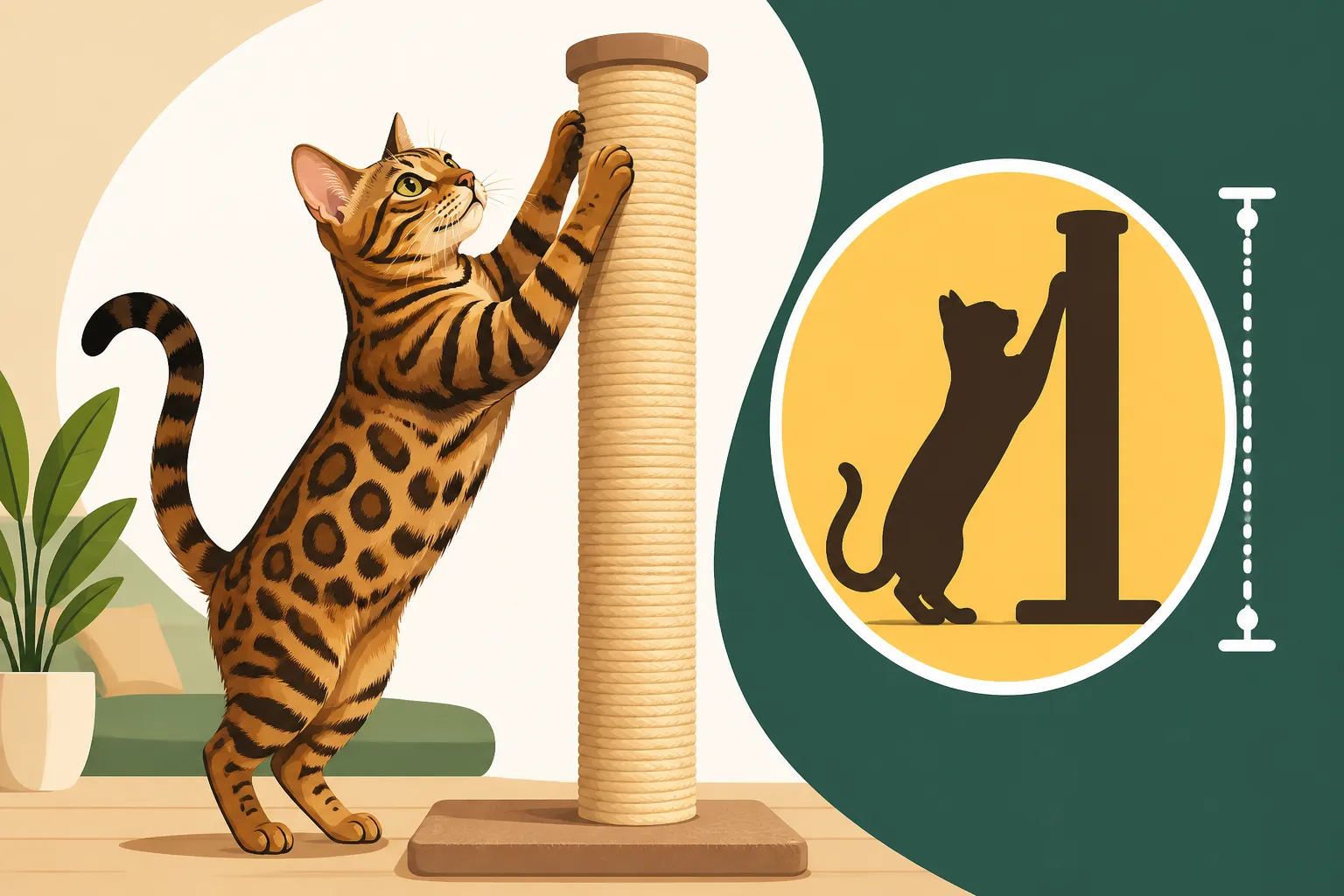
How Tall a Scratching Post a Bengal Cat Needs
If you've ever walked into your living room to find your beautiful Bengal cat meticulously shredding the arm of your favorite armchair, you know the particular frustration that comes with their natural, powerful urge to scratch. It’s not just an annoyance; it's a testament to their strength and instinct. This guide is here to walk you through exactly what kind of scratching post will finally satisfy your active Bengal, saving your furniture and giving them the healthy outlet they desperately need.
Understanding Your Bengal's Innate Need to Scratch
Let's be real, a Bengal cat isn't just idly stretching their paws when they scratch. This isn't just about sharpening claws; it's a deep-seated instinct tied to their wild heritage and their overall well-being. Trying to stop them without providing a suitable alternative is like trying to stop the tide – impossible and ultimately frustrating for everyone involved.
More Than Just Nail Care: Why Scratching is Primal
For a Bengal, scratching is a multifaceted behavior. First, yes, it helps them shed the outer layers of their claws, keeping them sharp and healthy. But it's so much more than a feline manicure. When your Bengal digs their claws into a surface, they're stretching out their entire body, flexing muscles from their shoulders all the way down their spine. This full-body stretch is crucial for their athletic build, helping to maintain flexibility and keep their powerful muscles toned. Think of it as their daily yoga session, but with more ripping involved!
Beyond the physical, scratching is also a vital form of communication. Cats have scent glands in their paws, and when they scratch, they leave behind their unique scent. This is their way of marking territory, telling other cats (or you, in this case) that this space belongs to them. It’s a confidence booster, a way to say, "I'm here, I'm present, and this is my domain." For a cat as confident and assertive as a Bengal, this territorial marking is incredibly important for their mental security.
Lastly, scratching is a stress reliever. If your Bengal is feeling anxious, bored, or overstimulated, a good vigorous scratch can help them burn off some of that pent-up energy and emotion. It's a healthy coping mechanism, provided they have the right place to do it. Understanding these deep-seated reasons helps us move past frustration and towards providing effective solutions.
The Damage: What Happens When Instinct Meets Your Sofa
Oh, the tales I could tell of shredded upholstery! If you've got a Bengal, you've likely seen firsthand the havoc their natural scratching can wreak on furniture, carpets, or even wallpaper. The problem isn't that your Bengal is "bad"; it's that they have an instinctual drive that needs an appropriate outlet, and if you don't provide one, they'll find their own. And that "own" often happens to be your expensive new sofa or that antique rug.
The issue is that many standard, flimsy scratching posts just don't cut it for a Bengal. They're too short, too wobbly, or covered in a material that doesn't feel satisfying to their claws. A quick, half-hearted scratch on a wobbly post isn't going to give them the full-body stretch or the territorial marking satisfaction they're looking for. Instead, they’ll seek out something substantial and immovable, something that truly resists their efforts and allows them to get a good, deep rake.
This mismatch between instinct and inadequate resources leads to what we perceive as "bad behavior." But from your Bengal's perspective, they're simply doing what comes naturally in the absence of a better option. It's our job as their human companions to provide that better option, preventing damage and fostering a happier cat. If you want to know more about how to protect your furniture, check out How to Save a Sofa From a Bengal Cat.
Unpacking the "Wild" in Their Scratching Habits
Remember, Bengal cats have that wonderful, exotic ancestry with the Asian Leopard Cat. This isn't just about their stunning looks; it influences their behavior, too. They retain many of the robust, athletic traits of their wild ancestors, and their scratching habits are no exception. A wild cat needs to keep its claws in prime condition for climbing, hunting, and self-defense. They would use trees, logs, and other sturdy natural surfaces to maintain their paws.
This means your Bengal isn't going to be satisfied with a tiny, carpet-covered post designed for a sedate housecat. They need something that mimics the sturdy, vertical surfaces they'd find in the wild. Think thick tree trunks that offer resistance and allow for a full, satisfying pull and stretch. Their claws are designed for serious work, and their scratching behavior reflects that. They're powerful, agile, and need an outlet that can stand up to their impressive physical capabilities.
This "wild side" means we need to think beyond typical cat products and really consider what a cat with such a dynamic heritage truly requires. It’s about meeting their primal needs with modern solutions.
The Quest for the Perfect Scratching Post: Height is Just the Start
When it comes to scratching posts for your Bengal, it’s not just about having a post; it's about having the right post. And trust me, getting this right can be a game-changer for both your cat's happiness and your furniture's longevity.
Why Height Matters for a High-Flying Bengal
This is where many standard scratching posts fall short, quite literally. Your Bengal is a long, athletic cat, especially when they stretch out fully. To get a truly satisfying scratch and a full-body stretch, a Bengal needs a post that is tall enough for them to extend their entire body upwards, with their front paws at the top of the post and their hind paws still on the ground. For many adult Bengals, this means a post that is at least 30-36 inches high, if not taller.
Imagine trying to stretch properly if the bar was only half your height. You'd feel cramped and unsatisfied, right? Your Bengal feels the same way. If the post is too short, they can't get that deep, elongating stretch through their back and shoulders, which is a key part of the scratching ritual. They'll either ignore it or use it awkwardly, still seeking out your sofa arm which does offer that satisfying height and resistance. Brands like those found on Chewy or Amazon offer a range of taller posts, but always double-check the actual dimensions. Don't just assume "tall" means Bengal-tall!
Beyond just stretching, a tall post also provides a sense of security and a vantage point. Some Bengals love to climb their posts, and a sturdy, tall option can double as a mini climbing wall. This caters to their natural desire for vertical space, which is incredibly important for such an active and curious breed. Understanding How High a Bengal Cat Can Jump really puts this into perspective.
Material World: What Your Bengal's Claws Crave
The material of the scratching post is just as crucial as its height. Most standard posts are covered in thin carpet, which might feel soft but doesn't offer the resistance and shredding satisfaction a Bengal desires. Their claws are strong, and they need something that gives them a good workout.
Sisal rope is often considered the gold standard for scratching posts. Its rough, fibrous texture provides excellent grip and allows your Bengal to really dig in and pull, mimicking the bark of a tree. It feels satisfying to their paws and provides the necessary resistance. Look for posts where the sisal is tightly wrapped and securely attached, so it doesn't unravel too quickly under your Bengal's enthusiastic assault.
Another excellent option is sisal fabric or corrugated cardboard. Sisal fabric offers a similar texture to rope but covers a wider surface area, which some Bengals prefer. Corrugated cardboard scratchers, especially the dense, heavy-duty ones, are surprisingly popular. They offer a unique ripping sensation that many cats adore, and while they wear out faster than sisal, they're often more affordable and can be replaced regularly. The key is to find what your individual Bengal prefers – some are sisal fanatics, while others swear by cardboard. Providing a variety can be a smart move. You can find many options from reputable retailers like Chewy or on Amazon.
Stability and Sturdiness: The Unsung Heroes of a Good Post
Picture your powerful Bengal launching themselves at a scratching post, claws out, ready for action. Now imagine that post wobbling precariously with every swipe. Not only is this frustrating for your cat, but it can also be dangerous if the post topples over. A Bengal needs a scratching post that is absolutely rock-solid and stable.
This means looking for a post with a heavy, wide base. A good rule of thumb is that the base should be at least as wide as the post is deep, and ideally wider, to prevent tipping. Some of the best posts for Bengals are those that are integrated into a larger cat tree or have a very substantial, weighted base. If you can find a wall-mounted scratching board in sisal, that's another fantastic option that provides unparalleled stability. Don't underestimate the sheer force a Bengal can exert!
Investing in a sturdy, well-made post might seem like a larger upfront cost, but it's an investment in your furniture's future and your cat's happiness. A flimsy post will be ignored, leading your Bengal back to your sofa, or worse, could cause an injury if it collapses. A solid post, however, will withstand years of vigorous scratching sessions, truly becoming your Bengal's preferred scratching surface. Consider posts advertised as "heavy-duty" or "for large cats" when browsing online at places like Chewy.
| Feature | Ideal for Bengal Cats | Why it Matters |
|---|---|---|
| Height | 30-36 inches minimum, taller is better | Allows full-body stretch, mimics natural scratching on tree trunks. |
| Material | Sisal rope (tightly wrapped), sisal fabric, dense cardboard | Provides satisfying resistance, texture, and shredding action for strong claws. |
| Stability | Heavy, wide base; wall-mounted options | Prevents wobbling or tipping, ensuring safety and confidence during vigorous scratching. |
| Construction | Durable, sturdy materials, no flimsy parts | Withstands powerful scratching, ensures longevity and value. |
Strategic Placement and Enticement: Making the Post Irresistible
So you've chosen the perfect, tall, sturdy, sisal-covered scratching post. Now what? Simply putting it in a corner and hoping for the best isn't usually enough for a clever Bengal. Placement and active encouragement are key to making it their go-to scratching spot.
Where to Put It: Location, Location, Location
Think about where your Bengal currently likes to scratch. Is it the corner of the sofa? The entryway rug? The bedroom door frame? These are prime locations for your new, appropriate scratching post. Cats prefer to scratch in prominent areas for territorial marking. Hiding the post away in an unused room means it's unlikely to be adopted. Place it near their favorite sleeping spots, feeding areas, or high-traffic zones where they often stretch and mark territory.
If your Bengal has already claimed a piece of furniture, place the new scratching post right in front of or beside that spot. It needs to be the most convenient and appealing option. As they start using the post, you can gradually move it slightly, inch by inch, to a more permanent, but still accessible, location. The goal is to redirect their natural instinct, not to thwart it. Remember that vertical space is king for a Bengal, so consider placing posts near cat trees or shelves where they already enjoy climbing. More tips on appropriate scratching surfaces are in Which Scratching Post a Bengal Cat Needs.
You might even need multiple posts throughout your home, especially if your Bengal has several "favorite" scratching spots. One large, central post and a few smaller, horizontal cardboard scratchers in other rooms can work wonders. Bengals are active explorers, and providing options in different areas encourages appropriate scratching wherever the urge strikes.
Making the Post the Best Place to Be
Once your post is strategically placed, it’s time to make it the most exciting thing in the room. Cats are motivated by positive reinforcement and appealing scents. Try sprinkling a little catnip on the post, especially when it's new. The enticing aroma can draw them in and encourage them to investigate. Some posts even come with a small bag of catnip for this very purpose.
Another trick is to use dangling toys or feathers attached near the top of the post. This can encourage them to bat at the toy, naturally bringing their claws into contact with the post and initiating a scratch. You can also play with them around the post, letting the toy sweep across its surface. When they engage with the post, even for a moment, offer immediate praise and perhaps a small, high-value treat. Positive associations are powerful.
Avoid any negative reinforcement when they scratch inappropriate items. Yelling or spraying them with water will only make them afraid of you, not stop the scratching. They'll just learn to scratch when you're not around. Instead, calmly redirect them to the post. Pick them up gently and place their paws on the post (don't force them to scratch, just position them), or simply distract them with a toy and then move to the post.
Introducing the New Scratching Post to Your Bengal
Introducing a new item to a cat can sometimes be met with suspicion. Your Bengal might need a little time and encouragement to fully adopt their new scratching post. Be patient and consistent. If they're hesitant, try gently rubbing your Bengal's paws along the sisal or cardboard (again, without forcing them to extend claws) to transfer their scent and introduce the texture.
Make sure the post is stable from the start. A wobbly new post will be instantly rejected. Consider placing a familiar blanket or a favorite toy on the base of the post to make it seem more inviting and less intimidating. And remember the power of play! Use a wand toy to lead your Bengal to the post, letting the toy dance up and down the scratching surface. When they interact with it, reward them enthusiastically.
Consistency is key here. Every time you see them even approaching the post, offer praise. If they start scratching something else, gently pick them up and place them by the post, encouraging them with a treat or toy. It might take a few days or even a few weeks, but with the right post and consistent encouragement, your Bengal will learn that this new, glorious scratching surface is their dedicated spot. And trust me, seeing them enthusiastically attacking their post instead of your sofa is one of the most satisfying sights for a Bengal owner!
Beyond the Post: Complementary Solutions for a Happy Scratcher
While the right scratching post is undeniably the hero in the battle against shredded furniture, it's not the only tool in your arsenal. A holistic approach, understanding your Bengal's entire world, can further ensure their scratching needs are met and their overall well-being is top-notch.
Diversifying Scratching Opportunities
Bengals are incredibly active and intelligent cats, which means they thrive on variety and challenge. Don't limit their scratching options to just one vertical post. Think about providing a range of surfaces and orientations to keep them engaged. Horizontal scratchers, for example, are essential. Many cats enjoy stretching out on a flat surface to scratch, and a good sturdy cardboard scratcher placed on the floor can be incredibly satisfying. These are often inexpensive and can be found in multi-packs on Amazon, making it easy to place them in various rooms.
Wall-mounted scratchers are another fantastic addition. These save floor space and offer a uniquely stable scratching surface, especially if your Bengal likes to really lean into their scratch. Look for those made of sisal or even cork. Cat trees often come with sisal-wrapped posts, and these can be excellent as they combine scratching opportunities with vertical climbing space and perches, which Bengals absolutely adore. For more on their activity levels, check out The Bengal Cat Is the Most Active Cat You Can Own.
Consider DIY options too! A simple log or a sturdy piece of untreated wood can be a surprisingly effective and natural scratching post for some Bengals. The more varied and appealing scratching options you provide, the less likely they are to seek out inappropriate surfaces. Remember, an engaged Bengal is a happy Bengal, and a happy Bengal is less likely to be a destructive Bengal.
Nail Trimming and Claw Caps: A Helping Hand
While scratching is a natural and necessary behavior, managing your Bengal's claws can certainly help mitigate potential damage. Regular nail trimming is a simple yet effective practice. Bengals have incredibly fast-growing, sharp claws, and keeping them trimmed can reduce the severity of any accidental (or intentional!) scratches on furniture or family members. If you're unsure how to do this safely, ask your vet or a professional groomer for a demonstration. It's often easier than you think, especially if you start when they're young. More on this topic can be found in Why a Bengal Cat's Claws Outrun the Clippers.
Another option, though more controversial and requiring consistent application, is claw caps. These are vinyl caps that are glued onto your cat's trimmed claws, effectively blunting them for a few weeks until they shed naturally. While they can be a solution for some owners struggling with severe scratching, it's crucial to ensure they fit properly and don't cause any discomfort to your Bengal. Always supervise your cat closely after applying them to ensure they're not trying to chew them off, which can lead to ingestion. It’s important to note that claw caps are a temporary solution to manage damage, not a replacement for providing proper scratching outlets. We absolutely discourage declawing; if you want to know why, read Why a Bengal Cat Should Never Be Declawed.
Addressing Underlying Boredom or Stress
Sometimes, excessive or inappropriate scratching isn't just about a lack of suitable posts; it can be a symptom of underlying boredom, stress, or anxiety. Bengals are highly intelligent and energetic, and if they're not getting enough mental and physical stimulation, they can become destructive. Think about their daily routine: How Much Enrichment a Bengal Cat Actually Needs. Are they playing enough? Do they have enough puzzles and toys?
Consider interactive play sessions daily with wand toys that mimic prey. A cat wheel can be a fantastic outlet for their boundless energy, allowing them to run off steam safely indoors. Puzzle feeders can engage their minds, making them "work" for their food, which taps into their natural hunting instincts. Creating a stimulating environment with vertical climbing spaces, window perches, and safe outdoor access (like a catio) can dramatically reduce boredom-induced behaviors.
If you suspect stress is playing a role, try to identify the source. Is there a new pet, a change in routine, or construction nearby? Feliway diffusers or calming supplements might offer some relief, but always consult with your veterinarian first. A well-adjusted, stimulated Bengal is less likely to resort to destructive scratching out of frustration. Providing ample play and mental challenges is just as important as having the right scratching post in keeping your Bengal (and your furniture) happy.
Disclaimer
This article is for general informational purposes only and does not constitute professional advice. Laws, prices and regulations vary by location and change over time. Consult a qualified professional for guidance on your specific situation.