Which Scratching Post a Bengal Cat Needs
It's a familiar sight for many Bengal cat owners: you come home to find new claw marks decorating your favorite armchair or a corner of your beautiful rug. Your energetic, intelligent Bengal isn't trying to be naughty; they're simply following their primal instincts, and if you haven't provided them with the right outlet, your furniture becomes the unfortunate target. This comprehensive guide will walk you through exactly what kind of scratching post your unique Bengal cat needs to satisfy their urge to scratch, stretch, and maintain their magnificent claws, ultimately saving your home from destruction and keeping your spotted friend happy.
Understanding Your Bengal Cat's Scratching Instinct
Let's face it, Bengal cats aren't your average couch potato housecats. They're bundles of energy with a strong connection to their wild ancestry, and that includes their scratching habits. Ignoring or misunderstanding this can lead to a lot of frustration for both you and your cat.
Why Bengals Scratch with Such Vigor
Scratching isn't just about sharpening claws for a Bengal; it's a multi-faceted, essential behavior. First off, it's about claw maintenance. Bengals, like all cats, need to shed the outer layers of their claws to reveal new, sharper ones underneath. A good scratching surface helps them achieve this naturally and efficiently. You might notice little "sheaths" of claw around their favorite scratching spots – that's a sign they're using it effectively!
Secondly, scratching is a vital form of scent marking. Cats have scent glands in their paws, and when they scratch, they're depositing their unique scent onto the object. This is a territorial declaration, a way of saying, "This is mine!" for other cats (and sometimes, for you!). For a breed like the Bengal, with that strong wild drive, this territorial instinct can be particularly pronounced, meaning they'll instinctively seek out prominent places to leave their mark. When you see your Bengal aggressively tearing into a post, they're not just exercising; they're actively communicating.
Finally, scratching is an incredible full-body stretch. Imagine waking up from a nap and needing to stretch every muscle in your back and shoulders. Bengals do this through scratching, extending their bodies to full length, engaging their powerful back and leg muscles. This is why height and stability are so important – a flimsy, short post simply won't cut it for their impressive athletic capabilities. It's a fundamental part of their physical and mental well-being.
The Cost of a Mismatched Scratching Post
Many well-meaning owners buy a scratching post, any scratching post, thinking they've solved the problem, only to be met with disappointment. A mismatched or inadequate scratching post quickly becomes an unused dust collector, and your Bengal will, quite rightly, find an alternative. That alternative is usually your sofa, your carpets, or those lovely wooden door frames you just had refinished.
The immediate cost, of course, is financial. Replacing or repairing furniture is expensive, and watching your home decor slowly get shredded is disheartening. Beyond the monetary aspect, there's a deeper cost in the relationship with your cat. If their scratching needs aren't met, they might become stressed, leading to redirected scratching, or even other behavioral issues born of frustration. You might find yourself constantly scolding them, which creates a negative association rather than building a trusting bond.
Think about it from your Bengal's perspective: they have a strong, innate need, and you've provided something that doesn't work. They'll continue their quest, often at the expense of your belongings. A poor scratching post choice isn't just a minor inconvenience; it's a missed opportunity to channel their natural behaviors constructively and preserve peace in your home. This is where understanding Why a Bengal Cat Scratches So Much really helps.
Key Features of an Ideal Bengal Cat Scratching Post
When you're shopping for a scratching post for your Bengal, you can't just pick the first cute thing you see. These cats need specific features to truly satisfy their powerful scratching instincts. Think durable, tall, and stable above all else.
Height and Stability Are Non-Negotiable
This is perhaps the single most important factor for a Bengal cat scratching post. Bengals are athletic, powerful jumpers, and when they scratch, they want to stretch their entire body. A short, dinky post that only allows them to stretch half their length simply won't do. They need to be able to reach up, extend their front paws, and pull down with all their might, fully elongating their spine.
Therefore, a good Bengal scratching post needs to be tall – ideally, at least 30-36 inches high, but taller is always better if you have the space. This allows them to get that satisfying, full-body stretch that mimics what they'd do on a tree trunk in the wild. If it's too short, they'll often ignore it and seek out taller alternatives, like the side of your couch.
Hand-in-hand with height is stability. A Bengal doesn't "gently" scratch; they launch into it with gusto, digging in their claws and pulling with their strong hindquarters. If the post wobbles or, worse, tips over, it's not only frustrating for them but potentially dangerous. A flimsy post teaches them that scratching posts are unreliable and scary, making them less likely to use any post in the future. Look for a heavy, wide base or a design that can be secured to a wall to ensure it stands firm against their powerful attacks. This prevents injuries and encourages consistent use. Considering How Much Vertical Space a Bengal Cat Needs is crucial for these athletic cats.
The Right Materials for a Bengal's Claws
The material of the scratching post is just as important as its height and stability. Bengals need a texture that offers resistance and allows them to effectively shred the outer layers of their claws.
Sisal Rope: This is often considered the gold standard. Sisal rope is incredibly durable, provides a rough, fibrous texture that cats love to sink their claws into, and stands up well to repeated scratching. When a Bengal pulls on sisal, they get that satisfying resistance and the sensation of really "working" their claws. Look for tightly wound sisal rope that doesn't unravel easily. Many high-quality posts feature this material, and it’s what your Bengal is likely to prefer over softer alternatives.
Sisal Fabric: Similar to sisal rope but in a flat, woven sheet, sisal fabric offers excellent durability and a consistent texture. Some cats prefer this flatter surface, and it can be particularly good for wall-mounted scratchers or panels on cat trees. It tends to be very hard-wearing and less prone to unraveling into strings that some cats might try to eat.
Corrugated Cardboard: While not ideal as a primary, standalone vertical post for a Bengal due to its relative lack of durability for vigorous scratching, corrugated cardboard can be excellent for horizontal scratchers or as an additional texture option. Many Bengals love the sensation of tearing into cardboard, and they can be quite affordable. However, they wear out quickly and definitely won't provide the full-body stretch needed from a vertical post. These are great for variety, but don't rely on them as your sole scratching solution.
What to avoid? Carpet. As we'll discuss later, carpeted posts are generally a bad idea for Bengals. They confuse your cat (is this carpet okay to scratch, but that carpet isn't?), wear out quickly, and don't provide the satisfying resistance that sisal does. Your goal is to guide your Bengal to appropriate scratching surfaces, not confuse them.
Vertical, Horizontal, and Combination Options
To fully cater to your Bengal's needs, it's not just about picking one type of post, but often offering a variety of options. Different scratching orientations work different muscles and satisfy different urges.
Vertical Scratchers: These are the tall poles or towers wrapped in sisal, which are absolutely essential for a Bengal. They allow for that full, elongated stretch from nose to tail tip, mimicking how they would scratch a tree in the wild. Think of these as the main event, the foundation of your scratching station. Place them in prominent areas where your Bengal likes to hang out or stretch.
Horizontal Scratchers: These can be flat mats, inclined ramps, or even cardboard boxes. Some cats prefer to scratch while lying down or leaning into it at an angle. While less crucial for the full body stretch, horizontal options are great for variety and can be particularly appealing if your Bengal occasionally scratches carpet. Having both vertical and horizontal options gives them a complete range of choices.
Combination Options (Cat Trees): Many cat trees integrate scratching surfaces into their design. This is fantastic because it combines climbing, perching, and scratching all in one multi-functional piece of furniture. When looking at a cat tree, ensure the scratching posts within it are tall enough and wrapped in durable sisal, not just carpet. A well-designed cat tree for a Bengal will have multiple sisal-wrapped posts and platforms that allow them to ascend, perch high, and scratch along the way. Which Cat Tree a Bengal Cat Needs is another great read on this topic. Providing a mix ensures all their scratching preferences are met, reducing the likelihood of them turning to your household items.
Choosing the Best Type of Scratching Post for Your Bengal
Now that we understand the core principles, let's dive into the specific types of scratching posts that truly shine for a Bengal cat. This isn't just about functionality; it's about finding solutions that your energetic cat will actually want to use.
Tall, Sturdy Sisal Posts and Towers
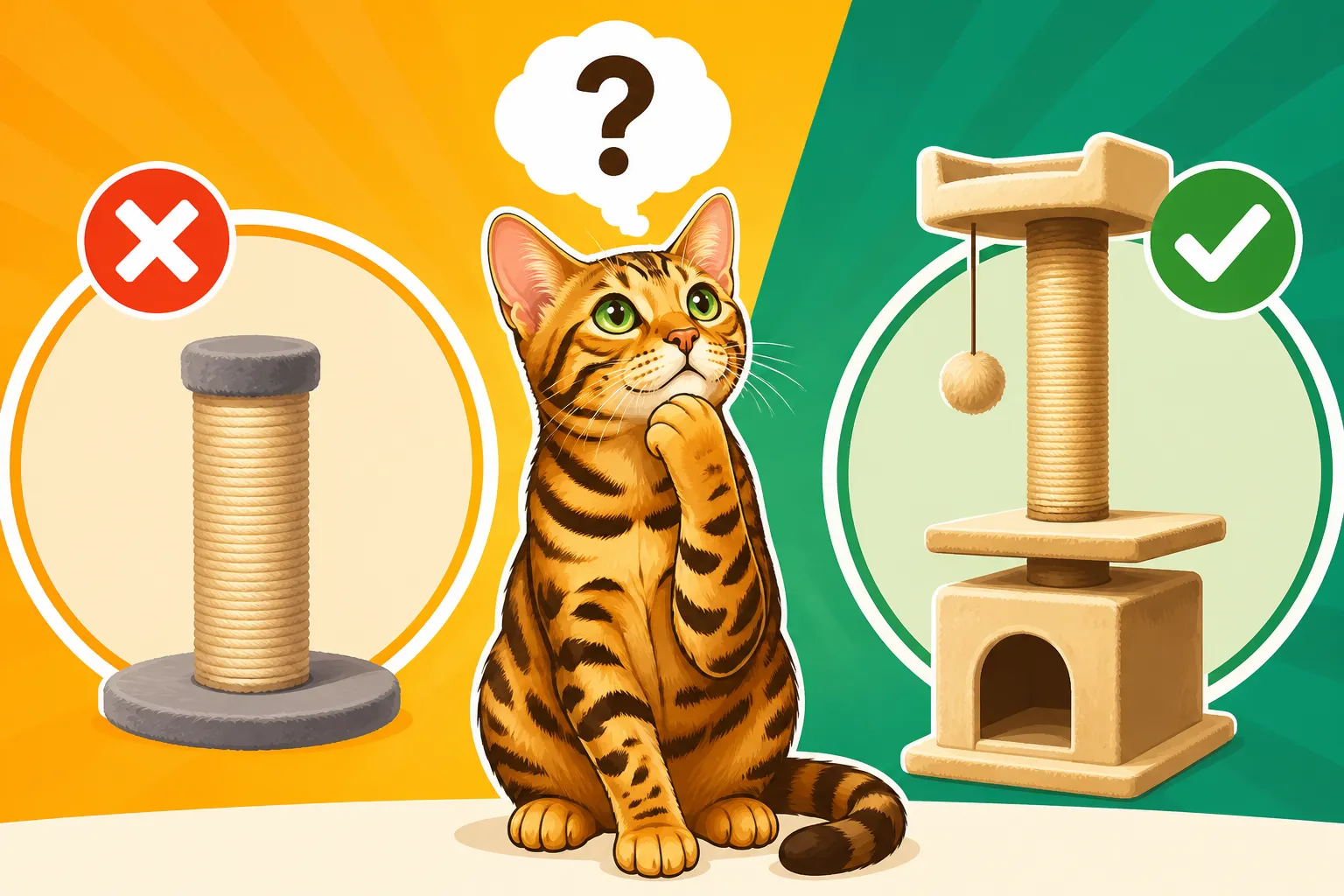
For a Bengal, a tall, standalone sisal post or tower is the absolute cornerstone of a successful scratching strategy. We're talking posts that are at least 30 inches, but ideally 36 inches or even 4 feet high. Imagine your Bengal standing on their hind legs, stretching their entire powerful body upwards, digging their claws into the sisal, and pulling down with satisfying force. This is the primal joy they seek, and only a truly tall post can deliver it.
The keyword here is "sturdy." Bengals are not dainty creatures. They launch themselves at these posts, they climb them, and they pull with incredible strength. A flimsy post with a small base will wobble, fall over, or become unstable very quickly, leading your cat to abandon it. Look for posts with a wide, heavy base that prevents tipping, or consider options with a larger overall footprint for added stability. Some even have anti-slip pads on the bottom to keep them from sliding across hard floors during an enthusiastic scratching session.
Don't skimp on the material. Ensure the post is wrapped in tightly bound, high-quality sisal rope or sisal fabric from top to bottom. Cheap alternatives will fray and disintegrate rapidly, turning your investment into an eyesore and a wasted effort. While these might seem like a bigger upfront cost, they are infinitely more durable and effective than their cheaper counterparts. Placing one near their favorite sleeping spot or next to your most vulnerable piece of furniture can work wonders in redirecting their scratching energy.
Wall-Mounted Scratchers for Space and Security
If you're tight on floor space, or if your Bengal is particularly boisterous and prone to tipping over even the sturdiest standalone posts, wall-mounted scratchers are a fantastic solution. These ingenious devices bolt directly to your wall studs, offering unparalleled stability. Your Bengal can climb, scratch, and pull with all their might, and the scratcher won't budge an inch.
Wall-mounted options typically come as sisal-wrapped panels or vertical posts designed to be screwed into the wall. They're excellent for providing that essential vertical scratching surface without taking up precious floor real estate. Installation does require a bit more effort, as you'll want to ensure they're securely anchored, but the peace of mind they offer is well worth it. You can even install several at varying heights or in different locations to create a "scratching circuit" for your cat.
When choosing a wall-mounted scratcher, think about the height. Just like standalone posts, you want one that allows your Bengal a full stretch. Consider placing it near a window where they like to observe the outdoors, or in a hallway they frequently pass through. These can be particularly effective in preventing damage to corners of walls or door frames, which Bengals often target due to their stability and vertical orientation. For durable options, you might check retailers like Amazon or Chewy, who often carry a range of specialized cat furniture.
Cat Trees with Integrated Scratching Surfaces
Cat trees are magnificent multi-functional pieces of furniture that can provide a Bengal with a complete enrichment package: climbing, perching, playing, and, crucially, scratching. However, not all cat trees are created equal for a Bengal, and you need to be discerning.
For a Bengal, a cat tree needs to be substantial. Look for robust construction, a heavy base, and multiple levels. The scratching surfaces themselves must be wrapped in sisal, not carpet. Many lower-quality cat trees use carpet on their posts, which is problematic for the reasons we've discussed. Instead, seek out trees where the vertical posts are fully covered in durable sisal rope or fabric.
A good Bengal-friendly cat tree will have multiple sisal posts, allowing your cat to scratch at various heights and angles as they ascend or descend. The platforms should be large enough for your Bengal to comfortably perch and stretch out, and the overall structure should be stable enough to withstand their energetic leaps and bounds. Think of it as a vertical playground that doubles as a scratching paradise.
Placing a large, sturdy cat tree in a prominent room, perhaps near a window, can become your Bengal's central hub for activity, rest, and essential scratching. This not only satisfies their physical needs but also provides mental stimulation and a sense of territory. Brands available on platforms like Amazon and Chewy offer a wide variety, so read reviews carefully for durability and suitability for active, larger cat breeds.
| Scratching Post Type | Pros | Cons | Bengal Suitability |
|---|---|---|---|
| Tall Sisal Pole | Allows full vertical stretch, durable, excellent claw conditioning | Can be knocked over if not sturdy, takes up floor space | Essential: Provides the crucial full-body stretch and resistance. |
| Wall-Mounted Scratcher | Unbeatable stability, space-saving, prevents wall damage | Requires installation, permanent fixture, less portable | Excellent: Ideal for powerful scratchers, small spaces. |
| Sisal Cat Tree Post | Multi-functional (climb, perch, scratch), offers variety | Quality varies wildly, often carpeted posts (avoid), bulky | Highly Recommended: If sisal posts are robust and tall enough. |
| Horizontal Cardboard | Affordable, disposable, some cats love texture, good for variety | Wears out quickly, not good for full stretch, creates mess | Supplemental: Good for variety, but not a primary solution. |
| Sisal Mat/Ramp | Versatile placement (floor, angled), good for cats who scratch flat | Not ideal for vertical stretch, can shift if not weighted/secured | Good: Offers alternative scratching angle, durable. |
Placement, Quantity, and Encouragement Strategies
Getting the right scratching post is only half the battle; knowing where to put it, how many you need, and how to encourage your Bengal to use it are equally crucial for success.
Where to Put Your Bengal's Scratching Posts
Location, location, location! This is paramount. Think about where your Bengal currently scratches (or tries to scratch) and where they like to spend their time. These are the prime spots for a new scratching post.
First, place a post in areas where your Bengal frequently stretches and wakes up. This often means near their favorite sleeping spots, whether that's a cat bed, a sunny windowsill, or even your bed. Cats naturally stretch and scratch after waking, so having an appropriate target immediately available is key.
Secondly, identify the areas of your furniture that are currently being targeted. If your Bengal is clawing the arm of your sofa, place a tall, sturdy sisal post right next to that exact spot. It might seem counterintuitive to put a scratching post right there, but you're giving them an acceptable alternative in the precise location where the urge strikes. Over time, you can gradually move the post a few inches away, but start by offering the immediate alternative.
Finally, consider high-traffic areas. Bengals are often social creatures and like to be where the action is. Placing posts in living rooms, entryways, or even hallways where your cat frequently passes can increase their visibility and appeal. Make sure the posts are visible and accessible; don't tuck them away in a corner where your cat won't notice them. Offering different types of posts in different rooms gives your Bengal choice and variety, catering to all their moods and scratching preferences. When they see a satisfying post, they'll instinctively choose it over your upholstery. This proactive approach saves your furniture, as covered in How to Protect Furniture From a Bengal Cat.
How Many Scratching Solutions Does a Bengal Need?
The simple answer? More than one! For a highly active and intelligent breed like the Bengal, a single scratching post, no matter how perfect, is rarely enough to satisfy all their needs throughout your home.
Think of it from your cat's perspective: they have territorial instincts and different "zones" in your home. They might want a scratching post for a big morning stretch in the living room, another near their favorite window perch, and perhaps a horizontal one in the entryway. A good rule of thumb is to have at least one scratching solution per main living area, plus an extra one in a prime "problem" spot. So, for a typical home, you're likely looking at a minimum of three to five different scratching options.
If you have multiple Bengal cats, the number increases. Each cat has their own scent and territorial needs, and while they might share, having individual options reduces any potential conflict or resource guarding. Imagine if you only had one armchair for your whole family – someone's bound to be left out! The same applies to scratching posts. The more appropriate outlets you provide, the less likely your Bengals are to resort to scratching inappropriate surfaces. This directly relates to How Many Scratching Posts a Bengal Cat Household Needs.
Encouraging Your Bengal to Use Their Posts
Once you've invested in the right posts and placed them strategically, you need to actively encourage your Bengal to use them. This isn't usually difficult, as a good post will naturally appeal to them, but a little positive reinforcement goes a long way.
Positive Reinforcement: When you see your Bengal using a scratching post, immediately offer praise, a gentle head scratch, or even a small, tasty treat. Make it a positive experience! Never punish your cat for scratching inappropriate surfaces; instead, redirect them to the post. Pick them up gently and place them near the post, perhaps dragging a wand toy down its surface to get their attention.
Catnip and Pheromone Sprays: For hesitant cats, a sprinkle of catnip or a spray of a feline pheromone product designed to encourage scratching can work wonders. Apply it directly to the sisal surface to make it irresistible. Many Bengals respond strongly to catnip, and it can be a great way to introduce them to a new post and associate it with pleasure.
Playtime near the Post: Engage your Bengal in play sessions right next to the scratching post. Use a wand toy to entice them to bat at the toy while it's against the post, or drag it up and down the sisal to encourage them to reach and scratch. Their natural hunting instincts will kick in, and they'll associate the post with fun and play. Just make sure to put the wand toy away when playtime is over! When thinking about play, consider How a Bengal Cat Reacts to a Laser as well, as laser play can sometimes be directed towards posts.
Gentle Guidance (with caution): You can gently take your Bengal's front paws and mimic a scratching motion on the post. However, only do this if your cat is relaxed and receptive. If they resist, stop immediately. Forcing them can create a negative association. The goal is positive encouragement, not coercion. Be patient; it might take a little time for them to fully adopt the new posts, especially if they've developed a habit of scratching elsewhere. Consistency is key, and they'll get the message.
What to Avoid When Buying for a Bengal Cat
Just as important as knowing what to buy is knowing what not to buy. Making the wrong choices can be a waste of money and, more importantly, can fail to address your Bengal's natural needs, leading to frustration for everyone.
The Pitfalls of Cheap, Flimsy Options
It's tempting to save a few dollars, but when it comes to Bengal cat scratching posts, cheaper often means a false economy. Flimsy, poorly constructed posts are a recipe for disaster with a powerful, athletic breed like a Bengal.
First, there's the tipping hazard. A lightweight post with a small base simply cannot withstand the force of a Bengal launching themselves at it, digging in their claws, and pulling. It will wobble, fall over, and potentially scare your cat or even injure them. Once a post has proven itself unstable, your Bengal will likely avoid it, associating it with an unpleasant or frightening experience. This means your money is wasted, and your furniture remains at risk.
Secondly, cheap materials wear out incredibly fast. Thin, loosely wound sisal rope will shred and unravel within weeks, leaving a messy, unattractive post that offers little resistance or satisfaction for your cat. The entire point of a scratching post is its durability and ability to stand up to repeated use. How much a Bengal destroys cheap furniture (Why a Bengal Cat Destroys Cheap Cat Furniture) is a harsh reality for many owners. If the post disintegrates quickly, your Bengal will once again be left without an adequate outlet, and you'll be back to square one, looking for a replacement much sooner than you anticipated. Investing in a higher quality, more durable post upfront will save you money and headaches in the long run.
Why Carpeted Posts Are a Bad Idea
This is a common mistake many new cat owners make, often because carpeted posts are readily available and seem "soft" and appealing. However, for a Bengal cat, carpeted scratching posts are almost universally a bad idea, and here's why:
The biggest issue is confusion. When you provide a scratching post covered in carpet, you're essentially telling your cat that carpet is an acceptable scratching surface. Then, when they turn their attention to your carpeted stairs or living room rug, you're left wondering why they don't understand the rules. The mixed message is incredibly confusing for your cat. You want to clearly differentiate between "acceptable" and "unacceptable" scratching surfaces.
Beyond the confusion, carpet simply isn't durable enough for a Bengal's powerful claws. It will quickly shred, fray, and look unsightly. Worse, the loops in carpet can catch a cat's claws, leading to discomfort or even injury if a claw gets snagged. It doesn't provide the same satisfying resistance or the deep-tissue workout that sisal does, so your Bengal is likely to ignore it in favor of something more effective – like your actual carpet or upholstered furniture. Always opt for sisal or sturdy corrugated cardboard (for horizontal options) over carpet for any scratching surface you provide.
Declawing Is Never an Option
It might seem like the ultimate solution to furniture destruction, but declawing a Bengal cat (or any cat) is a cruel and inhumane procedure that is never a suitable alternative to providing appropriate scratching posts. Declawing is not merely a nail trim; it is an amputation of the last bone of each toe, equivalent to severing a human finger at the last knuckle.
The procedure is incredibly painful and can lead to lifelong physical and behavioral problems. Cats who are declawed often experience chronic paw pain, nerve damage, and may develop aversions to their litter box due to pain when digging. Behaviorally, it can lead to increased biting (as they've lost their primary defense), aggression, and anxiety. A Bengal's natural athleticism and need to climb, balance, and express themselves are severely hampered by this surgery.
The solution to a Bengal's scratching is always behavioral modification and providing appropriate, irresistible outlets, not permanent mutilation. A well-chosen, well-placed, and effectively encouraged scratching post strategy is the humane, effective, and responsible way to manage your Bengal's natural scratching instincts. Your cat deserves to keep their claws, and you can absolutely live harmoniously with them by meeting their needs. Why a Bengal Cat Should Never Be Declawed covers this in more depth.
Disclaimer
This article is for general informational purposes only and does not constitute professional advice. Laws, prices and regulations vary by location and change over time. Consult a qualified professional for guidance on your specific situation.