Where the Bengal Cat’s Wild Ancestor Lives
It’s easy to look at your beautiful Bengal cat, with their stunning rosettes and athletic build, and wonder about their wild side. Many of us are captivated by that untamed look, but also left with questions: just how wild are they, really? And where exactly did that wildness come from? This guide will take you on a journey to the ancestral homelands of the Asian Leopard Cat, the magnificent wild feline that contributes so much to your Bengal's unique charm, helping you understand their deep-seated instincts.
The Asian Leopard Cat: A Creature of Diverse Asian Landscapes
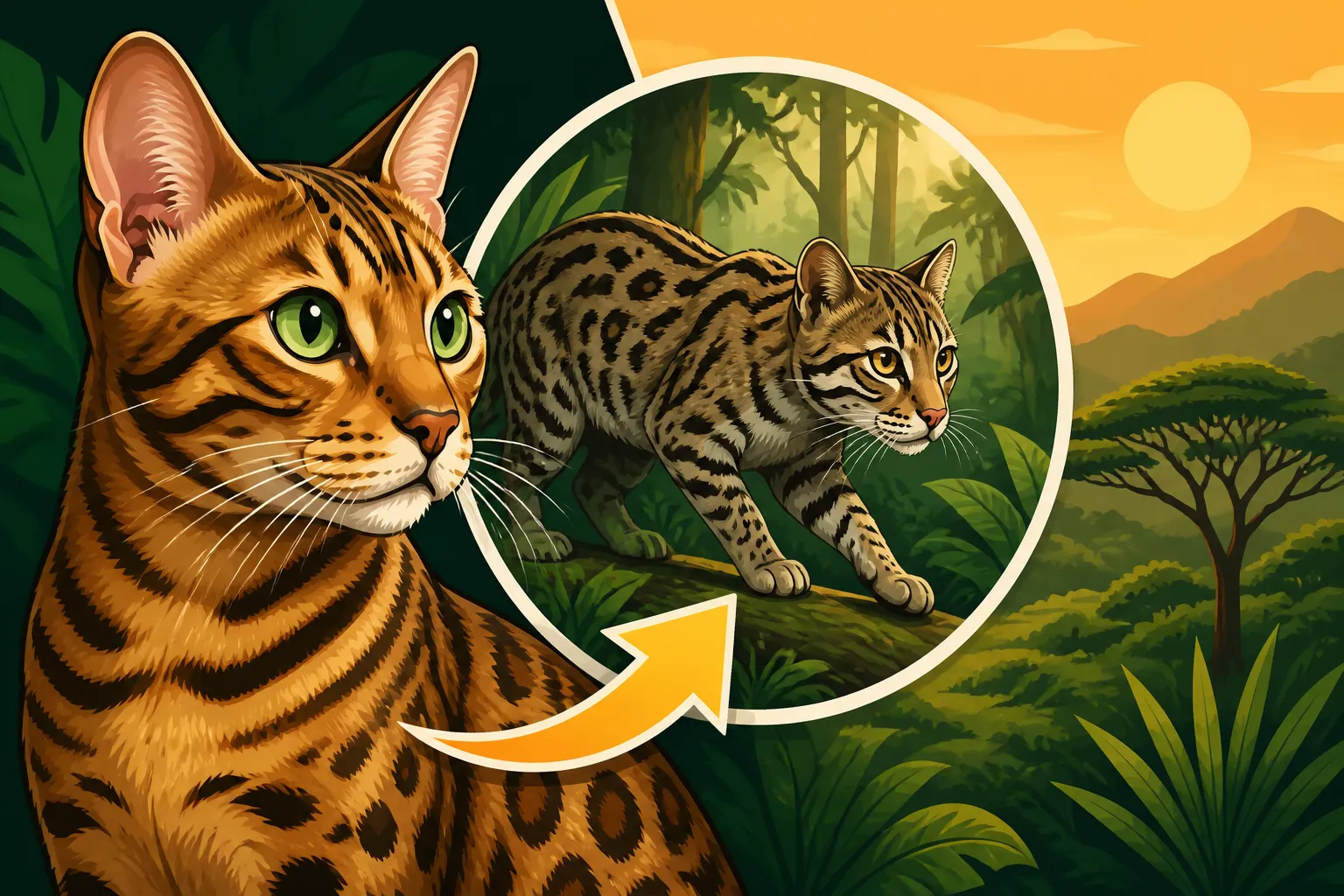
When we talk about the Bengal cat's wild ancestor, we're referring to the Asian Leopard Cat, often abbreviated to ALC. This isn't just one single, uniform creature living in one specific type of forest. Oh no, the ALC is a remarkably diverse and adaptable small wildcat, and understanding their natural habitat helps us truly appreciate the Bengal's heritage. Their incredible ability to thrive in a vast array of environments is a testament to their resilience and resourcefulness, traits that, even after generations of domestication, still echo in our Bengals today.
It's common to hear people talk about "the wild cat" that went into the Bengal, as if it's a monolithic entity. But in reality, the Asian Leopard Cat species, Prionailurus bengalensis, is incredibly widespread across Asia, encompassing numerous subspecies. Each subspecies has, over millennia, adapted to the specific conditions of its local environment. This means that an ALC from the frigid forests of Siberia might look a bit different, and certainly behave differently in some regards, from one living in the humid jungles of Indonesia. This vast geographic and environmental diversity is precisely what makes the ALC such a fascinating ancestor for our domestic Bengals.
Geographic Range Across Asia
The Asian Leopard Cat's territory is truly expansive, stretching from the frosty plains of the Russian Far East, through the dense forests of China, India, and Southeast Asia, all the way down to the tropical islands of Indonesia and the Philippines. Imagine a cat that can survive the biting cold of a Siberian winter, hunting through snow-covered landscapes, and then picture its cousin lounging in the sweltering humidity of a Bornean rainforest, adept at navigating tangled vines and damp undergrowth. That’s the versatility we're talking about!
This enormous range means that the ALC is exposed to virtually every type of climate and terrain Asia has to offer. They're not just confined to one specific niche, like some more specialized wildcats. This wide distribution has led to the development of many different subspecies, each subtly or not-so-subtly distinct. For instance, the northern subspecies, like Prionailurus bengalensis euptilurus, tend to be larger and have thicker coats to withstand colder temperatures, while their southern counterparts are generally smaller and sleeker. When breeders first started crossing ALCs with domestic cats to create the Bengal, they were drawing from this incredible genetic pool, selecting specific Asian Leopard Cats for their beauty and temperament. You can read more about What an Asian Leopard Cat Is Behind Every Bengal Cat.
Preferred Environments and Climate Adaptations
Despite their adaptability, ALCs do have a preference for certain types of environments, primarily those that offer good cover for hunting and protection from predators, both natural and human. They are most commonly found in forests – tropical rainforests, subtropical broadleaf forests, and temperate coniferous forests. However, they are also quite at home in secondary growth forests, plantations, and even agricultural areas, especially if there's sufficient vegetation to hide in. They're not ones to shy away from human-modified landscapes if it means access to food.
Their climate adaptations are equally impressive. In tropical regions, they are active year-round, benefitting from a constant food supply. Their shorter, coarser coats in these areas help them manage heat and humidity. Contrast this with ALCs in colder, northern latitudes, where they grow much denser fur in winter, sometimes even developing a noticeable undercoat. They also become more adept at hunting in snowy conditions. This phenomenal range of adaptations highlights why the Asian Leopard Cat has been so successful across the continent, and it hints at the robust, resilient nature that still flows through the veins of our domestic Bengals. It's a reminder that beneath that gorgeous spotted coat lies a history of incredible survival skills.
Habitat Specifics: Where Different ALC Subspecies Roam
To truly understand the "where" of the Asian Leopard Cat's life, we need to delve a little deeper than just "Asia." Their habitats are as varied as the landscapes of the continent itself, and different subspecies have made distinct niches their own. This granularity helps us appreciate the nuances of their wild existence and how that heritage informs the instincts of your Bengal cat. Thinking about Which Scientific Name the Bengal Cat's Ancestor Carries helps to ground this discussion in scientific fact.
Forests and Jungles: The Dominant Terrain
Without a doubt, forests and jungles are the quintessential homes for most Asian Leopard Cats. Whether it's the towering canopies of the Amazonian-like rainforests of Southeast Asia or the more open, deciduous forests of temperate zones, these environments provide everything an ALC needs. They offer dense undergrowth for stalking prey, trees for climbing and evading larger predators, and a rich biodiversity that ensures a steady food supply.
In tropical rainforests, for example, ALCs will navigate the forest floor, using fallen logs and thick vegetation as cover. They are agile climbers, and while they primarily hunt on the ground, they will readily ascend trees to escape danger or to hunt birds and small arboreal mammals. The humidity and warmth mean that prey is abundant, and the ALCs in these areas are often quite sleek and swift. You can often find them near water sources within these forests, which ties into the Bengal's famous love for water. The sheer complexity of these jungle ecosystems provides a constant challenge and opportunity for these clever cats.
Mountains and Islands: Adaptations to Varied Ecosystems
While forests are dominant, the ALC's adaptability extends far beyond them. You'll find certain subspecies thriving in mountainous regions, scaling rocky outcrops and navigating steep, forested slopes. Here, they adapt their hunting techniques to the terrain, perhaps preying on animals found in higher elevations or utilizing rock formations for ambush points. Their sturdy builds and keen senses make them excellent mountaineers in their own right.
Even more fascinating are the ALCs found on various islands throughout Southeast Asia, such as Borneo, Java, Sumatra, and the Philippines. These island populations have often evolved distinct characteristics due to isolation, leading to smaller sizes or unique coat patterns. On these islands, their habitat might be primary rainforest, but also coastal scrub, mangrove swamps, and even plantations. They've learned to exploit whatever resources are available, which might include crabs or other coastal delicacies. This highlights a key aspect of their survival: opportunistic hunting and an ability to make the most of what their environment offers. This resourcefulness is perhaps why your Bengal cat is so incredibly clever and always finding new ways to get into things!
Life in the Wild: Adapting to Their Environment
Understanding where the Asian Leopard Cat lives is only part of the story; we also need to grasp how they live in these diverse habitats. Their lifestyle, behaviors, and hunting strategies are all finely tuned to their environment, and it’s these ingrained patterns that contribute to the spirited nature of our domestic Bengals. It helps us answer the question, What the Bengal Cat's Wild Ancestor Is Like.
Nocturnal Habits and Solitary Nature
In the wild, the Asian Leopard Cat is primarily a nocturnal or crepuscular animal, meaning they are most active during the night, dusk, and dawn. This behavior is a smart adaptation to their environment. Hunting under the cover of darkness allows them to surprise prey more easily and avoid larger daytime predators. It also helps them conserve energy during the hotter parts of the day, especially in tropical climates. This nocturnal tendency is something that many Bengal owners will recognize in their own pets, who often have bursts of intense activity in the early morning or late evening.
Furthermore, ALCs are largely solitary creatures. They typically live alone, only coming together briefly for mating. Their territories can be quite extensive, depending on the availability of food and other resources, and they scent-mark to communicate their presence to other ALCs. While our domestic Bengals certainly thrive on human interaction and can be very social with their families, they often retain a certain independence and a preference for individual exploration that hints at this solitary ancestry. You might notice your Bengal preferring to play alone with a favorite toy, or disappearing to patrol their 'territory' (your house!) on their own terms, rather than always being a lap cat.
Diet and Hunting Strategies in Their Natural Home
The diet of an Asian Leopard Cat is as varied as its habitat, reflecting its opportunistic nature. They are carnivores, with a primary diet consisting of small mammals like rodents, squirrels, and rabbits, as well as birds, reptiles, and amphibians. They are also known to eat insects, fish (yes, they are great little fishers!), and sometimes even crustaceans in coastal areas. Their small, sharp teeth and strong jaws are perfectly adapted for seizing and dispatching small prey.
Their hunting strategy is a masterclass in stealth and agility. ALCs are excellent stalkers, using dense vegetation for cover and moving with incredible quietness. Once they spot prey, they will often freeze, then pounce with explosive speed. Their powerful hind legs allow for impressive leaps, and their keen eyesight, particularly in low light, gives them a significant advantage. This natural hunting prowess manifests in domestic Bengals as an intense love for interactive play. They crave toys that mimic prey, enjoy chasing laser pointers, and will often "hunt" their favorite wand toys with all the intensity of their wild ancestors. Providing stimulating toys, perhaps from a brand like Chewy, is crucial for satisfying this innate drive. Without enough outlets, this energy can easily turn into destructive behavior.
Bridging the Gap: What the Wild Ancestor's Habitat Means for Your Bengal
So, what does all this talk about wild Asian Leopard Cat habitats mean for your adorable, purring Bengal cat lounging on your sofa? It means quite a lot, actually. While your Bengal is many generations removed from their wild ancestor and is very much a domestic companion, those ancestral instincts and physical needs are still deeply ingrained. Ignoring this heritage can lead to behavioral issues and an unhappy cat.
Think of it this way: your Bengal carries the blueprint for a highly active, intelligent, and curious creature designed to thrive in a complex natural environment. They're not content to just eat, sleep, and occasionally bat at a toy mouse. Their physical prowess and mental acuity demand more. Understanding their wild habitat helps us provide a home environment that satisfies these deep-seated needs in a safe, domesticated way. This is where we bridge the gap between their wild ancestry and their life as a beloved pet.
Understanding the Domesticated Bengal's Needs
Even though your Bengal has never stalked a rodent through a bamboo forest or climbed a jungle vine, they still possess the genetic programming for such activities. This manifests as a need for high levels of physical exercise. They need to run, jump, climb, and pounce much more than your average domestic shorthair. Without sufficient outlets, this pent-up energy can lead to destructive behaviors, excessive vocalization, or even anxiety. This is why The Bengal Cat Is the Most Active Cat You Can Own.
Their intelligence, inherited from a creature that constantly solved problems to find food and survive, also means they need mental stimulation. Simple toys won't cut it for long. They need puzzle feeders, rotating toys, and engaging play sessions that challenge their minds. Their curiosity, honed by generations of exploring diverse terrains, means they will investigate every nook and cranny of your home. Cabinets, drawers, and high shelves are not just furniture to a Bengal; they are potential new territories to explore and conquer. Providing a variety of engaging activities and toys, perhaps from a selection like that found on Chewy, can make a huge difference in their overall well-being.
Creating an Enriched Environment for Your Bengal
Given their ancestral background, providing an enriched environment for your Bengal isn't a luxury; it's a necessity. It’s about bringing elements of their wild habitat safely indoors or into a secure outdoor space.
Vertical Space is Paramount: Remember those jungle trees and rocky outcrops? Your Bengal needs to climb! Invest in tall, sturdy cat trees that reach the ceiling, wall-mounted shelves, and cat hammocks. These allow them to survey their territory from a height, satisfying an ancient instinct. This vertical domain is incredibly important for their mental and physical health.
Interactive Play Sessions: Daily, dedicated play sessions are non-negotiable. Use wand toys that mimic birds or prey animals, encouraging their natural hunting instincts. Think about toys that move unpredictably, requiring your Bengal to strategize and pounce. Remember, it's not just about tiring them out physically, but also mentally engaging them in the "hunt."
Water Features: The ALC's comfort around water often translates to Bengals. Many Bengals absolutely adore playing in water. A cat-safe water fountain encourages hydration and provides an engaging sensory experience. Some even enjoy supervised access to a shallow bath or a running faucet!
Secure Outdoor Access: While free-roaming outdoors is generally unsafe for Bengals due to their value and wild instincts, a secure outdoor enclosure, often called a "catio," is an incredible gift. A catio allows them to experience fresh air, sunshine, and the stimulating sights, sounds, and smells of the outdoors without any risk. This closely mimics the varied sensory input they would receive in a natural habitat. If you're considering this, definitely look into Why a Catio Is the Answer to a Bengal Cat.
Puzzle Feeders and Food Enrichment: Ditch the plain bowl for at least some meals. Puzzle feeders force your Bengal to "work" for their food, simulating the effort an ALC would expend hunting. This taps into their intelligence and provides mental stimulation, slowing down eating and preventing boredom. You can find a fantastic array of these problem-solving feeders on sites like Chewy.
| Bengal Cat Need (Inspired by ALC Habitat) | How to Address in a Domestic Setting | Why It's Important |
|---|---|---|
| Climbing/Vertical Territory | Tall cat trees, wall shelves, cat hammocks | Satisfies natural instinct to climb, provides vantage points, exercise |
| Hunting Instinct | Wand toys, laser pointers, interactive toys | Physical and mental stimulation, outlet for predatory drives |
| Exploration/Curiosity | Rotating toys, safe household exploration, puzzle feeders | Prevents boredom, challenges intelligence, satisfies investigative nature |
| Water Play | Cat water fountain, supervised shallow water access | Engages natural fascination with water, encourages hydration |
| Outdoor Sensory Input | Secure catio | Safe exposure to fresh air, varied sights, sounds, and smells |
By providing an environment that respects and caters to these deep-seated instincts, you're not just making your Bengal happier; you're helping them live a more fulfilled life, one that truly honors their magnificent wild heritage. For more insights into how much they truly need, check out How Much Enrichment a Bengal Cat Actually Needs.
Disclaimer
This article is for general informational purposes only and does not constitute professional advice. Laws, prices and regulations vary by location and change over time. Consult a qualified professional for guidance on your specific situation.