What Mascara Marks Are on a Bengal Cat
A Bengal’s dark lines beside the eyes can look like eyeliner, which is why they’re often called mascara marks. They’re a natural part of the breed’s facial pattern, not something applied to the coat or usually a sign of illness. This guide explains where the marks appear, how they vary, and when a change around the eyes deserves a closer look.
What mascara marks look like on a Bengal cat
The dark lines beside the eyes
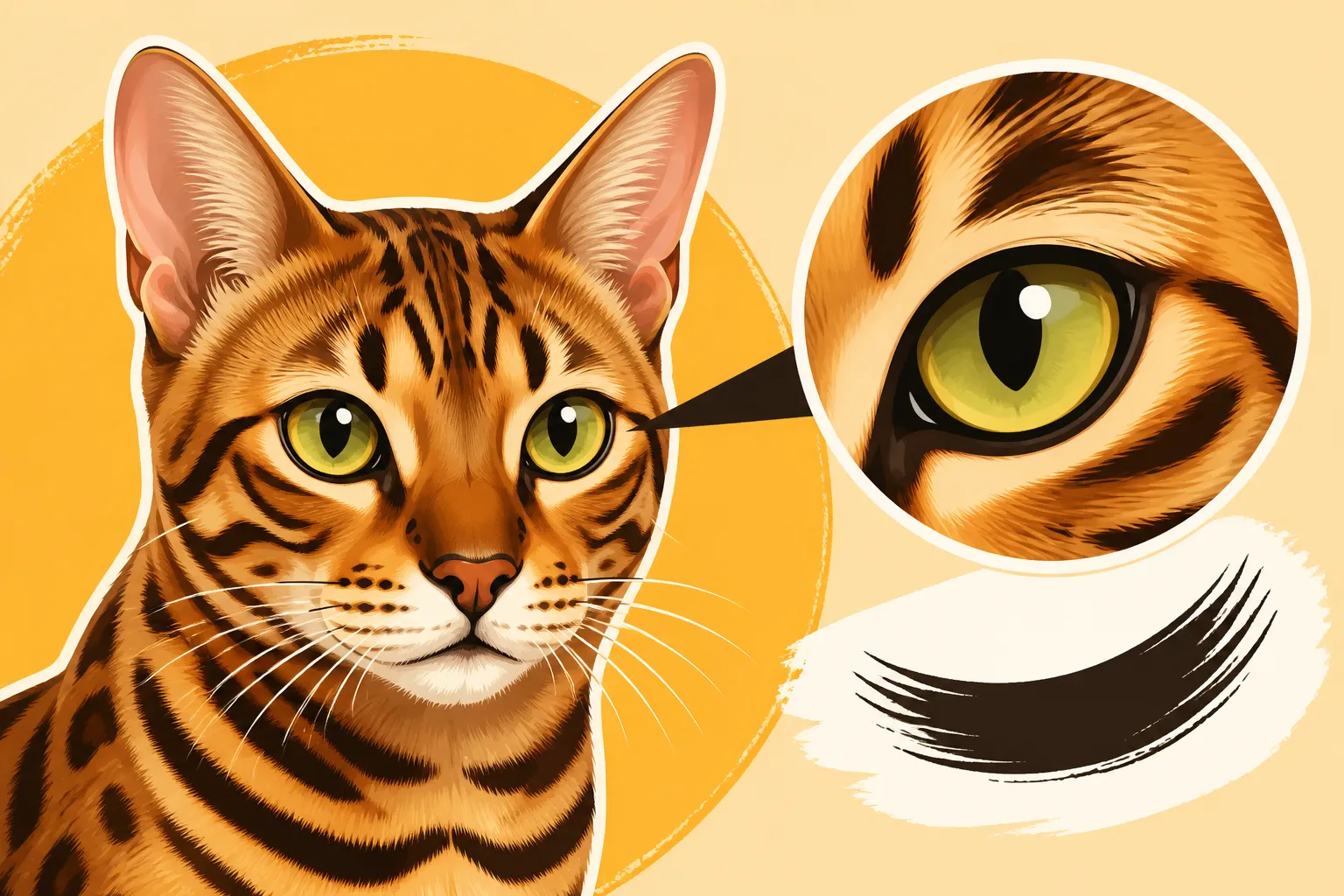
Mascara marks are dark lines or streaks around a Bengal cat’s eyes, often extending outward and down across the cheeks. Depending on the individual cat, they may look like a fine outline along the lower eyelid, a short stripe at the outer corner, or a more noticeable marking that sweeps toward the side of the face.
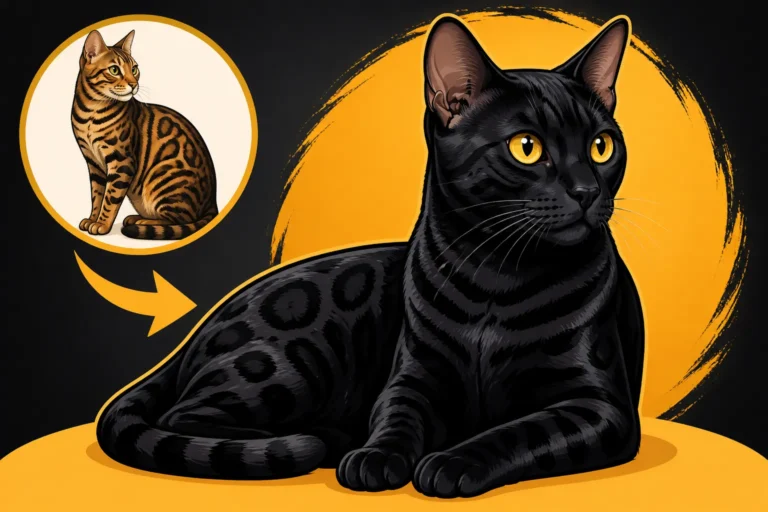
The word “mascara” is a visual description, not a separate coat type or a product. These markings are part of the cat’s natural pigmentation, much like the stripes and spots elsewhere on the coat. A clear, dark line can stand out strongly against a pale face, while the same marking may look subtler on a darker or more heavily patterned Bengal.
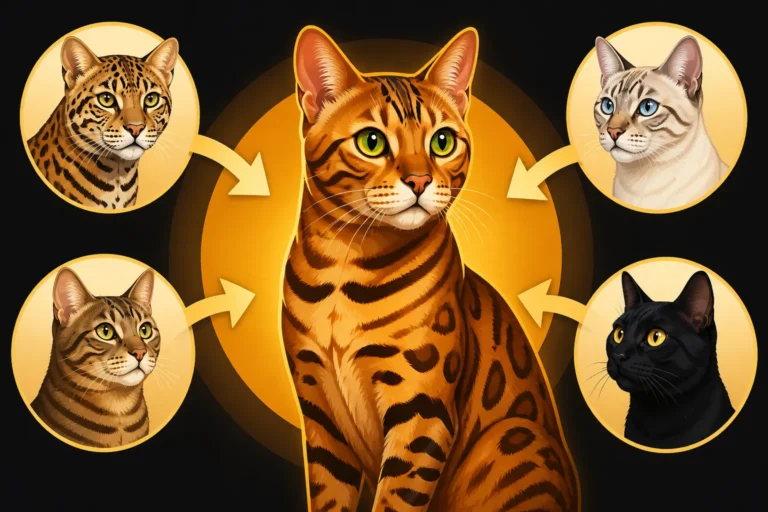
Bengals do not all have identical facial markings. One cat may have bold, tidy lines on both sides; another may have a lighter mark on one cheek or a slightly different shape on each side. That variation is normal. The overall face can include several markings together, including lines around the eyes and nose, cheek markings, and the characteristic tabby pattern on the forehead.
How mascara marks fit into the whole face pattern
The marks are easiest to understand as one element of a Bengal’s facial pattern, rather than as a feature that has to look exactly the same from cat to cat. The forehead, cheeks, muzzle, and eye area all contribute to the face’s overall appearance. If you’re comparing features, What a Bengal Cat Looks Like by the Standard and What a Bengal Cat's Head Should Look Like offer useful broader context.
A Bengal’s eye shape can also affect how its markings appear. Almond-shaped eyes, the surrounding coat color, and the placement of the dark lines all influence whether the marks look like a fine outline or a dramatic sweep. The markings do not change the actual shape of the eyes; they simply frame them. For more on the feature itself, see What Shape a Bengal Cat's Eyes Should Be.
Photos can make the effect look especially strong. Close-up portraits, directional lighting, and a dark line of fur against a bright background may create the impression of heavy eyeliner. In ordinary room light, the same cat’s markings may appear softer. If you’re judging a kitten from pictures, look at several images rather than relying on one carefully lit close-up.
Why Bengal cats have mascara marks
Natural pigment and coat pattern
Mascara marks are part of a Bengal’s inherited coat pattern. They are not drawn on, stained into the fur, or caused by grooming. The dark pigment in the hair creates a defined line or patch that belongs to the cat’s natural coloring.
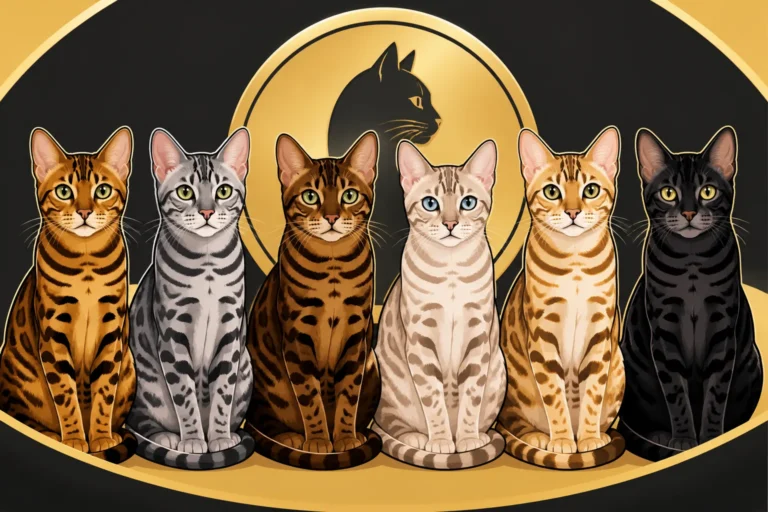
Bengals are known for patterned coats, but the pattern does not stop at the body. Facial markings are part of the same broad picture of coat color and pattern. The appearance may differ with the cat’s background color and pattern type, so the marks can look more or less distinct from one Bengal to another. Which Colors a Bengal Cat Comes In gives a useful overview of the accepted color range, while What a Rosette Is on a Bengal Cat and What a Marbled Bengal Cat Is explain two familiar body patterns.
It’s tempting to treat a striking face marking as a guarantee of a particular quality or pedigree. It isn’t. A single feature cannot confirm that a cat is a Bengal or determine its overall health, temperament, or show potential. If you are assessing a kitten or adult, consider the whole cat and the breeder’s records rather than putting too much weight on one attractive detail.
Why the marks look different from one Bengal to another
The darkness, width, and apparent length of the lines can vary. Some Bengals have crisp marks that are easy to see at a glance; others have softer lines that blend into the surrounding facial pattern. Symmetry can vary too. A cat’s left and right sides do not need to be mirror images for the markings to be natural.
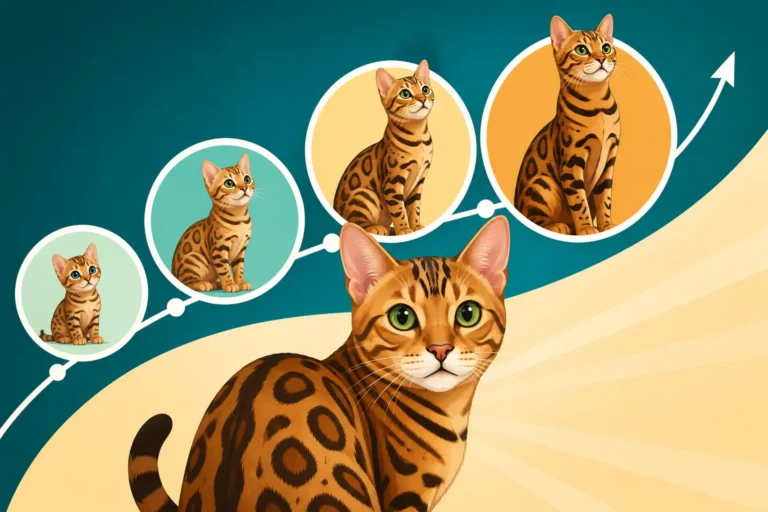
Age and coat development can also affect what you see. A kitten’s coat may look different as it grows, and lighting or seasonal coat condition can change how clearly a marking shows in a photograph. That does not mean the marks are being added or removed. It may simply be that the coat and the viewing conditions make the contrast look different.
When people search for “Bengal cat eyeliner,” they may be picturing a dramatic, perfectly even line. Real cats are less uniform than illustrations or edited photos suggest. A little unevenness, a faint mark, or a different shape on each side is not, by itself, a problem. The useful distinction is between a stable coat marking and a new change in the eye area, such as redness, swelling, discharge, or a sudden patch of missing hair.
Mascara marks compared with eye problems
A natural marking versus a new change
A natural mascara mark is pigmentation in the coat. It usually looks like a stable dark line or patch, with the surrounding skin and eye appearing comfortable. A mark that has been present in photos over time and has not changed is more likely to be part of the cat’s normal pattern.
Eye discharge is different. Moisture, crust, redness, squinting, swelling, or repeated pawing at the face are not simply mascara marks. Dried discharge may collect near the corners of the eyes and look dark, especially on pale fur, but it is residue rather than coat pigment. Avoid assuming that anything dark near the eye is a breed marking.
If you’re unsure, compare the area with older photos taken in similar light, then observe the cat without rubbing or pulling at the fur. A sudden change, discomfort, or discharge is a reason to contact a veterinarian. Do not use makeup remover, human eye products, or whitening products to “clean” a natural marking. If you need basic grooming supplies, Chewy carries pet-care items, but choose products for a specific need only after checking that they are appropriate for your cat.
| What you notice | More consistent with a natural mascara mark | Worth checking with a veterinarian |
|---|---|---|
| Appearance | Dark line or patch in the coat | New redness, swelling, or a change in the eye itself |
| Timing | Present in older photos and stable | Appeared suddenly or is getting worse |
| Cat’s behavior | Normal blinking and comfortable face | Squinting, pawing, rubbing, or keeping the eye closed |
| Material | Pigmented hair with no unusual residue | Wetness, crust, discharge, or irritated skin |
| Best next step | Observe and leave the marking alone | Contact a veterinarian for advice |
When to get advice
Seek veterinary guidance if the cat’s eye looks painful, becomes cloudy, is held partly closed, or has persistent discharge. The same applies if the surrounding skin becomes swollen or irritated, or if the cat is rubbing its face repeatedly. Eye concerns can worsen quickly, so don’t wait for a coat marking to “settle” if the eye itself appears affected.
A practical way to describe the concern is to note when you first noticed it, whether it is on one side or both, and whether the cat is behaving differently. A clear photo can help show what has changed, especially if the appearance varies with lighting. If getting to an appointment is the difficult part, having a secure carrier ready can make transport less stressful; Chewy is one place owners look for carriers and other cat travel supplies.
For routine grooming, there is generally no need to scrub, trim, or try to sharpen the lines. Those efforts can irritate delicate skin and will not improve a natural coat pattern. A Bengal’s facial markings are not dirt that needs to be removed. If discharge is present, ask the veterinarian how to clean the area safely rather than improvising with products or household wipes.
Caring for a Bengal’s face and coat
Keep grooming gentle and simple
Most Bengals do not need elaborate coat grooming. Their short coats are usually manageable with occasional gentle brushing, and the face generally needs no special treatment. If you want to look closely at the markings, choose a calm moment when your cat is relaxed. Avoid restraining the head or repeatedly touching the eyelids just to inspect a line.
A soft, clean cloth may be useful for ordinary mess on the coat, but it should not be used to rub at the eyeball or scrape away pigment. If there is material around the eyes, pause and consider whether it is a one-off bit of debris or something that keeps returning. Recurrent or sticky discharge calls for veterinary advice, not stronger cleaning.
Some owners buy brushes or grooming accessories because they assume a striking coat needs extra maintenance. For a Bengal, the priority is comfort and a routine the cat tolerates. Chewy can be a convenient place to browse basic grooming tools, but a tool is only useful if it suits your cat and you can use it gently. The marks themselves do not require a special brush, cleanser, or cosmetic product.
Appreciate the markings without overreading them
Mascara marks can give a Bengal a wonderfully expressive look, especially when the dark lines contrast with a lighter face. They are one of the details that make the breed’s facial pattern distinctive, but they do not tell you everything about the cat. A bold line does not prove a particular personality, health status, or pedigree, and a faint line does not make a cat less of a Bengal.
If you’re choosing a kitten, ask to see the kitten’s face in natural light and look at photos of its parents when available. Treat the marks as one aesthetic feature among many. A responsible decision should also take account of the cat’s health history, temperament, socialization, and the care it will need in your home.
For an existing cat, the best approach is simple: learn what its normal face looks like, leave stable coat pigment alone, and pay attention to changes in the eye or surrounding skin. Chewy may help with ordinary supplies such as a carrier or grooming brush, but it cannot tell you whether a new eye symptom is harmless. When the appearance changes or your cat seems uncomfortable, a veterinarian is the right person to assess it.
Disclaimer
This article is for general informational purposes only and does not constitute professional advice. Laws, prices and regulations vary by location and change over time. Consult a qualified professional for guidance on your specific situation.