How Big an Asian Leopard Cat Is Next to a Bengal Cat
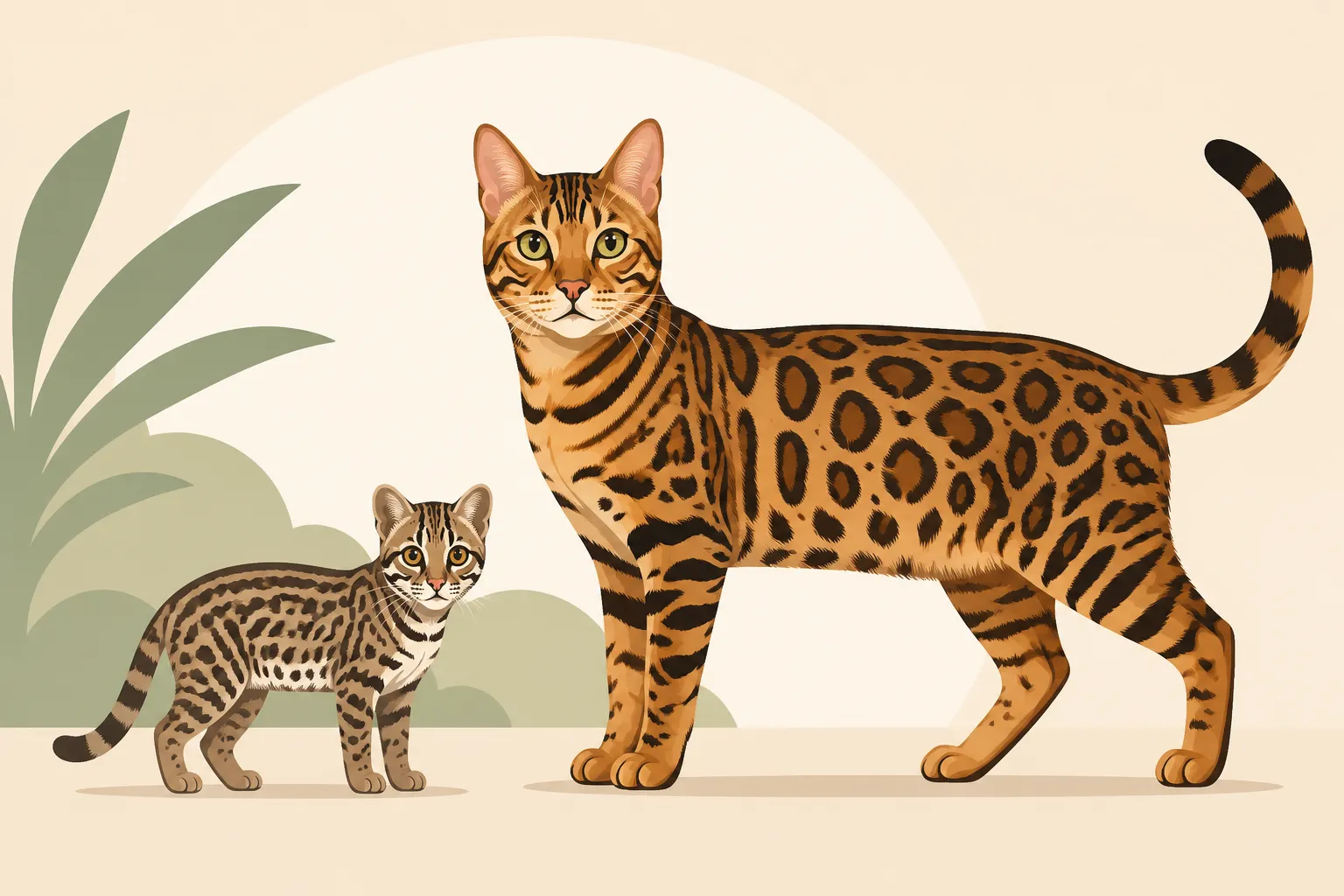
An Asian leopard cat and a Bengal may share a spotted, wild-looking coat, but they are not the same size in a simple, predictable way. The wild species varies considerably across its range, and domestic Bengals vary too. This guide compares their typical adult weight and build, explains why the numbers overlap, and shows how to assess a Bengal’s size without relying on appearance alone.
Asian leopard cat versus Bengal size
How much an Asian leopard cat weighs
The Asian leopard cat is a wild small-cat species found across a broad part of Asia. Its size varies with factors including sex, local population, and habitat. As a broad guide, adults can weigh from around 2 to 7 kilograms, or roughly 4 to 15 pounds. Many fall toward the middle of that range, but there is no single weight that describes every Asian leopard cat.
That wide variation matters when comparing one to a Bengal. A smaller Asian leopard cat may weigh less than a large adult Bengal, while a larger individual may be in a similar weight range. A number on a scale also does not tell the whole story: two cats at the same weight can differ in length, muscle, and overall frame.
For more on the wild species and its physical traits, see What the Bengal Cat's Wild Ancestor Is Like. The Bengal’s breed history is also worth understanding: it helps explain why a modern Bengal should not be treated as a miniature wild cat. A Leopard Cat and a Housecat Made the First Bengal Cat explores that background.
How much a Bengal cat weighs
A typical adult Bengal may weigh roughly 6 to 15 pounds, though individuals can fall outside that broad range. Sex, age, genetics, and body condition all influence the number. Some males have a larger frame and more muscle than some females, but sex alone does not predict an individual cat’s healthy weight.
Bengals are domestic cats. Their athletic appearance can make them seem heavier or larger than they are, particularly when a sleek coat outlines a muscular body. Conversely, a long-bodied cat can look lean even when its weight is appropriate. That is why a scale reading should be considered alongside the cat’s frame and condition, not used as a pass-or-fail test.
For an overview of the breed’s general measurements, see How Big a Bengal Cat Gets and What a Bengal Cat Weighs. Those topics can help set expectations, but neither replaces an individual assessment by a veterinarian.
| Feature | Asian leopard cat | Bengal cat |
|---|---|---|
| Type | Wild small-cat species | Domestic cat breed |
| Broad adult weight range | Around 2 to 7 kilograms, or 4 to 15 pounds, with substantial variation | Roughly 6 to 15 pounds for many adults, with individuals outside that range |
| Typical impression | Lean, lightly built, and adapted for life in the wild | Muscular, athletic, and variable in domestic size |
| Main reason comparisons are tricky | Size differs among populations and individuals | Weight depends on sex, genetics, age, and body condition |
| What weight alone cannot show | Exact length, health, or condition | Whether the cat is at a healthy weight |
These ranges are broad reference points, not a direct ranking. Their overlap means it is not accurate to say that every Bengal outweighs every Asian leopard cat, or that the two are always the same size.
Why the two cats can look different at similar weights
Frame and build matter as much as the scale
Weight measures mass, not body shape. An Asian leopard cat is generally described as lithe and compact, with a body suited to moving through varied natural habitats. A Bengal is a domestic cat whose build can be muscular and substantial, but individual Bengals differ in height, length, and bone structure.
Imagine two cats that each weigh 10 pounds. One might have a longer body and a fine frame; the other could be shorter through the torso but more muscular. They may not look alike, even though the scale shows the same number. This is why a photograph or a single weight comparison can give a misleading impression of size.
Coat pattern can add to the confusion. Bold rosettes and strong contrast may make a Bengal appear larger or more imposing, while a sleek coat can make the body’s outline easy to see. For a closer look at the Bengal’s shape and breed appearance, read What a Bengal Cat Looks Like by the Standard. Pattern and build are separate traits, however: dramatic markings do not tell you whether a cat is tall, heavy, or in good condition.
Age and sex change the comparison
A kitten should not be compared with an adult of either type. Young cats are still growing, and their proportions can change quickly. A Bengal kitten may look rangy during one stage and fill out later, so an early weight is not a dependable prediction of its final adult size.
Sex can influence average size, but the overlap between individuals is substantial. A large female Bengal may be bigger than a small male Bengal, and a Bengal’s size cannot be reliably inferred from sex alone. Similar caution applies to broad comparisons with Asian leopard cats: the species’ regional and individual variation makes a tidy one-number comparison unrealistic.
When looking at a Bengal kitten, ask about its parents’ size and growth history, but treat these as clues rather than guarantees. For a fuller explanation of the breed’s ancestry categories, see F1 to SBT: How a Bengal Cat's Generation Is Counted. Generation can provide context about pedigree, but it is not a simple size chart.
How to tell whether a Bengal is growing well
Track weight consistently rather than guessing by sight
If you are monitoring a Bengal at home, weigh the cat under similar conditions each time. A pet scale is convenient, but you can also weigh yourself holding the cat and subtract your own weight. That method is less precise, especially if the cat squirms, so repeat the measurement and look for a consistent trend rather than reacting to a tiny fluctuation.
A small notebook or phone note can make the pattern easier to see. Record the date, weight, and any relevant changes such as a new diet, illness, or a change in activity. If you need a scale or other basic weighing supplies, you can check the options available through pet retailers such as Chewy; confirm the scale’s size and capacity before choosing one.
For kittens, regular veterinary appointments are especially useful because a veterinarian can consider growth alongside development and health. For adults, a gradual upward or downward trend is more informative than a single reading. If your cat’s weight changes unexpectedly, or you are unsure what is appropriate for its frame, contact your veterinary clinic rather than trying to diagnose the cause from the number alone.
Look at body condition, not just adult size
A healthy weight is not the same thing as a particular breed-average weight. A vet can assess body condition by considering the ribs, waist, and abdominal outline, as well as the cat’s overall health. At home, you can gently feel along the ribs and look for a visible waist from above, but thick muscle, coat, and personal variation can make this harder to judge.
It is easy to misread an athletic Bengal. A defined, muscular body may feel firm without being overweight. On the other hand, a cat with a broad outline may be carrying excess fat even if its weight seems ordinary for the breed. If you are unsure, ask your veterinarian to show you how they assess body condition so you have a useful reference for your own cat.
A consistent weighing routine can help you notice changes, but avoid putting a growing kitten or adult cat on a restrictive diet without veterinary guidance. If you are comparing food choices or planning a feeding change, Chewy may be one place to browse available pet-food options, but the right diet depends on your cat’s individual needs. Your veterinarian can help you choose a suitable approach and decide whether further assessment is needed.
What this comparison does and does not tell you
A Bengal is not simply a smaller Asian leopard cat
The Bengal breed has historical ancestry connected to the Asian leopard cat, but a modern Bengal is a domestic cat breed with its own variation in size and appearance. Similar markings can make the connection feel obvious, yet coat pattern does not make a Bengal equivalent to a wild cat in body size, behavior, or care needs.
It is more useful to treat the comparison as a way to understand the breed’s history than as a prediction of how large a pet Bengal will become. A Bengal’s adult size depends on its own genetics, sex, age, and condition. Even cats from the same litter can develop into noticeably different adults.
If the question comes up because you are considering a Bengal, start with practical expectations: ask about the kitten’s parents, discuss routine health care, and plan for an active domestic cat rather than assuming it will match a wild species in size. Whether the Asian Leopard Cat Behind the Bengal Cat Is Endangered offers further context about the wild species, while What People Get Wrong About the Bengal Cat addresses common misconceptions about the breed.
Use a veterinarian’s assessment for individual concerns
A comparison article cannot determine whether a particular Bengal is underweight, overweight, or growing as expected. That judgment depends on the cat’s age, frame, body condition, health history, and sometimes changes over time. If your cat’s appetite, energy, or weight has changed, make a note of what you have observed and share it with your veterinarian.
For a new kitten, bring any breeder-provided growth or veterinary records to the first appointment. For an adult Bengal, take along your weight log if you have one. A clear record can make it easier to discuss whether a change is meaningful and what follow-up, if any, is appropriate.
The simplest answer is that Asian leopard cats and Bengals have overlapping weight ranges, and neither is one fixed size. The wild species varies widely, while domestic Bengals differ from one another too. For a pet Bengal, the most useful measure is not how it compares with a wild relative, but whether its own body condition and growth are healthy.
Disclaimer
This article is for general informational purposes only and does not constitute professional advice. Laws, prices and regulations vary by location and change over time. Consult a qualified professional for guidance on your specific situation.