Which Eye Colors a Bengal Cat Has
A Bengal’s eye color can range from gold and green to vivid blue, but the answer depends partly on its coat color and pattern. That can make kitten photos confusing: some eyes shift as the cat matures, while others stay blue for life. This guide explains the colors Bengal cats can have, what’s typical for each coat type, and when an eye change deserves a vet’s attention.
Bengal cat eye colors at a glance
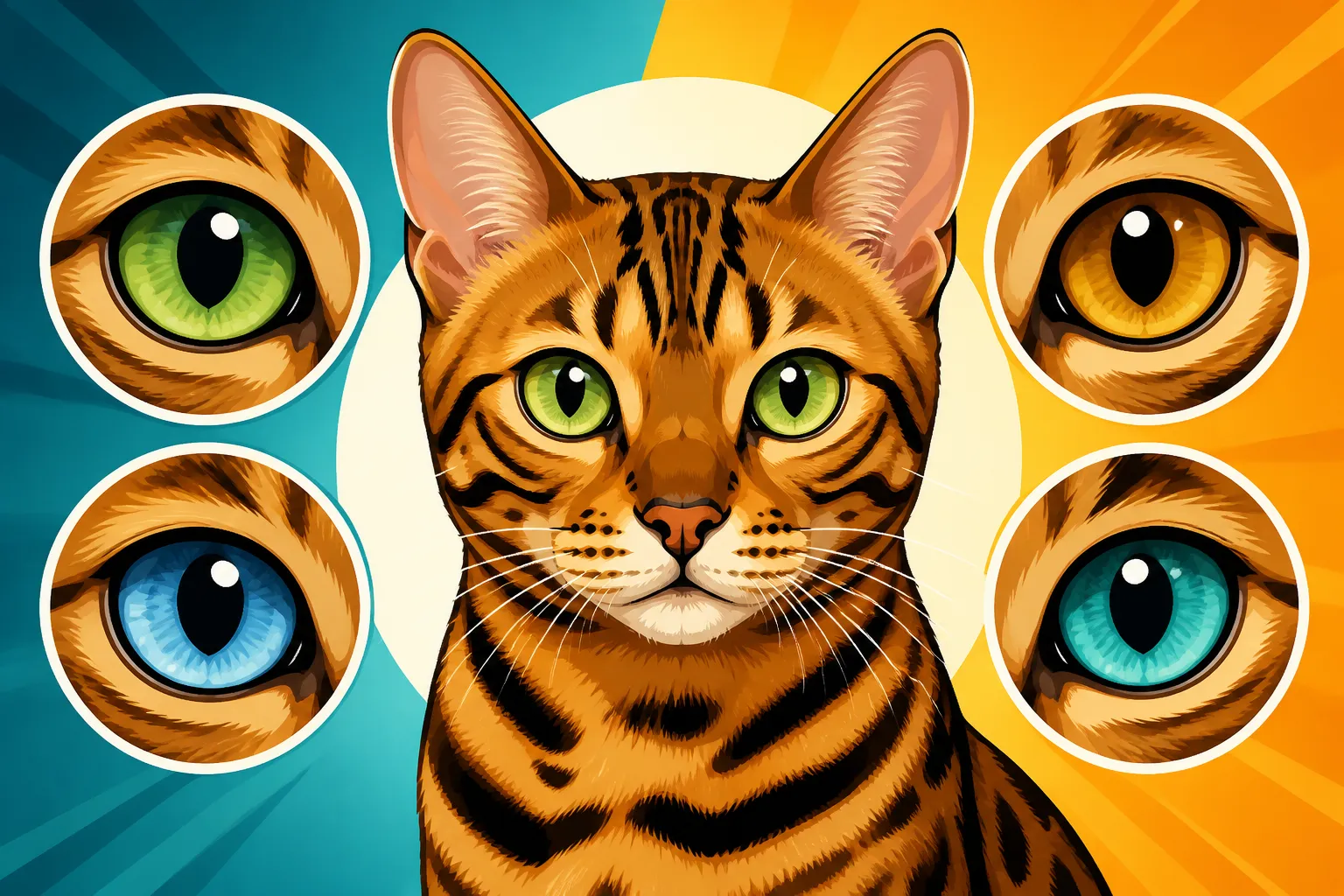
Bengal cats may have green, gold, amber, aqua, blue-green, or blue eyes. The most common possibilities depend on the cat’s color variety. Brown and silver Bengals are generally associated with green or gold eyes, while the snow varieties can have blue, aqua, or greenish eyes.
| Bengal color variety | Eye colors commonly associated with it | What to know |
|---|---|---|
| Brown | Green, gold, or amber | Eye color can vary within the variety |
| Silver | Green or gold | Silver coat color does not automatically mean blue eyes |
| Seal lynx point snow | Blue | Blue eyes are a characteristic feature |
| Seal mink snow | Aqua or blue-green; sometimes blue | Often appears between the lynx point and sepia types |
| Seal sepia snow | Green or gold | Typically has warmer eye colors than the lynx point |
| Blue or melanistic | Often green or gold tones | Appearance and accepted colors can depend on the registry standard |
These are general associations, not a promise that every cat will have a particular shade. A Bengal’s eye color is influenced by its genetics and variety, and individual cats can differ. The breed’s coat pattern—such as rosettes or marbling—does not, by itself, tell you what color its eyes will be.
For more background on the coat varieties, see Which Colors a Bengal Cat Comes In. Snow Bengals are not all the same type, either: What a Snow Bengal Cat Is explains the distinctions behind that broad label.
Why brown Bengals can have green, gold, or amber eyes
Brown Bengals are often seen with green or golden eyes, and amber tones may appear as well. There isn’t one eye color that every brown Bengal is expected to have. Two cats can share a similar brown coat and still have noticeably different eyes.
The exact shade can also be difficult to judge from a photo. Warm indoor lighting may make green eyes look gold, while flash or a bright window can change how the iris appears. When comparing a kitten’s eyes with an adult cat’s, use photos taken in similar natural light rather than relying on a single image.
Eye color should be considered alongside the cat’s overall appearance and pedigree, not as a stand-alone way to confirm breed. A spotted domestic shorthair may have green or gold eyes too. If you’re trying to distinguish a Bengal from a lookalike, Whether a Spotted Domestic Shorthair Is a Bengal Cat offers useful context.
Why snow Bengals may have blue, aqua, or green eyes
“Snow Bengal” refers to several related color types rather than one identical appearance. Seal lynx point Bengals are especially associated with blue eyes. Seal mink cats may have aqua or blue-green eyes, while seal sepia Bengals more commonly have green or gold tones.
Those differences come from the cats’ color genetics, not from whether their coats are rosetted or marbled. It’s possible for two snow Bengals to have similar-looking coats but different eye colors because they belong to different color varieties. For a closer look at how those categories differ, read What a Seal Lynx Point Bengal Cat Is, What a Seal Mink Bengal Cat Is, and What a Seal Sepia Bengal Cat Is.
Blue eyes are a familiar trait in seal lynx point Bengals, but they’re not a general feature of every Bengal. Why a Snow Bengal Cat Has Blue Eyes explains why this eye color is associated with that particular variety.
How coat type and breed standards relate to eye color
Eye color is one part of a Bengal’s appearance, but it isn’t a reliable shortcut for identifying the breed or deciding whether a cat is well bred. A cat’s color variety can make certain eye shades more likely, yet appearance should be considered as a whole.
Coat pattern does not determine eye color
Rosettes and marbling describe markings on the coat. They don’t directly predict whether a Bengal will have green, gold, or blue eyes. A rosetted brown Bengal may have green eyes, while another brown Bengal with a similar pattern may have gold eyes.
That can be disappointing if you’re choosing a kitten based on a particular look in a breeder’s photos. A picture may not show the kitten’s eventual eye shade accurately, and a litter can include kittens with different appearances. Ask the breeder what eye colors the parents have and what color variety each kitten is, but treat that information as a guide rather than a guarantee.
Eye color also shouldn’t be used to decide whether a cat is a purebred Bengal. Breed identity is better assessed through credible records and a cat’s overall characteristics. The article What a Bengal Cat Looks Like by the Standard provides a broader view of the traits used to describe the breed.
What breed standards can and cannot tell you
Breed standards describe preferred features for a show Bengal, including the relationship between coat color and eye color. The details may vary between registries, so a shade considered appropriate in one variety may not be the expected shade in another.
A standard is not a medical assessment, and it does not mean that a pet Bengal with a less typical eye color is unhealthy. Nor does a particular eye shade prove that a cat meets a breed standard. If you’re evaluating a kitten, consider its health, temperament, living conditions, and records alongside its appearance.
If you are comparing a cat with descriptions from different registries, keep the variety in mind. For example, blue eyes are a familiar feature of seal lynx point Bengals, but they are not the expected eye color for all brown or silver Bengals.
When Bengal kitten eyes change color
Many kittens are born with blue-looking eyes because pigment in the iris has not fully developed. As a kitten grows, its eye color may deepen or shift toward the color associated with its variety. That normal development can make early photos misleading.
Normal eye-color development
A kitten’s eyes may begin changing during its early weeks and continue to develop as it matures. The timing and final shade vary. A brown kitten that looks blue-eyed in a very young photo may later have green or gold eyes. A seal lynx point kitten, by contrast, is expected to retain blue eyes as part of its variety.
This is one reason not to make a firm prediction from a newborn or very young kitten’s picture. If the final color matters to you, ask the breeder about the kitten’s age in each photo and whether the eyes have started to settle. Even then, a breeder’s estimate is just that—an estimate.
A gradual change in both eyes as a kitten grows is different from a sudden change in a mature cat. If an adult Bengal’s eyes seem to change quickly, or one eye looks different from the other, it’s worth checking with a veterinarian rather than assuming it is simply a coat-color trait.
When a change needs veterinary attention
Contact a veterinarian if an eye becomes cloudy, red, swollen, unusually watery, or painful, or if your cat is squinting or rubbing at it. A sudden difference between the eyes can also be a reason to arrange an examination. Eye changes may have causes that cannot be identified just by looking at eye color.
Avoid putting human eye drops or unprescribed products into your cat’s eyes. If you’re considering cleaning around the eye, ask your vet what is appropriate. Retailers such as Chewy may list pet eye wipes and other grooming supplies, but a product being sold for pets does not make it suitable for every eye concern. Chewy’s product information can help you review labels, but it cannot diagnose redness, cloudiness, or a sudden color change. If your vet recommends a specific product, check its instructions and ingredients before using it.
Choosing a Bengal by eye color
It’s natural to have a favorite—blue eyes can be striking, and green or gold eyes can look especially vivid against a Bengal’s patterned coat. Still, eye color is only one small part of living with a cat. Health, temperament, and a responsible source matter far more than matching a photo.
Questions to ask a breeder
If you’re speaking with a breeder, ask what color variety the kitten is and what eye color is typical for that variety. You can also ask whether the kitten’s eyes have changed since birth and whether the breeder has recent photos taken in natural light. These questions help you understand what you’re seeing without treating an early photo as a guarantee.
A helpful breeder should be able to explain the kitten’s background and answer questions about its care. Be cautious if someone relies on eye color alone to claim that a cat is a Bengal or promises a precise adult shade from a very young kitten. Eye color can support an overall description, but it cannot establish pedigree or replace health information.
If you’re buying supplies for a kitten, Chewy can be one place to compare everyday pet-care products, but eye-related concerns are best discussed with a veterinarian before you purchase or apply anything. In particular, don’t use a grooming product near the eye unless its label clearly allows that use and your vet agrees it is appropriate.
What matters more than the shade
A Bengal with green eyes and a Bengal with gold eyes can both be wonderful companions. Rather than choosing solely for a particular shade, look for a kitten that appears bright and comfortable, has clear eyes without persistent discharge, and is being raised in a clean, attentive environment. Ask for relevant veterinary and breeder records, and make sure the kitten’s behavior and needs are a good fit for your home.
If the eye color is not what you expected, that doesn’t automatically mean something is wrong. A color that differs from a typical description may simply reflect variation, age, or lighting. But a new or sudden change—especially alongside discomfort or cloudiness—is a health question, not a breed-color question. When in doubt, have a veterinarian examine the cat rather than trying to diagnose it from photos or retailer listings.
Disclaimer
This article is for general informational purposes only and does not constitute professional advice. Laws, prices and regulations vary by location and change over time. Consult a qualified professional for guidance on your specific situation.