What a Seal Lynx Point Bengal Cat Is
A seal lynx point Bengal can look almost white as a kitten, with faint markings that seem to appear gradually as the cat grows. That change can make it hard to tell what color pattern you’re looking at—or whether the cat is even a Bengal. This guide explains the seal lynx point look, how it differs from other snow Bengals, and what to consider when identifying one.
What a seal lynx point Bengal looks like
A snow Bengal with colorpoint coloring
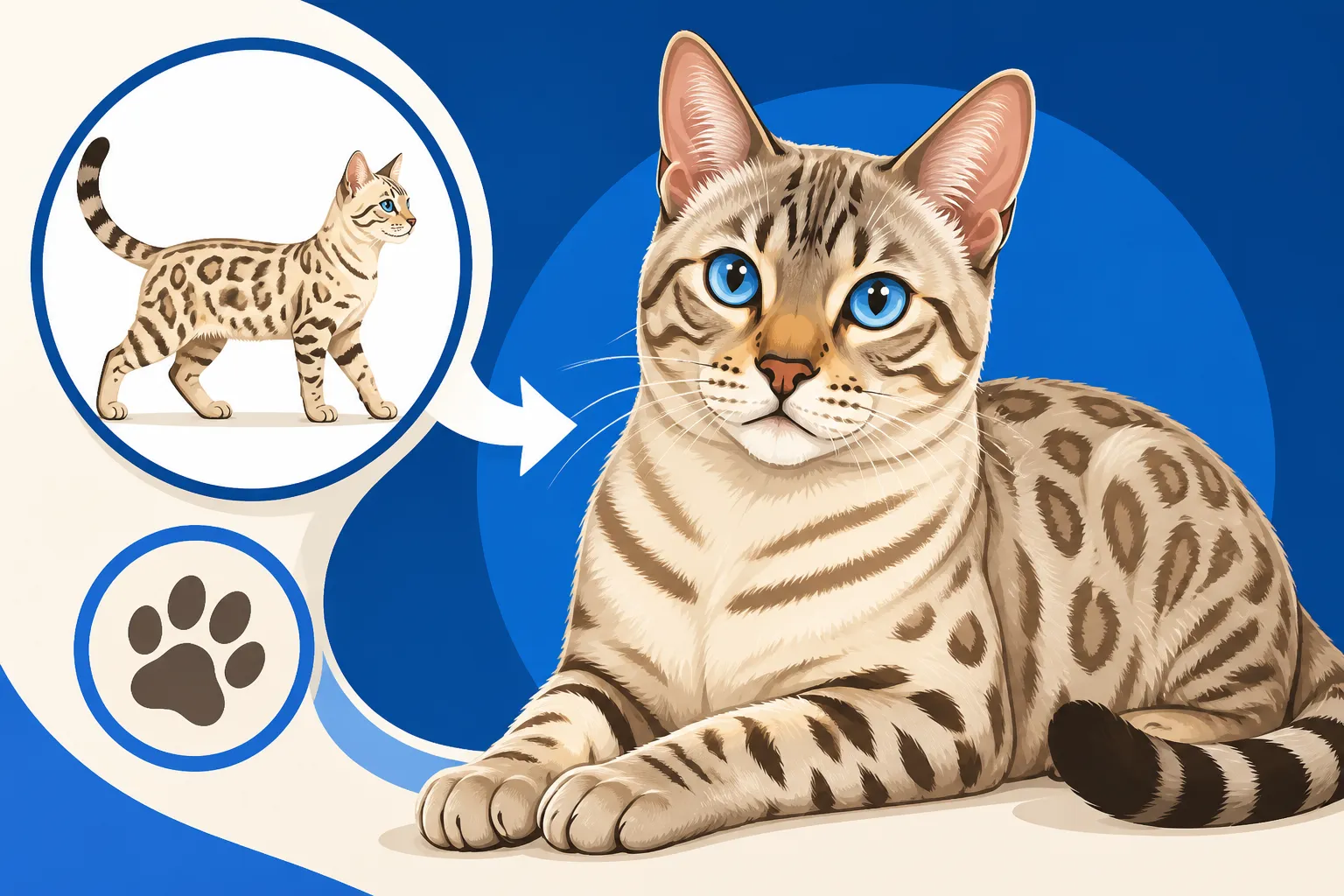
Seal lynx point is one of the snow color varieties found in Bengal cats. “Seal” describes the dark brown-toned color of the markings, while “lynx point” refers to a colorpoint pattern associated with pale coloring on the body and darker color developing on areas such as the face, ears, legs, and tail.
The body is usually a light cream, ivory, or near-white shade. Its markings may be subtle, especially when the cat is young. Depending on the individual, those markings can form spots, rosettes, or a marbled pattern. The overall effect is often softer and lower-contrast than the look many people picture when they think of a richly marked brown Bengal.
Seal lynx point is not a separate breed. It is a color and pattern variety within the Bengal breed. If you’re comparing the recognized Bengal colors, Which Colors a Bengal Cat Comes In provides broader context, while What a Snow Bengal Cat Is focuses on the snow group.
Blue eyes and markings that develop over time
Blue eyes are a characteristic feature of the seal lynx point colorpoint pattern. The kitten’s body may be very pale, and the markings can be difficult to see clearly at first. As the coat develops, the points and body pattern often become more noticeable. The timing and degree of contrast vary from cat to cat.
This gradual change can catch new owners off guard. Someone may bring home a pale kitten expecting the coat to stay almost solid, then notice more definition around the face, tail, or body over the following months. That is not necessarily a sign that the cat’s color is changing into a different variety; it may simply be the developing pattern becoming easier to see.
A photo taken in warm indoor lighting can make pale markings look nearly invisible, while daylight may reveal them more clearly. When comparing pictures, look at several areas—the face, legs, tail, and sides of the body—and remember that coat color can look different under different lighting.
Pattern and color are related but not the same thing
“Seal lynx point” describes the colorpoint color variety, not a single specific pattern. A seal lynx point Bengal may have spotted or rosetted markings, or a marbled pattern. Rosettes are markings with more than one shade inside them, while marbling creates flowing, swirled markings across the body. For a closer look at the difference, see How Marbling Differs From Rosetting in a Bengal Cat.
This distinction matters because two cats can both be seal lynx point Bengals and still look quite different. One may have distinct rosettes on a pale background; another may have broad, curved marbling. Their pattern, contrast, and overall coat appearance are individual features, not different names for the same color.
| Feature | Seal lynx point Bengal |
|---|---|
| Bengal color group | Snow |
| Typical body color | Pale cream, ivory, or near-white |
| Marking color | Seal or dark brown-toned |
| Eye color | Blue |
| Pattern possibilities | Spotted, rosetted, or marbled |
| Appearance as a kitten | Often very pale, with subtle markings |
| Coat development | Contrast can become more noticeable as the cat matures |
How seal lynx point differs from other snow Bengals
Seal lynx point versus seal mink
Seal lynx point, seal mink, and seal sepia are all snow Bengal varieties, but they are not interchangeable labels. They are associated with different colorpoint genetics and can have different eye colors and degrees of contrast. A seal mink Bengal commonly has aqua or blue-green eyes, while seal lynx point Bengals are known for blue eyes. There can be variation in how colors appear in photographs, so eye color should be considered alongside the coat and the cat’s documented background.
Seal mink cats may show more body color than a very pale lynx point, but visual impressions can be unreliable. A kitten’s coat is still developing, lighting can distort subtle differences, and individual cats do not always match a casual observer’s expectation of a color label. What a Seal Mink Bengal Cat Is explains the mink variety in more detail.
Seal lynx point versus seal sepia
Seal sepia Bengals tend to have a warmer, deeper overall appearance than seal lynx points, with stronger body color often visible. Their eyes are generally green, gold, or a similar shade rather than the blue associated with lynx point coloring. Still, not every photo makes the distinction obvious, particularly when the image is overexposed or the cat is young.
It helps to compare the whole cat rather than one feature in isolation. Look at the body color, markings, eyes, and age, and ask whether the description comes from a breeder’s records or simply someone’s visual guess. The overview What a Seal Sepia Bengal Cat Is can help clarify the terminology.
Why photographs can make the colors confusing
A bright white background, direct sunlight, phone-camera processing, and indoor bulbs can all shift how a pale coat appears. A seal lynx point photographed in strong light may look nearly white, while a warmer image can make the same coat seem beige or cream. Markings that are visible in person may disappear in a low-quality photo.
If you are evaluating a kitten or adult cat, ask for several recent photos in natural light. A short video can also help show the coat from different angles. Avoid relying on one close-up of the face or one heavily edited image; the body pattern and eye color are easier to assess when you can see the cat as a whole.
How to identify a seal lynx point Bengal responsibly
Start with breed identity, not just coat color
A pale, blue-eyed cat with spots is not automatically a Bengal. Other cats and mixed-breed cats can have similar coloring or markings. Coat appearance alone cannot confirm pedigree, and a DNA test is not a substitute for reliable breed documentation. If you are trying to understand what the Bengal standard describes, What a Bengal Cat Looks Like by the Standard is a useful starting point.
Ask the breeder or current owner for the cat’s registration and pedigree information, and make sure the details refer to the individual cat rather than a parent or littermate. If the cat is being represented as a Bengal, clear documentation should support that claim. This is especially important when purchasing a kitten, because a striking coat can make it tempting to accept a label without checking the background.
For a rescue cat, the most useful approach is to describe what you can observe without assuming a pedigree. A pale cat with blue eyes and Bengal-like markings may resemble a seal lynx point, but appearance by itself does not establish that it is a registered Bengal.
Ask focused questions about color and parentage
If you’re speaking with a breeder, ask what they mean by “seal lynx point” and how they determined the color. Ask whether the kitten’s parents’ colors and records are available, and whether the breeder can explain how the kitten’s expected coat and eye color fit its lineage. A careful breeder should be willing to discuss both the kitten’s appearance and the documentation behind its description.
It is also reasonable to ask for current, unfiltered photos of the kitten and its parents. The goal is not to demand that every kitten look exactly like a show photograph; it is to understand what is known, what is still developing, and what is being described as an expectation rather than a certainty.
If you’re comparing patterns as well as colors, What a Rosette Is on a Bengal Cat explains one common Bengal marking. For the broader breed background, Where the Bengal Cat Comes From helps distinguish the Bengal’s history from the shorthand people sometimes use to describe a cat as “wild-looking.”
Look beyond color when choosing a cat
Color can be part of the appeal, but it says little about whether a particular cat will suit your household. Ask about the kitten’s temperament, early socialization, health history, and the daily care it is accustomed to. Spend time with the cat if possible, and consider whether you’re prepared for an active, curious companion rather than choosing primarily for a coat pattern.
A practical shopping list might include a secure carrier, sturdy scratching surfaces, interactive toys, and food that can be transitioned gradually from the kitten’s current diet. If you use Chewy to browse basic supplies, compare product details carefully and choose items that fit your home and the cat’s size. The same applies to grooming tools: Bengals often have short coats, but a gentle brush or grooming glove may still be useful if the cat enjoys it.
Caring for a seal lynx point Bengal
Coat care is usually straightforward
The seal lynx point coat is short, and routine care is generally simple. A gentle brush or grooming glove can lift loose hair and give you a chance to check the skin, but many cats do not need frequent or elaborate grooming. Follow the cat’s comfort level rather than turning brushing into a daily struggle.
A pale coat may make dirt or residue easier to notice in some areas, but that does not mean the cat needs frequent baths. Bathing is usually best reserved for a specific need, such as getting into something messy, and should be done with a cat-safe product. If you’re putting together a basic care kit, Chewy can be one place to compare brushes, nail clippers, and other supplies; introduce new tools calmly and stop if your cat becomes stressed.
Routine grooming is also a chance to notice changes such as irritated skin, unusual hair loss, or a new mark. Those observations are more useful than trying to keep the coat looking a particular shade. Coat color and pattern are natural features, not something that needs to be maintained with special products.
Enrichment matters more than the color variety
Seal lynx point Bengals have the same basic enrichment needs as other Bengals. Many are active, curious cats who benefit from daily interactive play, climbing opportunities, and places to watch household activity. A tall, stable cat tree, puzzle feeders, and wand-toy sessions can help turn that energy into healthy play rather than late-night cabinet exploration.
A simple routine can make a difference: offer a play session before a meal, rotate toys so they remain interesting, and give the cat safe places to climb or perch. If you’re choosing toys through Chewy or another retailer, look for sturdy construction and supervise toys with strings or small parts. The best toy is not necessarily the most complicated one; it is the one your individual cat will use safely.
Colorpoint coloring does not mean the cat needs special exercise or a special diet. Food choices should be based on life stage, health, and veterinary guidance, not on the seal lynx point label. If a cat has a sudden change in appetite, weight, energy, or coat condition, discuss it with a veterinarian rather than assuming it is related to color.
Keep identity and health separate
A cat’s color variety does not guarantee a particular health outcome. A seal lynx point Bengal should receive ordinary preventive care, including veterinary checkups, appropriate vaccinations, dental attention, and a plan for parasite prevention based on the cat’s lifestyle and location. The breeder’s health practices and records are more meaningful than the kitten’s coat color when you’re assessing responsible breeding.
For a new kitten, request veterinary records and ask what follow-up care is due. For an adult cat, share any available history with your veterinarian and describe changes in behavior or appetite clearly. If the cat is newly adopted, a checkup can establish a baseline and help you plan a comfortable transition at home.
The short version of the terminology is simple: seal lynx point describes a pale snow Bengal with seal-toned markings and blue eyes, while the cat’s pattern may be spotted, rosetted, or marbled. Its appearance can develop over time, so use reliable records and more than one photo when identifying the color—and choose a cat based on health, temperament, and fit for your household as well as looks.
Disclaimer
This article is for general informational purposes only and does not constitute professional advice. Laws, prices and regulations vary by location and change over time. Consult a qualified professional for guidance on your specific situation.