Whether a Spotted Domestic Shorthair Is a Bengal Cat
A spotted cat can look strikingly like a Bengal, especially when its coat has high contrast or bold markings. But spots alone do not establish breed: “domestic shorthair” describes a cat’s coat and general type, while Bengal is a pedigreed breed. This guide explains what appearance can tell you, what it cannot, and how to investigate a cat’s background without guessing.
Why spots do not prove a cat is a Bengal
Domestic shorthair describes a coat type
Domestic shorthair is a broad term for a short-coated cat without documented membership in a particular recognized breed. It does not describe one specific appearance. A domestic shorthair may be spotted, striped, patched, solid-colored, or marked with several patterns at once.
That means a spotted domestic shorthair is not necessarily a Bengal mix, either. Spotted coats occur among cats with varied backgrounds, and a cat can inherit a pattern that resembles a breed’s look without having a known Bengal ancestor. The coat is a clue about appearance, not proof of pedigree.
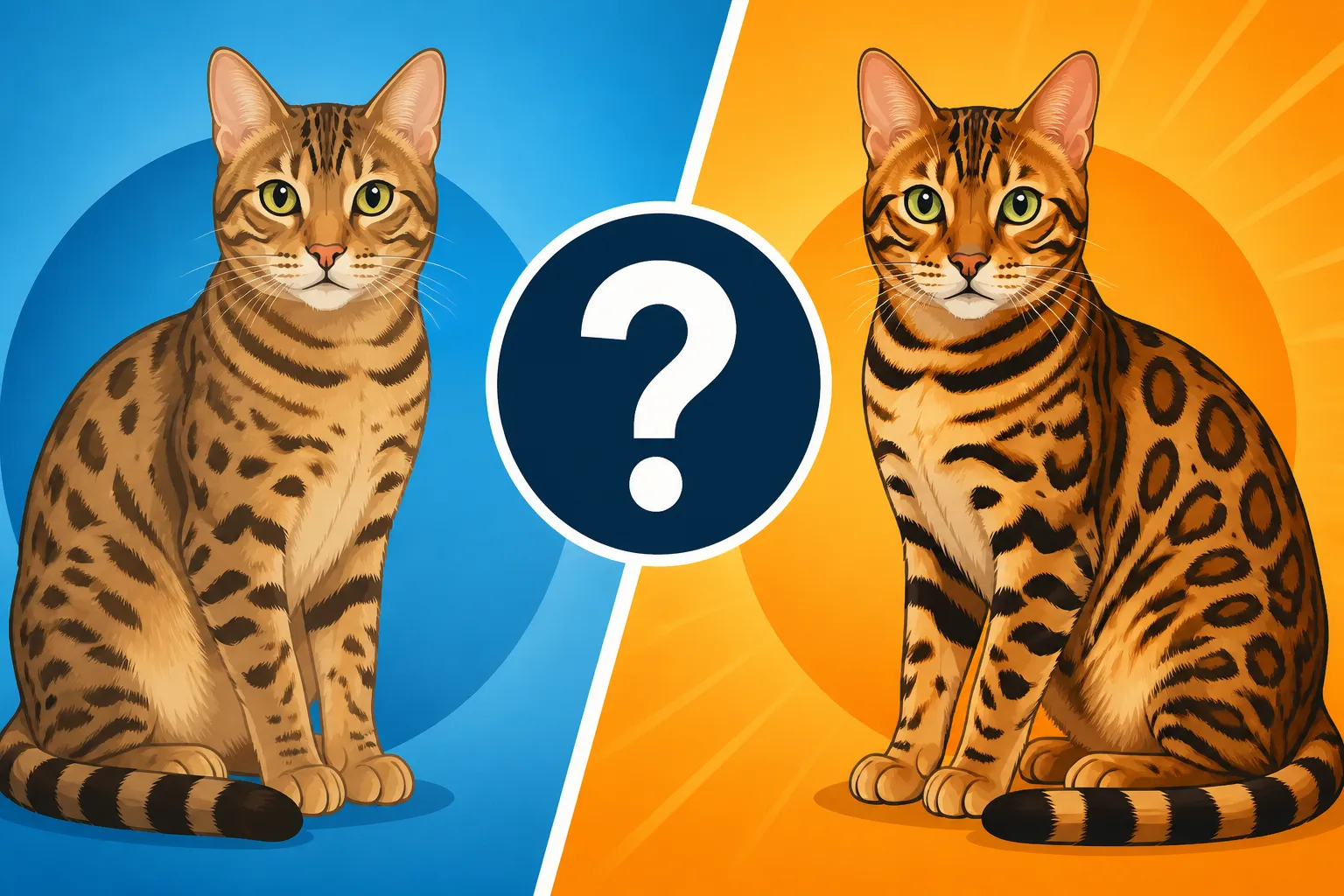
Bengal, by contrast, is a recognized breed with documented ancestry and breed standards. A Bengal may have rosettes, single spots, or a marbled pattern, among other details. Some Bengals have dramatic, open rosettes; others have smaller, more solid spots. So even the reverse assumption—“it has to be a Bengal because it has rosettes”—isn’t reliable by itself.
A Bengal’s markings are only one part of its appearance
Bengals are often recognized for their patterned coats, but the breed’s overall appearance includes more than spots. People may notice a sleek coat, muscular build, distinctive head shape, or a particular pattern layout. Yet individuals vary, and lighting, age, coat condition, and the way a cat is standing can make visual comparisons tricky.
A spotted pet cat might share one or several of those features and still be a domestic shorthair. Some domestic cats have bold contrast between their spots and background color. Some Bengals have subtler markings than people expect. A photo can be useful for describing a cat, but it cannot reliably confirm its breed.
If you’re curious about how particular Bengal patterns are described, What a Rosette Is on a Bengal Cat explains the markings people often mean when they talk about rosettes. For a broader look at how spotted and marbled patterns differ, see Rosetted Against Marbled: The Two Bengal Cat Patterns.
Behavior is not a breed test
A lively cat that climbs shelves, follows you around, or plays enthusiastically may remind you of a Bengal. But behavior is shaped by many things: temperament, early experiences, age, health, the home environment, and how much play and interaction the cat gets. A playful or vocal cat is not automatically a Bengal.
The same goes for habits such as enjoying water, learning tricks, or being unusually curious. Those traits can occur in cats of many backgrounds. If a shelter description calls a cat “Bengal-like,” it may be referring to appearance or energy level rather than a verified family tree.
It can still be helpful to learn what the breed is commonly like, especially if you’re preparing to live with a high-energy cat. But use behavior to understand the individual in front of you, not to settle a question of ancestry. What People Get Wrong About the Bengal Cat covers several common assumptions that can make visual identification confusing.
What can help confirm whether a cat is a Bengal
Look for reliable pedigree records
The clearest evidence that a cat is a pedigreed Bengal is credible documentation tracing its ancestry through a breeder or recognized registry. If you are speaking with a breeder, ask what registration paperwork is available and whether the documents identify the kitten and its parents. The records should correspond to the individual cat, not simply show that the breeder has registered other cats.
A pedigree is different from a verbal assurance that a kitten “has Bengal in it.” Sellers may use terms such as Bengal mix, Bengal-type, or part Bengal to describe appearance or claimed ancestry. Those descriptions can be sincere, but without reliable records they do not establish a verified breed background.
If a cat has come from a shelter or rescue, its history may be incomplete. That does not make the cat any less deserving of a home; it simply means you may not be able to confirm its breed. Read Whether a Shelter Cat Can Be a Bengal Cat for more on why a shelter cat’s appearance and known history may not settle the question.
Understand what a DNA test can and cannot tell you
People often hope a DNA test will provide a simple yes-or-no answer. In practice, genetic testing and breed identification are not the same thing as documented pedigree. A test may provide information about genetic markers or ancestry estimates, depending on the test and its reference data, but those results should not be treated as a substitute for registration records.
Before ordering a test, check what the company says it can determine and how it describes its results. Be cautious about interpreting a percentage or breed label as definitive proof that a cat is a registered Bengal. A genetic result may be interesting background information, but it does not necessarily establish a cat’s formal breed status.
For more context, see Whether a DNA Test Confirms a Bengal Cat. The practical takeaway is simple: if you need to know whether a cat is a pedigreed Bengal, ask for traceable paperwork. If you are simply curious about a rescue cat’s possible ancestry, a test may be one piece of information, but it may not deliver a conclusive answer.
Know what “Bengal mix” means in everyday use
“Bengal mix” is commonly used for a cat believed to have some Bengal ancestry, but the phrase can mean different things depending on who is using it. One person may have paperwork for a Bengal parent; another may be describing a spotted cat that looks like a Bengal. Ask what evidence supports the claim rather than relying on the label alone.
Even when one parent is a documented Bengal, the kitten’s appearance and temperament can vary. A mixed-background cat might inherit striking spots, a short coat, or an energetic personality—or might not. Appearance does not reveal exactly how much ancestry a cat has, and a breed-like coat does not establish a specific generation.
For an overview of the distinction between documented ancestry and resemblance, Whether a Bengal Cat Mix Keeps the Pattern is a useful related topic. When the records are missing, the most accurate description may simply be “spotted domestic shorthair” or “domestic shorthair with Bengal-like markings.”
A practical way to assess a spotted cat
Start with the cat’s known history
If you are considering adopting or buying a cat, begin with the information available from the person or organization who knows the cat. Ask where the cat came from, whether its parents are known, and whether any pedigree or registration paperwork exists. If the cat is a rescue, ask what is documented versus what is only a guess.
A responsible conversation should leave room for uncertainty. For example, “We don’t know the parents, but the cat has a spotted coat” is clearer than presenting a guess as a verified breed. If you are buying from a breeder, ask to see records for the kitten and confirm that the paperwork actually relates to the cat being offered.
When paperwork is not available, focus on concrete facts: age, veterinary records, known health history, vaccination status, and behavior in the home or foster setting. Those details help you decide whether the cat is a good fit, regardless of breed.
Use appearance to describe, not diagnose
It’s perfectly reasonable to notice that a cat has large spots, rosettes, a sleek coat, or a muscular frame. You can describe those features without turning them into a breed claim. For instance, “a short-haired spotted cat with high-contrast markings” is accurate even if the cat’s ancestry is unknown.
A quick comparison can help keep the terms straight:
| What you observe | What it may tell you | What it cannot prove |
|---|---|---|
| Spots or rosettes | The cat has a patterned coat | That the cat is a Bengal |
| A sleek, short coat | The coat is short and close-lying | A specific breed or ancestry |
| High energy or curiosity | The cat may need play and enrichment | That the cat has Bengal temperament by ancestry |
| Pedigree and matching registration records | Documented breed lineage may be available | That every claimed detail is automatically correct without checking the records |
| DNA test results | Possible genetic or ancestry information, depending on the test | Formal registration or pedigree by themselves |
Use the cat’s actual needs—not a breed stereotype—to guide daily care. A spotted domestic shorthair may need a lot of interactive play, while a pedigreed Bengal may have a calmer individual temperament than you expect.
Get veterinary advice about the individual cat
A veterinarian can assess health, body condition, and care needs, but a routine exam is not a visual breed certification. If you have questions about a cat’s diet, activity, or health, share its history and describe the behaviors you’ve noticed. That is more useful for day-to-day care than trying to make a breed guess from coat markings.
For example, if a cat is gaining weight, the useful conversation is about its body condition, food portions, and activity—not whether it looks like a Bengal. If it has ongoing digestive trouble, bring up the symptoms and timeline rather than assuming the problem comes from breed. A vet can help decide whether further evaluation is needed.
You might use a pet retailer such as Chewy to compare routine food, litter, or enrichment supplies, but those choices should suit the cat’s age, health, preferences, and household. Chewy products or a breed label cannot verify ancestry. If you are unsure about a diet change, ask your veterinarian before switching foods, especially if the cat has a medical condition.
What to do when the cat’s breed is uncertain
Choose care based on the cat, not the label
If a shelter cat is listed as a Bengal mix, treat that as a possible description rather than a guarantee unless there is documentation. Spend time learning the cat’s personality: Does it seek active play? Does it climb? Is it comfortable with visitors or other animals? These everyday observations are more useful for planning than trying to predict its needs from a label.
Set up a home that gives the cat safe outlets for normal feline behavior. A sturdy climbing area, scratching surfaces, interactive play, hiding places, and puzzle-style activities can benefit many cats. If your cat is particularly energetic, offer short play sessions throughout the day and rotate toys so that the environment stays engaging.
Chewy can be one place to look for basic supplies such as litter or toys, but no single shopping list suits every cat. Watch what your cat actually uses. A cat that ignores a tall tower may prefer a window perch; another may spend hours chasing a wand toy. Keep the useful items and adjust the setup around the cat’s preferences.
Be careful when buying a cat advertised as a Bengal
If a seller is advertising a kitten as a Bengal, ask for registration and pedigree details before making a decision. Request records that identify the kitten and its parents, and make sure you understand what the seller means by “Bengal,” “Bengal mix,” or any generation label. Don’t let an especially dramatic coat pattern replace clear documentation.
You can also ask about the kitten’s socialization, veterinary care, and the conditions in which it was raised. Breed paperwork answers a question about lineage; it does not, on its own, tell you whether the kitten has been well cared for. A careful buyer looks at both the records and the kitten’s health and living situation.
If the seller cannot provide reliable documentation, consider whether you are comfortable adopting the cat as a cat of unknown or mixed ancestry. That may still be a wonderful choice. The important distinction is between choosing a cat because you love it and paying for a breed claim that cannot be substantiated.
Describe uncertainty honestly
If no records exist, it is fine to say that your cat looks Bengal-like or may have Bengal ancestry. It is more accurate to avoid stating that the cat is a Bengal as a confirmed fact. That wording matters when discussing the cat with a veterinarian, an insurer, a landlord, or a future adopter, since each may treat breed information differently.
The simplest answer is that a spotted domestic shorthair is not automatically a Bengal. Spots can inspire the question, but credible lineage records are what support a claim of pedigreed breed. When those records are missing, enjoy the cat’s distinctive coat and get to know the individual rather than letting an uncertain label define it.
Disclaimer
This article is for general informational purposes only and does not constitute professional advice. Laws, prices and regulations vary by location and change over time. Consult a qualified professional for guidance on your specific situation.