Whether a DNA Test Confirms a Bengal Cat
A spotted cat with a sleek coat can look strikingly like a Bengal, but looks alone don’t prove breed—and a DNA report may not settle the question either. This guide explains what feline DNA tests can tell you, what they can’t confirm, and which records matter most when you’re trying to establish whether a cat is a Bengal.
What a Bengal cat DNA test can tell you
Breed estimates are not the same as breed confirmation
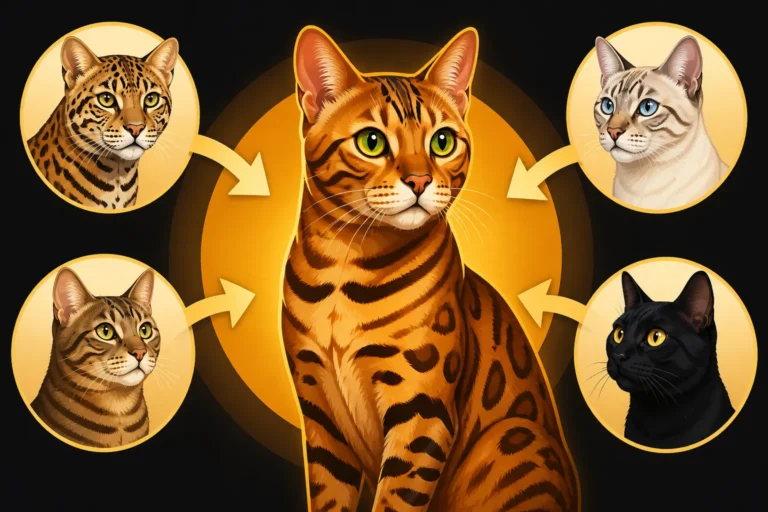
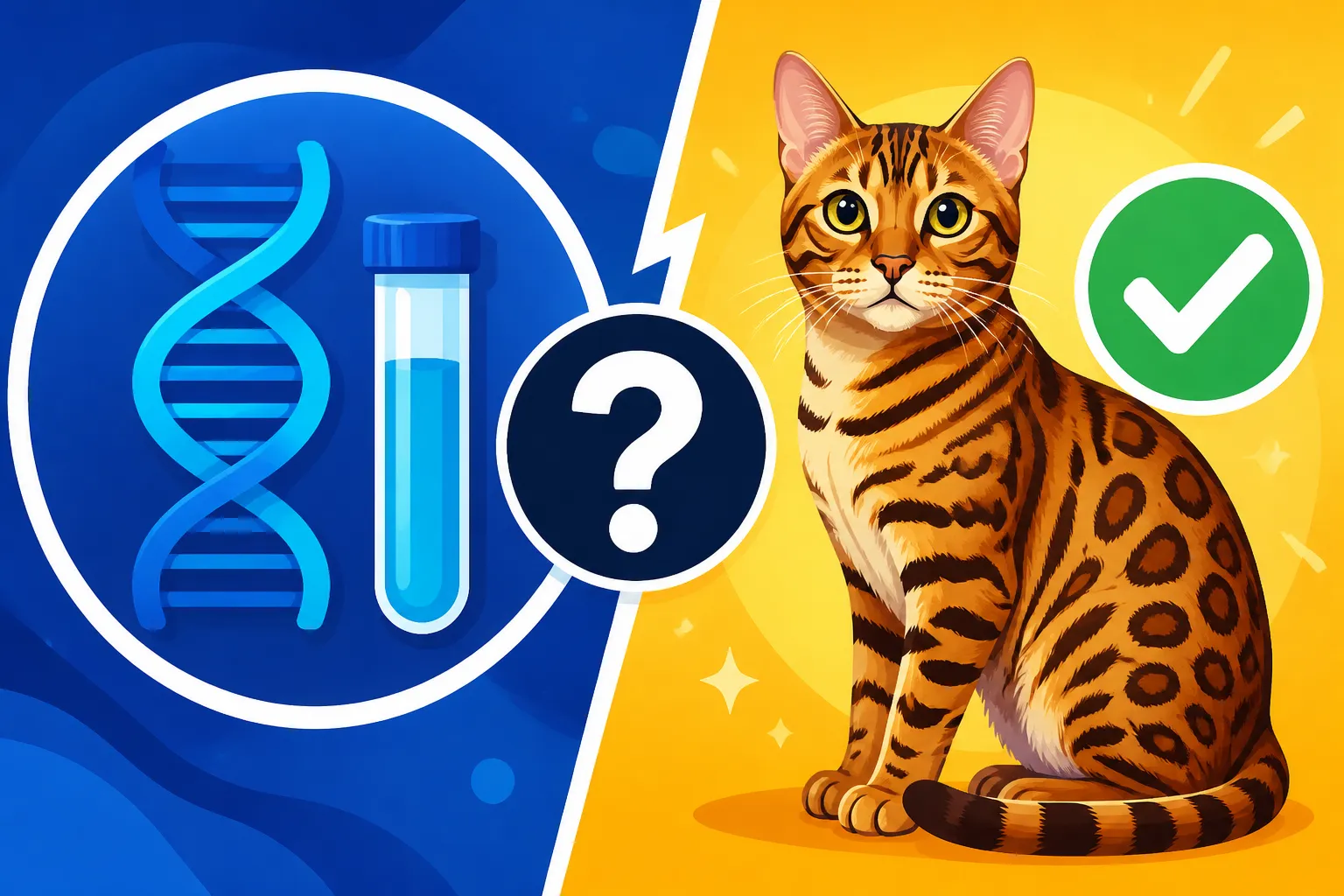
Some commercial cat DNA tests compare a cat’s genetic markers with reference data and estimate which breed groups its DNA resembles. A result may suggest Bengal ancestry, or show genetic similarities to breeds that contributed to Bengal development. That can be interesting, especially if you adopted a cat with an unknown history, but an estimate is not the same as a formal certificate saying the cat is a registered Bengal.
The distinction matters because a test’s answer depends on the laboratory’s reference samples, methods, and categories. A company may be able to report that a cat shares markers with its Bengal reference group without proving that the cat came from registered Bengal parents. Another company could use a different database and produce a different-looking result. The wording “Bengal ancestry detected” should not be read as “purebred Bengal confirmed.”
A consumer test can still give you useful clues. It may help you understand why your cat has a certain appearance or provide information about genetic traits included in the test. But if you need to verify breed for a purchase, breeding decision, registration, or legal requirement, a breed estimate alone is unlikely to do the job.
Health testing answers a different question
A DNA panel may test for particular inherited conditions or traits. That is separate from identifying a cat’s breed. A Bengal can have a health-test result without the panel establishing its pedigree, and a cat that receives a Bengal-like ancestry estimate may not have been tested for any Bengal-related health risks.
This is easy to muddle when a report combines several kinds of results. For example, the same document might discuss ancestry, coat traits, and genetic variants associated with disease. Read each section on its own terms: an ancestry result is not a health diagnosis, and a health result is not proof of breed. If a result suggests a health concern, discuss what it means for your particular cat with a veterinarian.
If you’re trying to understand whether a spotted shelter cat could be a Bengal, appearance and a consumer DNA report are only pieces of the puzzle. Whether a Spotted Domestic Shorthair Is a Bengal Cat and Whether a Shelter Cat Can Be a Bengal Cat explore why a convincing pattern does not necessarily establish ancestry.
A Bengal appearance is not a genetic certificate
Bengals are known for patterned coats, athletic builds, and distinctive facial markings, but individual cats vary. Other domestic cats can also have spots, rosettes, or marbled patterns. A cat may look remarkably Bengal-like while having no documented Bengal ancestry—or may have Bengal ancestry without matching the stereotypical image people expect.
That uncertainty is especially common with rescue cats and cats whose early history is unknown. A shelter might describe a cat as a “Bengal mix” based on its appearance, but unless there are reliable records or a meaningful test result, that label may be an informed guess rather than a verified family history. It can still describe what the cat looks like; it should not be treated as proof of a particular pedigree.
What proves that a cat is a Bengal
Pedigree records are the strongest evidence
For a registered purebred cat, the clearest evidence is a traceable pedigree supported by registration records and breeder documentation. A pedigree connects the cat to its parents and earlier generations. Registration documents can help establish that those family records are recognized by the relevant registry, though paperwork should still be checked for consistency and authenticity.
When buying a kitten, ask to see the registration or pedigree documents for the kitten and the information linking it to its parents. Make sure names, dates, and registration details make sense together. If the breeder says the paperwork will arrive later, ask what documentation will be provided and when. A photo of a rosetted kitten or a DNA estimate is not a replacement for a documented lineage.
For an adopted adult cat, those records may simply not exist. That does not make the cat less deserving of care or affection; it just means its exact breed may remain unknown. If the question is important for a formal purpose, such as a registry application or a rule that distinguishes generations, ask the relevant organization what evidence it accepts before relying on a commercial test.
A Bengal’s generation comes from its family history
The terms F1, F2, F3, and later filial generations describe ancestry across generations. They are based on a cat’s documented breeding history, not on a consumer DNA percentage. You generally cannot use an ancestry estimate to reliably calculate a Bengal’s generation or prove how close it is to an Asian leopard cat ancestor.
That distinction matters because generation labels can have practical consequences. Rules for ownership, registration, and breeding may treat early-generation cats differently from later-generation Bengals. If you need to know a cat’s generation, traceable pedigree information is more relevant than a report that assigns a broad ancestry category. How a Bengal Cat's Generation Is Counted explains the family-history basis for those labels, while Whether a DNA Test Shows a Bengal Cat's Wild Percentage addresses why a DNA report should not be treated as a precise wild-ancestry measurement.
The term SBT is also tied to documented generations and breeding records, rather than simply a visual appearance or commercial DNA score. If a seller describes a cat as SBT, ask what registry paperwork supports that claim. What SBT Means in a Bengal Cat provides more context on what the term indicates.
Registration details still deserve careful checking
Paperwork is valuable, but it should be coherent and verifiable. Ask the breeder which registry issued the documents and whether the cat’s details can be checked with that registry. Compare the cat’s identifying information with the contract, vaccination records, and any health-test documents provided. If names or dates don’t match, ask for an explanation before making a decision.
Be wary of anyone who presents a DNA test as a shortcut around missing pedigree records, particularly when the seller is making a specific claim about generation or registration status. A test could support a broader picture of ancestry, but it cannot automatically fill gaps in a lineage. If you are uncertain, get guidance directly from the registry involved rather than relying on a seller’s interpretation.
How to evaluate a DNA report
Read the test’s exact language
Start with the report itself, not just a sales page or a short summary of the result. Look for the name of the laboratory, the test’s stated purpose, the breeds or reference groups used, and the wording applied to the result. Does it say “matches,” “similarity,” “ancestry,” or “confirmed breed”? Those terms may represent very different levels of certainty.
Also check whether the lab explains how its breed estimate is generated and what limitations apply. A useful report should make clear that an estimate depends on the data available to the testing company. If the description makes sweeping promises but offers little detail about its method, treat the result cautiously.
If you encounter breed-test information while comparing pet-health products on Chewy, separate the retailer’s description from the testing laboratory’s own explanation. Chewy may be a familiar place to browse pet-related information, but the important questions are still who performs the analysis, what the test measures, and how the report defines its conclusions. A product listing or customer review is not a substitute for those details.
Compare the report with independent records
Use a DNA report as one clue and compare it with whatever reliable history you have. If a breeder supplied registration documents, check whether the report’s findings are broadly consistent with the documented background. If you adopted the cat, ask the rescue or previous owner whether they have intake paperwork, breeder information, or veterinary records that clarify the cat’s history.
A mismatch does not automatically mean a test is wrong or that paperwork is fraudulent. Different tests may use different reference groups, and a cat’s appearance can differ from what people expect of its documented breed. But a substantial conflict is a reason to pause and ask questions rather than choosing whichever result supports the answer you wanted.
If a seller claims that a test proves a particular generation, request the pedigree and ask the registry how it evaluates generation. How to Find a Bengal Cat's Generation on Its Pedigree can help you understand where that information belongs. If documentation appears inconsistent or unverifiable, Whether a Breeder Can Fake a Bengal Cat's Generation offers related questions to consider.
Understand what a cheek swab can and cannot do
Many consumer genetic tests use a cheek swab or another sample type specified by the laboratory. Follow the kit’s instructions carefully so the sample is collected and packaged as directed. Poor collection, contamination, or a sample that cannot be processed may delay the result or require another sample.
A successful sample only means the laboratory could analyze the material it received. It does not make every interpretation definitive. The quality of the collection and the strength of the conclusion are separate issues: a technically valid genetic result can still be an estimate rather than breed confirmation.
Before ordering a test, ask what decision you expect it to help with. If you are simply curious about possible ancestry, an estimate may satisfy that curiosity. If you need proof for registration, breeding, ownership rules, or a purchase dispute, ask the organization or authority involved what documentation it accepts. A commercial test may not meet that standard, even if its report sounds confident.
Choosing the right evidence for your situation
If you are buying a Bengal kitten
Ask the breeder for pedigree or registration records, information about the kitten’s parents, and the health documentation relevant to the litter and breeding cats. Look for clear answers about what the kitten’s papers will show. A seller who emphasizes a DNA result but cannot explain the kitten’s lineage is not giving you the same evidence as a documented pedigree.
You can also ask which registry the breeder uses and how to verify the documents. If generation matters to you, ask the breeder to explain it using the pedigree, not a percentage from an ancestry report. Which Generation TICA Registers as a Bengal Cat is useful background when you are trying to understand how registration and generation claims relate.
If the breeder offers DNA results, ask what each result tests. A genetic health panel may be helpful information about inherited conditions, but it should not be presented as a substitute for the kitten’s registration records. Keep copies of the contract, pedigree, test reports, and veterinary records together.
If you adopted a cat with unknown history
It is reasonable to be curious about your cat’s ancestry, especially when its coat strongly resembles a Bengal’s. A DNA test may offer clues, but consider the result an estimate unless the testing company clearly explains a stronger basis for its conclusion. Your cat’s health, behavior, and care needs do not depend on having a confirmed breed label.
If the cat’s possible ancestry affects a practical decision, such as whether a housing rule or local regulation applies, check the exact rule and ask what evidence the relevant authority accepts. Do not assume that a consumer DNA result will settle a legal question. Breed and generation rules can depend on paperwork, definitions, and local requirements.
For everyday care, focus on the individual cat rather than trying to make every need fit a breed label. A lively cat may need enrichment whether it is a Bengal, a mix, or a domestic shorthair. A concerning health change deserves veterinary attention regardless of what a DNA report says.
| What you want to know | Evidence that is most useful | What a consumer DNA test may add |
|---|---|---|
| Whether a cat is registered as a Bengal | Verifiable registry and pedigree records | An ancestry clue, but not a replacement for registration |
| A Bengal’s generation | A traceable pedigree showing breeding history | Usually not a reliable way to establish generation |
| Possible inherited health risks | Veterinary guidance and relevant genetic testing | May identify specific variants included in the panel |
| Whether a rescue cat has Bengal ancestry | Available history plus a clearly explained ancestry report | A possible clue, with uncertainty depending on the test |
| Whether a cat’s appearance proves breed | It does not prove breed on its own | May add information, but does not make appearance conclusive |
The practical answer is simple: a DNA test can suggest Bengal ancestry or test for selected genetic traits, but it does not automatically confirm that a cat is a registered Bengal or establish its generation. For those claims, documented lineage and verifiable registry records carry more weight. If you do order a test, read exactly what it measures, treat ancestry estimates as estimates, and match the evidence to the decision you need to make.
Disclaimer
This article is for general informational purposes only and does not constitute professional advice. Laws, prices and regulations vary by location and change over time. Consult a qualified professional for guidance on your specific situation.