How to Tell a Bengal Cat From an Egyptian Mau
A spotted coat can make a Bengal and an Egyptian Mau look surprisingly alike, especially in a photo or at a shelter. But coat pattern is only one clue, and it cannot prove a cat’s breed on its own. This guide compares their spots, coloring, build, and background, then explains what paperwork or testing can—and cannot—confirm.
The main differences between a Bengal and an Egyptian Mau
Compare the spots and coat pattern
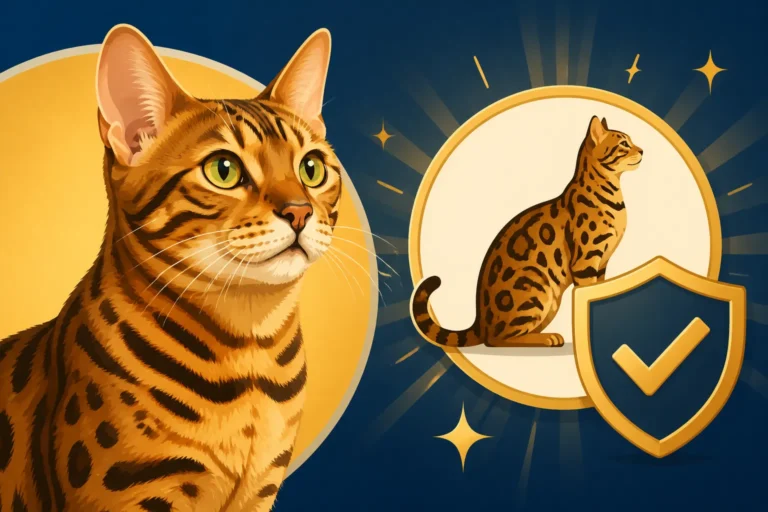
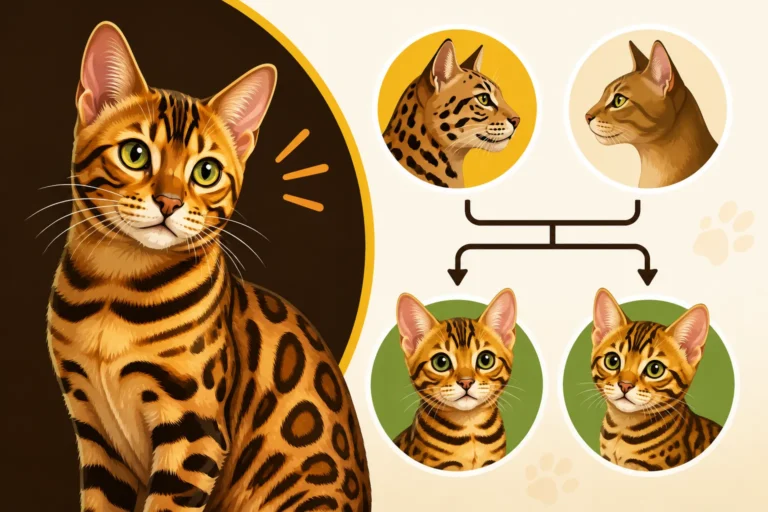
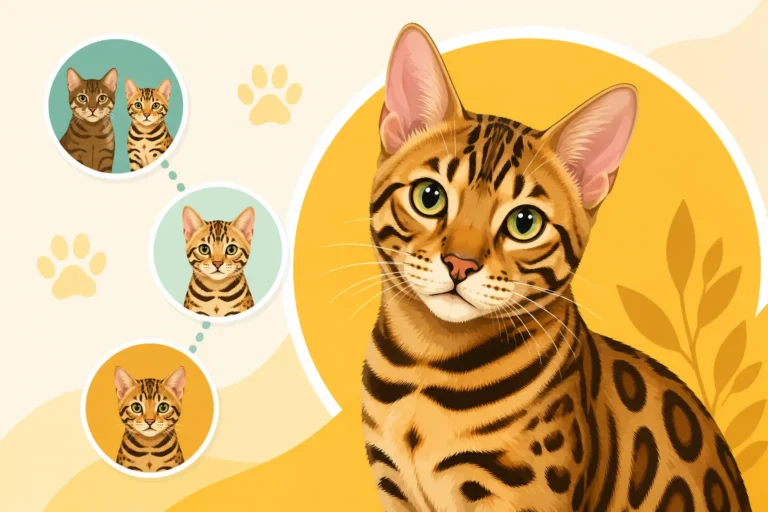
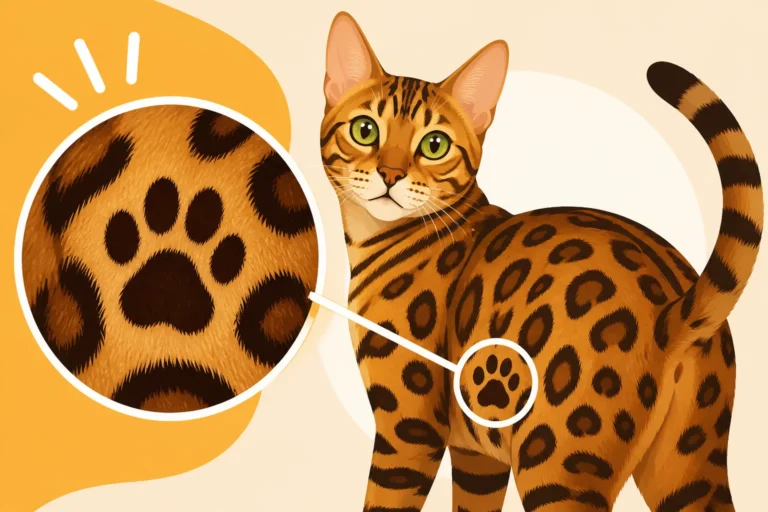
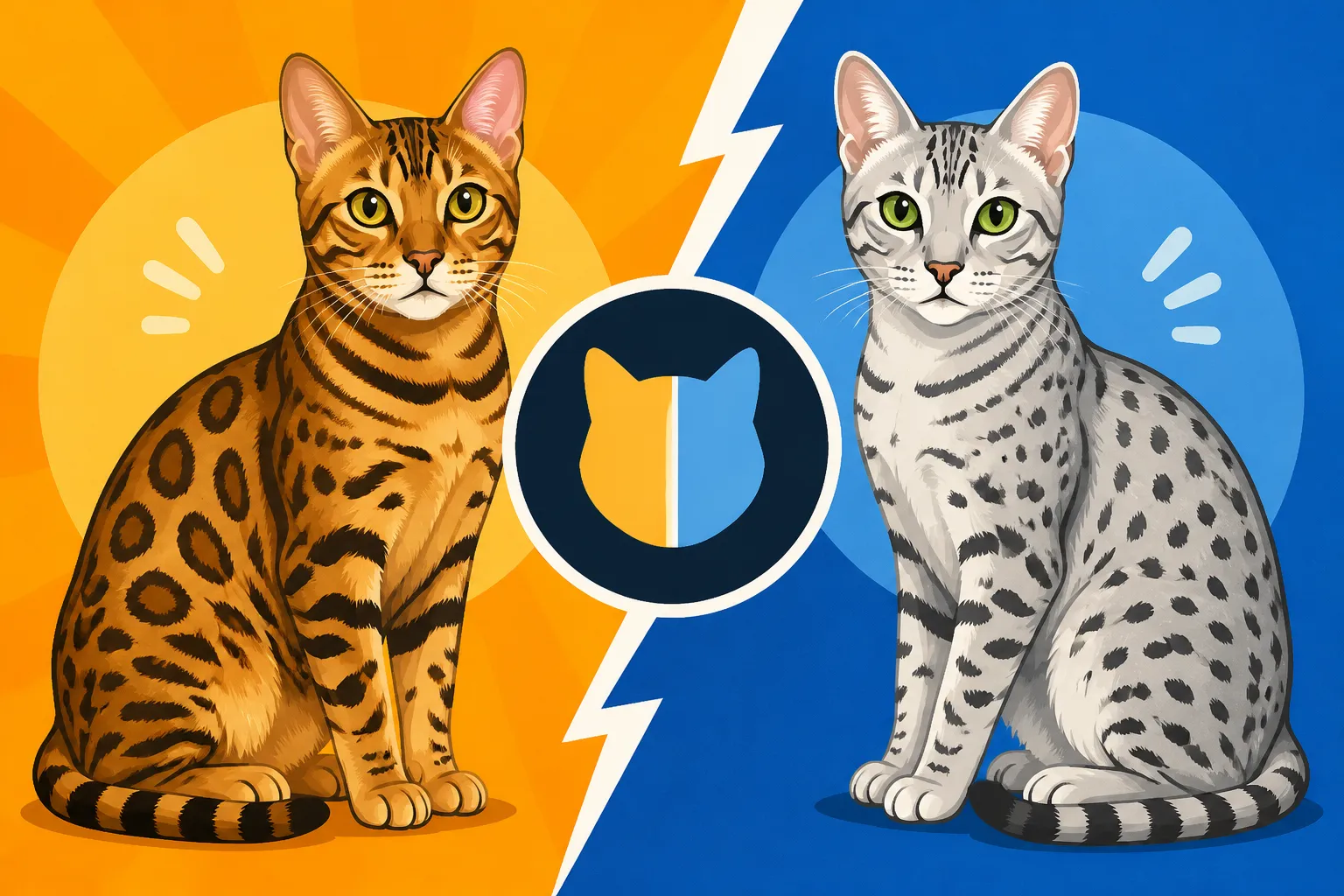
Both breeds are known for spots, but the spots usually look different when you examine the whole coat. A Bengal may have large, clearly defined rosettes: spots with darker outlines and a lighter center. Some Bengals have single spots instead, and others have a marbled pattern rather than spots. Rosettes are a familiar Bengal feature, but not every Bengal has them. The breed standard describes a broader range of appearance than the classic golden cat with dramatic rosettes. For a closer look at the breed’s overall features, see What a Bengal Cat Looks Like by the Standard.
An Egyptian Mau’s spots are typically solid rather than rosetted. They can vary in size and shape, and they are scattered across the body rather than arranged in a neat, repeated pattern. A Mau may have striking markings on its face, including lines around the eyes, and dark bands on its tail. These markings can be helpful clues, but they are not a breed certificate. Domestic cats and mixed-breed cats can have similar spots or facial markings.
Color also helps, though it should not be treated as proof. Bengals are seen in several colors, including brown, silver, and snow varieties. Egyptian Maus are most often associated with silver, bronze, and smoke coats. A smoke Mau can look much darker overall than a silver or bronze one, and its spots may be harder to pick out. When comparing cats, look at the pattern and the underlying coat color together—not just one photo or a single patch of fur.
Look at body shape, face, and eyes
Bengals tend to look athletic and muscular, with a sturdy body, strong hindquarters, and a coat that lies close to the body. Their heads are generally broad, with rounded contours and relatively small ears set toward the sides of the head. The details are easier to judge when you compare the cat with the breed description in What a Bengal Cat's Head Should Look Like. A sleek, muscular outline can support a Bengal identification, but it does not establish one by itself.
Egyptian Maus are often described as medium-sized, graceful, and visibly athletic, with longer-looking legs and a slightly different overall outline. Their hind legs are longer than their front legs, which can give the back a gently sloping appearance. Maus also have a distinctive fold of skin extending from the flank toward the back knee. These features may be subtle in a relaxed cat, and body shape can vary with age, health, and weight.
Eye color can be a useful clue, but it is not decisive. Egyptian Maus are known for their green eyes, while Bengals may have green, gold, or other accepted eye colors depending on their coat variety. Snow Bengals, for example, may have blue eyes. Lighting, camera color, and a kitten’s age can all make eye color look different in photographs. For more detail, see Which Eye Colors a Bengal Cat Has.
| Feature | Bengal | Egyptian Mau |
|---|---|---|
| Common coat pattern | Rosettes, single spots, or marbling | Solid spots scattered across the body |
| Common coat colors | Brown, silver, and snow varieties | Silver, bronze, and smoke |
| Typical impression | Muscular, substantial, and athletic | Graceful, medium-sized, and athletic |
| Helpful markings | Strong contrast and rosettes may be present | Facial lines and banded tail may be present |
| Eye color clue | Varies by color variety | Green is characteristic |
| Can appearance prove breed? | No | No |
Why spots alone do not identify a breed
Many cats can have a spotted coat
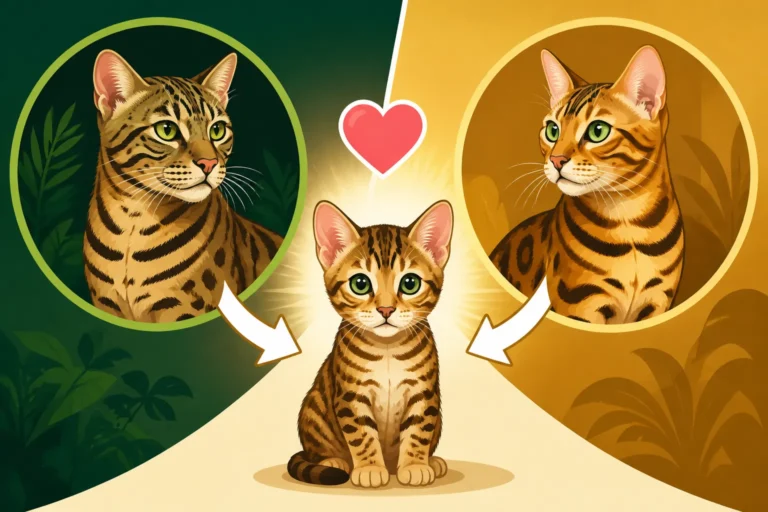
A spotted coat is not exclusive to either breed. Domestic shorthairs, mixed-breed cats, and cats with other pedigrees can all have spots, stripes, or markings that resemble those of a Bengal or Mau. In a rescue setting, a cat may be described as a “Bengal mix” because it has rosettes or a dramatic coat. That description may be a reasonable guess, but it is not the same as documented ancestry.
The same caution applies to Egyptian Maus. A cat with small, scattered spots may look Mau-like without being a pedigreed Mau. Breed appearance can be especially hard to judge in young kittens, whose proportions and coat patterns may change as they grow. A blurry photo, unusual lighting, or a winter coat can also hide important details.
It helps to separate three questions: what the cat looks like, what ancestry it may have, and whether it is registered as a particular breed. Visual comparison can help with the first question. A DNA test may offer clues about the second. Pedigree and registry records are what support the third. These are related, but they are not interchangeable.
Behavior and origin are weaker clues than they seem
People sometimes try to identify a Bengal by its energy, vocalizing, or interest in water. Those traits can be associated with the breed, but they are not reliable diagnostic signs. Individual cats vary widely, and a lively domestic shorthair can be just as demanding or playful as a Bengal. Temperament is shaped by more than breed, including early socialization, health, age, and the cat’s own personality.
A Bengal’s history does differ from a Mau’s. The Bengal breed was developed from domestic cats and the Asian leopard cat, with later generations bred as domestic companions. Egyptian Maus are a naturally occurring domestic breed with a long-standing spotted appearance. That background can explain why the breeds have distinct standards, but it does not mean that every spotted cat has one of those ancestries. More on the Bengal’s background is covered in What the Bengal Cat's Wild Ancestor Is Like.
A cat’s generation is also not something you can reliably read from its coat or behavior. Modern pet Bengals are generally several generations removed from their wild ancestor, and a striking pattern does not tell you how many generations are in the pedigree. The basics of that terminology are explained in How a Bengal Cat's Generation Is Counted. For breed identification, documented lineage matters more than assumptions based on a cat’s appearance.
How to assess a cat you suspect is a Bengal or Mau
Start with clear, whole-body observations
If you are comparing your own cat with breed descriptions, take several clear photos in natural light. Include a full side view, the back and sides, the face, and the tail. A close-up of the spots may show whether they appear rosetted or solid, while a full-body view makes it easier to assess coat color, body shape, and proportions. Avoid relying on a single image, especially if the cat is crouched or the fur is wet.
Write down what you can actually observe without assigning a breed label. For example: “small solid spots across the sides, green eyes, dark tail bands” is more useful than “definitely an Egyptian Mau.” Likewise, “large open rosettes and a muscular build” describes visible features without overstating what they prove. This kind of neutral description is helpful if you later speak with a veterinarian, rescue group, or breeder.
If you are caring for a found cat, prioritize its immediate needs and check for identification before trying to settle its breed. A veterinarian or shelter can scan for a microchip and assess health. If the cat needs temporary essentials, a local pet shop or retailer such as Chewy may be one option for supplies; a shopping label, however, cannot establish breed. A spotted domestic cat may still be a wonderful companion without having a confirmed pedigree.
Check records and ask the right questions
For a cat sold as a Bengal or Egyptian Mau, ask the breeder for pedigree documentation and the name of the registry associated with it. Look at the records themselves rather than relying only on a social media post, a verbal claim, or a certificate that does not show the cat’s ancestry. If a breeder cannot explain the paperwork or is reluctant to share it, treat that as a reason to ask more questions.
Ask for details that connect the specific cat to its records, such as its registered name, identifying information, and the names of its parents. A pedigree document should make it possible to trace ancestry; a general registration statement may not answer every question about a particular cat. Breed standards can help you understand what appearance is expected, but a cat that does not perfectly match a standard is not automatically a mix. Age, health, and individual variation matter.
If you are comparing the two breeds before adopting or buying, speak with people who know the breed and can explain both its appearance and its care needs. Avoid making a decision based on coat alone. A cat’s temperament, health history, household fit, and the quality of the breeder or rescue’s information are all more important than whether its spots look especially dramatic.
What DNA tests and pedigree papers can confirm
Understand what a consumer DNA test can tell you
A cat DNA test may estimate ancestry or report genetic traits, depending on the test and its reference database. It should be treated as one piece of information rather than a definitive visual breed check. The test’s report may not be the same as a pedigree, and an ancestry estimate does not automatically register a cat with a breed association. Before ordering a test, read exactly what it measures and how it describes its results. See Whether a DNA Test Confirms a Bengal Cat for a more detailed explanation.
If you encounter an at-home test through a retailer such as Chewy, focus on the test maker’s description and the limits of the report—not only the product title. A retailer such as Chewy may help you find products for pet care, but the retailer does not verify a cat’s ancestry or certify a pedigree. Availability and product listings can change, so check the test provider’s own information before making a purchase.
DNA testing can be especially tempting when a cat has a convincing Bengal-like coat but no known history. Keep expectations realistic: a result may provide useful genetic context, but it may not resolve every question about a cat’s breed identity. If you need formal proof for a registry, breeder agreement, or other specific purpose, ask the relevant organization what documentation it accepts before relying on a consumer ancestry report.
Use appearance, records, and testing together
The most sensible identification process combines evidence instead of asking one clue to do everything. Start with physical features: look for Bengal-style rosettes or marbling, or the Egyptian Mau’s solid spots and characteristic markings. Then check the cat’s history and any available pedigree records. If useful, consider a DNA test while keeping in mind that its report and a formal pedigree serve different purposes.
For a pedigreed cat, reliable records are generally more meaningful than a guess based on coat pattern. For a rescue cat with no known history, it may be impossible to confirm a precise breed, even if the cat strongly resembles one. That uncertainty is normal. A spotted shelter cat does not need to be labeled a Bengal or Mau to deserve good care, and a breed guess should not determine how affectionate, intelligent, or suitable the cat will be as a companion.
If your cat’s appearance seems closer to another spotted breed, comparison can help narrow down what you are seeing without turning it into a diagnosis. For example, How to Tell a Bengal Cat From an Ocicat and How to Tell a Bengal Cat From a Savannah explain other look-alike comparisons. And if the cat simply has spots without the documentation to establish a breed, Whether a Spotted Domestic Shorthair Is a Bengal Cat offers useful context for keeping that distinction clear.
Disclaimer
This article is for general informational purposes only and does not constitute professional advice. Laws, prices and regulations vary by location and change over time. Consult a qualified professional for guidance on your specific situation.