Which Puzzle Feeder Beats a Bengal Cat
Anyone who shares their life with a Bengal cat knows that their intelligence is a double-edged sword: it’s captivating, but it also means they get bored incredibly easily. If you’ve tried a few standard puzzle feeders only to watch your clever companion solve them in minutes and then stare at you expectantly, you're not alone. This guide is dedicated to exploring the types of puzzle feeders that can actually provide a lasting challenge for your brilliant Bengal, keeping their minds sharp and their predatory instincts satisfied.
The Bengal Cat Challenge: Why Most Puzzle Feeders Fail
Let's be real: your Bengal isn't just "a cat." They're a whirlwind of energy, curiosity, and sheer brainpower. Many cat owners, even those with super smart domestic shorthairs, often find themselves perplexed by how quickly their Bengal masters seemingly complex toys. This isn't a flaw in the feeder; it's a testament to the unique lineage and boundless intellect of the Bengal breed. Their wild ancestry means they're hardwired for problem-solving, hunting, and exploring, and a simple bowl just doesn't cut it.
Hardwired for Hunting and Problem-Solving
Think about it: the Asian Leopard Cat, the wild ancestor of our domestic Bengals, spends its days hunting, navigating complex environments, and figuring out how to get its next meal. This isn't just about chasing a mouse; it involves strategy, patience, and often, dexterity. When we bring a Bengal into our homes, we're bringing that innate drive with them. They crave mental stimulation just as much as physical exercise. A bowl of kibble laid out for them is, in their eyes, an absolute snooze-fest. They need to work for it, to "hunt" for it, even if that hunt takes place on your living room floor.
Most basic puzzle feeders, while excellent for many domestic cats, simply don't tap into this deep-seated need for complex engagement. They might involve batting a treat out of a simple opening or sliding a single cover. For a Bengal, this is often a one-and-done scenario. They figure out the mechanism, get the reward, and then they're ready for the next challenge, leaving you wondering if you just wasted your money. It's frustrating to invest in something you hope will entertain them, only for them to treat it like a trivial game. How Clever a Bengal Cat Is is something that truly sets them apart, and we need to cater to that.
Common Pitfalls of Basic Puzzle Feeders
When you pick up a puzzle feeder, it might look intricate to us, but a Bengal's mind works differently. Many feeders are designed with a single, repeatable action. Slide this, bat that, tip this. Once the Bengal understands the core mechanic, the "puzzle" aspect vanishes. They just repeat the action, and while they still get the food, the mental workout is gone. It becomes a robotic exercise rather than a stimulating one. This leads to quick disinterest and, often, a bored Bengal seeking entertainment elsewhere – perhaps by opening cabinets or exploring places you'd rather they didn't.
Another common issue is durability. Bengals are strong, agile, and not always gentle. Plastic parts can break, light feeders can be tipped over, and small pieces can go missing. A feeder that’s easily destroyed isn't just a waste of money; it can be a choking hazard or just lead to more frustration for both you and your cat. We're looking for something that can withstand the intense play of a feline that thinks every object is a challenge to be conquered.
Advanced Puzzle Feeders That Actually Stump a Bengal
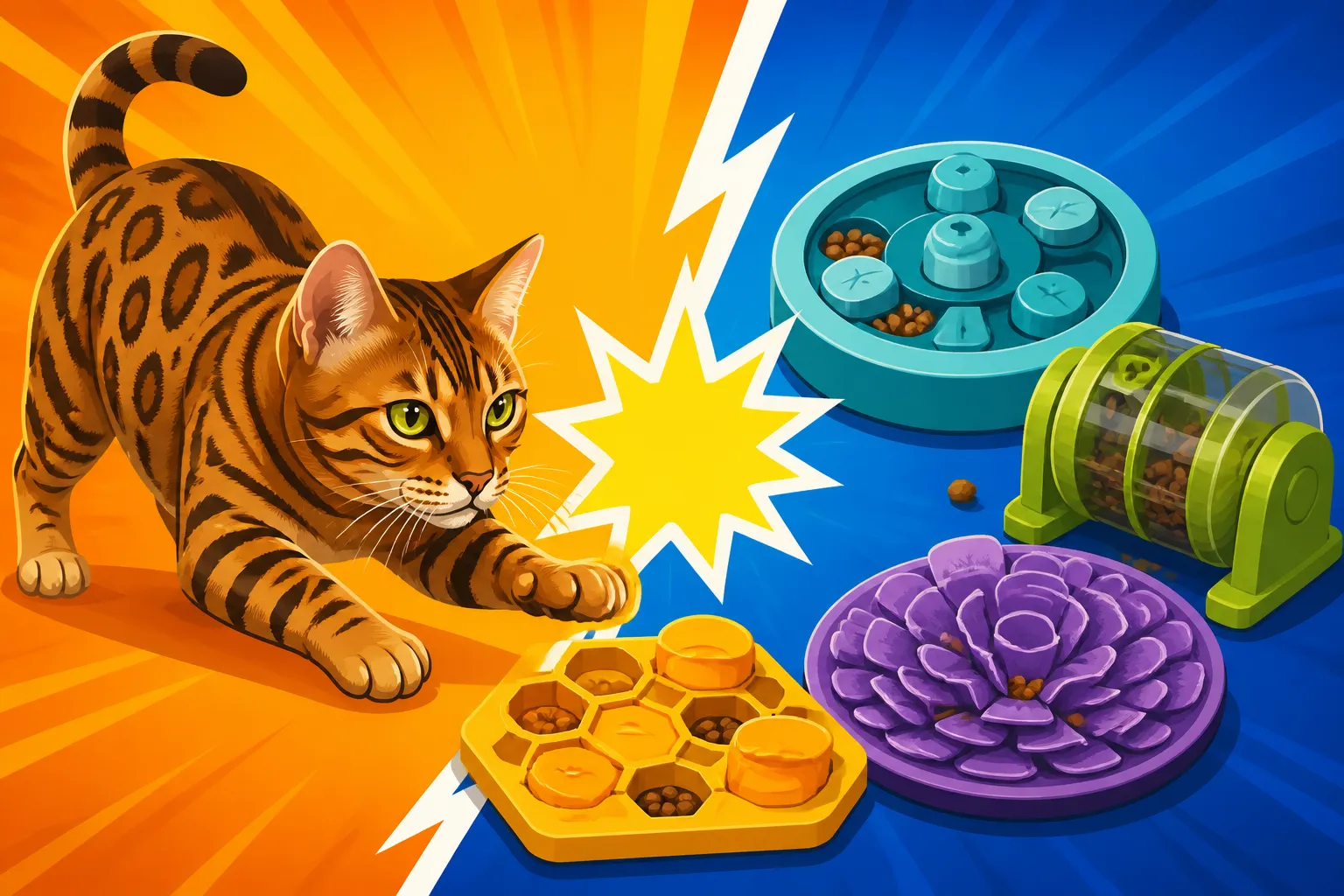
So, what kind of puzzle feeders can stand up to the intelligence and vigor of a Bengal? We need to look for multi-stage puzzles, those that require sequential steps, or feeders that incorporate different types of manipulation. These aren't your grandma's kibble dispensers; these are brain teasers designed to make your Bengal truly think.
Multi-Stage or Layered Puzzles
These are the gold standard for clever cats. A multi-stage puzzle feeder requires more than one action to get to the treat. Imagine a feeder where your Bengal has to slide a door, then paw a ball, then lift a lid, all in sequence, to get a single piece of kibble. This mimics a more complex hunting scenario, where they might have to dig, then reach, then maneuver an obstacle. It keeps them engaged longer because they're not just repeating one simple motion. Each step requires a bit of thought, and they learn that a combination of actions yields the reward.
Look for feeders that have different compartments or layers that unlock as your cat progresses. Some designs feature pegs or obstacles that cats must maneuver around, or drawers that need to be pulled out with a paw. When shopping on sites like Amazon, specifically search for "advanced cat puzzle feeder" or "multi-stage cat toy" to filter out the simpler options. These are often made from sturdier materials like wood or thick, chew-resistant plastics, designed to withstand more rigorous interaction. They usually have a higher price point, but the longevity and increased engagement for your Bengal often make them a worthwhile investment.
"Digging" or "Foraging" Style Puzzles
Bengals love to use their paws, and replicating a natural digging or foraging behavior is a fantastic way to engage them. These puzzles often involve deep compartments, tunnels, or various textures that require your Bengal to literally "dig" for their food. Instead of just batting a piece of kibble, they might have to scoop it out of a narrow tube, or use their claws to pull it from a textured surface. This engages their fine motor skills and provides a more primal sense of satisfaction.
Consider feeders with tall, narrow tubes or intricate mazes that they need to explore with their paws. Some models mimic grass or rocky terrain with different nooks and crannies. The trick here is that the cat can't see all the food at once, forcing them to investigate and work for each morsel. This also slows down their eating, which can be a bonus for fast eaters. You can even create simple versions of these by using a muffin tin with various sized balls or toys placed in some cups, requiring your cat to remove obstacles to get to the food. This kind of challenge can help prevent your Bengal from getting bored, which, as many owners know, can lead to What a Bored Bengal Cat Destroys.
Interactive Electronic Puzzles
While not purely physical manipulation, some electronic puzzle feeders offer dynamic and unpredictable challenges that can stump a Bengal. These often involve moving parts, lights, or sounds that react to your cat's interaction. The unpredictability is key here, as it prevents the Bengal from learning a single, repeatable solution. Imagine a feeder that dispenses treats only when your cat presses a button in a specific sequence, or one where treats appear in random locations.
These can be particularly good for variety in their enrichment routine. Some even have different modes or difficulty levels, allowing you to increase the challenge over time. However, it's crucial to check reviews for durability and reliability, as electronic components can be more fragile. Look for reputable brands on Amazon that specialize in pet electronics. While they might not replicate the "hunt" perfectly, the mental engagement of figuring out a new system can be a great workout for their sharp minds. How Much Enrichment a Bengal Cat Actually Needs is a lot, and these can contribute significantly.
Here's a quick comparison of puzzle feeder types and their potential for challenging a Bengal:
| Feeder Type | Challenge Level for Bengals | Key Feature for Bengals | Durability Consideration | Best For |
|---|---|---|---|---|
| Basic Slide/Bat | Low | Simple, single action. | Varies, often moderate | Beginners, occasional quick snack. |
| Multi-Stage/Layered | High | Sequential actions, multiple steps. | High | Sustained mental engagement, complex thinkers. |
| Digging/Foraging | Medium-High | Mimics natural hunt, paw dexterity. | High | Slowing eating, sensory exploration. |
| Electronic Interactive | Medium-High | Unpredictable movements, light/sound cues. | Moderate, check reviews | Variety, breaking repetitive patterns. |
| DIY Obstacle Course | High (customizable) | Adapts to specific cat's skills, highly variable. | Varies | Infinite customization, budget-friendly. |
Beyond the Bowl: Strategies to Keep Your Bengal Engaged with Food Puzzles
Even the most complex puzzle feeder won't "beat" a Bengal forever if it's the only thing they interact with. The key to sustained engagement lies in variety, rotation, and thinking beyond just the feeder itself. Our Bengals are constantly learning, and we need to stay one step ahead of them.
The Power of Rotation and Variety
Imagine doing the same crossword puzzle every single day. Eventually, you'd memorize the answers, and the challenge would vanish. The same goes for your Bengal and their puzzle feeders. Once they master a feeder, it becomes a simple task, not a mental exercise. This is where rotation comes in. Instead of having one or two feeders out all the time, invest in a collection of different types. Think about having 5-7 different puzzle feeders that you can rotate every few days or even week-to-week.
This keeps things fresh and exciting. When an old favorite reappears after a break, it might feel like a new challenge all over again, or at least require them to "remember" the solution. It prevents boredom and ensures they are consistently challenged. You can find a vast array of options on Amazon, allowing you to build up a diverse collection. Don't be afraid to mix and match different styles – perhaps a foraging mat one day, a multi-stage puzzle the next, and an electronic one for a change of pace.
DIY Solutions for the Super-Smart Bengal
Sometimes, commercial puzzle feeders, even the advanced ones, just don't offer enough complexity or novelty for a truly genius Bengal. This is where your creativity comes in! DIY puzzle feeders can be fantastic because you can custom-tailor the challenge to your specific cat's skill level and constantly modify it. Plus, it's often more cost-effective.
Simple ideas include using cardboard boxes with holes cut into them, or toilet paper rolls stuffed with treats and folded at the ends. You can create a "snuffle mat" by tying strips of fleece to a rubber mat, where your cat has to really dig and sniff out the kibble. For a higher challenge, use a plastic bottle with holes, suspended horizontally, requiring your Bengal to spin it to release treats. You can even build a simple vertical feeder system with PVC pipes and caps, where your Bengal has to bat at different levels to get food to drop. How a Bengal Cat Learns From Watching You means they will often quickly pick up on how to manipulate these homemade contraptions, so be ready to evolve your designs!
Remember to always prioritize safety with DIY projects. Ensure there are no sharp edges, small pieces that can be swallowed, or toxic materials. Supervise your Bengal's initial interactions with any new DIY feeder. The beauty of DIY is that as soon as your Bengal "beats" one design, you can easily modify it or create an entirely new one to keep them guessing.
Incorporating Puzzle Feeders into Daily Routines
Puzzle feeders shouldn't just be an occasional treat; they can be an integral part of your Bengal's daily feeding routine. Instead of putting all their meals in a bowl, divide their daily ration among several different puzzle feeders placed in various locations around the house. This encourages natural foraging behavior, provides mental stimulation throughout the day, and slows down their eating.
Consider placing some feeders up high, requiring them to jump or climb, engaging their physical prowess. Others can be hidden slightly, encouraging exploration. This doesn't just provide physical and mental enrichment; it also creates a healthier eating pace, which can be beneficial for digestion. This method also helps prevent some of the typical bored Bengal behaviors, such as incessant yowling or destructive scratching. The Bengal Cat Is the Most Active Cat You Can Own, and channeling that energy through productive activities like puzzle feeders is crucial for their well-being.
Signs Your Bengal Has "Beaten" Its Puzzle Feeder
It's important to recognize when a puzzle feeder is no longer serving its purpose so you can introduce a new challenge. Your Bengal is smart, and they'll let you know in their own unique ways when they've mastered a puzzle. Being attentive to these signs will help you keep their enrichment fresh and effective.
Rapid Completion and Lack of Interest
The most obvious sign is how quickly they complete the puzzle. If your Bengal is solving a multi-stage feeder in seconds rather than minutes, or emptying a foraging toy without much thought, it's a clear indicator that the challenge is gone. Initially, a new puzzle might take them a good while to figure out, with lots of sniffing, pawing, and observation. Once it becomes a routine, the mental effort decreases significantly.
Another sign is a general lack of interest. If you present the feeder and your Bengal gives it a quick sniff, bats at it once, and then walks away, they're likely bored with it. They might even try to find other, less appropriate ways to entertain themselves, perhaps by attempting to open doors or raiding your pantry. This shows they're still craving stimulation, just not from that particular puzzle.
Destructive Behavior Towards the Feeder
While Bengals are powerful, if they start to become overly aggressive with a feeder – batting it off a shelf repeatedly, trying to chew through it, or deliberately dismantling it – it could be a sign of frustration, but often it's a sign of boredom with the puzzle's limitations. They might be trying to bypass the intended "puzzle" part to get to the food faster, or they're just getting their kicks out of destroying something because the mental challenge isn't there.
If a feeder is constantly being tipped over and emptied without any finesse, or if you find pieces of it broken off, it might be time for retirement, or at least a long break in the rotation. Bengals thrive on mental engagement, and if a puzzle feeder isn't providing that, they might resort to physical force to get the reward, or simply move on to a more "interesting" target – sometimes your furniture. Signs a Bengal Cat Is Bored often include these kinds of destructive tendencies.
Seeking Out Other Forms of "Trouble"
A truly bored Bengal will create their own entertainment, and this often involves activities we'd rather they avoid. If your Bengal is suddenly more insistent about exploring off-limits areas, attempting to open new cabinets, playing excessively rough with other pets, or becoming more vocal than usual in demanding attention, it might be a cry for more mental stimulation.
Puzzle feeders are one piece of a larger enrichment strategy. If you notice an uptick in these "trouble-making" behaviors, it’s a good time to reassess their puzzle feeder collection. Perhaps it’s time to introduce a brand new, highly challenging feeder, or to revisit your DIY options to craft something uniquely perplexing for your clever cat. Keeping their busy minds occupied with appropriate challenges is the best way to ensure a happy, well-behaved Bengal.
Disclaimer
This article is for general informational purposes only and does not constitute professional advice. Laws, prices and regulations vary by location and change over time. Consult a qualified professional for guidance on your specific situation.