What a Bengal Cat’s Head Should Look Like
A Bengal’s head can look strikingly different from a typical house cat, but “wild-looking” does not mean pointy, oversized, or exaggerated. If you are comparing a kitten with breed descriptions or wondering whether an adult Bengal has the expected features, the details can be hard to judge in photos. This guide explains the head shape, ears, eyes, nose, and muzzle to look for—and what those traits can’t prove.
The overall shape of a Bengal cat’s head
A broad, modified wedge
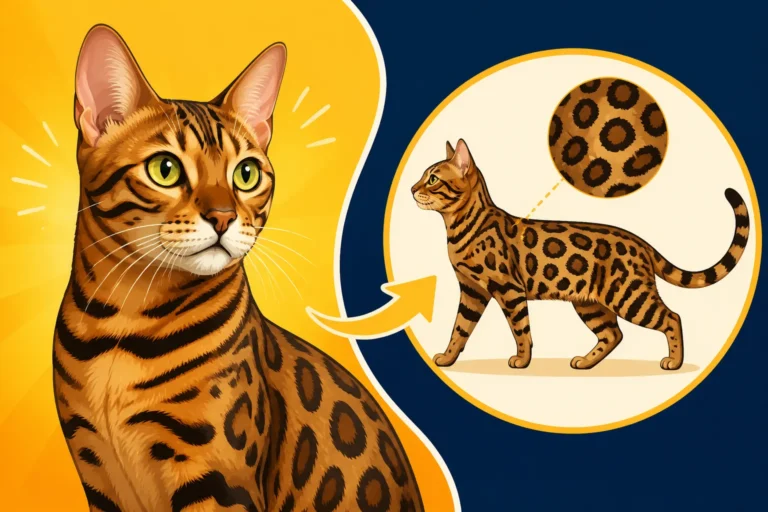
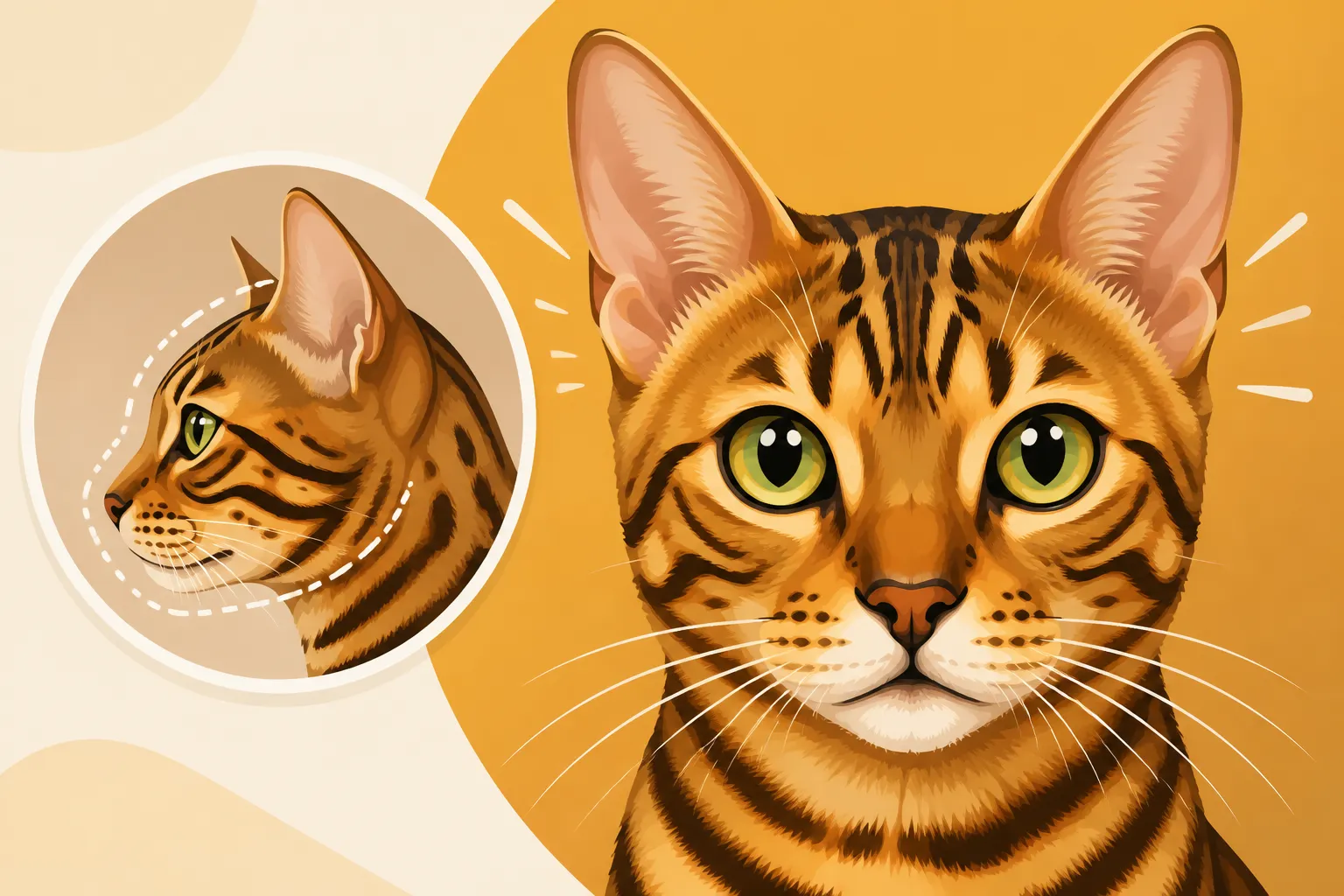
A Bengal’s head is generally described as a broad, modified wedge: wider through the cheek area and gently narrowing toward the muzzle, with smooth, rounded contours rather than sharp angles. It should look balanced with the body. The outline is not meant to resemble a narrow triangle or a long, pointed domestic-cat face.
“Modified wedge” can be difficult to picture, especially when a cat is sitting at an angle. Try looking at a clear, straight-on photograph as well as a side view. From the front, notice whether the cheeks and whisker pads give the face some width. From the side, look for a gradual transition between forehead, nose, and muzzle rather than a steep, straight slope.
There is variation between individual Bengals, and registry standards may describe features somewhat differently. The goal is not to measure a pet cat against a single perfect photograph. For a fuller explanation of the overall breed description, see What the Bengal Cat Standard Asks For and What a Bengal Cat Looks Like by the Standard.
Rounded contours, not an extreme expression
A Bengal’s face can seem intense because its eyes, facial markings, and strong muzzle draw attention. But the head should not look exaggerated simply to appear more “wild.” Overly sharp angles, a very narrow face, or an unusually heavy-looking brow can distract from the breed’s characteristic balance.
The contours around the cheeks, forehead, and muzzle are generally soft and rounded. That does not mean the face should look flat or lacking in structure. The cheek area can be pronounced, and the muzzle should have substance, but the features work together rather than appearing like separate, dramatic shapes.
When assessing a photo, check the camera angle before judging proportions. A close-up taken with a phone’s wide-angle lens can make the nose or muzzle look larger and the ears seem farther apart than they are. A head-on image, a profile, and a relaxed three-quarter view offer a more useful impression than one tightly cropped portrait.
Bengal ears and eyes
Ears that sit in proportion to the head
Bengal ears are usually medium to small, with a broad base and rounded tips. They tend to sit fairly wide apart and follow the general contour of the head. Very tall, narrow, pointed ears can change the expression and make the head look more like a sharp triangle than a rounded wedge.
Look at ear size in relation to the face, not in isolation. A kitten’s ears may seem prominent while the head is still developing, and a particular pose can make one ear appear larger or more upright. A relaxed cat with ears turned forward is easier to assess than one with ears rotated sideways or flattened in response to noise.
The markings on the back of the ears are separate from ear shape. Bengal ears may show lighter spots sometimes called ocelli, but those marks do not define the shape of the head. If you are curious about the marking itself, Why a Bengal Cat Has an Ocelli on Each Ear goes into more detail.
Large eyes with an open expression
Bengal eyes are typically large and set well apart. Their shape is often described as oval, though they can look nearly round when the cat is alert. The eyes should contribute to an open, expressive face without making the head appear overwhelmed by them.
Eye shape is easier to judge when the cat is calm and looking toward the camera. A startled expression can make the eyes seem rounder, while a sleepy or squinting expression can make them look smaller. Avoid drawing conclusions from one moment: lighting, mood, and the angle of the photograph all change how the eyes appear.
Eye color varies, and color alone does not establish whether a cat is a Bengal or whether its head matches the breed description. For related details, see What Shape a Bengal Cat's Eyes Should Be and Which Eye Colors a Bengal Cat Has. A retailer photo from a site such as Chewy may show a cat in everyday lighting, but it is not a formal reference for judging breed type or pedigree.
The nose, profile, and muzzle
A broad nose and gently changing profile
The nose is generally broad, with a substantial nose leather and a profile that has a gentle change in direction rather than a perfectly straight line. Breed descriptions often refer to a slight concave curve in profile. That subtle contour is not the same as a dramatic dip or a sharply broken nose line.
To assess the profile, look at a clear side view with the head held naturally. A cat looking down, stretching its neck, or turning away can make the nose bridge seem different. Likewise, a close camera angle can distort the apparent length of the nose. Use more than one photo before deciding that a feature is particularly pronounced.
If you want to explore that contour in isolation, Why a Bengal Cat's Profile Curves explains the profile feature in more detail. Keep in mind that a profile is only one part of the head. A pleasing side view does not cancel out the need for balance across the muzzle, cheeks, eyes, and ears.
A full muzzle, prominent whisker pads, and strong chin
A Bengal’s muzzle should have noticeable width and substance. Prominent whisker pads contribute to the broad, rounded look around the mouth, while a strong chin helps support the lower part of the face. From the side, the chin is generally expected to align reasonably with the tip of the nose rather than receding far behind it.
The muzzle should not look pinched or sharply pointed. At the same time, “full” does not mean swollen or excessively bulky. Look for a natural transition from the cheek area into the muzzle, with enough width to give the face strength without making it seem disproportionate.
Whisker pads can look more pronounced when the cat is sniffing, vocalizing, or pushing its face against something. That is normal facial movement, not a reliable way to evaluate the head’s resting shape. If you are comparing breeder photos, a retailer page from Chewy, or pictures shared by owners, prioritize relaxed, unfiltered images where the cat’s mouth is closed and the face is viewed from more than one angle.
How to assess a Bengal head in real life or in photos
Use several views and compare the same features
A single image can be misleading. For a fair comparison, look for a straight-on view, a side profile, and a relaxed three-quarter view. Try to assess the same traits in each: overall breadth, rounded contours, ear proportions, eye placement, nose shape, and the fullness of the muzzle.
| View | What it helps you assess | Common photo trap |
|---|---|---|
| Straight-on | Face width, eye spacing, ear placement, and muzzle balance | Wide-angle distortion can exaggerate the nose |
| Side profile | Nose bridge, forehead transition, muzzle, and chin | A lowered or stretched head changes the outline |
| Three-quarter view | How the features work together | Turning the head can hide one ear or cheek |
| Relaxed candid photo | Natural expression and proportions | Shadows can make markings look like contours |
Retail and owner photos can be useful for seeing how a cat looks outside a show setting, but don’t treat them as formal breed references. A Chewy listing, for example, may use a photo chosen to show a product or an appealing cat rather than to document head structure. Customer-submitted images can also vary in lighting, angle, and editing, so compare several images rather than relying on one.
Separate appearance from proof of breed
A cat’s head can resemble the Bengal type without proving that the cat has a documented Bengal pedigree. Head shape, rosettes, coat color, and other visible traits are not a substitute for reliable pedigree records. A spotted domestic shorthair can share some surface features, while a pedigreed Bengal may not match every ideal feature in every photo.
If you are considering a kitten, ask the breeder for clear images of both parents and an opportunity to see the kitten in person or by live video. Ask for registration and health information as well as photographs. Photos can help you understand appearance, but they cannot verify health screening or establish a complete pedigree on their own.
A retailer or adoption listing from Chewy or another site may help you notice how varied cats’ faces can look in everyday settings, but it should not be used as proof of breed. For more on why visual appearance has limits, see Whether a Spotted Domestic Shorthair Is a Bengal Cat and Whether a DNA Test Confirms a Bengal Cat.
Expect a kitten’s face to change as it matures
Kittens can look slightly out of proportion while growing. Their ears may seem large relative to the head, and their faces may be less defined than an adult’s. Coat pattern and contrast also develop over time, which can change the impression the face makes even when the underlying features are simply maturing.
When comparing a kitten with an adult Bengal, keep age in mind. Rather than expecting a young kitten to have the same facial fullness as a mature cat, look for general balance and ask the breeder how the parents’ features developed. A series of photos over time is more informative than one image taken at a particular stage.
If you are looking at a Bengal mainly because of its appearance, remember that head shape is only one part of living with the breed. Temperament, activity needs, health history, and your home environment matter just as much. A beautiful profile may catch your eye, but the right match is the cat whose needs and personality suit your household.
Disclaimer
This article is for general informational purposes only and does not constitute professional advice. Laws, prices and regulations vary by location and change over time. Consult a qualified professional for guidance on your specific situation.