Whether a Bengal Cat Escapes a Catio
Oh, the catio! It's a dream for so many Bengal cat owners, offering that perfect blend of safe outdoor exploration and peace of mind. But let's be real, the nagging question always lurks in the back of your mind: Can my incredibly clever and athletic Bengal cat actually escape this seemingly secure enclosure? It's a valid worry, and frankly, a lot of folks underestimate just how determined and ingenious these cats can be. This guide is going to walk you through the ins and outs of catio security, examining common vulnerabilities, and offering real-world strategies to keep your adventurous Bengal safely contained.
The Allure of the Catio and the Bengal Cat's Drive
Catios are wonderful inventions, a true godsend for active cats like Bengals who crave the sights, sounds, and smells of the outdoors without the inherent dangers of free-roaming. They offer a compromise between keeping your beloved feline safe indoors and satisfying their wild instincts. However, for a Bengal, a catio isn't just a nice-to-have; it's practically a necessity for their physical and mental well-being. But that doesn't mean they won't still test its limits.
Why Bengals Love Catios (and Why They Still Try to Get Out)
Picture this: your Bengal, with their stunning coat and boundless energy, gazing longingly out the window. They see birds flitting by, squirrels chattering, and feel the breeze whispering through the leaves. A catio provides a safe way to experience all of this. They can bask in the sun, watch the world go by, and feel the fresh air on their whiskers. For a breed as active and curious as the Bengal, this sensory enrichment is incredibly important. Without it, you might find them turning their incredible energy toward less desirable indoor pursuits, like redecorating your curtains or systematically emptying your cupboards. It's why we often say Why a Bengal Cat Needs a Catio in the first place.
However, even the most elaborate catio might not completely quell the primal urge to explore beyond its boundaries. Bengals are, after all, several generations removed from a wild ancestor, the Asian Leopard Cat, and some of those instincts run deep. They aren't just looking for entertainment; they're driven by an innate curiosity and a desire to hunt and patrol. If a small gap or a flimsy latch presents itself, their mind might just interpret it as a challenge, not an insurmountable barrier. It's like giving a puzzle master a partially solved puzzle – they can't resist finishing it.
Understanding the Bengal's Natural Instincts
To truly understand why a Bengal might try to escape a catio, you need to appreciate their unique blend of intelligence, agility, and persistence. These aren't your average couch potato cats. Bengals are known for being incredibly intelligent, problem-solvers who can quickly figure out how things work, including latches, zippers, and even basic locks. They learn by watching you, and their observational skills are truly uncanny. How Clever a Bengal Cat Is isn't just a boast; it's a daily reality for Bengal owners.
Combine this intelligence with their phenomenal athleticism. Bengals are powerful jumpers, agile climbers, and surprisingly strong. They can scale heights you wouldn't believe and squeeze through openings that seem impossibly small. Their wild ancestry gives them an almost relentless drive to move, explore, and hunt. The Bengal Cat Is the Most Active Cat You Can Own, and that activity isn't always confined to horizontal spaces. If they can climb it, jump it, or push it, they will. This persistent nature means they'll often try multiple times, approaching the same weakness from different angles until they find success. They don't give up easily, which is both admirable and, for a catio owner, a bit terrifying.
Common Catio Weaknesses and How Bengals Exploit Them
You might have built what you thought was a fortress, but a Bengal cat has a way of finding the tiny chink in the armor. It's not about being destructive for the sake of it, but rather a focused effort to explore beyond the perceived limits. Recognizing these vulnerabilities before your cat does is key to maintaining a secure outdoor space.
Identifying Structural Vulnerabilities
Often, the weakest points in a catio aren't obvious until a determined Bengal starts poking around. These can include:
- Gaps and Seams: Any slight opening where panels meet, where the catio attaches to the house, or around a door frame can be exploited. Even a gap that seems too small for their head can be enough for them to squeeze through if they are persistent. Remember the old adage: if a cat's head fits, the rest will follow.
- Weak or Insecure Mesh/Wiring: Not all mesh is created equal. Flimsy chicken wire or plastic netting might deter a less determined feline, but a Bengal can chew through it, claw it open, or simply stretch it until it breaks. The attachment points of the mesh to the frame are also critical. Staples or thin zip ties might not be enough to withstand a strong, persistent tug.
- Flimsy Latches and Locks: A simple hook-and-eye latch or a basic magnetic catch might work for a while, but a Bengal will eventually figure it out. They'll pull, push, and jiggle until it gives. I've seen Bengals open lever handle doors inside the house, so a simple catio latch is often no match for their paws and wits. This is where you might need to reconsider Which Locks Stop a Bengal Cat.
- Unsecured Roof or Floor: If your catio has an open top or sits directly on uneven ground, it presents an obvious escape route. A Bengal can jump surprisingly high, so an open roof is an invitation to explore the vertical limits. If the bottom isn't securely anchored, they might try to dig their way out, especially if the base is loose gravel or dirt.
Overcoming Bengal Ingenuity: The Art of the Escape
Bengals don't just find weaknesses; they actively create them or exploit them in ways you didn't anticipate. Their escape methods are often a testament to their intelligence and physical prowess.
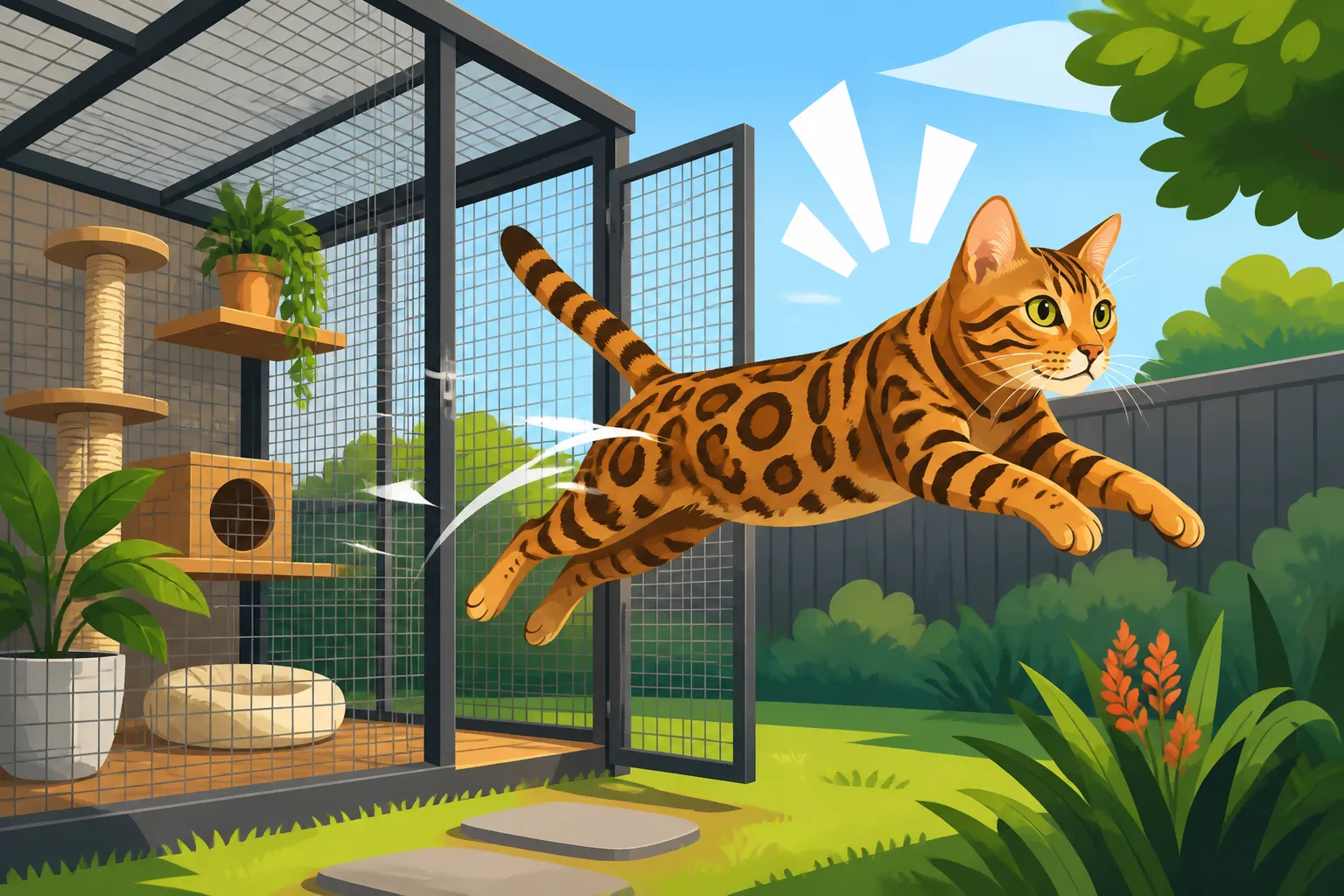
Imagine a scenario: you've built a lovely wooden-framed catio with strong hardware cloth. You feel pretty good about it. But then your Bengal starts to notice a slightly loose section of the mesh where it meets the wooden frame. At first, they might just bat at it. Then, they might start to pull. Over days, or even hours, that small weakness can become a significant gap. Their sharp claws and teeth are formidable tools when applied with relentless determination.
Another common trick involves latches. Many pet owners use simple barrel bolts or spring-loaded latches. Your Bengal, watching you open the door countless times, starts to mimic the motion. They'll paw at the mechanism, learn to push it, or even use their body weight to jiggle it open. One owner told me their Bengal would actually stand on its hind legs and use its nose to push the bolt back, completely bypassing a seemingly secure latch. Investing in more complex, two-step locking mechanisms, like a padlock or a slide bolt combined with a carabiner, can often deter them.
Even seemingly solid structures can be compromised. If your catio is connected to a window, ensure the window frame itself is completely sealed and impossible to pry open from the outside. If there's a small shelf or beam inside the catio close to the ceiling, a Bengal might use it as a launchpad to reach a higher, less secure point in the roof or wall, demonstrating just How High a Bengal Cat Can Jump. Their ability to survey their environment and formulate a plan is truly remarkable.
Fortifying Your Catio: Practical Escape Prevention Strategies
Preventing a Bengal cat from escaping their catio requires a proactive approach, combining robust construction with thoughtful design and ongoing vigilance. It’s not just about building it once; it’s about maintaining it with their cleverness in mind.
Choosing the Right Materials and Construction
When planning or upgrading your catio, the materials you choose are paramount. Skimping here can lead to heartbreak.
- Strong, Secure Mesh: Opt for galvanized hardware cloth (typically 1/2 inch or 1 inch squares) or welded wire mesh. These materials are incredibly difficult for cats to chew through or bend. Avoid plastic netting, chicken wire, or anything that can be easily torn or stretched. Make sure the mesh is attached to the frame not just with staples, but with heavy-duty screws and washers, or by sandwiching the mesh between two pieces of wood for extra security. Think of it as creating a solid, impenetrable box.
- Durable Framing: Wood is a popular choice, but ensure it's sturdy and treated for outdoor use. Metal frames (aluminum or steel) offer excellent durability and can be harder for a cat to climb or chew on. The joints should be strong and tightly secured.
- Solid Roof: A full roof is essential. This prevents your Bengal from scaling the walls and jumping out, and also protects them from weather and potential aerial predators. Roofing materials can range from sturdy mesh to polycarbonate panels, which offer shade and rain protection. Don't underestimate the need for a roof – What Size Catio a Bengal Cat Needs often includes thinking about overhead security.
- Secure Base: The catio should sit on a solid foundation, like a concrete slab, patio, or decking, to prevent digging out. If it's on grass or dirt, bury a section of mesh horizontally around the perimeter, extending at least 12-18 inches outwards and downwards, to create an "L" shaped barrier that deters digging.
Beyond the main structure, every access point needs careful consideration. Double-entry systems, like a small vestibule before the main catio door, can add an extra layer of security, especially for those quick dashes.
Advanced Security Measures and Routine Checks
Once the basic structure is sound, it's time to think about the details. These are often where Bengal cats find their leverage.
- Heavy-Duty Latches and Locks: As mentioned, simple latches won't cut it. Invest in heavy-duty barrel bolts, keyed locks, or even a combination lock. A gate latch with a spring-loaded mechanism that requires a deliberate lift and pull is often a good option. Better yet, use two different types of latches, so your cat has to figure out two distinct mechanisms. You can find excellent options on platforms like Amazon, from simple carabiners that reinforce a regular latch to more complex gate lock systems.
- Perimeter Patrols: Regularly walk around your catio's exterior and interior. Look for loose mesh, chewed areas, bent wire, or any signs of tampering. Check door hinges, latches, and the integrity of the connection to your house. A tiny hole can become a big one quickly under persistent attention. This isn't a one-time check; it should be part of your routine pet care.
- Weatherproofing and Wear: Over time, sun, rain, and temperature changes can degrade materials, causing wood to rot, metal to rust, or mesh to weaken. Periodically inspect for these signs of wear and tear and address them promptly. A well-maintained catio is a secure catio.
Environmental Enrichment as an Escape Deterrent
Sometimes, the best defense is a good offense – or in this case, a truly engaging environment. A bored Bengal is an inventive Bengal when it comes to finding ways out. By making the catio an irresistible haven, you can reduce their motivation to escape.
- Vertical Play Space: Bengals are climbers. Provide plenty of vertical structures like shelves, ramps, and cat trees within the catio. This fulfills their instinct to climb and survey their territory from above. Make sure these are securely fastened and don't provide a direct route to an escape point. Consider cat trees designed for outdoor use or repurpose sturdy shelving.
- Interactive Toys: Even in a catio, interactive toys can keep their minds busy. Puzzle feeders, hanging toys, and even simple crinkle balls can provide mental stimulation. Rotating toys keeps things fresh and prevents boredom. What to Put in a Bengal Cat's Catio goes beyond just shelter; it's about creating a dynamic environment.
- Sensory Delights: Catnip plants, pet-safe grasses, and even a shallow dish of fresh water (Bengals love water!) can add to the appeal. The constantly changing smells and sounds of the outdoors are already a huge draw, but specific elements can enhance their experience. Think about How Much Enrichment a Bengal Cat Actually Needs indoors, and translate that need to their outdoor space. A Bengal that is mentally and physically stimulated within its catio is less likely to be focused on finding an exit.
What to Do If a Bengal Cat Escapes Your Catio
Despite all your best efforts, sometimes an escape happens. It can be a heart-stopping moment, but quick, calm action can significantly increase your chances of a safe reunion.
Immediate Steps for Retrieval
The moment you realize your Bengal has made a break for it, here's what you should do:
- Stay Calm (as much as possible): Panic can make it harder to think clearly. Your cat will also pick up on your anxiety, which can make them more elusive.
- Search Immediately and Systematically: Don't assume they've gone far. First, check around the catio itself. Did they just squeeze out and are now exploring the immediate vicinity of the house? Look under bushes, cars, decks, and in any nearby sheds or garages. Call their name in a calm, reassuring voice.
- Lure Them Back: Place their favorite food, treats, or a familiar blanket near the escape point. The smell of their litter box can also be a powerful draw; some owners even place a used litter box outside the escape point. Use familiar sounds, like the crinkle of a treat bag or their favorite toy.
- Inform Neighbors: Let your immediate neighbors know your Bengal is missing, describe them, and ask them to check their yards and outbuildings. Often, a curious cat will explore nearby properties first.
- Prepare for Nightfall: If it's getting dark, set up a humane trap (available for rent from animal shelters or purchase from places like Amazon) with strong-smelling food inside, like tuna or sardines, near the escape point. Place a familiar item inside, like a piece of your clothing or their bed. Cover the trap with a blanket to make it feel more secure.
Remember, How Far a Bengal Cat Goes If It Escapes can vary greatly depending on their personality and the environment, but immediate action is always best.
Preventing Future Escapes
Once your Bengal is safely back inside (and a huge sigh of relief is exhaled!), it's crucial to understand how they got out and prevent it from happening again.
- Thorough Investigation: Examine every inch of your catio. Look for the exact point of escape. Was it a loose mesh section? A faulty latch? A chewed seam? Don't assume it was a one-off. Bengals are often very strategic in their escape attempts.
- Reinforce the Weakness: Once the escape point is identified, fortify it. If the mesh was weak, replace it with stronger material. If a latch failed, upgrade to a more secure system. Add extra screws, bolts, or clamps. Consider adding a secondary barrier in that specific area.
- Review Your Routine: Was the door left ajar? Was a window not properly secured? Sometimes, human error plays a part. Establish a strict routine for checking all access points before and after your cat uses the catio.
- Microchipping and ID: While not escape prevention, ensuring your Bengal is microchipped and wears a collar with ID tags (ensure it's a breakaway collar for safety) is vital for their safe return if they do get out. This links back to the advice to always know Why a Bengal Cat Should Be Microchipped.
- Ongoing Enrichment: Re-evaluate the enrichment within the catio. Could it be more engaging? Could there be new toys, new climbing opportunities, or different sensory experiences? A Bengal that is truly content and stimulated within their safe space is less likely to seek adventure beyond it. This is a crucial element of managing What a Bengal Cat's Temperament Is Really Like.
Keeping a Bengal cat safely in their catio is an ongoing process of smart design, robust construction, and attentive maintenance. With their unparalleled cleverness and agility, they'll always keep you on your toes, but with these strategies, you can provide them with a fantastic outdoor experience without constant worry.
Disclaimer
This article is for general informational purposes only and does not constitute professional advice. Laws, prices and regulations vary by location and change over time. Consult a qualified professional for guidance on your specific situation.