How to Find a Bengal Cat’s Generation on Its Pedigree
A Bengal pedigree can look like a tangle of names and abbreviations, especially when a breeder gives you an F-number but the registration papers say something else. This guide shows you how to trace the family tree, understand F1, F2, F3 and SBT labels, spot missing information, and ask the right questions before relying on a Bengal cat’s stated generation.
What a Bengal cat’s generation means
Start with the Asian leopard cat ancestor
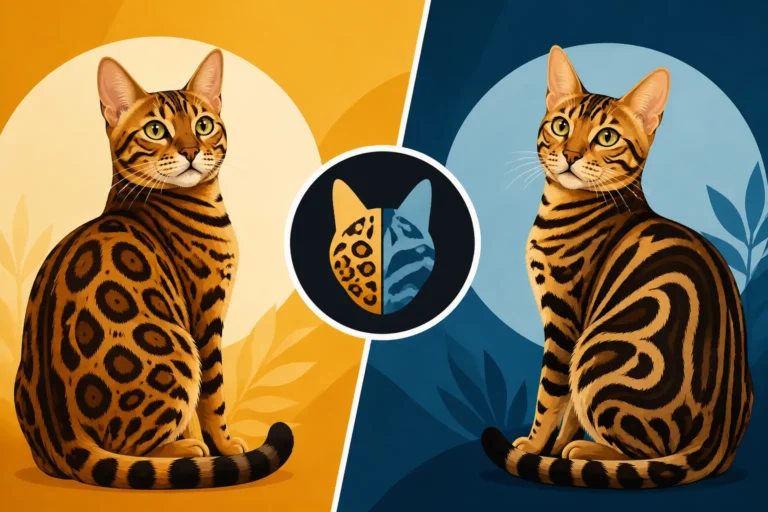
Bengals were developed from crosses involving the Asian leopard cat and domestic cats. The generation label describes how far a cat is removed, through its ancestry, from that wild ancestor. It is a family-tree term, not a visual description: spots, rosettes, size, and temperament do not tell you a cat’s generation.
An F1 Bengal is generally the direct offspring of an Asian leopard cat and a domestic cat. Later generations descend through further matings. That simple outline can become less straightforward when pedigrees include different kinds of crosses, foundation cats, or several branches of ancestry. For the basics, see F1 to SBT: How a Bengal Cat's Generation Is Counted and What F1 Means in a Bengal Cat.
The generation label matters for more than curiosity. It can help you understand a cat’s place in the breed’s development and may be relevant to local ownership rules. Laws and definitions vary by location, though, so a pedigree label should not be treated as a substitute for checking the rules that apply where you live.
Understand F1, F2, and F3 labels
F1, F2, and F3 are commonly used to describe early filial generations. In broad terms, each step refers to another generation removed from the original Asian leopard cat cross. But the exact label a breeder uses can depend on how the cat’s ancestors were mated and which registry’s conventions are being followed.
That is why two people can look at a short description and use different language for a cat’s ancestry. One may be speaking informally about filial generations; another may be using the registration terminology printed on official papers. If you are comparing a breeder’s description with a registry pedigree, ask what system the breeder means rather than assuming the terms match exactly. The articles What F2 and F3 Mean in a Bengal Cat and How a Bengal Cat's Generation Is Counted explain the distinctions in more detail.
An early-generation designation also does not automatically tell you how an individual cat behaves or what kind of home it needs. Generation is one piece of background information. Socialization, temperament, health, and the cat’s own history matter too.
Know what SBT means
SBT stands for Stud Book Tradition. It is a registry designation used for Bengals whose recorded ancestry meets that registry’s requirements for Bengal-to-Bengal breeding over a specified number of generations. It is not simply another way to write “F4,” and the terms should not be swapped casually.
In general conversation, people may describe SBT Bengals as several generations removed from the Asian leopard cat. Still, the registration code is a registry classification, while an F-number is often used as a generation shorthand. The details of a registration system matter, so check the registry named on the actual paperwork. You can read more in What SBT Means in a Bengal Cat.
When a breeder says “SBT” but does not provide a pedigree or registration record, ask for the documentation behind the claim. A confident label is useful only if you can see how it was assigned.
How to trace a generation on a pedigree
Find the cat’s own registration details first
Begin with the cat’s full registered name, registration number if available, date of birth, and the name of the registry that issued the paperwork. A breeder may use a pet name, cattery name, or shortened name in everyday conversation; the registered name is usually the better starting point for matching the cat to its pedigree.
Check that the document belongs to the cat you are researching. Compare names and identifying details against the purchase agreement, breeder records, or other paperwork you received. If something does not match, pause and ask for clarification before trying to infer a generation from the tree.
A pedigree may show parents, grandparents, and more distant ancestors, but the format varies. Some records include registration codes or notations; others display names and registration numbers without explaining every abbreviation. If the generation is not printed clearly, do not assume that a blank field means the cat has no recorded ancestry. Contact the issuing registry or ask the breeder to explain the record.
Follow the ancestry branch by branch
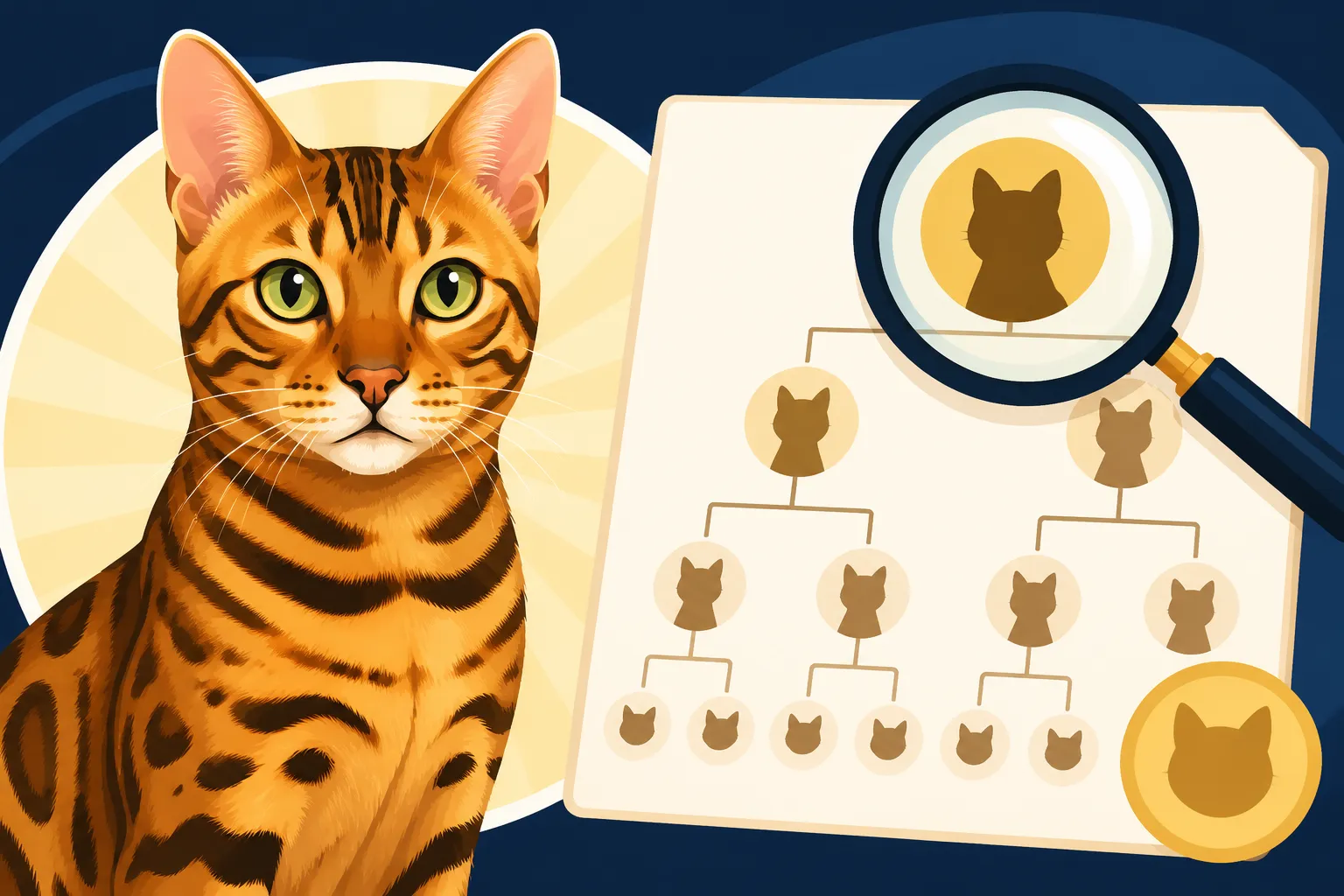
Once you have the pedigree, identify the cat’s parents and trace each branch backward. Look for listed foundation ancestors, Asian leopard cat ancestry, non-Bengal outcrosses, and any generation designations included in the record. The aim is to understand the documented path, not to count names or rows mechanically.
A common mistake is to count the number of visible lines on a printed pedigree and declare that the cat is a particular generation. A pedigree may show only a limited number of generations, and an ancestor’s position on the page does not always settle how a registry classifies the descendant. In addition, breeding choices across branches can make a quick “one row equals one F-number” calculation unreliable.
If the pedigree is incomplete or uses unfamiliar codes, ask the breeder to explain the ancestry in plain language: Which ancestor is the relevant foundation cat? How is the stated generation calculated? Which registry’s definition is being used? A breeder who knows the cat’s records should be able to walk you through the claim without asking you to guess from a screenshot.
Match the pedigree to the registry’s terminology
Treat the registry’s own records as the anchor for interpreting registration terms. A breeder’s website, advertisement, or social-media post may use familiar shorthand, but it is not the same thing as a registry-issued document. Ask for the registered name or number and verify that the record corresponds to the cat and the stated classification.
A pedigree can support a generation claim, but it may not answer every ownership question by itself. If you are checking local rules, find out what documentation the relevant authority accepts and whether it requires a particular kind of proof. For background, see How to Prove Your Bengal Cat's Generation and Whether a Registration Paper Proves a Bengal Cat's Generation.
Keep copies of the pedigree and related records in one place. If you use Chewy for supplies, its order history may help you keep track of purchases, but it does not document a cat’s ancestry. Store pedigree papers separately from receipts and routine care records so the important lineage documents are easy to find.
Pedigree clues, limitations, and common mix-ups
Do not confuse a pedigree with a DNA test
A pedigree records known ancestry as documented by a breeder or registry. A DNA test may provide information about particular genetic traits or ancestry categories, depending on the test, but it should not be assumed to establish a Bengal’s exact filial generation or replace the registered pedigree.
This distinction matters when someone says a test “proves” the cat is F-numbered. Ask what the test actually measures, who issued the result, and whether the registry or local authority accepts it for the purpose you have in mind. A test result and a pedigree answer different questions.
The same caution applies to breed appearance. A spotted cat may resemble a Bengal, and a Bengal mix may inherit striking markings, but coat pattern alone cannot confirm registry status or generation. If you are trying to identify a cat without papers, read Whether a DNA Test Confirms a Bengal Cat and Whether a Spotted Domestic Shorthair Is a Bengal Cat.
Watch for incomplete or contradictory records
A missing parent, inconsistent registered name, or unexplained generation label does not automatically mean that someone has misrepresented the cat. Records can be incomplete, paperwork can be delayed, and a breeder may use casual terminology that differs from a registry’s wording. But those gaps are reasons to ask follow-up questions rather than accept a claim at face value.
Make a short list of what does not line up. For example: the sales listing says F4, the pedigree shows an SBT designation, and the breeder has not explained how those terms relate. Ask the breeder to reconcile the labels and provide the registry record supporting the explanation. If you still have questions, contact the registry listed on the document.
Keep financial and care records distinct from ancestry evidence. A Chewy receipt, veterinary invoice, microchip record, or adoption contract can be useful for other reasons, but none independently establishes a Bengal’s generation. This is especially important if the information is being used for legal or registration purposes.
Use the pedigree to ask better questions
A pedigree is most useful when it gives you a starting point for a clear conversation. Ask the breeder to explain the generation label, identify the registry that assigned it, and show how the cat’s parents and grandparents fit into the stated classification. If the breeder says the cat is SBT, ask what that designation means in the registry’s system.
You can also ask whether the paperwork names all parents and whether the breeder has a copy of the full pedigree. If a seller cannot provide documents, ask what records are available and why. A reasonable explanation may exist, but you should understand what is documented and what is only being reported verbally.
If you are keeping a file for a move or a local-rule check, save the pedigree, registration details, contract, and any correspondence from the breeder together. Chewy purchase records can remain in your general pet-care folder, but keep them clearly separate from proof of lineage. For the broader distinction between generation labels and registry rules, see Which Generation TICA Registers as a Bengal Cat and F4 Is the Line Between Wild and Domestic Bengal Cats.
A practical checklist for checking a Bengal pedigree
Use this checklist before relying on a generation claim:
- Get the registered name and registry. Make sure the document refers to the cat you are considering or own.
- Ask for the pedigree, not just a verbal label. A listing that says “F3” is not the same as a record showing how that classification was reached.
- Trace both parent branches. Check which ancestors are listed and whether the pedigree identifies relevant foundation ancestry.
- Clarify the terminology. Ask whether the breeder means an informal F-generation label or a formal registry designation such as SBT.
- Resolve discrepancies in writing. If the advertisement, contract, and pedigree use different terms, ask the breeder to explain the difference.
- Check the purpose of the proof. If you need the information for local regulations, confirm what the relevant authority accepts instead of assuming a pedigree alone will be enough.
- Keep the records together. Save a clear copy of the pedigree and registration information; store purchase receipts and routine veterinary documents separately.
| What you see | What it may indicate | What to do next |
|---|---|---|
| An F-number in a breeder listing | Informal or breeder-used generation shorthand | Ask how it was calculated and which records support it |
| SBT on registry paperwork | A registry classification based on its Bengal ancestry rules | Confirm the registry’s definition and keep the full record |
| A pedigree with several generations shown | Recorded ancestry for the listed branches | Check whether the document is complete enough to support the specific claim |
| A DNA result described as generation proof | A genetic result being used to support an ancestry claim | Ask what the test measures and whether it is accepted for your purpose |
| A mismatch between listing and paperwork | Different terminology, an error, or incomplete explanation | Request clarification before relying on either label |
Finding a Bengal’s generation is less about decoding one magic letter and more about matching a breeder’s description to the pedigree and the registry’s terminology. If the paperwork is unclear, ask for the explanation in writing and verify what the relevant registry or local authority requires. That small bit of extra checking can prevent a confusing label from becoming a much bigger problem later.
Disclaimer
This article is for general informational purposes only and does not constitute professional advice. Laws, prices and regulations vary by location and change over time. Consult a qualified professional for guidance on your specific situation.