Whether a DNA Test Shows a Bengal Cat’s Wild Percentage
A cat DNA kit may report breed-like matches, traits, or inherited health risks, but that does not mean it can calculate a Bengal’s exact percentage of Asian leopard cat ancestry. If you are trying to confirm a cat’s generation, settle a disagreement about its pedigree, or understand a test result, the key distinction is between a DNA estimate and a documented family tree.
Can a DNA test show a Bengal cat’s wild percentage
What “wild percentage” means
A Bengal’s wild percentage usually refers to its expected ancestry from the Asian leopard cat, the wild species involved in the breed’s history. In a simple pedigree, the expected share is halved with each generation: an F1 has one Asian leopard cat parent, an F2 has an F1 parent and a domestic cat parent, and subsequent generations are further removed. You can read more about How a Bengal Cat's Generation Is Counted and What a Bengal Cat's Wild Ancestor Is Like.
Those fractions are useful shorthand for understanding a family tree. They are not the same thing as a laboratory measuring every stretch of a cat’s DNA and returning an exact, universally accepted wild-ancestry percentage. An individual kitten inherits a shuffled selection of DNA from its parents, so the amount it receives from a particular ancestor can differ from the simple expected fraction.
That distinction matters when someone says, “My Bengal is 12.5% wild because he is an F3.” The figure may describe the expected ancestry in a simplified pedigree, but it does not necessarily describe a precise measured percentage in that individual cat. Generation labels and ancestry estimates answer related but different questions.
What commercial cat DNA tests usually report
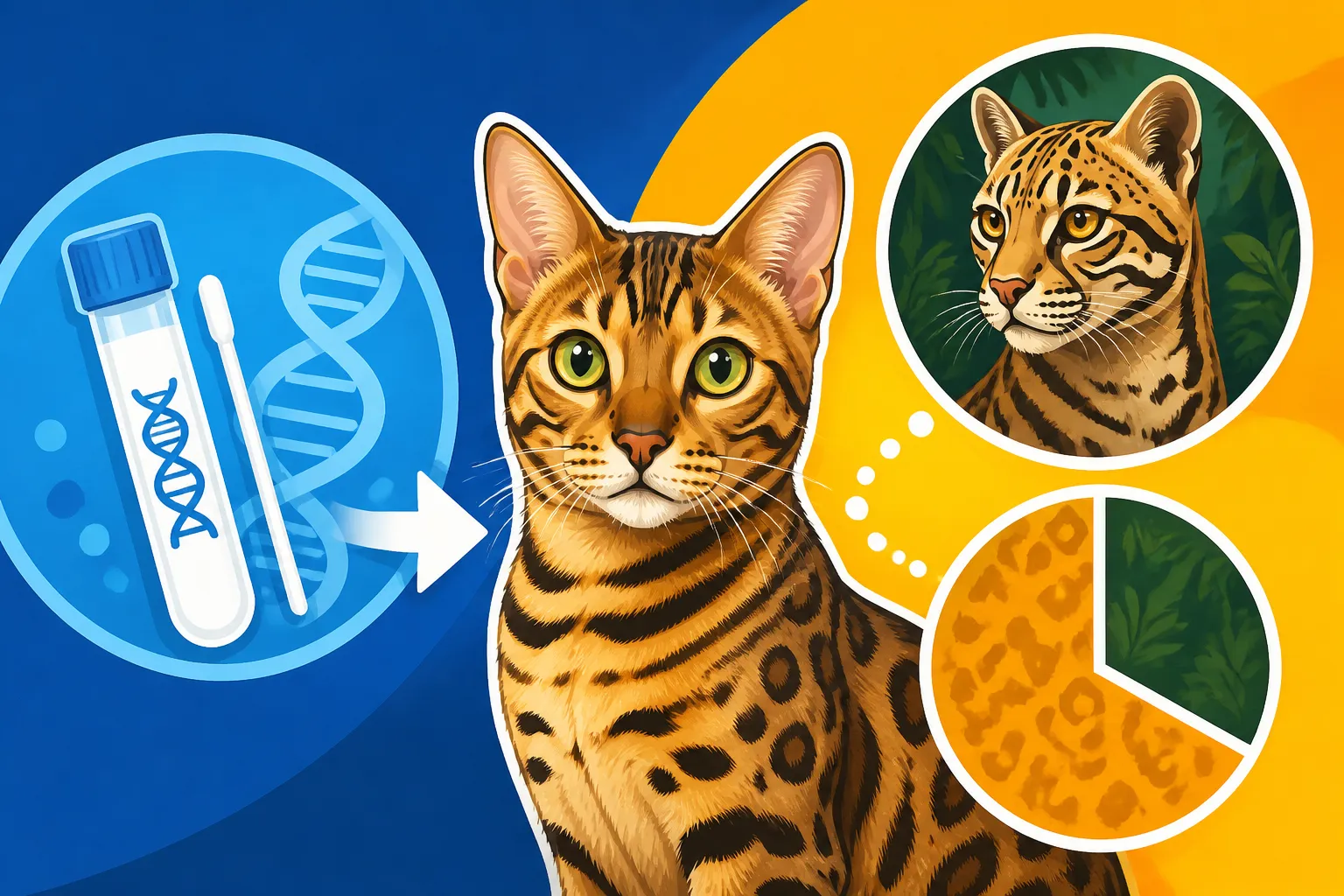
Commercial cat DNA tests may look at selected genetic markers to report possible breed affinities, inherited traits, or health risks. What a particular test can tell you depends on the company’s reference data and testing method. A report that names Bengal ancestry or shows a breed match is not automatically a reliable measurement of Asian leopard cat ancestry.
The challenge is that a domestic Bengal is not simply a fresh wild-cat cross. Bengals have been bred through multiple generations, and their genetic background is shared and reshuffled over time. A test may recognize patterns associated with certain domestic populations without being able to distinguish a particular filial generation or calculate an exact wild percentage.
Even if a report gives a percentage, read carefully what that number represents. It might be an estimate of similarity to the company’s reference populations, not a literal statement that a fixed proportion of the cat’s genome came directly from an Asian leopard cat. Ask the testing company what its percentage means, which reference samples it uses, and whether the method has been validated specifically for Bengal generations.
Why a Bengal’s appearance cannot settle the question
A rosetted coat, sleek build, or wild-looking face may make a cat look unmistakably Bengal, but appearance cannot establish its generation. A domestic cat can have striking spots, and Bengals from later generations can retain dramatic markings. Looks are not a substitute for a documented pedigree or a test designed for the exact question at hand.
The same caution applies to behavior. A lively, vocal cat that loves climbing may fit a familiar Bengal stereotype, but those traits do not reveal how many generations separate the cat from an Asian leopard cat. Individual temperament varies, and a cat’s habits cannot establish its ancestry percentage.
For more on the limits of breed identification, see Whether a DNA Test Confirms a Bengal Cat. That question is separate from whether a kit can estimate wild ancestry: a test might provide one kind of ancestry clue without proving a cat’s registered breed, pedigree, or filial generation.
What a DNA test can and cannot establish
A health test is not a wild-ancestry test
Some genetic tests are designed to check for particular inherited conditions or variants. Those tests answer a focused health question: whether the tested sample carries a variant included in the assay. They do not, by themselves, show how much Asian leopard cat ancestry a cat has.
This difference is easy to miss when a breeder provides a folder of test results. A health certificate, parentage result, and pedigree each serve different purposes. A health result can be valuable, but it does not replace records showing the cat’s parents and generation. For a broader look at generational labels, see What SBT Means in a Bengal Cat.
Likewise, a DNA test that confirms parentage can help verify whether a kitten is biologically related to its stated parents, if the relevant parents have also been tested and the lab offers that service. Parentage confirmation still does not independently calculate a wild percentage. It helps check one link in the family history rather than recreate the entire history from a cheek swab.
Why percentages become less straightforward over generations
The familiar fractions for early generations are averages based on a simplified inheritance model. For example, an F1 Bengal is expected to have one Asian leopard cat parent and one domestic cat parent. An F2 is expected to have an F1 parent and a domestic parent. Later generations continue the same basic pattern, as explained in How Much Asian Leopard Cat DNA an F1 Bengal Cat Has, How Much Wild DNA an F2 Bengal Cat Has, How Much Wild DNA an F3 Bengal Cat Has, and How Much Wild DNA an F4 Bengal Cat Has.
But inherited DNA does not travel as a perfectly measured whole-number portion from one generation to the next. Before reproductive cells are formed, chromosomes recombine, so offspring receive a new mixture. A pedigree fraction is therefore a useful expectation, not necessarily a direct measurement of the exact ancestry present in one cat.
There is another practical issue: a laboratory needs appropriate reference samples and a validated method to identify ancestry from a particular wild species. Without those, a numerical result may sound more precise than the underlying evidence warrants. A percentage with a decimal point is not automatically more meaningful than a well-supported pedigree.
| Question you want answered | Most relevant evidence | What it does not establish by itself |
|---|---|---|
| What generation is this Bengal? | A documented pedigree and the applicable registry’s rules | An exact DNA-measured wild percentage |
| Is this cat related to these stated parents? | Parentage testing, where the lab offers it and parent samples are available | The cat’s full ancestry or generation |
| Does this cat carry a tested health variant? | A test specifically designed for that variant | Breed identity or wild ancestry |
| Does a commercial kit show Bengal-like ancestry? | The test report and its method and reference data | A definitive filial generation or exact Asian leopard cat percentage |
What a test result may mean for ownership or registration
A DNA report should not be treated as a substitute for whatever documents a registry, landlord, insurer, or local authority may require. If a Bengal’s generation affects a decision, check the rules of the specific organization or jurisdiction involved and ask what documentation it accepts. Requirements can differ, and a general ancestry estimate may not satisfy them.
For a pedigree-based answer, request the original records and trace the parentage through the relevant generations. How to Find a Bengal Cat's Generation on Its Pedigree explains why the pedigree is central to that task. If records are incomplete, be cautious about treating a test result, photo, or seller’s description as conclusive proof.
When buying or adopting, ask who issued the pedigree, whether the listed parents can be verified, and whether any DNA testing was performed for parentage or health. Those are distinct questions, so ask for the specific document that addresses each one. A seller who offers a DNA result should be able to explain what the test was designed to establish and what it cannot establish.
How to assess a Bengal DNA test result
Read the test’s claims before ordering
Start with the exact question you want answered. If you want to know whether a cat has a particular health variant, look for a test that names that condition and explains its scope. If you want to know a cat’s generation, ask whether the test is validated to determine Bengal filial generation—not merely whether the company offers a general cat ancestry report.
Check whether the company explains its reference populations, limitations, and meaning of any percentages. Look for clear wording about whether the result is an estimate, a parentage finding, or a test for a named genetic variant. If the website only promises to reveal a cat’s “breed mix,” that wording alone does not demonstrate that it can quantify Asian leopard cat ancestry.
If you come across a cat DNA kit through Chewy or another retailer, use the retailer listing as a starting point, not as proof of what the test can determine. Check the laboratory’s own explanation of the assay and make sure the product is intended for cats and for the question you have. A listing on Chewy does not, by itself, validate a wild-ancestry percentage.
Questions to ask the laboratory or breeder
Before relying on a result, ask a few plain questions. Does the test measure Asian leopard cat ancestry specifically, or compare the sample with domestic breed reference groups? Can it identify a Bengal’s filial generation, or does it provide a broader ancestry estimate? What reference samples support that claim, and has the method been validated for Bengals?
If you are considering a kit found on Chewy, check whether the listing links to a detailed test description and whether the laboratory explains how results are interpreted. If the details are vague, contact the testing company directly before purchasing. Chewy can be one place a shopper encounters a product, but the lab’s method—not the storefront—is what determines what the result means.
A breeder should also be able to distinguish between pedigree paperwork, parentage testing, and health screening. If someone says a DNA test proves an exact wild percentage, ask which test and what its report actually states. You can also read Whether a Breeder Can Fake a Bengal Cat's Generation for context on why documentation and verification matter.
A practical way to interpret a report
When a result arrives, separate its claims into categories. Write down what it says about ancestry, what it says about health, and whether it confirms parentage. Do not combine them into a single conclusion such as “the DNA proves this cat is an F3” unless the testing provider clearly describes a validated method for establishing that specific generation.
Then compare the result with the pedigree and the stated purpose of the test. If a report identifies a possible ancestry match but the family records point to a different history, do not assume the percentage resolves the disagreement. Ask the laboratory what its report can support, and ask the registry or relevant authority what evidence it accepts for the decision you need to make.
The most dependable answer is usually straightforward: a general commercial cat DNA test may offer clues, but it should not be assumed to provide an exact, definitive wild percentage or Bengal generation. For those, a documented pedigree is generally the key evidence, while a genetic test is useful only for the specific questions its method has been designed to answer.
Disclaimer
This article is for general informational purposes only and does not constitute professional advice. Laws, prices and regulations vary by location and change over time. Consult a qualified professional for guidance on your specific situation.