Whether Bengal Cats Are Still Bred From Wild Cats
A Bengal’s spotted coat can make it look as though a wild cat is only a generation away, which understandably raises questions about how breeders produce today’s kittens. The short answer is that most pet Bengals are not newly crossed with wild cats. This guide explains the breed’s ancestry, what generation labels mean, how to check a breeder’s claims, and what the distinction means for a future owner.
Do Bengal breeders still mate domestic cats with wild cats?
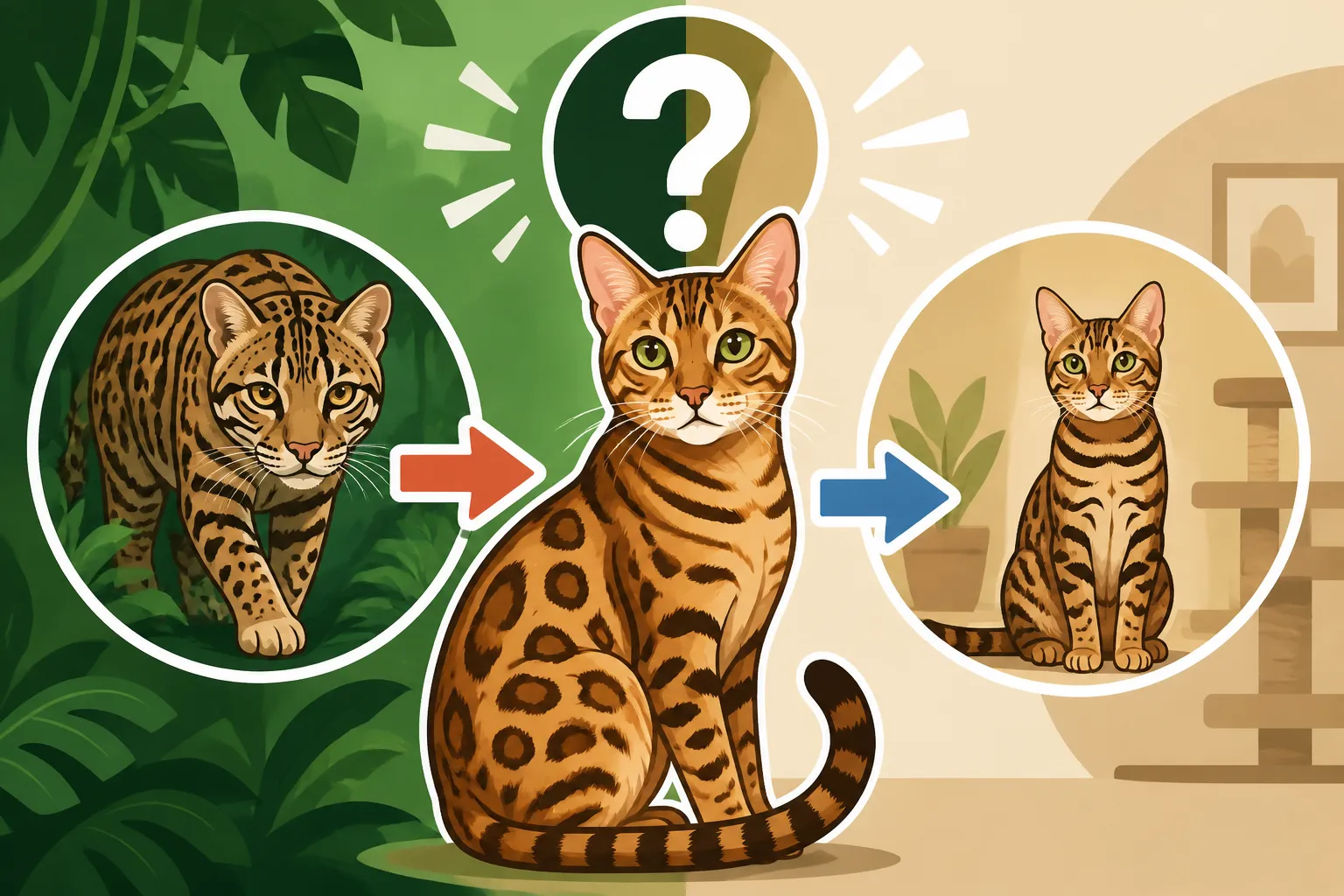
For the typical Bengal kitten sold as a companion, no. Modern Bengals generally come from established Bengal-to-Bengal breeding lines, rather than a fresh mating between a domestic cat and an Asian leopard cat. The breed does have a real wild ancestor, but that historical fact is different from saying today’s pet Bengals are routinely bred from wild cats.
The Bengal’s wild ancestry is real but mostly historical
The Bengal breed was developed through crosses involving the Asian leopard cat, a small wild feline native to parts of Asia, and domestic cats. Those early crosses helped establish the spotted appearance that many people associate with Bengals. If you are curious about the species behind that history, What the Bengal Cat's Wild Ancestor Is Like explains more about the Asian leopard cat itself.
But a breed’s origin does not describe every generation that follows. Once breeders have established a domestic breeding population, they can continue producing cats by mating Bengals with other Bengals. The kittens retain ancestry from that original wild contributor through their pedigrees, but they are not necessarily the product of a recent wild-to-domestic cross.
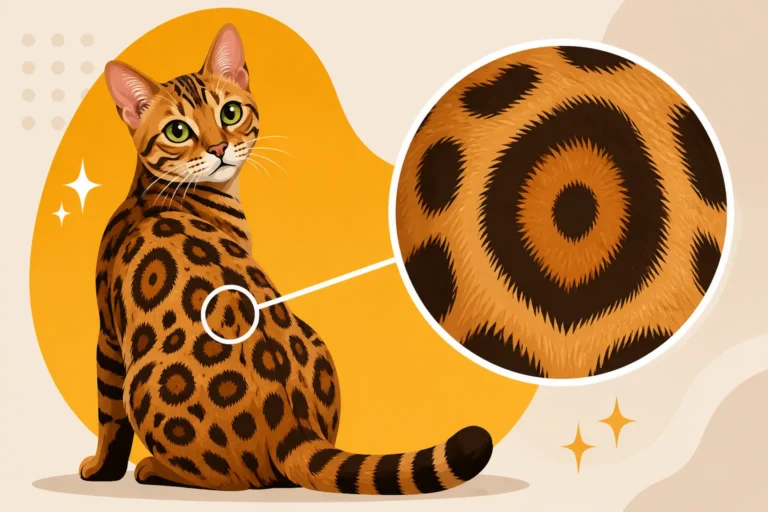
That distinction is easy to miss when a cat has a dramatic, wild-looking coat. A rosetted Bengal can look strikingly exotic while being several generations removed from an Asian leopard cat. Appearance alone cannot tell you whether the cat has a recent wild ancestor or whether it belongs to a domestic, established line.
Fresh wild crosses are not the usual route to a pet Bengal
A breeder intentionally introducing an Asian leopard cat into a Bengal line would be making a new foundation cross. That is different from breeding two established Bengals, even if both cats trace back to wild ancestry far up their family trees. The difference matters for temperament, care needs, documentation, and sometimes local law.
New wild crosses are not a routine way to produce ordinary pet Bengals. Breed rules and registration policies can restrict which matings qualify for registration, and legal rules may also limit ownership or breeding of early-generation hybrids. Those requirements differ across registries and places, so it is wise to check the rules that apply to the specific cat and location rather than assume every Bengal is treated the same way.
The practical takeaway: when a breeder says a kitten is a Bengal, ask what they mean by that label. Is the kitten from an established domestic Bengal line, or is it an early-generation hybrid? A responsible breeder should be able to explain the pedigree and generation clearly, rather than relying on a kitten’s spots or a “wild” sales description.
What Bengal generations mean in practice
Generation labels describe a cat’s position in a family tree relative to the Asian leopard cat. They are not a simple measure of personality, and they do not tell you everything about an individual cat’s behavior. Still, they help distinguish early-generation hybrids from later-generation Bengals bred within domestic lines.
Early generations and established Bengals are not the same thing
F1 refers to a first-generation cross between an Asian leopard cat and a domestic cat. F2 and F3 refer to subsequent generations further down that line. These cats may have different ownership considerations from later-generation Bengals, and their behavior and needs can vary. The label is about lineage, not a promise that a particular cat will behave in a specific way. For a closer explanation, see What F1 Means in a Bengal Cat and How a Bengal Cat's Generation Is Counted.
Many people looking for a companion Bengal are looking for an established domestic cat, not an early-generation hybrid. In pedigrees, the term SBT is commonly used for Bengals whose ancestry meets a particular established-line standard. The exact registration language and requirements should be checked with the relevant registry, but SBT is often a useful term to understand when comparing a breeder’s claims. What SBT Means in a Bengal Cat explores that label in more detail.
A generation number should not be treated as a character guarantee. A later-generation Bengal can be lively, clever, vocal, and demanding of attention. An early-generation hybrid may have additional challenges, but individual temperament is also shaped by health, socialization, environment, and the cat’s own personality. Ask about the individual parents and kittens, not just the number on a pedigree.
A quick comparison of the terms
| Term | What it generally indicates | What it does not tell you |
|---|---|---|
| F1 | A first-generation Asian leopard cat and domestic cat cross | Whether the individual cat will be easy to handle or suitable for a particular home |
| F2 or F3 | A later generation descended from an early cross | That the cat is automatically accepted as a household pet under local rules |
| SBT | An established Bengal pedigree category used by registries | That the cat has no wild ancestry in its family tree |
| “Wild-looking” | A description of coat, markings, or appearance | The cat’s generation, pedigree, or legal status |
If a seller uses these terms loosely, ask them to define the label and show the pedigree records that support it. A kitten’s coat cannot establish its generation, and a social media caption is not a substitute for documentation.
How to check whether a Bengal has a recent wild cross
If you are choosing a kitten, the most useful evidence is a clear, consistent account of its parentage. A genuine breeder should be comfortable discussing the parents, the litter, the generation, and any registry paperwork. You do not need to be an expert in feline pedigrees; you do need enough information to understand what you are being offered.
Ask for the pedigree and a plain-language explanation
Ask the breeder to explain the kitten’s generation in everyday terms. For example: “Are both parents established Bengals?” and “Does this kitten have an Asian leopard cat as a parent, grandparent, or more distant ancestor?” Those questions make it harder for vague phrases such as “close to the wild” to stand in for useful information.
Request to see the pedigree and registration documentation available for the kitten and its parents. Then check that the names and parentage match the breeder’s explanation. If the seller says a kitten is SBT, ask which registry’s terminology they are using and how the pedigree qualifies. You can also read Whether a New Wild Cross Into the Bengal Cat Is Allowed to understand why registry and breeding rules matter.
Be cautious if the seller cannot provide records, changes the explanation when you ask follow-up questions, or uses “rare wild hybrid” as a selling point without explaining the cat’s needs and legal status. A responsible breeder should not pressure you to pay a deposit before answering basic questions about lineage and care.
Check local rules before you commit
Rules may depend on the cat’s generation, the local jurisdiction, or both. A city may have requirements that differ from the state or country’s rules. If the kitten is described as early-generation, do not rely on a breeder’s assurance that it is legal everywhere. Confirm requirements with the relevant local authorities before bringing the cat home. For broader context, see Which Countries Ban New Bengal Cat Wild Crosses.
Also ask whether the breeder expects the buyer to keep or provide any particular documentation. Keep copies of the pedigree, contract, vaccination records, and other paperwork together. If you move, travel, or need to demonstrate the cat’s lineage later, having the documents organized can save a frustrating scramble.
Finally, consider why you want a Bengal. If the attraction is the coat, an established domestic Bengal may fit your household better than an early-generation hybrid. If the draw is the idea of owning something “part wild,” pause and look carefully at the animal’s welfare, your experience, and your ability to meet its needs. The appearance of a wild cat and the realities of caring for a hybrid are not the same thing.
What this means for Bengal owners
For most owners, the important question is not whether a Bengal has distant wild ancestry. It is whether the cat is a well-socialized individual from a transparent breeding program, and whether your home can support its needs. Bengals are domestic cats, but they can be active, curious, and very persistent about getting attention and stimulation.
Plan for the individual cat, not the exotic label
Ask the breeder about the kitten’s daily routine, favorite kinds of play, comfort with handling, and experience with household sounds. A kitten raised with thoughtful socialization may settle into a home more easily than one with limited positive exposure, regardless of dramatic markings or pedigree language.
Before bringing a kitten home, prepare a quiet room, safe hiding places, scratching surfaces, climbing options, and interactive play. Check with the breeder about the food and litter the kitten already knows so the transition is less abrupt. Some owners arrange familiar supplies through retailers such as Chewy, but the key is to match the kitten’s established routine at first rather than make several changes on arrival.
A Bengal’s energy can surprise people who expect a low-key lap cat. Daily play, puzzle activities, and safe vertical space help give that energy somewhere appropriate to go. If you are still deciding whether the breed fits your household, Which Bengal Cat Generation Suits a Family can help frame the choice around lifestyle rather than appearance alone.
Think carefully about the ethics of hybrid breeding
People disagree about the ethics of breeding hybrids, and the discussion involves more than whether a cat looks beautiful. It can include animal welfare, responsible breeding practices, the challenges of managing early generations, and whether buyers understand what they are taking on. Whether Breeding Hybrids Like the Bengal Cat Is Ethical looks at those concerns from a broader perspective.
A practical way to approach the issue is to ask what serves the cats’ welfare. Does the breeder prioritize health, appropriate housing, careful socialization, and lifelong responsibility for cats they produce? Are they open about generation and ancestry, or do they make the wild connection sound like a novelty? Do they help buyers understand the cat’s needs instead of selling an image?
These questions matter whether you are buying from a breeder or considering a rescue. When adopting, ask what is known about the cat’s background, temperament, and care history, while recognizing that a rescue may not have a complete pedigree. For any Bengal, a predictable routine, enrichment, veterinary care, and a secure home are more useful than assumptions based on the word “wild.”
If your main concern is preparing for daily care, gather supplies before the cat arrives and ask for recommendations based on its current routine. Chewy is one option some households use to source familiar food or basic enrichment items; confirm that any product suits the cat and, for food changes, make transitions gradually. The goal is continuity and a comfortable landing, not buying a particular brand.
Questions to ask before choosing a Bengal kitten
A short, direct conversation can reveal a lot about whether a breeder is being transparent. These questions help you separate lineage facts from marketing language and focus on what living with the individual cat will involve.
Use questions that invite specific answers
Ask who the kitten’s parents are, whether both are Bengals, what generation the kitten is described as, and which records support that description. Then ask about the parents’ temperaments and how the kittens are socialized. A good answer should be more informative than “they’re very wild-looking” or “they’re a rare line.”
You can also ask what health screening has been done, what veterinary care the kitten has received, and what support the breeder offers after the sale. The questions are relevant because a pedigree label does not establish health or good care. To learn more about lineage and breeding standards, see Where the Bengal Cat Comes From.
If you are comparing breeders, write down the answers and look for consistency. One breeder may use different terminology from another, but they should still be able to explain the kitten’s parentage clearly and provide the documentation they claim to have. If anything feels evasive, take time to verify the details before making a commitment.
Watch for claims that overstate what a label proves
“Pure Bengal,” “wild blood,” and “first-generation look” can be used in ways that sound impressive but do not explain the actual pedigree. Ask what each phrase means in that seller’s use. A breeder should be able to distinguish appearance from generation and should not suggest that a particular coat pattern proves a recent wild cross.
Likewise, don’t assume that a domestic Bengal has no connection to wild ancestry simply because it is several generations removed. The cat’s broader breed history still matters, but ancestry is not the same as current breeding practice. For many prospective owners, that distinction answers the original question: Bengals have wild ancestry, yet most pet Bengals today are produced from established domestic Bengal lines rather than newly crossed wild cats.
Chewy may help with the practical shopping list once you have confirmed the kitten’s diet and routine, but a retailer cannot verify a breeder’s pedigree or replace a conversation about lineage. Keep those decisions separate: verify the cat’s background with records and the breeder, then choose supplies based on the kitten’s actual needs.
Disclaimer
This article is for general informational purposes only and does not constitute professional advice. Laws, prices and regulations vary by location and change over time. Consult a qualified professional for guidance on your specific situation.