Whether a New Wild Cross Into the Bengal Cat Is Allowed
A new Asian leopard cat cross may sound like a way to make Bengal cats look wilder, but it is not a simple breeding choice. Whether it is allowed depends on the registry, local wildlife and ownership laws, and the animals involved. This guide explains what “new wild cross” means, how it differs from established Bengal breeding, and what to check before trusting a breeder’s claims.
What a new wild cross means
The original Bengal cross and a new cross are not the same thing
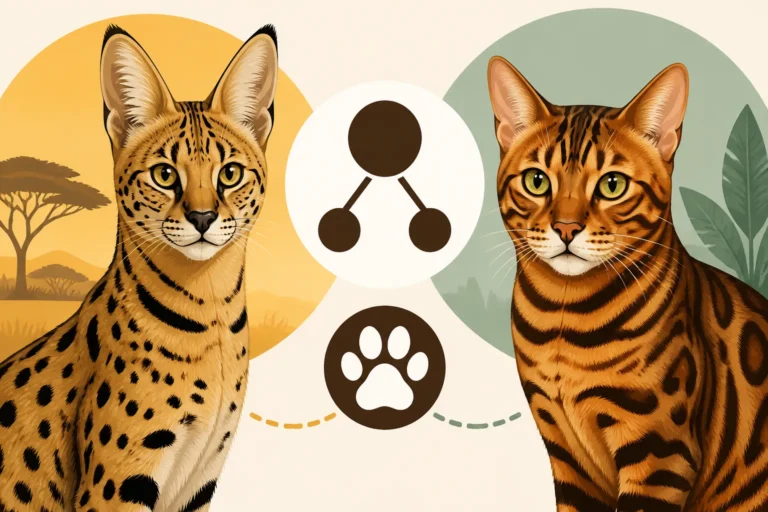
The Bengal breed began through crosses between domestic cats and the Asian leopard cat, a small wild feline. Those early generations helped establish the breed’s distinctive spotted and rosetted coat. The modern Bengal, however, is generally bred from established domestic Bengal lines rather than by repeatedly bringing wild cats into the breeding program.
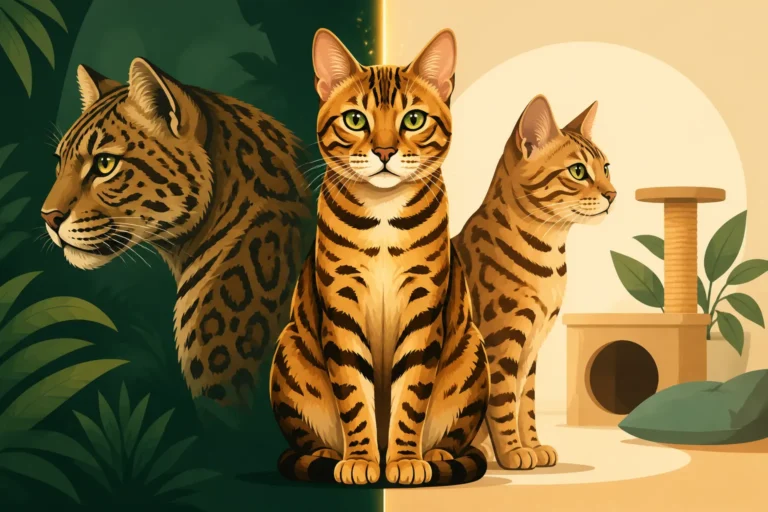
A new wild cross means introducing an Asian leopard cat, or another wild feline, into a breeding program that is already producing Bengals. That is different from mating two established Bengals, even if a kitten from those established lines has a strikingly wild-looking coat. Appearance alone does not tell you whether a cat has a recent wild ancestor.
The distinction matters for registration and ownership. A breeder might use “new blood” or “fresh lines” to describe a domestic Bengal from an unrelated pedigree. That does not necessarily mean a wild cross. Ask what the phrase means in that breeder’s specific case, and request the pedigree and registration details rather than relying on marketing language.
For background on the breed’s origins, see Whether Bengal Cats Are Still Bred From Wild Cats and What a Bengal Cat's Wild Ancestor Is Like. The history explains why the Asian leopard cat is part of the Bengal story, but it does not mean that new wild crosses are a routine or automatically accepted part of Bengal breeding today.
How a kitten’s generation relates to the question
Bengal generations are often described with labels such as F1, F2, F3, and SBT. An F1 is the first generation from a domestic cat and an Asian leopard cat. Later generations are progressively farther removed from that original wild ancestor through additional breeding. SBT, or Stud Book Tradition, is a registry term used for Bengals with a qualifying multigeneration Bengal pedigree.
These labels do not, by themselves, establish that a particular cat can be legally owned or registered everywhere. They also do not replace a pedigree or official paperwork. The practical question is not only “What generation is this cat?” but also “Who recognizes that generation, what documentation supports it, and what does local law allow?”
If you are untangling the terminology, F1 to SBT: How a Bengal Cat's Generation Is Counted, What F1 Means in a Bengal Cat, and What SBT Means in a Bengal Cat explain the labels in more detail. A claimed generation should be supported by records, not inferred from coat pattern, size, or a seller’s description.
Is a new wild cross allowed
Registry rules decide whether a cat can be registered as a Bengal
There is no single worldwide rule that answers whether every new Asian leopard cat cross is allowed. Cat registries set their own pedigree and registration requirements, and those requirements can differ. A cross that a breeder conducts does not automatically qualify the resulting kittens for registration as Bengals with a particular organization.
For an established Bengal program, registries generally rely on documented pedigrees and their own rules about which cats and matings qualify. A newly introduced wild ancestor may fall outside the accepted path for registering a standard Bengal. The important point is to verify the rules with the specific registry named by the breeder; do not assume that “Bengal” on an advertisement means the cat is eligible for registration.
If a breeder says that a new wild cross is “approved,” ask what that means. Approved by whom? Is the mating recognized by a cat registry, permitted by wildlife authorities, or simply something the breeder has decided to do? Those are separate questions. A registration claim should be backed by registry documentation that identifies the cat and its pedigree. Which Generation TICA Registers as a Bengal Cat is a useful place to start when checking how registry eligibility is framed.
| Question | What it helps establish | What it does not establish |
|---|---|---|
| Is the kitten registered with a named cat registry? | Whether the registry has recorded the cat under its rules | Whether every local law permits ownership |
| Does the pedigree document the parents and generations? | Whether the claimed ancestry is supported by records | Whether the breeding was ethical or lawful |
| Was a wild animal involved in the mating? | Whether wildlife rules and permits may apply | Whether the kittens qualify as Bengals |
| Is the cat described as F1, F2, or later generation? | How the breeder represents its distance from a wild ancestor | Whether that label is accurate without paperwork |
| Does the seller provide written documentation? | Whether you can independently review the claim | Whether the documents meet every registry or legal requirement |
Wildlife and ownership laws are a separate layer
Even if a registry accepts a pedigree, local law may impose separate restrictions on wild felines, hybrids, imports, breeding, or ownership. Rules can vary by country and may also differ between states, provinces, counties, and cities. A breeder’s location is not necessarily the only place that matters: the kitten’s destination and the route it travels may also be relevant.
This is why a casual assurance such as “they’re legal” is not enough. Before paying a deposit, check the rules that apply where the cat will live and ask which authority administers them. If a wild animal or recent hybrid is involved, you may need clear answers about permits, animal welfare requirements, transport, and what happens if you move.
Do not assume that a domestic-looking kitten is exempt from rules connected to its ancestry. Nor should you assume that a registration certificate settles the legal question. For more on how geography changes the answer, see Which Countries Ban New Bengal Cat Wild Crosses and Which Countries Restrict the Bengal Cat.
The label “allowed” may mean several different things
Breeders and buyers sometimes use “allowed” as though it has one meaning. In reality, it can refer to at least three different decisions: whether a registry will record the cat as a Bengal, whether a government authority permits the breeding or ownership, and whether the breeding is considered responsible by the relevant animal-welfare community.
A breeder could be acting within one set of rules while still being unable to provide the registration status a buyer expects. Or a mating could be recognized in a pedigree context while local laws restrict keeping the parent animal. Each question needs its own answer, backed by the relevant organization or authority.
If you are considering a kitten advertised as a new wild cross, pause until the breeder can explain all three layers in writing. The answer should be specific to the cat, the registry, and the location—not a broad promise that “Bengals are legal” or that “the paperwork is fine.”
What to ask a breeder before considering a kitten
Request the pedigree and registration details
Ask for the registered names and identification details of both parents, the kitten’s pedigree, and the name of the registry involved. Then confirm the information directly with that registry. A social media post, an informal family tree, or a certificate from an unrelated organization may not prove that the kitten meets the registration rules you care about.
Ask the breeder to define any terms that sound vague, including “new blood,” “wild type,” “foundation Bengal,” and “new cross.” These phrases can be used differently by different sellers. A reputable explanation should be concrete: which animal was crossed, what generation the kitten is claimed to be, and how the breeder documents that ancestry.
Also ask whether the kitten is being sold as a registered Bengal, a nonstandard experimental cross, or a companion animal without Bengal registration. Those are not interchangeable descriptions. If the seller cannot answer plainly or discourages you from contacting the registry, treat that as a reason to slow down rather than a reason to hurry.
Ask what laws and permits apply
If the breeder says a wild animal was used, ask what legal requirements applied to keeping, breeding, and transporting that animal. Request the name of the relevant authority and any documentation the breeder is willing and legally able to provide. You should independently confirm the rules for your own location before making a commitment.
Ask whether the breeder has checked the rules at the kitten’s destination, not only at the cattery. This is especially important if the cat will cross a state, provincial, or national border. Transport requirements and ownership restrictions may be different from the rules that applied where the kitten was born.
A breeder should not pressure you to accept “trust me” as the answer. If the details are complicated, take time to contact the appropriate agency or a qualified local professional. The consequences of misunderstanding a restriction can be serious for both the owner and the cat.
Look beyond the exotic appearance
A wild-looking coat is not proof of better health, temperament, or quality. Ask about veterinary care, socialization, the parents’ behavior, and the kitten’s living environment. A responsible breeder should be able to discuss the needs of the animals without presenting wild ancestry as a shortcut to a more desirable pet.
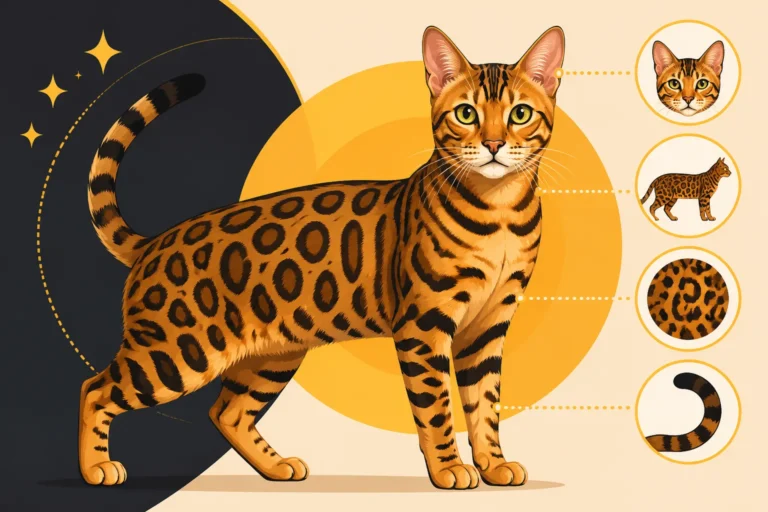
Think about the everyday realities too. A cat’s activity level, comfort around people, and ability to settle into a home cannot be judged from dramatic photographs. If a seller emphasizes appearance while avoiding questions about temperament, health, or documentation, that imbalance deserves attention. For context on breed expectations, read What a Bengal Cat Looks Like by the Standard.
Why breeders and owners treat new wild crosses cautiously
Welfare and handling can be more complicated
Wild felines are not simply domestic cats with unusual markings. Bringing one into a breeding program can raise additional questions about appropriate housing, handling, veterinary care, socialization, and the needs of both the wild parent and the kittens. The relevant standards may be more demanding than those for an ordinary companion-cat breeding setup.
A kitten’s behavior also cannot be reliably predicted from a seller’s promise that it will “act just like a Bengal.” Early-generation hybrids may have different needs and may not be a suitable match for a typical household. A buyer should think carefully about whether the home, experience, and local support are appropriate—not just whether the kitten looks appealing.
Ethical concerns are not settled by a dramatic coat or a claim of preserving a breed. Consider where the wild parent came from, whether the breeding serves a clear welfare purpose, and whether the animals can be cared for throughout their lives. Whether Breeding Hybrids Like the Bengal Cat Is Ethical explores those broader questions.
Be wary of promises that sound too simple
Claims such as “the registry allows all wild crosses,” “the kitten is legal everywhere,” or “the wild percentage is guaranteed by appearance” should prompt follow-up questions. Registration rules, local laws, and pedigrees are distinct, and no coat pattern can substitute for records.
Be cautious with sellers who offer an unusual cross but cannot identify the registry or provide a verifiable pedigree. The same applies when a breeder gives changing explanations about generation or refuses to state clearly whether the kitten is a recognized Bengal. Written records help you assess the claim before you are emotionally or financially committed.
The most sensible approach is to separate what the breeder says from what can be confirmed. Verify registration with the named organization, check applicable laws where the cat will live, and seek qualified advice if permits or hybrid status are involved. If any part remains unclear, waiting—or choosing a well-documented domestic Bengal from established lines—is a reasonable decision.
Disclaimer
This article is for general informational purposes only and does not constitute professional advice. Laws, prices and regulations vary by location and change over time. Consult a qualified professional for guidance on your specific situation.