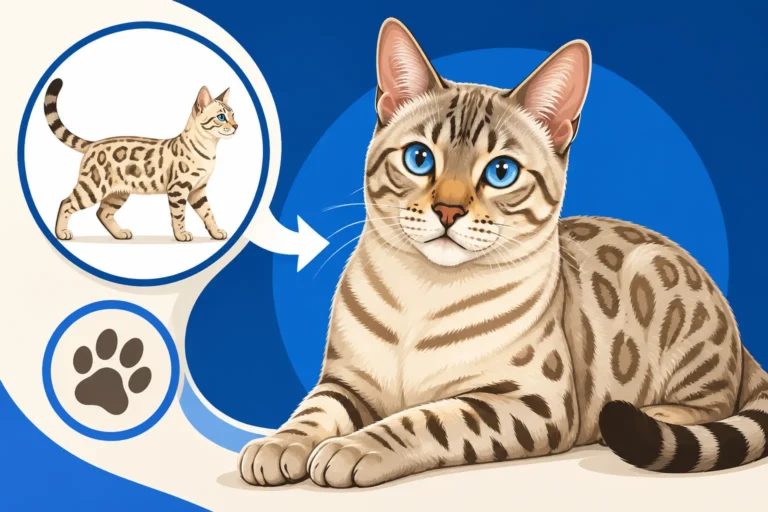
What a Donut Rosette Is on a Bengal Cat
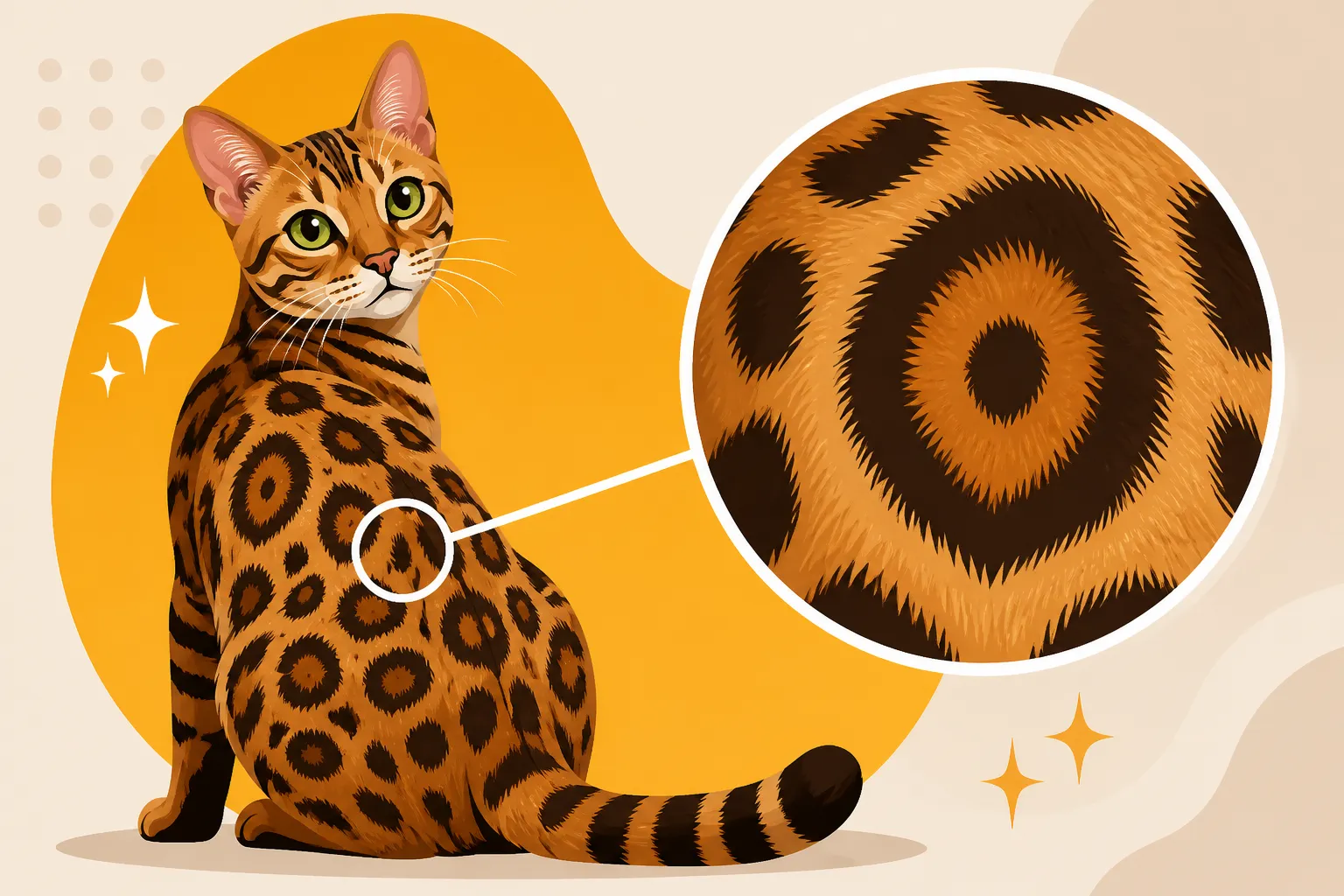
A donut rosette is a Bengal cat’s spotted marking with a dark outline that forms a ring around a contrasting center. If you are trying to tell it apart from a simple spot or another rosette shape, the key is that enclosed center. This guide explains what to look for, how the pattern differs from similar markings, and why a donut rosette alone does not determine a cat’s health or quality.
How to recognize a donut rosette
Look for a closed ring and a contrasting center
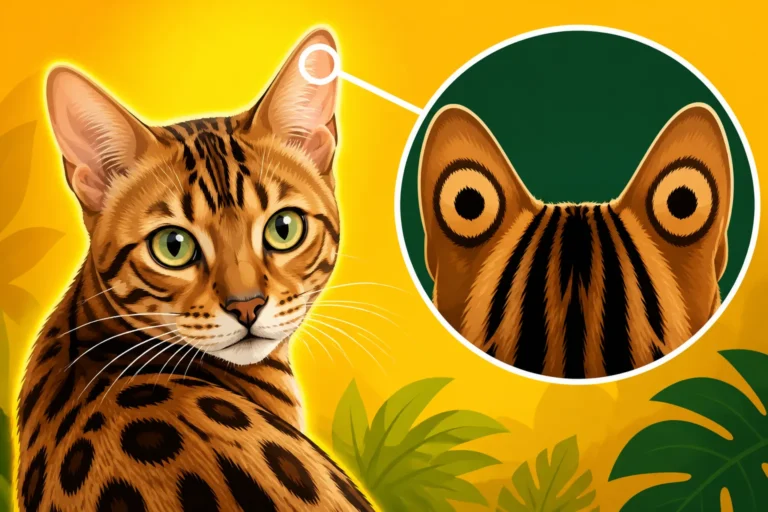
A donut rosette is generally identified by a darker outline surrounding a center that contrasts with the surrounding coat. On a brown Bengal, for example, the outline may look dark brown or nearly black, while the center appears lighter brown or golden. The exact shades vary between cats, and the same marking can look quite different in bright sunlight, indoor lighting, or photographs.
The most useful feature to look for is the shape of the marking, not whether it looks perfectly round. Donut rosettes may be oval, stretched, or irregular. Their outlines can also vary in thickness. If the darker border closes around the center, giving the marking a ring-like appearance, it may be described as a donut rosette.
This is different from a single spot, which is usually one solid mark without a distinct center enclosed by a darker border. If you are comparing pattern types, What a Rosette Is on a Bengal Cat explains the broader term, while What a Single Spotted Bengal Cat Is covers the simpler marking that can be mistaken for a small rosette.
Check the marking across the whole coat
A Bengal’s pattern is not always uniform from shoulder to hip. The markings on the back may be more noticeable than those on the sides, and spots can vary in size, direction, and clarity. The chest, legs, and tail may have their own patterns. So, one ring-shaped mark does not necessarily tell you how the cat’s entire coat should be described.
Look at several markings rather than choosing one especially clear example. Do you see multiple spots with a darker outline and a paler center? Are they spread across the flanks, or is the ring effect limited to one or two marks? Viewing the coat from different angles can help, because a pale center may blend into the base coat in a dim room.
Photographs can make this harder. A flash may brighten the center or flatten the contrast, while shadows can make a broken marking look closed. If you are assessing a kitten from pictures, ask for clear, natural-light photos of the sides and back, and remember that a close-up cannot show the full pattern. What the Bengal Cat Standard Asks For offers wider context on the features considered when a Bengal is evaluated.
Do not expect every rosette to look identical
Rosettes are individual markings, not stamped shapes. One cat may have several obvious rings, alongside less distinct or differently shaped marks. Even on the same cat, the outline of one rosette may be broad and bold while another is narrow or uneven. That variation is normal.
The name “donut” is a practical description of appearance, not a promise that every marking will form a smooth, symmetrical circle. A rosette with a slightly uneven edge may still have the defining ring-and-center look. If you are unsure, compare the overall structure of several marks rather than judging a single marking as if it were a perfect diagram.
How donut rosettes differ from other Bengal markings
The terms used to describe Bengal patterns can be confusing, especially when a cat has several kinds of markings at once. “Rosette” is an umbrella description for a marking with contrasting parts; names such as donut, paw print, or arrowhead describe different visual shapes. The categories help people talk about patterns, but they do not mean that every mark fits neatly into one box.
| Marking type | What to look for | Common point of confusion |
|---|---|---|
| Donut rosette | A darker outline enclosing a contrasting center | A large spot can look ring-shaped in a shadow |
| Single spot | A relatively solid mark without a distinct enclosed center | A small or blurred rosette may look solid in a photo |
| Paw print rosette | A central area with smaller dark markings along part of its edge | It may be mistaken for an incomplete donut |
| Arrowhead rosette | A marking with a pointed or directional shape | Its outline can vary and may not look like a neat arrow |
| Marbling | Flowing, connected bands or swirls across the coat | A patch of marbling can be mistaken for an unusually large spot |
Donut rosette versus paw print rosette
A paw print rosette is often described as a contrasting central area with smaller dark marks clustered along one part of its border. It can resemble a footprint, though the shape is not necessarily a tidy paw. A donut rosette, by contrast, is usually recognized by a more continuous outline surrounding its center.
In real coats, there can be overlap in appearance. A rosette may have a partly broken border or a shape that looks more like one type from one angle than another. That is why pattern labels should be treated as helpful descriptions rather than precise scientific categories. For a closer look at the paw-print form, see What a Paw Print Rosette Is on a Bengal Cat.
Donut rosette versus arrowhead rosette
An arrowhead rosette is described by its pointed or directional appearance. The outline and center may create a shape that looks like an arrowhead, but the overall marking can still vary from cat to cat. A donut rosette’s more characteristic feature is the enclosed, ring-like outline rather than a point.
Some Bengal markings will not look like a textbook example of either shape. A cat may have several rosettes with different forms, and individual markings may be difficult to name. If you are comparing them, focus on the broad visual difference: closed ring around a center for a donut, pointed direction for an arrowhead. What an Arrowhead Rosette Is on a Bengal Cat describes that second shape in more detail.
Rosettes versus marbling
Marbling is made up of flowing bands and swirls rather than a collection of separate ring-like spots. A marbled Bengal may have dramatic, connected markings across the body, while a rosetted Bengal tends to show distinct spots or rosette shapes. The distinction is often clearest when you step back and view the coat as a whole.
Some coats can have markings that look more connected in one area than another, so a close-up may be misleading. Look at the flanks and back together, and note whether the pattern reads as separate outlined spots or as broader, flowing shapes. How Marbling Differs From Rosetting in a Bengal Cat explains the difference between those overall pattern styles.
What donut rosettes say about a Bengal cat
They describe appearance, not personality or health
A donut rosette is a coat-pattern description. It does not, by itself, tell you whether a Bengal will be more active, affectionate, vocal, or easy to live with. Nor does the shape of a rosette diagnose a health condition. A cat with striking markings still needs the same thoughtful care, veterinary attention, and suitable home environment as any other Bengal.
It is easy to get swept up in a kitten’s dramatic pattern, especially when a photograph makes the coat look unusually crisp. But temperament and health are better considered through a broader picture: the cat’s behavior, early socialization, veterinary records, and the breeder’s practices. For health-related questions, What a Bengal Cat Breeder Should Have Tested is a more useful starting point than coat appearance.
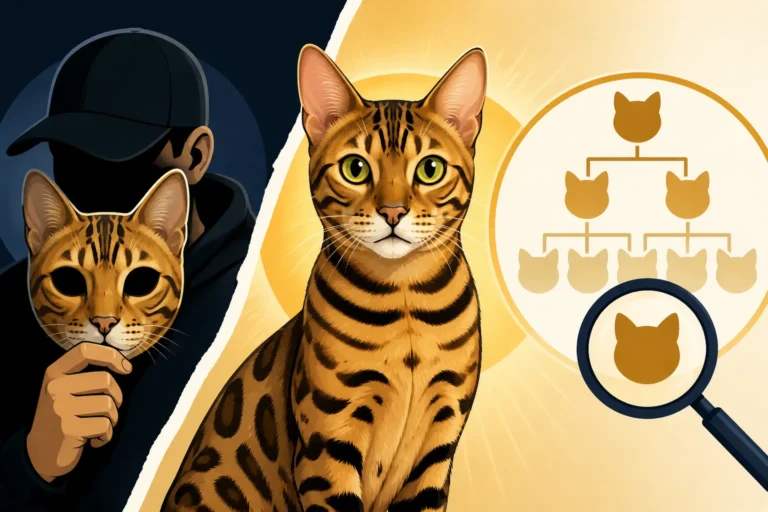
Pattern alone also cannot confirm that a cat is a Bengal. Spotted domestic cats and mixed-breed cats can have beautiful coats too. Registration and pedigree information, when relevant, are separate from the visual pattern. Whether a DNA Test Confirms a Bengal Cat discusses why appearance and breed identification are not the same thing.
A kitten’s markings can look different as it grows
Bengal kittens may go through a stage when their coats appear softer or less sharply defined. This is often called the “fuzzy” stage. As the kitten matures, the coat can become clearer and the contrast between the base color, center, and darker outline may be easier to see. That does not mean every rosette will develop into a perfectly defined ring.
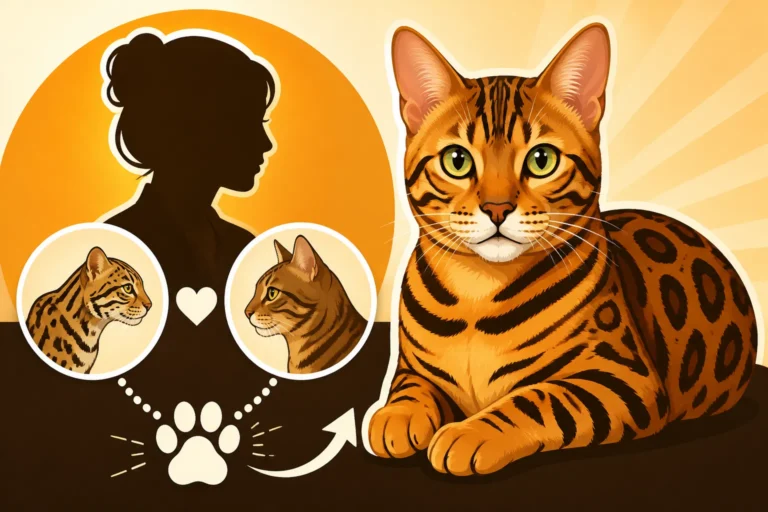
When assessing a young kitten, avoid treating a temporary photograph or a single unclear marking as a final verdict on the adult coat. Ask how the breeder describes the kitten’s pattern, but also look at its parents or older relatives if that information is available. Family patterns can offer context, although they do not guarantee the exact markings a kitten will have later.
Coat pattern is one part of the Bengal’s appearance, alongside color, contrast, body type, and other features. If you want to learn how the coat’s markings are viewed more broadly, Rosetted Against Marbled: The Two Bengal Cat Patterns provides a wider overview of the two familiar pattern styles.
A dramatic pattern is not automatically a better fit
A high-contrast coat may attract attention, but the best choice of cat is not necessarily the one with the most visually striking rosettes. Think about the match between the cat’s needs and your day-to-day life: how much interaction you can offer, whether your home can be made secure, and how you will provide play and enrichment. Those practical questions matter regardless of whether the coat has donut, paw print, or arrowhead markings.
If you are choosing a kitten, ask questions that go beyond appearance. Find out what the kitten has been exposed to, how it responds to handling, and what support the breeder provides after placement. A clear description of the coat is helpful, but it should sit alongside honest information about health, behavior, and care.
Caring for a Bengal’s coat and enjoying the pattern
Keep coat care simple and gentle
A Bengal’s short coat usually does not require elaborate grooming. A gentle brush or grooming mitt can help remove loose hairs and give you a chance to check the skin, but brushing should be comfortable for the cat. Start with brief sessions and stop if your Bengal becomes tense or tries to move away. Grooming is not a way to create or sharpen a rosette; the pattern is part of the coat’s natural appearance.
If you need basic supplies, a pet retailer such as Chewy may offer grooming mitts and soft brushes, but choose a tool your cat tolerates rather than buying one because it is marketed for a particular breed. You can also ask your veterinarian or groomer what is appropriate if your cat has sensitive skin or reacts badly to brushing.
Use good lighting when looking at the pattern
Natural, indirect daylight is usually more helpful than a strong flash for seeing coat contrast. Let the cat stand or move normally rather than trying to hold it in one position for a perfect picture. A relaxed cat is easier to observe, and forcing a photo session can quickly turn a harmless curiosity into an unpleasant experience.
If you are documenting how a kitten’s coat changes, use similar lighting and angles each time. That makes comparisons more meaningful than alternating between a sunny window, a dim room, and flash photography. Keep the goal realistic: you are observing the coat, not measuring a cat against a perfectly uniform pattern.
Chewy and other pet stores may carry lint rollers and washable throws that are handy for keeping a favorite viewing spot tidy, but they will not affect the markings themselves. Bengal coats can look especially glossy in certain light, which may make the dark borders appear stronger in one image than another.
Enjoy the markings without turning them into a scorecard
It is fine to have a favorite pattern, and donut rosettes can be especially eye-catching because the darker outline makes the center stand out. Still, no single rosette shape determines whether a Bengal is a good companion. A cat’s comfort, health, and relationship with its household are far more important than whether every mark is symmetrical or easy to label.
If you are comparing photos or asking a breeder about a kitten, use “donut rosette” as a descriptive term and invite a clear explanation of what you are seeing. A thoughtful answer should help you understand the coat without suggesting that pattern alone guarantees show success, a particular temperament, or superior health. That keeps the conversation grounded in what the marking can actually tell you: how the coat looks.
Disclaimer
This article is for general informational purposes only and does not constitute professional advice. Laws, prices and regulations vary by location and change over time. Consult a qualified professional for guidance on your specific situation.