What a Paw Print Rosette Is on a Bengal Cat
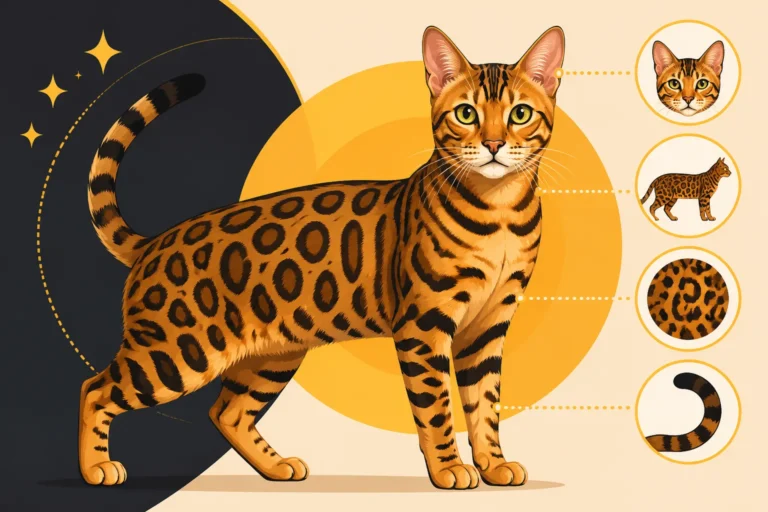
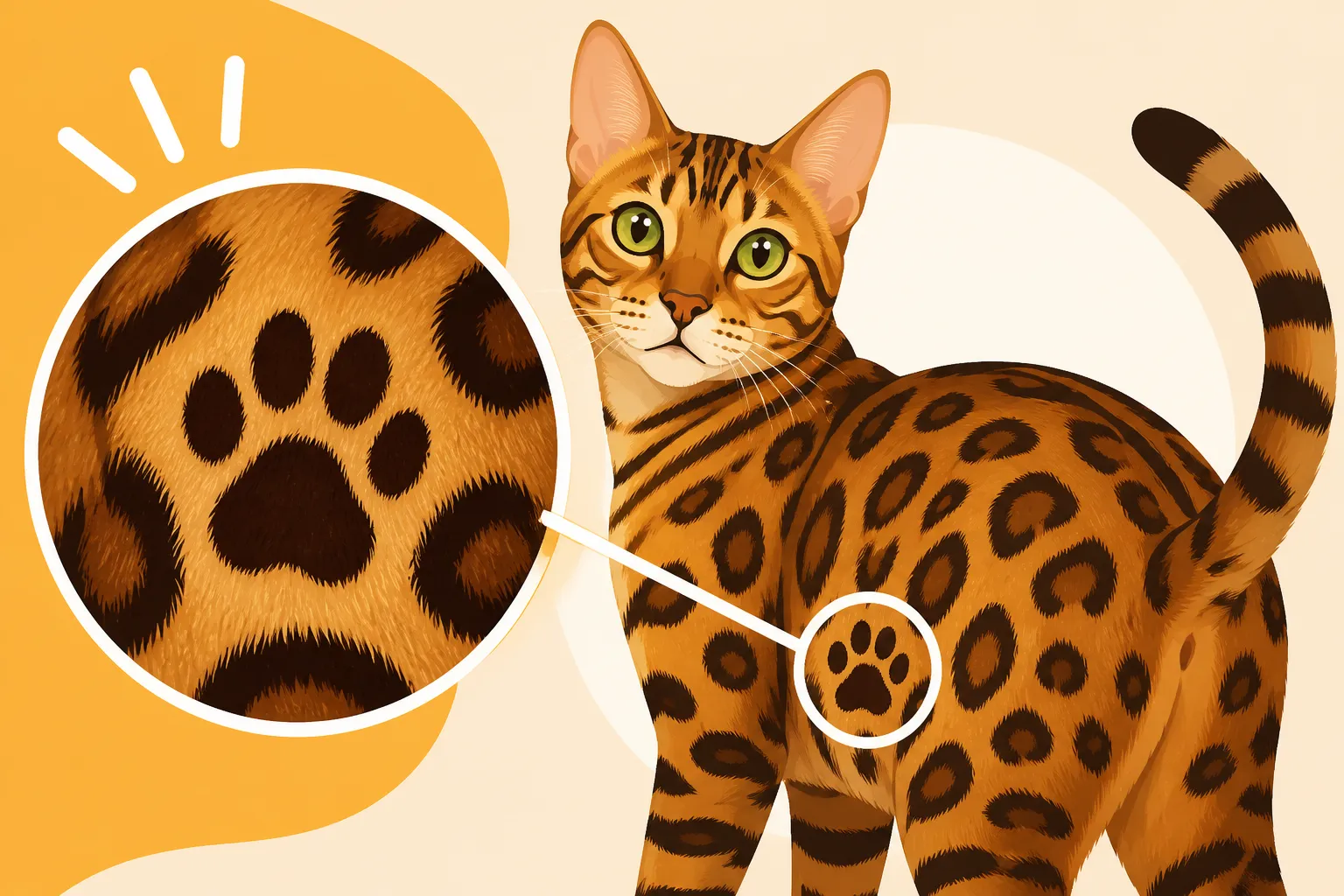
A Bengal’s paw print rosette can look like a tiny dark paw stamped onto its coat: a darker outline surrounds a lighter center, often with one or more smaller spots inside. The name describes a visual pattern, not a separate color or health trait. This guide explains how to recognize one, how it differs from other markings, and what to expect as a Bengal kitten’s coat develops.
How to recognize a paw print rosette
Look for a dark border and a lighter center
A rosette is a marking made up of more than one shade. In a paw print rosette, the darker outer edge forms a loose outline around a lighter patch, while small dark spots inside that patch can create the impression of a paw and toes. The result is more layered than a single solid spot.
The shape does not need to look like a perfect paw. On one cat, the outline may be open or uneven; on another, the inner spots may be small and close together. Coat patterns are made of natural variations, so markings can differ across the same cat’s body. A rosette on one side may look especially clear, while a similar one nearby appears less defined.
It helps to inspect several markings rather than deciding from one unusual spot. Look across the flank and back, where the pattern is often easiest to see. A phone photo taken in natural daylight can help, too: indoor lighting and a moving cat can make a lighter center appear darker or blur the outline.
The label describes appearance, not a special gene
“Paw print” is a descriptive name for a rosette’s look. It does not mean that the marking is a separate breed variety, a sign of a particular health condition, or proof of a specific family line. Bengal coat appearance is influenced by inherited traits, but one marking alone does not reveal a cat’s complete genetic background.
Names for rosette shapes are useful shorthand, especially when people are comparing photos or talking about a cat’s pattern. They are not always used with perfect consistency, though. Two breeders or Bengal owners may use slightly different words for markings that look broadly similar.
For a wider introduction to the marking, see What a Rosette Is on a Bengal Cat. It can also help to compare rosettes with the other broad pattern family described in Rosetted Against Marbled: The Two Bengal Cat Patterns. The key distinction is that rosettes have a more enclosed, spot-like structure, while marble patterns form flowing, swirled shapes.
How paw print rosettes compare with other Bengal markings
Paw print, donut, and clouded rosettes
Paw print, donut, and clouded are common names for different rosette appearances. A donut rosette usually has a more noticeable ring-like border around a lighter middle. A paw print rosette tends to have smaller spots within the lighter center, giving it a clustered appearance. A clouded rosette may look broader and more irregular, with a soft, layered shape rather than a neat ring.
These names are visual categories, not rigid boxes. A rosette can be somewhere between two descriptions, and its appearance may change depending on the direction of the hair, the lighting, and how much contrast there is between the colors. It is perfectly normal for a Bengal to have a mixture of rosette shapes rather than one identical type repeated across the coat.
If you want to compare examples, What a Donut Rosette Is on a Bengal Cat and What a Clouded Rosette Is on a Bengal Cat explain those shapes separately. Keep in mind that a photo can exaggerate or hide features: a dark center shadow, for example, may make an open marking look more enclosed than it does in person.
Rosettes and single spots are not the same
A single spot is typically a solid-looking mark without a clearly contrasting center and outer border. A rosette, by comparison, has at least two tones arranged in a more complex shape. From a distance, the two can look similar, especially if the rosette’s inner area is small or the coat has low contrast.
One practical way to tell them apart is to look closely at the edge and middle. Does the marking have a darker outline and a noticeably lighter center? Are there smaller spots within that center? Those features suggest a rosette. If it appears to be one uninterrupted spot, it may be a single spot instead. Some cats have markings that are hard to classify from a quick glance, and that does not make their coat any less Bengal-like.
For another comparison, see What a Single Spotted Bengal Cat Is. Breed descriptions focus on the overall pattern and coat, not on whether every individual mark fits neatly into a named category. A cat may have rosettes alongside less distinct spots, especially in areas where the markings fade or blend together.
| Marking type | Typical appearance | What to look for |
|---|---|---|
| Paw print rosette | Dark outline with a lighter center and smaller dark marks inside | A clustered, paw-like impression |
| Donut rosette | Dark, ring-like border around a lighter middle | A more continuous outline |
| Clouded rosette | Broad, irregular, layered shape | A softer or less ring-like structure |
| Single spot | One solid-looking mark | No clear contrasting center-and-border pattern |
| Marble pattern | Flowing, swirled bands or shapes | Long, connected lines rather than separate rosettes |
How a kitten’s pattern changes as it grows
Fuzzy kitten coats can make markings hard to judge
Bengal kittens can go through a fuzzy-looking phase in which their coats appear softer, hazier, or less sharply patterned than an adult’s. This can make a paw print rosette look faint or indistinct, particularly in photos. The pattern may still be there; it is simply harder to see clearly while the kitten’s coat is changing.
A kitten’s early appearance is not always a reliable preview of every detail of its adult coat. The markings may become more visible as the coat matures, while contrast and definition can look different from one growth stage to another. A breeder’s photos of earlier litters can sometimes show how kittens from that line developed, but no photo can guarantee the exact adult look of an individual cat.
For more on that transition, read When a Bengal Cat's Adult Pattern Comes Through. It is useful context if you are comparing a young kitten with photos of mature Bengals and wondering why their markings seem so different.
Pattern names should not be treated as promises
People sometimes expect every rosette on a Bengal to be sharply outlined and perfectly paw-shaped. That is a lot to ask of a natural coat pattern. Some markings are highly defined; others are uneven, partially open, or subtly shaded. A coat can still be attractive and recognizable without having uniform markings across every part of the body.
This is especially worth remembering when choosing a kitten from photographs. Camera exposure, shadows, and the kitten’s pose can all affect how the coat appears. Ask for clear images in ordinary light and, if possible, photos from more than one angle. A close-up of one striking rosette tells you less about the whole coat than a few views showing the sides, back, and shoulders.
A breeder or owner may describe a kitten’s markings using terms such as paw print, donut, or clouded, but those labels are best understood as shorthand. They should not replace looking at the cat’s overall appearance, temperament, health information, and fit for your household.
What paw print rosettes mean for appearance and care
A rosette is a coat feature, not a care requirement
Paw print rosettes do not need special grooming, treatment, or protection. They are part of the coat’s natural pattern. A healthy Bengal’s markings are not something to enhance with dye, trimming, or products intended to change the coat’s color. If a marking seems to change suddenly alongside hair loss, irritated skin, or a sore, that is different from ordinary pattern variation and is worth discussing with a veterinarian.
For routine coat observation, choose good light and let the coat lie naturally rather than rubbing or wetting it to make a marking easier to see. A gentle grooming glove can lift loose hair, but Bengals generally do not need elaborate grooming just to show their pattern. If you are comparing grooming tools, Chewy is one place where owners may browse soft gloves or basic brushes; focus on a comfortable, cat-safe tool rather than one marketed as a way to alter coat appearance.
If your cat dislikes being handled, do not force a photo session or grooming routine simply to inspect its markings. You can observe the coat during a relaxed moment, such as when the cat is stretched out on a sunny floor. A few calm snapshots over time are often more useful than trying to hold a wriggly kitten still.
Overall breed appearance matters more than one rosette
A Bengal’s appearance is considered as a whole: coat pattern, contrast, color, body, and general presentation all contribute. A paw print rosette can be a distinctive detail, but it is not the only feature that defines a Bengal or determines whether a cat meets a particular show standard. For the broader context, What a Bengal Cat Standard Asks For explains how breed standards describe the overall look.
If you are preparing to visit a show or simply want to understand how people discuss coat patterns, remember that judges evaluate the whole cat according to the relevant standard. They are not judging a single mark in isolation. Which Rosette Type Judges Prefer in a Bengal Cat offers more detail on how rosette shapes may be discussed in that setting.
For everyday owners, the most useful approach is much simpler: enjoy the coat your cat has. A paw print rosette may be especially striking, but irregular markings and mixed pattern types are part of the natural variety that makes individual Bengals look different from one another. Chewy’s grooming listings may help you compare gentle tools if you need one for basic coat care, but no brush can create a rosette or make a natural marking more symmetrical. And if you are shopping for supplies, Chewy is a retailer to check for ordinary grooming basics—not a source of special products needed to maintain the pattern.
Disclaimer
This article is for general informational purposes only and does not constitute professional advice. Laws, prices and regulations vary by location and change over time. Consult a qualified professional for guidance on your specific situation.