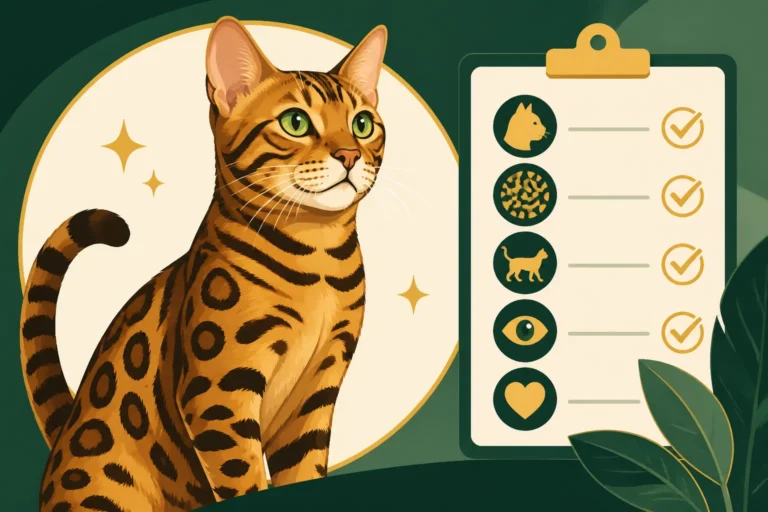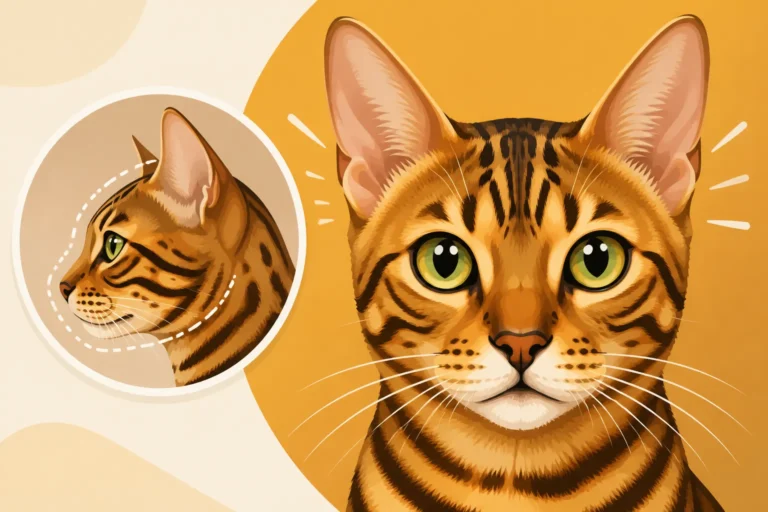
What a Single Spotted Bengal Cat Is
A Bengal with small, solid-looking spots can be confusing to identify, especially when online photos make every coat look rosetted. A single-spotted Bengal has distinct spots rather than markings with a clearly different-colored center. This guide explains how to recognize the pattern, how it differs from rosettes and what the coat can—and cannot—tell you about a cat.
What a single-spotted Bengal looks like
Solid spots across a contrasting coat
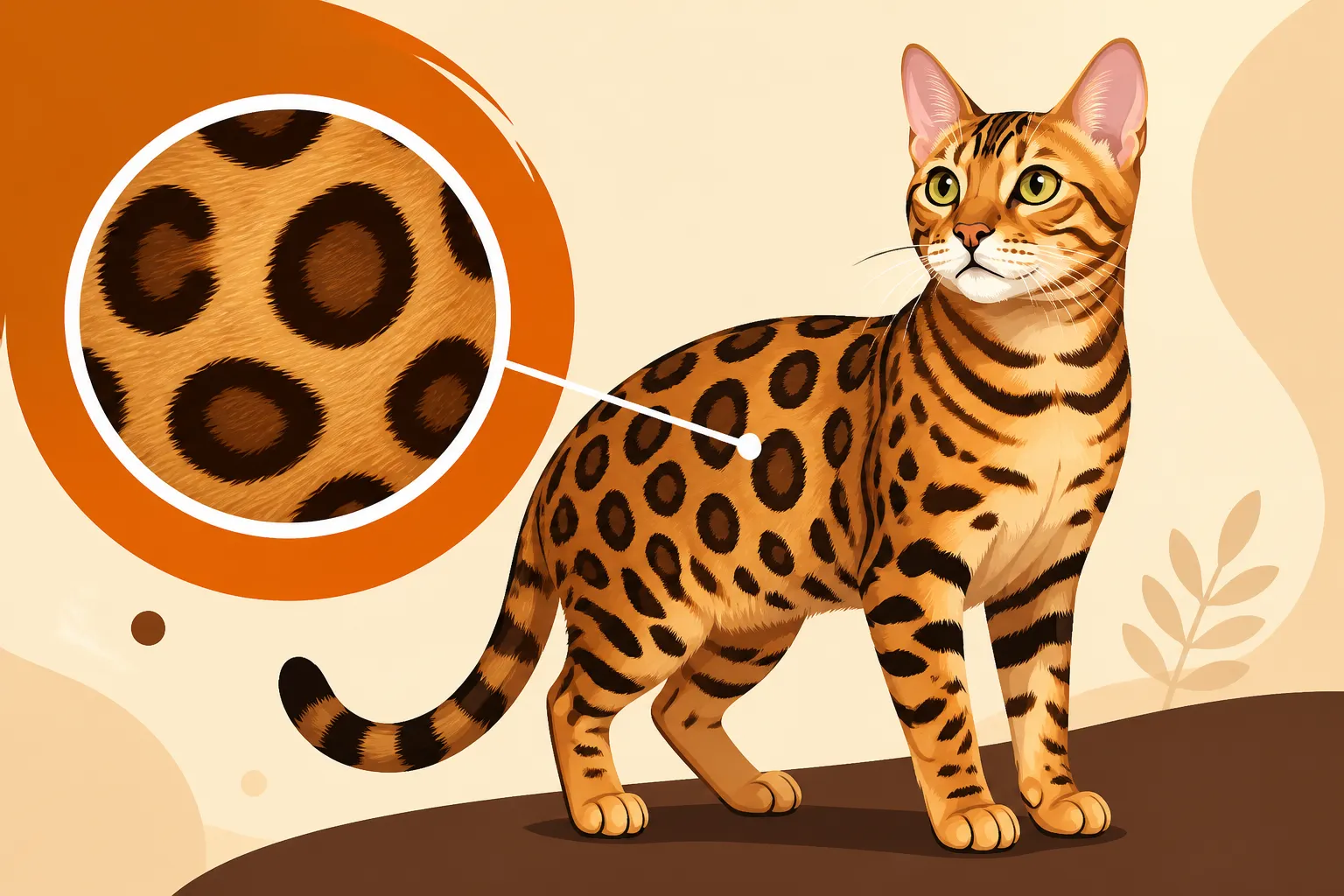
The phrase “single-spotted” describes the appearance of a Bengal’s markings: individual spots look like one solid color against a lighter or otherwise contrasting background. Depending on the cat, the spots may be round, oval, elongated or irregular. Their size and spacing can vary across the body.
The word “single” is about the structure of each marking, not the number of spots. A single-spotted Bengal can have markings over much of its body, including its sides, shoulders and legs. The shape may look less tidy than the spots on a cartoon big cat, and the pattern does not have to be perfectly even from one side to the other.
Bengal coats come in different colors and levels of contrast, so the same basic pattern can look quite different from one cat to another. A dark spot on a warm brown coat is easy to pick out, while markings on some lighter coats may be more subtle in indoor lighting. A clear photo taken in natural light can help you see the coat’s details more reliably than a flash photo or heavily edited image.
The pattern is not a measure of breed purity
A spotted coat alone cannot confirm that a cat is a Bengal. Many domestic cats have spots or broken tabby markings, and a cat that resembles a Bengal may be a mix or a spotted domestic shorthair. Pedigree records and trustworthy breeder documentation are more useful for establishing breed background than appearance alone.
The reverse is also true: a Bengal does not have to show large, dramatic rosettes to be a Bengal. Single spots are one of the ways Bengal markings can appear. To understand how the breed’s overall appearance is described, see What a Bengal Cat Looks Like by the Standard. For more on how spots relate to other coat markings, Rosetted Against Marbled: The Two Bengal Cat Patterns provides helpful context.
It is also worth remembering that photographs can exaggerate differences. Lighting, coat condition, camera angle and image processing all affect how dark or sharply defined spots appear. If you are evaluating a kitten, ask to see clear, unfiltered photos and, when possible, observe the cat in person.
Single spots compared with rosettes
The main visual difference
A rosette is a marking with a darker outline and a visibly lighter or differently colored center. It can look like a small ring, an open circle or an irregular patch. A single spot, by contrast, appears mostly filled in with one color rather than having that distinct two-tone structure.
| Feature | Single spots | Rosettes |
|---|---|---|
| Appearance | Mostly solid markings | Markings with a darker edge and a different-looking center |
| Shape | Round, oval, elongated or irregular | Ring-like, paw-shaped, arrowhead-like or cloud-like |
| Contrast | Depends on the spot and background colors | Often comes from contrast between the outline and center |
| What the term describes | The visible marking pattern | A particular kind of marking |
| What it proves | Coat appearance only | Coat appearance only |
The distinction may seem obvious in a sharp photograph, but some coats sit in a visual middle ground. A spot can have a subtle interior shade without looking like a classic rosette. Conversely, shadows or uneven lighting can make a solid spot look like it has a darker rim. Look at several markings across the cat’s body rather than making a decision from one patch.
For a closer look at the terminology, What a Rosette Is on a Bengal Cat explains the basic structure of a rosette. The important point is not to treat “spotted” and “rosetted” as interchangeable: rosettes are a type of marking, while single spots are solid-looking markings.
Why coat pattern names can be confusing
Everyday descriptions do not always match the exact language used by breeders, registries or show communities. One person may call a cat “spotted” because the coat has visible spots; another may say “single-spotted” to distinguish those markings from rosettes. In casual conversation, the terms may be used loosely.
If you are speaking with a breeder, ask what they mean by the description and request photos showing the cat’s sides, back and legs. If you are looking at a show listing, check the applicable organization’s terminology rather than assuming that a label has the same meaning everywhere. What a Single Spotted Bengal Cat Is is a useful reference point for the everyday term, but a label by itself does not establish show quality or pedigree.
A pattern description also does not tell you whether a cat will be a good match for your home. Temperament, health history, socialization and your ability to meet the cat’s needs matter far more than whether its spots are solid or open in the middle.
How a Bengal kitten’s spots can change
Kitten coats are works in progress
A Bengal kitten’s coat can look less defined than an adult’s. Some kittens have a soft, muted appearance during early development, and their markings may become easier to assess as the coat changes. The effect can make a kitten look less sharply spotted in one photo and more contrasted in another taken later.
That does not mean every kitten will develop a particular pattern or that an adult coat can be predicted perfectly from a very young age. Spot shape, spacing and contrast vary. A breeder may be able to explain what they have observed in the kitten and its relatives, but no one should promise an exact adult appearance based only on a brief look at a very young kitten.
When comparing photos, use similar lighting and angles if possible. A picture taken in bright window light can reveal markings that disappear in a dim room. Ask for images of both sides of the kitten, since patterns are not always identical on each flank.
Color affects how easy spots are to see
Bengals come in several recognized colors, and the background color changes how the spots read. A high-contrast coat may make individual markings seem bold and obvious. A lower-contrast coat can make the same general pattern look softer, particularly in a snapshot.
The color category and the marking pattern are related parts of the appearance, but they are not the same thing. A cat can be single-spotted in one color, or single-spotted in another. To explore the range of coat colors, see Which Colors a Bengal Cat Comes In. Avoid assuming that a particular color automatically means a particular spot shape.
If you are shopping for a kitten, focus on truthful descriptions rather than dramatic claims. Ask what the breeder means by “single-spotted,” whether the kitten’s coat is likely to change as it matures, and whether the photos show the kitten without filters. A careful answer is more useful than a promise that the cat will develop a specific look.
Choosing and caring for a single-spotted Bengal
Pattern does not create special grooming needs
A single-spotted Bengal does not need a special grooming routine because of its spots. The markings are a coat pattern, not a separate coat type. Routine care is still about keeping the coat and skin in good condition, checking for changes and helping the cat become comfortable with basic handling.
Gently run your hands over the coat now and then, and look for irritation, bald patches, unexpected lumps or other changes. If something seems unusual, ask a veterinarian rather than trying to diagnose it from the pattern. For general coat-care expectations, A Bengal Cat Needs Almost No Grooming offers more detail.
Some Bengals are energetic and enjoy interactive play, regardless of whether their coats are spotted or rosetted. If you are preparing for a new cat, think about sturdy play options and places to scratch. Chewy is one retailer where owners can compare wand toys and scratching products, but check the product’s construction and suitability for your individual cat rather than choosing based on appearance alone.
Look beyond markings when choosing a cat
A beautiful pattern can catch your eye, but it should not be the main reason you choose a kitten. Ask about veterinary care, socialization, the kitten’s daily routine and the health information available for its parents. A responsible breeder should be willing to discuss the cat’s background and answer reasonable questions without pressuring you to decide immediately.
It can help to make a short list before contacting a breeder:
- Ask how the breeder defines the kitten’s pattern.
- Request clear photos in natural light, including views of both sides.
- Ask what health records and pedigree documents are available.
- Ask how the kitten has been socialized and what care it is used to.
- Consider whether the cat’s activity level and needs fit your household.
Once the cat is home, give it time to settle in. A new Bengal may explore, climb and investigate far more than you expect, so prepare the space before arrival. Chewy can be a convenient place to compare enrichment supplies, but a safe room, patient introductions and regular interaction are just as important as the gear you buy. If you are deciding whether a Bengal fits your lifestyle, Whether a Bengal Cat Is Right for You can help you think through the bigger picture.
Common misconceptions to avoid
“A single-spotted Bengal is not a real Bengal.” A single-spotted coat is a pattern description, not evidence against the cat’s breed. Breed background should be assessed through reliable records, not a preference for rosettes.
“Single spots are always perfectly round.” They may be round, but they can also be oval, stretched or irregular. The key distinction is that they look solid rather than clearly open-centered.
“A striking pattern guarantees a show-quality cat.” Appearance is only one consideration in show evaluation, and standards vary by organization. A dramatic coat does not tell you everything about structure, condition, temperament or documentation.
“The coat tells me what the cat will be like.” Spots do not predict personality. Ask about the individual cat’s behavior and needs instead of assuming that its markings determine its temperament.
Finally, if you are browsing supplies while preparing for a Bengal, Chewy listings can help you compare options such as interactive toys or scratchers. Read descriptions carefully, and choose equipment that is stable, appropriately sized and suited to how your cat actually plays.
Disclaimer
This article is for general informational purposes only and does not constitute professional advice. Laws, prices and regulations vary by location and change over time. Consult a qualified professional for guidance on your specific situation.