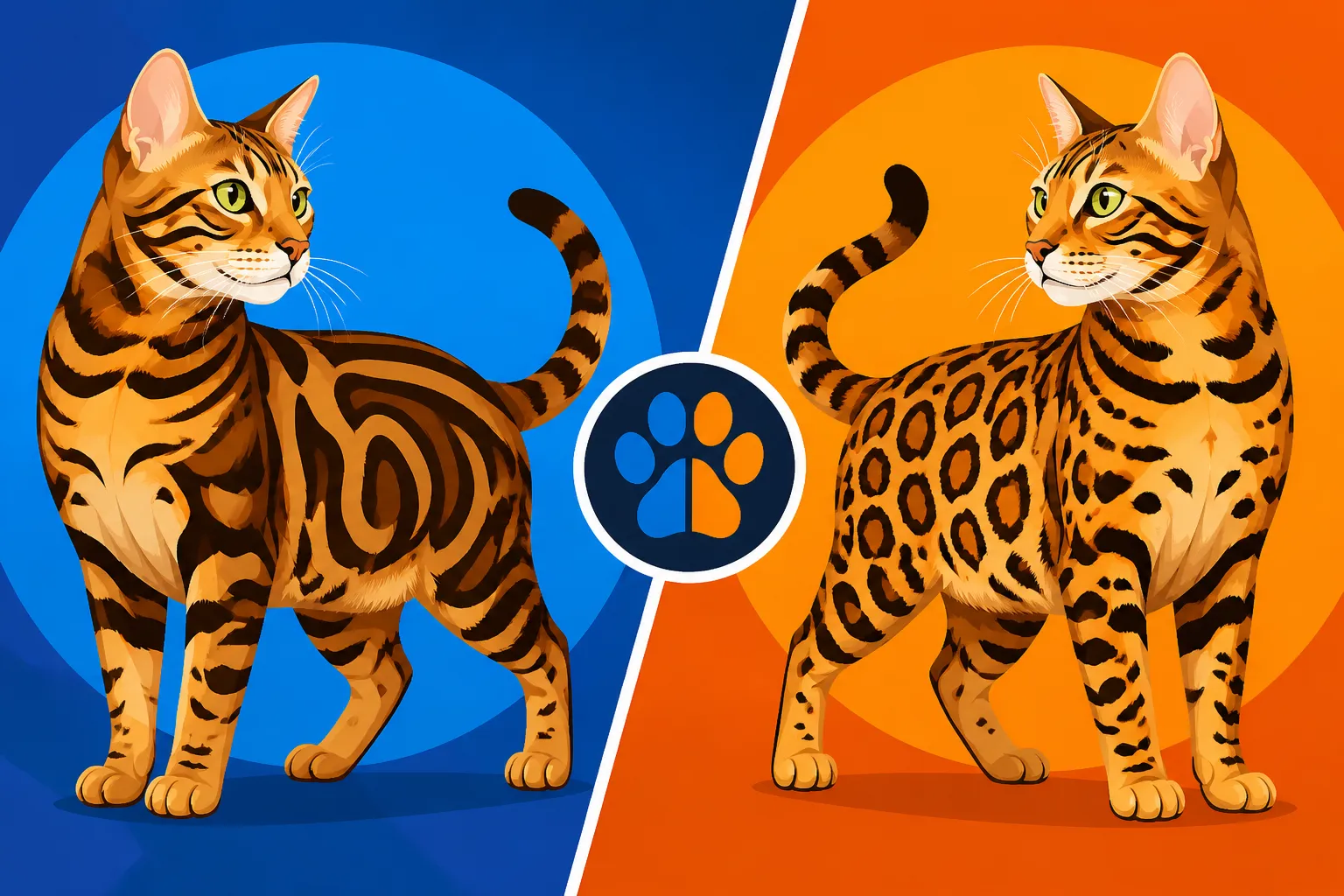
How Marbling Differs From Rosetting in a Bengal Cat
A Bengal cat’s coat can look like a field of flowing ribbons, a scatter of dark spots, or a set of dramatic outlined marks. If you’re trying to tell marbling from rosetting, the difference can be harder to see in kitten photos or under indoor lighting. This guide explains what each pattern looks like, how they develop, and what to notice without confusing coat style with breed quality.
The basic difference between marbling and rosetting
What marbling looks like
A marbled Bengal has broad, flowing markings that sweep across the body in curves, swirls, and elongated shapes. Rather than reading as separate dots, the pattern often resembles ribbons or pools of color laid over the lighter background coat. The markings may stretch along the cat’s sides, shoulders, and back, creating a sense of movement.
Marbling varies from cat to cat. Some cats have large, open areas of contrasting color, while others have a busier pattern with narrower lines and smaller shapes. The markings can be symmetrical or irregular, and they may look especially different depending on whether the cat is standing, curled up, or stretching.
A useful way to picture the pattern is to imagine looking at a Bengal’s side and tracing the markings with your eyes. If they connect into sweeping bands and curved shapes, rather than forming distinct individual spots, you’re probably looking at marbling. For a closer look at the pattern itself, see What a Marbled Bengal Cat Is.
What rosetting looks like
Rosettes are distinct markings that resemble spots with a darker outline and a lighter center. Depending on their shape, people may describe them as donut-like, paw-print-like, or arrowhead-like. The lighter interior helps separate a rosette from a simple, solid-colored spot.
A rosetted Bengal’s markings are usually seen as separate shapes across the body, although rosettes can vary in size and definition. Some are rounder; others are more open or elongated. A cat may also have areas of smaller spots alongside larger rosettes, so the coat does not always look perfectly uniform.
If the marks appear as individual outlined patches rather than connected ribbons, rosetting is the better description. You can explore the markings in more detail in What a Rosette Is on a Bengal Cat. The broader distinction between the two coat styles is also covered in Rosetted Against Marbled: The Two Bengal Cat Patterns.
| Feature | Marbled pattern | Rosetted pattern |
|---|---|---|
| Overall impression | Flowing bands, swirls, and curves | Separate spots with darker outlines |
| How markings relate | Often connect or sweep into one another | Usually read as individual shapes |
| What to look for | Ribbon-like movement across the body | A lighter center inside a darker border |
| Common source of confusion | Dense marbling can look like irregular spots | Small or faint rosettes can look like solid spots |
| Does one automatically mean better quality? | No; the overall cat and applicable standard matter | No; the overall cat and applicable standard matter |
How to tell the patterns apart in real life
Look at the shape and connection of the markings
Start by looking at the Bengal from the side, where the pattern is often easiest to read. With marbling, your eye tends to follow lines and curves across a larger area. The shapes may seem to flow into each other, even when patches of the lighter background coat remain between them.
With rosetting, focus on individual marks. A rosette has an interior and an outline, so you can often identify it as one distinct shape. If you find yourself counting separate marks rather than following a continuous pattern, rosetting may be a better fit. This isn’t a strict test, though: real coats can have variation within the same pattern.
Lighting can make the distinction more confusing. A strong flash may wash out the lighter center of a rosette, making it look like a solid spot. In dim light, stripes or curves in a marbled coat may seem to merge into one dark area. When possible, look at the cat in natural, even light and view more than one part of the body.
Check more than one part of the coat
A single close-up can be misleading. A patch of marbling may look spotty when photographed tightly, while a section of rosetted coat can appear as a continuous pattern if the marks sit close together. Step back and look at the back, sides, shoulders, and flanks as a whole.
Also pay attention to the direction of the markings. Flowing curves that extend across the body often support a marbled description. Repeated, individually outlined shapes are more consistent with rosetting. A Bengal’s markings do not need to match each other exactly, so look for the overall pattern rather than expecting every mark to be a textbook example.
If you are comparing two cats, use similar lighting and viewing angles. One cat photographed in bright window light and another in shadow can appear to have very different levels of contrast. Photos can help, but an in-person look is often more useful for seeing whether the coat’s shapes connect or remain distinct.
Why Bengal patterns can be confusing
Kittens may not show their adult pattern clearly
Bengal kittens can look less sharply defined than adults. Their coat may appear soft, blurry, or muted during early development, and markings that later become easier to distinguish may not yet stand out. This can make it difficult to decide from a young kitten’s photo whether the adult coat will read as marbled or rosetted.
That softer appearance is often associated with a phase called “fuzzies,” when the coat can look less crisp. It does not mean that every kitten will change from one pattern type to another. Rather, a developing coat can make the pattern harder to judge until the kitten matures. For more on this stage, read What Fuzzies Are on a Bengal Cat Kitten and When a Bengal Cat Kitten's Fuzzies Clear.
When you’re evaluating a kitten, ask the breeder how they describe the pattern and whether they can show clear photos of the kitten as it grows. A breeder’s description is useful context, but it is sensible to treat early photos as a preview rather than a guarantee of exactly how the adult coat will look.
Color, contrast, and photography affect what you see
The amount of contrast between the markings and the background coat can change how clearly a pattern reads. On a cat with strong contrast, individual rosettes may stand out dramatically. On a cat with subtler contrast, the same kind of markings may look faint or blended into the background.
Camera angle matters too. A curled Bengal may hide parts of the pattern beneath overlapping fur, while a stretched cat may make bands or shapes appear longer. Editing, filters, and warm indoor bulbs can also change the apparent color of the coat. If pattern detail matters to you, look for unfiltered photographs taken in natural light, ideally from several angles.
The term “rosetted” is not simply another way to say “spotted.” A solid spot lacks the clearly lighter center typical of a rosette, though the difference may be subtle in some coats or images. Likewise, a dense marbled pattern can have isolated-looking shapes that resemble spots in one small section. It’s the overall arrangement that matters, not one mark viewed alone.
Pattern, breed standard, and choosing a Bengal
A pattern label does not tell you everything about the cat
Marbling and rosetting describe coat patterns; they do not, by themselves, tell you whether a Bengal is healthy, friendly, well socialized, or a good match for your home. A dramatic coat can catch your eye, but temperament and care needs matter much more in day-to-day life.
If you are choosing a kitten, ask about the cat’s health history, socialization, and the parents’ temperaments, as well as how the breeder describes the coat. It is reasonable to admire a particular pattern, but try not to let appearance crowd out questions about veterinary care and the environment the kitten has grown up in.
The coat is only one part of how the breed is assessed. What a Bengal Cat Looks Like by the Standard gives a broader picture of appearance, while What the Bengal Cat Standard Asks For explains why judging a Bengal involves more than choosing between marbling and rosetting.
There is no universal winner between the two patterns
Some people prefer the flowing movement of marbling; others love the bold, outlined look of rosettes. That choice is personal. Neither pattern automatically makes a cat a better companion, and the presence of rosettes alone does not establish that a Bengal is healthier or more desirable in every context.
If you are looking at a show cat, a breeder’s planned pairing, or a kitten being described in a listing, ask what the pattern terms mean in that specific context. A clear explanation should help you understand what you are seeing without promising that every marking will look identical as the cat matures. Breed standards may guide how appearance is evaluated, but they are not a shortcut for assessing the cat’s overall welfare.
It is also easy to assume that every Bengal must have bold rosettes. In reality, Bengal coats include variation, and marbling is a recognized pattern rather than a lesser version of rosetting. For a wider look at common misconceptions, see What People Get Wrong About the Bengal Cat.
Disclaimer
This article is for general informational purposes only and does not constitute professional advice. Laws, prices and regulations vary by location and change over time. Consult a qualified professional for guidance on your specific situation.