What a Melanistic Bengal Cat Is
A black Bengal can look like a sleek miniature panther, but the dark coat does not always hide its spots. A melanistic Bengal has a very dark, often black-looking coat with a pattern that may show as a subtle “ghost” in certain light. This guide explains what melanism looks like, how it differs from other Bengal colors, and what to consider when identifying one.
What a melanistic Bengal cat looks like
A dark coat with a hidden pattern
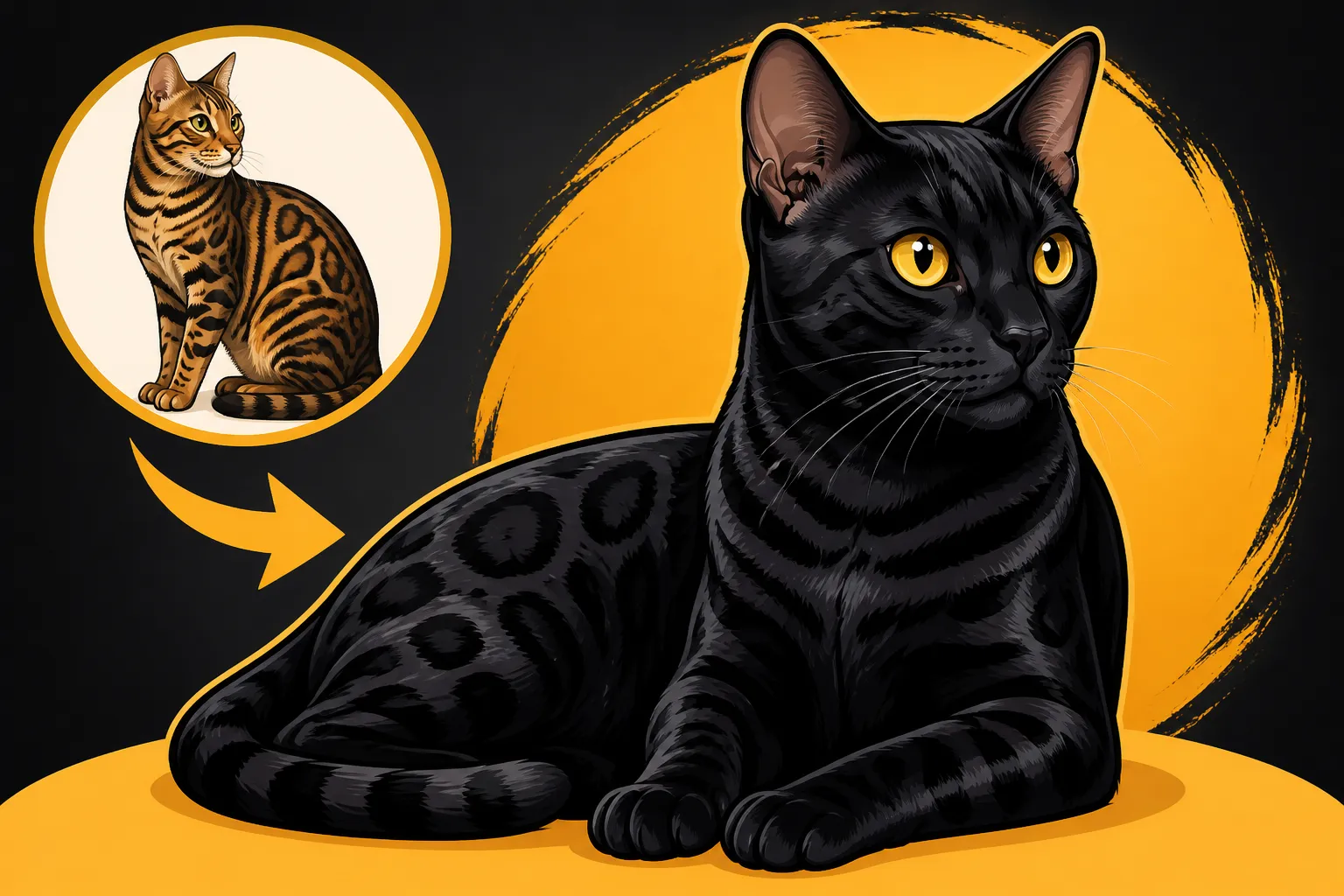
Melanistic Bengals are often described as black Bengals. Their coats can appear nearly solid black from across a room, especially in dim light. Up close, though, you may notice a darker-on-dark pattern: rosettes, spots, or marbling that becomes easier to see when sunlight or a bright lamp catches the coat.
That faint pattern is sometimes called a ghost pattern. It is not necessarily a sign that the cat’s coat is changing or that the pattern is fading. The markings are simply less contrasting against the dark background than the rosettes on a brown Bengal or the spots on a lighter-colored one.
A useful way to picture it is to imagine black ink printed on a very dark charcoal page. The shapes are there, but they do not stand out unless the light hits them at the right angle. Some melanistic Bengals have a more noticeable pattern than others, so “black Bengal” does not always mean a completely uniform coat.
The pattern itself can be rosetted, spotted, or marbled, just as Bengal patterns can vary in other colors. To understand the difference between those markings, see What a Rosette Is on a Bengal Cat, What a Marbled Bengal Cat Is, and What a Single Spotted Bengal Cat Is.
How lighting changes the way the coat appears
A melanistic Bengal may look different in photographs than in person. A close-up taken beside a bright window can reveal markings that disappear in a dim indoor photo. Direct flash, on the other hand, may flatten the coat’s appearance or create reflections that make the pattern harder to read.
If you are looking at a kitten online, ask for more than one picture. A natural-light photo, a side view, and a short video can show how the coat looks as the cat moves. In a video, the pattern may appear and disappear as the light shifts across the fur. That can be a more helpful reference than a heavily edited image or a single dramatic portrait.
Coat appearance can also change as a Bengal matures. Kittens may go through a phase when their pattern looks less crisp, and the mature coat can develop more contrast as they grow. A very young kitten’s dark appearance therefore does not always tell you exactly how its adult pattern will look.
For a wider overview of Bengal features, including body shape, coat pattern, and other physical traits, read What a Bengal Cat Looks Like by the Standard.
What melanism does not tell you
A dark coat does not, by itself, confirm that a cat is a Bengal. Domestic shorthair cats and mixed-breed cats can also have black coats, and some may have faint markings that are visible in certain light. A coat pattern can be interesting evidence to consider, but it is not a substitute for reliable breed information.
If a seller or online listing calls a cat a melanistic Bengal, ask what supports that description. For a registered kitten, useful details may include pedigree paperwork and information about the breeder and the kitten’s parents. A dramatic coat alone cannot establish a cat’s ancestry. More on that distinction is covered in Whether a Spotted Domestic Shorthair Is a Bengal Cat.
How a melanistic Bengal’s color compares with other Bengal colors
A dark pattern is different from a dark background
Bengal coats are often described by both their background color and their pattern. A brown Bengal, for example, has a warm background with darker markings. A melanistic Bengal has a much darker overall appearance, so the pattern may be hard to distinguish from the background.
The visible coat is the result of several features working together, including the background shade, the markings, and the amount of contrast between them. That is why two dark Bengals may not look identical. One may show clear ghost rosettes in daylight, while another may appear almost solid unless you look closely.
A melanistic coat should also not be confused with a charcoal appearance. Charcoal Bengals can have distinctive shading and facial markings, but charcoal and melanistic are not interchangeable labels. A cat’s appearance can be nuanced, and a photograph may not capture the details breeders or registries use when describing a coat.
For more on how recognized coat colors are described, see Every Bengal Cat Color the Registries Accept. Color terminology can be confusing because everyday descriptions and formal registration categories do not always match.
Is a melanistic Bengal considered a standard show color
A cat may be a Bengal by ancestry and still have a coat color or pattern that is not accepted for championship competition under a particular registry’s rules. Whether a melanistic Bengal can be registered, shown, or described in a specific way depends on the registry and its current standards.
That distinction matters if you are choosing a pet. A coat that is not considered a standard show color does not automatically mean the cat is unhealthy, less affectionate, or less of a companion. It simply means that show eligibility and pet suitability are separate questions. If you are considering a kitten from a breeder, ask how the cat is registered and whether the description refers to appearance, pedigree, or show classification.
It is also sensible to avoid treating “rare” as proof of quality. A rare-looking coat is not a substitute for health information, responsible breeding practices, or a good match between the cat’s needs and your household. A prospective owner may care most about temperament, health history, and the cat’s daily activity level—not whether a particular color is eligible in a show ring.
A quick comparison of dark Bengal descriptions
| Description | What it usually refers to | What you may notice |
|---|---|---|
| Melanistic or black Bengal | A very dark coat with dark markings | Ghost spots, rosettes, or marbling may appear in good light |
| Charcoal Bengal | A Bengal with charcoal shading and related pattern features | Darker facial and body shading, often with visible pattern contrast |
| Brown Bengal | A warm brown or golden background with darker markings | Rosettes or spots are usually easier to see |
| Black domestic shorthair | A black-coated cat without confirmed Bengal ancestry | Coat color alone does not establish breed |
These are visual descriptions rather than a reliable way to identify pedigree. When in doubt, ask for documentation and take time to understand the breeder’s explanation of the cat’s background.
Genetics and ancestry behind the dark coat
What melanism means in plain language
Melanism describes unusually dark pigmentation. In cats, the term is used for coats that are much darker than the more familiar color pattern. A melanistic Bengal’s markings may still be present, but because the coat is so dark, the pattern can be subtle.
It is tempting to expect a simple explanation such as “one gene makes every black Bengal look the same.” Coat color and pattern are not always that tidy. The appearance of a particular cat can reflect inherited traits from its family, and the visible result can vary between individuals. If you are interested in a specific kitten, the breeder is best placed to explain what is known about its parents and lineage.
A dark coat does not mean that a Bengal has become a wild cat or has more wild ancestry than a lighter Bengal. The breed’s appearance and its genetic background are different questions. Bengal ancestry is understood through pedigree and breeding history, not by judging how dramatic or panther-like the coat looks.
For context on the Bengal’s wild ancestor and the breed’s history, see What a Bengal Cat's Wild Ancestor Is Like. The resemblance to a small wild cat is part of the breed’s appeal, but appearance alone cannot tell you a cat’s generation or temperament.
Does a melanistic Bengal look like a black panther
The comparison is understandable. A glossy, dark coat and a hidden pattern can give a melanistic Bengal a panther-like look, especially when the cat is moving through low light. But it remains a domestic cat, and the resemblance is visual rather than a sign that it needs to be treated like a wild animal.
That distinction is important when choosing a Bengal. A cat’s coat does not predict that it will be unusually independent, difficult to handle, or suited to roaming outdoors. Individual personality, early socialization, home setup, and daily enrichment all matter. Bengals are often energetic and curious, so a household should be prepared for play, climbing, and interaction regardless of coat color.
The dark coat may also make small details harder to see in a dim room. For example, a loose thread, a bit of debris, or a subtle skin change may be less obvious against black fur. Regular hands-on checks and good lighting help you notice changes, just as they would with any cat.
Living with and caring for a melanistic Bengal
Grooming and coat checks
A melanistic Bengal does not need a special grooming routine just because its coat is black. Bengals generally have short coats, and many owners find that occasional brushing or a grooming glove is enough to remove loose hair. The right routine depends on the individual cat and how comfortable it is with being handled.
Because subtle coat details can be harder to see, use your fingertips as well as your eyes when checking the skin. During a calm cuddle or brushing session, feel for bumps, scabs, or areas of tenderness. If your cat dislikes being brushed, keep sessions brief and pair gentle handling with a treat or a favorite activity rather than trying to hold the cat still for a long grooming session.
If you are shopping for a basic brush or grooming glove, a retailer such as Chewy can be one place to compare options. Choose a tool that feels gentle on a short coat and that your cat will tolerate; the most elaborate grooming kit is not useful if your Bengal bolts as soon as it comes out.
Toys, visibility, and everyday enrichment
The coat color does not change a Bengal’s need for play and stimulation. A dark cat may be harder to spot in a shadowy room, so choose toys that are easy for both you and your cat to see. Brightly colored wand attachments or toys with clear movement can make interactive play easier to follow, especially in a room with dark furniture or low lighting.
A Chewy search for wand toys, puzzle feeders, or other interactive options can help you compare styles when you are building a small rotation. You do not need to buy a large collection at once. Start with a few toys that encourage chasing, pouncing, and problem-solving, then notice what your cat actually enjoys. Some Bengals love a feather wand; others are far more interested in a toy they can bat under a cabinet.
For a dark-coated cat, it is also worth checking where toys end up after play. A black toy can disappear under a dark sofa just as easily as a black cat can disappear in a dim corner. Keep a bright basket or storage spot nearby, and use good lighting during play so you can see your cat’s body language and avoid stepping on a toy—or on the cat who has quietly settled beside it.
Choosing a kitten or identifying an adult cat
If you are choosing a melanistic Bengal kitten, look beyond the coat description. Ask about the kitten’s temperament, socialization, health records, and parents. Ask the breeder to explain the registration paperwork and how they describe the kitten’s color and pattern. A trustworthy conversation should leave you with a clearer understanding, not pressure to make a quick decision because the kitten is supposedly rare.
For an adult cat, especially one adopted through a rescue or rehoming situation, focus on the information that can be confirmed. Ask what is known about the cat’s history, veterinary care, and behavior in a home. If there is no pedigree documentation, it may be more accurate to describe the cat as a dark or Bengal-like cat rather than assume its breed from its appearance.
A melanistic Bengal can be striking, but it is still the same kind of commitment as any Bengal: a curious, active companion who needs thoughtful care and an enriching home. The best fit is not determined by coat color alone. It comes down to whether you can meet the individual cat’s needs and enjoy the personality behind that dramatic dark coat.
Disclaimer
This article is for general informational purposes only and does not constitute professional advice. Laws, prices and regulations vary by location and change over time. Consult a qualified professional for guidance on your specific situation.