How Much Wild DNA an F4 Bengal Cat Has
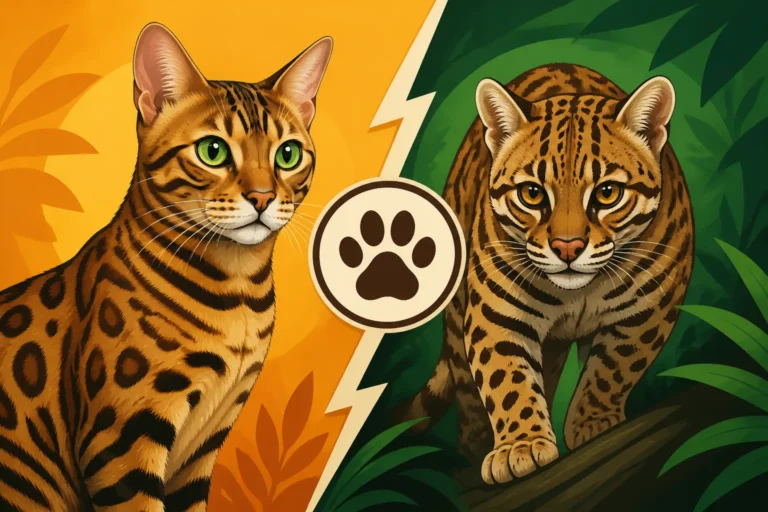
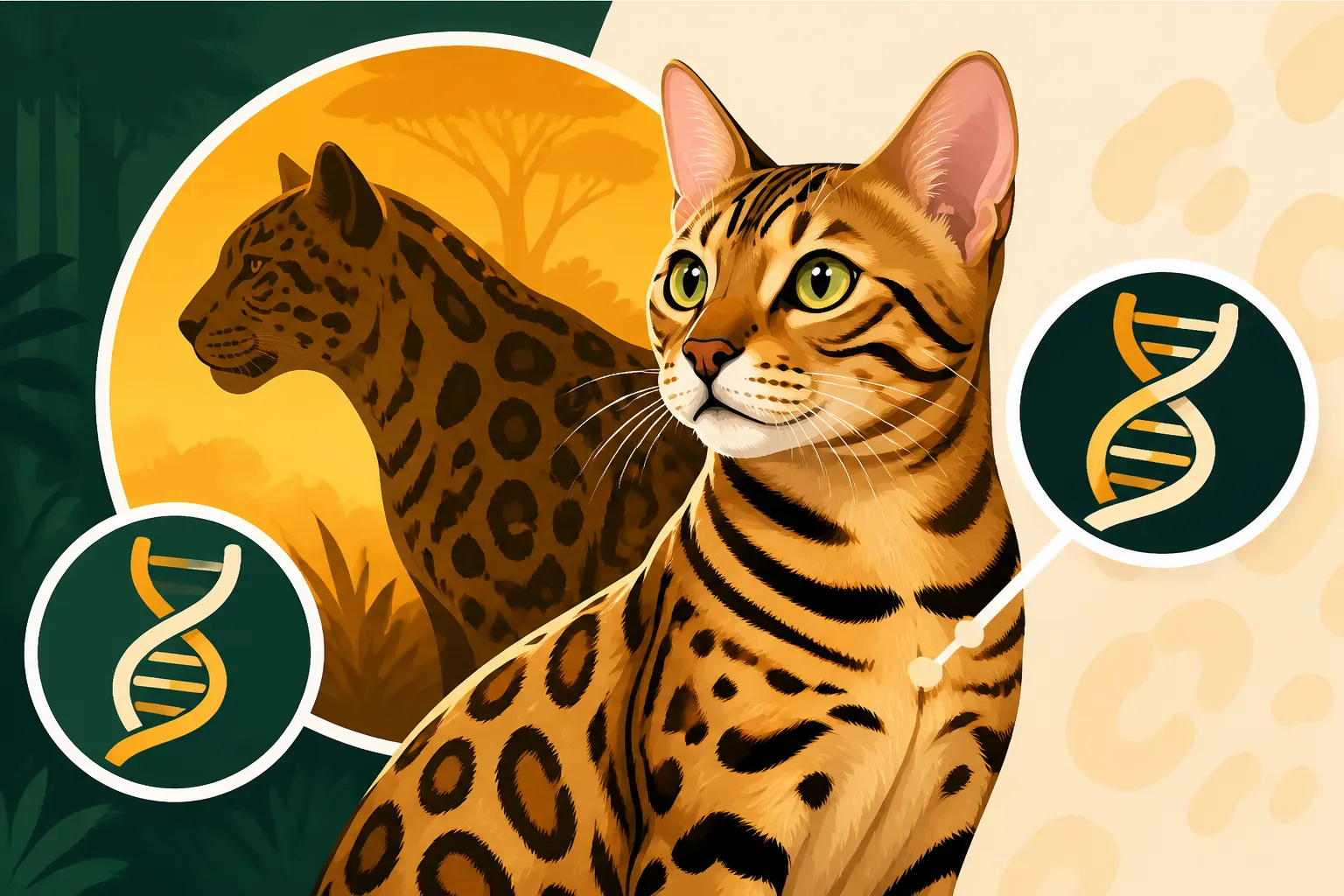
An F4 Bengal is often described as having about 6.25% Asian leopard cat ancestry, but that number is an estimate—not a DNA test result. The exact figure depends on the cat’s pedigree and how its ancestors were bred. This guide explains the simple calculation, what “F4” does and does not tell you, and how to check a particular cat’s documented generation.
The estimated wild ancestry of an F4 Bengal
The simple calculation behind 6.25%
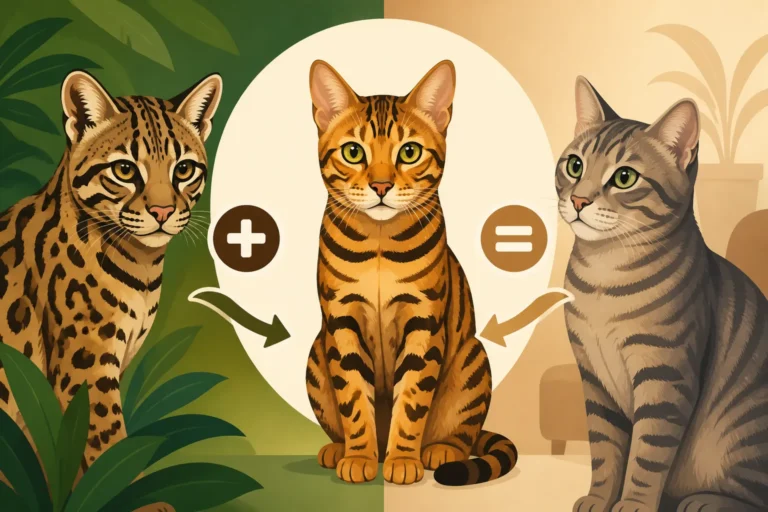
The familiar estimate comes from a simplified breeding model. If each generation is bred to a domestic cat with no Asian leopard cat ancestry, the expected share from the original wild ancestor is roughly halved each time:
| Generation | Estimated Asian leopard cat ancestry in a simple model |
|---|---|
| F1 | 50% |
| F2 | 25% |
| F3 | 12.5% |
| F4 | 6.25% |
So, under those assumptions, an F4 Bengal has an expected average of about 6.25% Asian leopard cat ancestry. This is a useful way to understand the lineage, but it should not be treated as a precise measurement of an individual cat’s DNA.
The calculation assumes a particular sequence of pairings: each generation has one parent whose expected wild ancestry is half that of the previous generation, and one domestic parent with no such ancestry. Real breeding histories can be more complicated. If a Bengal from one generation is paired with another Bengal, for example, the expected percentage may differ from the simple chart.
For background on the labels themselves, see How a Bengal Cat's Generation Is Counted and What Filial Generation Means for a Bengal Cat. The names describe ancestry through a pedigree; they do not function like a laboratory report stating an exact percentage.
Why the number is an estimate, not a guarantee
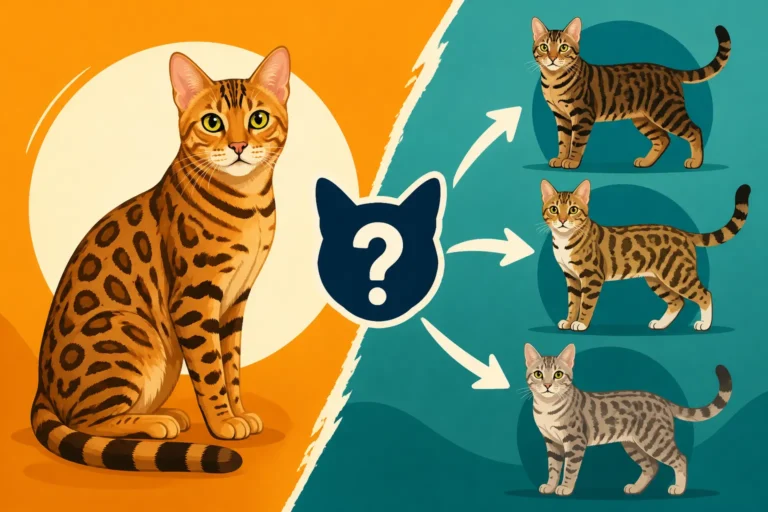
Ancestry estimates describe what is expected across a breeding pattern. They do not mean every kitten receives exactly the same share of DNA from every ancestor. Inheritance is passed down in segments, and siblings can inherit different combinations from the same parents. Even when two kittens have the same recorded generation, their inherited genetic makeup is not necessarily identical.
The F1-to-F4 chart is also easiest to understand as a teaching model, not a complete description of every Bengal pedigree. Breeders may pair cats with different ancestry, and pedigrees can include Bengal-to-Bengal matings as well as domestic outcrosses. That history matters when someone tries to turn a generation label into a precise percentage.
The same caution applies when comparing generation numbers. The estimate for an F1 is often described as 50% because that is the expected result of a direct Asian leopard cat and domestic cat cross. The later figures—25% for F2 and 12.5% for F3—follow from the same simplified halving assumption. For more detail on those earlier generations, read How Much Asian Leopard Cat DNA an F1 Bengal Cat Has, How Much Wild DNA an F2 Bengal Cat Has, and How Much Wild DNA an F3 Bengal Cat Has.
What F4 means and what it cannot tell you
F4 is a pedigree label, not a genetic test result
“F4” refers to a cat’s place in a line of generations traced back to the Asian leopard cat. It tells you something about ancestry and distance from that foundation cross. It does not, by itself, report a tested percentage of wild DNA, confirm a cat’s registration status, or guarantee a particular temperament.
That distinction can be frustrating if you are trying to compare two cats and want one clear number. A seller may describe a cat as F4, while a registry uses a different formal category or requires specific pedigree details for registration. Those terms may be related, but they are not automatically interchangeable. Ask what the seller means by F4 and request the supporting pedigree rather than relying on the label alone.
You may see F4 discussed as an important dividing line between early-generation hybrids and later-generation domestic Bengals. That general distinction can help orient you, but the actual classification depends on the pedigree and the rules being applied. Why F4 Is the Line Between Wild and Domestic Bengal Cats explores why this generation is often treated as a transition point.
F4 and SBT are not the same word
SBT is a registry designation, while F4 is a generational label. They answer different questions. F4 describes a cat’s generation in relation to its wild ancestor; SBT indicates that the cat meets a registry’s pedigree requirements for that category. A cat should not be assumed to be SBT simply because someone calls it F4, or assumed not to be eligible because the terms sound different.
The exact pedigree requirements depend on the registry. If registration matters to you, ask which organization issued the papers and what category appears on them. What SBT Stands For in a Bengal Cat explains the term, while Which Generation TICA Registers as a Bengal Cat discusses generation and registration in the TICA context.
This matters beyond cat-show terminology. Some local rules distinguish between early-generation hybrids and later generations, and the wording can vary by location. Do not use a seller’s casual description as proof that a cat qualifies under a particular law or policy. Check the relevant local rules and keep the pedigree documents that support the cat’s stated ancestry.
How to verify an F4 Bengal’s generation
Start with the pedigree and ask specific questions
A reliable way to assess an F4 claim is to request the cat’s pedigree and trace the generations shown there. Look for the parents, grandparents, and earlier ancestors, along with registration information where available. If the seller cannot explain how the F4 designation was determined, or offers only a verbal assurance, treat the label as unverified until you can review the documentation.
Useful questions include:
- Which registry, if any, issued the cat’s papers?
- What generation is listed for the cat’s parents?
- How does the breeder count the generations back to the Asian leopard cat?
- Does the paperwork use F4, SBT, or another designation?
- Can the breeder show the pedigree records that support the description?
A clear answer should connect the label to a documented family history. If the explanation shifts between “four generations from the wild ancestor,” “four generations of Bengals,” and “6.25% wild DNA,” ask the breeder to clarify. Those phrases are not necessarily describing the same thing.
For a practical guide to reading the records, see How to Find a Bengal Cat's Generation on Its Pedigree. Paperwork is especially useful if you need to confirm a generation for registration, travel, insurance, or local regulations. Keep a copy rather than depending on a screenshot or an informal message that could be difficult to retrieve later.
Can a DNA test tell you the wild percentage?
A DNA test should not be assumed to provide a precise, universally accepted percentage of Asian leopard cat ancestry. A test may assess particular genetic variants or ancestry information, depending on the laboratory and the test offered, but that is not the same as certifying a cat’s filial generation from its full pedigree.
If a breeder or seller presents a test as proof of an exact wild percentage, ask what the test measures and what the result can establish. A genetic result and a pedigree answer different questions: one concerns the markers included in a test, while the other documents the recorded ancestry across generations. Whether a DNA Test Shows a Bengal Cat's Wild Percentage explains why those methods should not be treated as interchangeable.
For many owners, the most useful next step is not hunting for a single percentage. It is collecting the pedigree, confirming how the breeder defines F4, and checking any registry or local requirements that matter to your situation. If the question is about care, a generation label alone is not a substitute for veterinary advice or an assessment of the individual cat.
What 6.25% means for life with an F4 Bengal
An ancestry estimate does not predict personality
A percentage can sound like a shortcut for predicting behavior: more wild ancestry must mean a more “wild” pet. In practice, temperament is shaped by many factors, including individual personality, socialization, environment, and breeding history. The F4 label alone cannot tell you whether a particular cat will be outgoing, vocal, energetic, or comfortable with visitors.
If you are choosing a Bengal, spend time asking about the individual cat’s routine and behavior. Find out how it responds to handling, household noise, other animals, and being left alone. An honest breeder or rescue can usually describe what the cat is actually like more usefully than a DNA percentage can.
This also helps avoid an unfair expectation that an F4 will behave exactly like another cat with the same label. Two cats from different lines can have noticeably different temperaments. Rather than treating “6.25%” as a personality forecast, use the documented generation as one piece of background and assess the cat in front of you.
Focus on the cat’s needs, not a percentage
The ancestry estimate does not automatically prescribe a special diet, exercise plan, or care routine. Pay attention to the cat’s health, age, body condition, and behavior, and discuss diet or medical concerns with a veterinarian. For everyday supplies, choose items that suit the individual cat and your home; a retailer such as Chewy may be one place to compare routine food, litter, or enrichment options, but product choice does not verify a pedigree.
If you are planning for a new cat, practical questions may matter more day to day than whether its inherited ancestry is exactly 6.25%. Consider whether your home has safe climbing opportunities, interactive play, appropriate scratching surfaces, and a quiet place where the cat can retreat. Chewy can be a convenient option for browsing basic supplies, while your breeder, rescue, and veterinarian can help you decide what is suitable for that particular animal.
It is also sensible to keep the cat’s records together: pedigree, registration paperwork, veterinary history, and any relevant test results. If you buy supplies through Chewy or another retailer, keep those purchase records separate from the documents that establish ancestry. Chewy order information can help you track routine purchases, but it is not evidence of a cat’s generation.
Ultimately, an F4 Bengal is commonly estimated at about 6.25% Asian leopard cat ancestry under a simple inheritance model. The number is a useful shorthand for understanding the breeding history, not a guaranteed measurement of an individual cat’s genome. For a specific cat, the pedigree and the definition used by the breeder or registry are the details that matter most.
Disclaimer
This article is for general informational purposes only and does not constitute professional advice. Laws, prices and regulations vary by location and change over time. Consult a qualified professional for guidance on your specific situation.