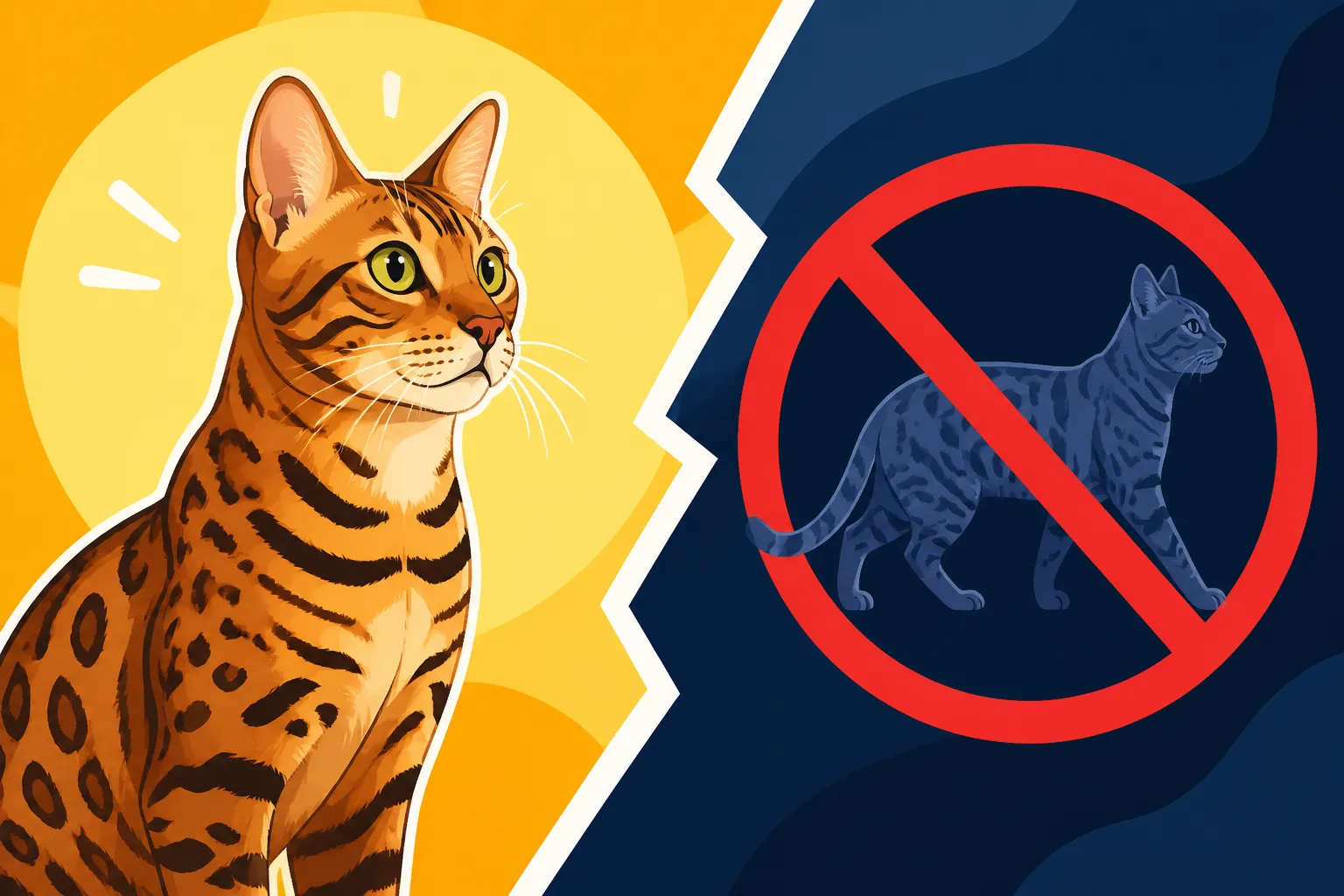
Whether the Bengal Cat Is Banned in the UK
A Bengal’s spotted coat can make people assume it is a wild hybrid that is automatically illegal in Britain. That is not the whole picture: the answer depends on the cat’s ancestry, its generation and the laws where you live. This guide explains what to check before buying, adopting, moving or travelling with a Bengal in the UK.
Is the Bengal cat banned in the UK
The breed is not automatically prohibited
There is no simple UK-wide rule that bans every cat registered or described as a Bengal. Many Bengals kept as ordinary domestic pets are several generations removed from their wild ancestor, the Asian leopard cat. A cat’s striking appearance alone does not establish that it is legally restricted.
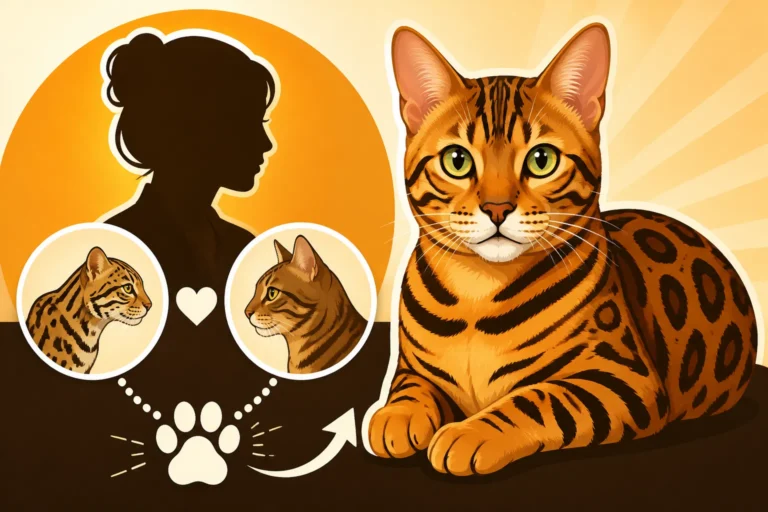
The complication is that Bengal cats originated through crosses between domestic cats and Asian leopard cats. Laws dealing with certain wild animals and their hybrids may apply to some earlier-generation cats. Depending on the applicable rules, an owner may need a licence or may have to meet other requirements. That is different from saying that the entire Bengal breed is banned.
It also helps to separate a breed name from a legal classification. A cat described casually as a “Bengal” might be a later-generation pedigree Bengal, an early-generation hybrid, or a spotted domestic cat with no verified Bengal ancestry. Those situations should not be treated as interchangeable. If you are trying to understand a cat’s background, What F1 Means in a Bengal Cat and What F2 and F3 Mean in a Bengal Cat explain the generation terms breeders use.
UK rules can depend on where you live
The UK is made up of England, Wales, Scotland and Northern Ireland, and animal-keeping rules are not always identical across those jurisdictions. Rules may also be administered locally, so the authority you need to speak with can depend on your address and the kind of cat you own.
That makes quick answers in online forums risky. Someone in one part of the UK may be describing a rule that does not apply in another. Even when two owners have cats with similar appearances, their cats’ pedigrees and generations may differ enough to change what questions need answering.
Before you buy, adopt or bring an early-generation Bengal into your home, contact the relevant local authority and ask how it applies the rules to Bengal hybrids. Give the authority the cat’s documented generation and ancestry rather than relying on a general breed description. If the cat is already with you, ask what documentation it needs and whether any action is required. Getting a clear answer in writing is a sensible way to avoid relying on a misunderstood phone conversation.
What the generation terms do and do not tell you
Breeders use labels such as F1, F2, F3 and SBT to describe a Bengal’s place in a family line. In broad terms, an F-number refers to filial generations from an earlier cross, while SBT is a pedigree designation used for Bengals several generations into established Bengal lines. For background, see How a Bengal Cat's Generation Is Counted and What SBT Means in a Bengal Cat.
Those labels are useful clues, but they should not be treated as a universal legal decision by themselves. The relevant law may define the ancestry or generation threshold in its own terms, and a registry’s terminology may not answer every legal question. Ask the local authority whether the specific pedigree and registration records meet the requirements that apply where you live.
A further source of confusion is that people sometimes use “F4” or “F5” loosely when describing a cat. Ask the breeder to explain the pedigree, not just repeat a label. How to Find a Bengal Cat's Generation on Its Pedigree can help you understand what to look for in the paperwork.
How to check whether your Bengal needs a licence
Start with the cat’s paperwork
Ask for records that identify the cat and show its ancestry. Depending on the cat, useful documents may include a pedigree, registration papers, breeder records and a written explanation of the generation. Check that the name, date of birth and identifying details match the cat you are considering.
A registration certificate can help document a pedigree, but do not assume that one certificate automatically settles a legal question. The local authority may need more detail, or it may interpret a particular generation under the rules that apply in its area. If the breeder says “it is legal because it is registered,” ask for the exact paperwork and independently confirm the position with the authority.
If you are looking at an adoption or rescue cat, records may be incomplete. That does not prove that the cat is an early-generation hybrid, nor does its spotted coat prove that it is a pedigree Bengal. Ask the rescue what background information it has and what steps it recommends. Whether a Shelter Cat Can Be a Bengal Cat discusses why appearance alone is not a reliable way to establish breed.
Ask the local authority specific questions
A useful enquiry is more detailed than “Are Bengal cats legal here?” Explain that you want to confirm the requirements for a Bengal or Bengal hybrid with the generation shown in the available paperwork. Ask whether a licence is required, what evidence it accepts, and whether there are conditions you need to meet before keeping or moving the cat.
You can use a checklist like this when you contact the authority:
- State the address where the cat will live and the relevant UK nation.
- Give the cat’s documented generation and describe the records you have.
- Ask whether those records are sufficient to establish its status.
- Ask whether a licence or other permission is required.
- If the answer is unclear, ask which team or officer handles animal-keeping licences.
- Keep the response and copies of the paperwork with the cat’s other records.
This is especially important if you are buying a kitten, as you may be making a commitment before the cat’s full paperwork has arrived. Ask the breeder to provide the documents before you pay a deposit or collect the kitten. If an early-generation cat is involved, confirm the rules before arranging transport or taking the cat home.
Do not rely on a DNA test to prove legal generation
A DNA test can answer particular questions about a cat’s genetic markers, but it is not a substitute for a pedigree or a legal decision by the relevant authority. A test should not be assumed to establish exactly how many generations separate a cat from an Asian leopard cat or to prove that a particular legal exemption applies. Read Whether a DNA Test Shows a Bengal Cat's Wild Percentage for more on the limits of genetic testing.
Likewise, photographs and coat patterns cannot settle the question. Rosettes and spots can look dramatic, but domestic cats can also have spotted coats. If a breeder, seller or online post offers certainty based only on appearance, ask for verifiable records instead.
| What you have | What it can help establish | What it does not automatically establish |
|---|---|---|
| Pedigree or breeder records | The cat’s recorded ancestry and generation | That the local authority accepts it as sufficient legal evidence |
| Registration papers | The cat’s registration details and pedigree context | That no licence or other requirement applies |
| DNA test | Specific genetic information covered by the test | The cat’s exact legal generation or permission to keep it |
| Coat photographs | What the cat looks like | Breed, ancestry or legal status |
| Seller’s verbal assurance | What the seller claims about the cat | The truth of the claim or compliance with local rules |
Buying, adopting and moving with a Bengal in the UK
Before buying a Bengal kitten
Ask the breeder which generation the kitten is, how that generation is recorded and whether the kitten’s parents’ paperwork is available. A responsible breeder should be willing to explain the lineage clearly and let you review relevant documents. If the breeder is uncertain, or says legal status is guaranteed without showing evidence, pause and check independently.
Do not assume that a kitten advertised as “F5,” “SBT” or simply “Bengal” needs no further thought. These terms can be useful, but the local authority is the right place to confirm how the documentation fits the rules in your area. If the cat is an early-generation hybrid, find out what permissions or conditions might apply before making a commitment.
It is also worth confirming that the cat’s microchip, veterinary records and registration details will be transferred correctly. Those records are not a replacement for proof of ancestry, but consistent identification can make it easier to show that the paperwork belongs to the cat in your care.
If you are adopting or already own one
A rescue may not know a cat’s complete history, especially if it arrived without breeder paperwork. Share everything you do know with the relevant authority, including any previous registration documents, veterinary records or information supplied by the former owner. Ask what it recommends when ancestry cannot be confirmed.
If you already own a Bengal and have just learned about generation-based restrictions, avoid making assumptions in either direction. Do not conclude that the cat is illegal based only on its appearance, and do not dismiss the issue because someone told you all Bengals are exempt. Gather the available records and ask the local authority for guidance on your particular circumstances.
A change of address can also be a reason to check again. Permission or rules that applied in one place may not answer the question for a new home in a different UK nation or local area. Confirm requirements before moving, particularly when the cat’s generation is unclear or its paperwork is incomplete.
Travel and temporary arrangements
A Bengal’s legal status at home does not automatically answer every question about travel, transport or temporary accommodation. If you are moving across the UK, taking the cat to a boarding facility or arranging transport, check whether the destination or route raises additional requirements. Ask the carrier or boarding provider what documents it expects and confirm any legal questions with the appropriate authority.
Keep copies of the cat’s pedigree and other relevant records with its routine veterinary documents. If the cat needs to travel unexpectedly, having the paperwork ready can save time and reduce confusion. Make sure the cat is securely contained during transport; an escape during a move can be stressful for both you and the animal, quite apart from the paperwork.
If you are travelling outside the UK, do not assume that UK rules determine what another country permits. Requirements can differ substantially between countries, and some places regulate hybrids differently. Which Countries Restrict the Bengal Cat offers broader context, but check the destination’s rules directly before making travel plans.
Common misunderstandings about Bengal cat legality
“Every Bengal is a wild animal”
That is an overgeneralisation. Bengal cats have hybrid ancestry, but later-generation Bengals are bred as domestic cats. The legal question is not answered simply by the fact that the breed has a wild ancestor. What matters is the cat’s documented background and the rules that apply in the place where it will be kept.
“A registered Bengal is automatically legal”
Registration can be valuable evidence, but it is not a guarantee that every legal requirement has been met. A registry’s records and a local authority’s licensing decision serve different purposes. Ask the authority what it accepts, especially if the cat is from an early generation or its pedigree is disputed.
“A spotted cat must be a Bengal”
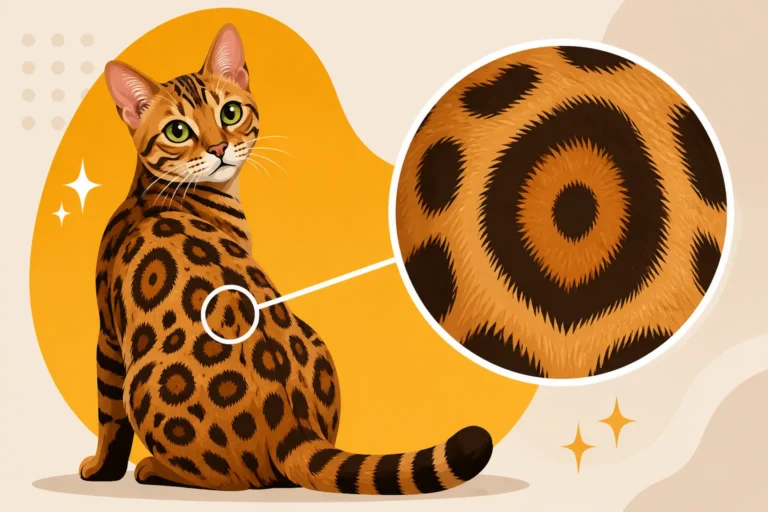
A spotted or rosetted coat does not prove that a cat is a Bengal, much less establish its generation. Domestic shorthair cats can have striking markings too. If legal status matters, rely on records and an official answer rather than visual guesses or a seller’s description.
The practical takeaway is to check the individual cat, not just the breed label. Confirm its generation from reliable paperwork, speak with the authority responsible for your address, and keep the response with the cat’s records. That is the safest way to understand whether a Bengal can be kept in your particular circumstances.
Disclaimer
This article is for general informational purposes only and does not constitute professional advice. Laws, prices and regulations vary by location and change over time. Consult a qualified professional for guidance on your specific situation.