Whether Texas Leaves Bengal Cat Rules to Cities
It's incredibly frustrating, isn't it, when you're trying to figure out if your beloved Bengal cat is even legal where you live? You dig through state laws, maybe find nothing definitive, and then realize the real battleground is often at the city level. For those of us in Texas, this often means a patchwork of rules that can feel impossible to navigate. This guide is here to shed some light on why Texas often leaves Bengal cat regulations to its cities and what that means for you as an owner or prospective owner.
Navigating the Murky Waters of Bengal Cat Laws in Texas
Understanding pet ownership laws can feel like trying to untangle a ball of yarn after a particularly playful kitten has had its way with it. You pull one thread, and it seems to lead nowhere, or worse, it just creates more knots. This is especially true when it comes to hybrid breeds like Bengal cats, where the line between "domestic pet" and "exotic animal" can be surprisingly blurry depending on who you ask and where you live. Texas, like many states, has a particular way of handling these nuances.
Why State Laws Can Be Vague for Specific Breeds
Most states, including Texas, tend to focus their overarching animal welfare and public safety laws on broader categories rather than getting bogged down in breed-specific legislation for cats. You might see comprehensive regulations for dogs (think dangerous dog laws or breed-specific bans for certain canines), but cats generally fly under the radar at the state level. This isn't because cats are inherently less interesting to lawmakers, but rather because their perceived threat to public safety is generally lower than that of, say, a large, powerful dog breed.
When it comes to unique felines like Bengal cats, the state's concern typically centers on animals that are genuinely wild or exotic. Think tigers, lions, or even certain venomous snakes. These animals often fall under specific exotic animal permits or outright bans due to their inherent danger to humans and the ecosystem. Bengal cats, especially those many generations removed from their wild ancestor, typically don't fit neatly into that category for state-level legislation. The state aims for broad strokes, leaving the finer details to those who are closer to the ground, literally and figuratively: the city councils and local animal control departments. This often leaves owners feeling adrift, unsure if their pet, which is clearly a domestic animal to them, could be considered something else by a local official.
The Lack of a Statewide Bengal Cat Ban in Texas
Here's the good news, or at least the starting point for it: Texas does not have a blanket statewide ban on Bengal cats. You won't find a law on the books in Austin that says, "No Bengal cats allowed anywhere in the Lone Star State." This is a significant distinction from some other states or even countries that have explicit prohibitions on hybrid felines. For the most part, if your Bengal cat is considered a domesticated animal by widely accepted standards, the state of Texas is generally fine with you owning it.
The key here, and where much of the confusion arises, lies in that "domesticated animal" distinction. Reputable registries like The International Cat Association (TICA) consider Bengal cats of the "SBT" (Studbook Tradition) generation and beyond as fully domesticated. These are typically F4 (fourth filial generation) and later. If your Bengal is an F4 or further removed from its Asian Leopard Cat ancestor, it’s generally treated like any other domestic cat under state law. However, if you possess an earlier generation Bengal—an F1, F2, or F3—the waters get a little murkier, and this is where local jurisdictions often step in. The state allows for this grey area, which then means the burden of clarification, and often regulation, falls squarely on individual cities and counties. Understanding How a Bengal Cat's Generation Is Counted is crucial in this context.
When Your City Becomes the Rule-Maker for Bengal Cats
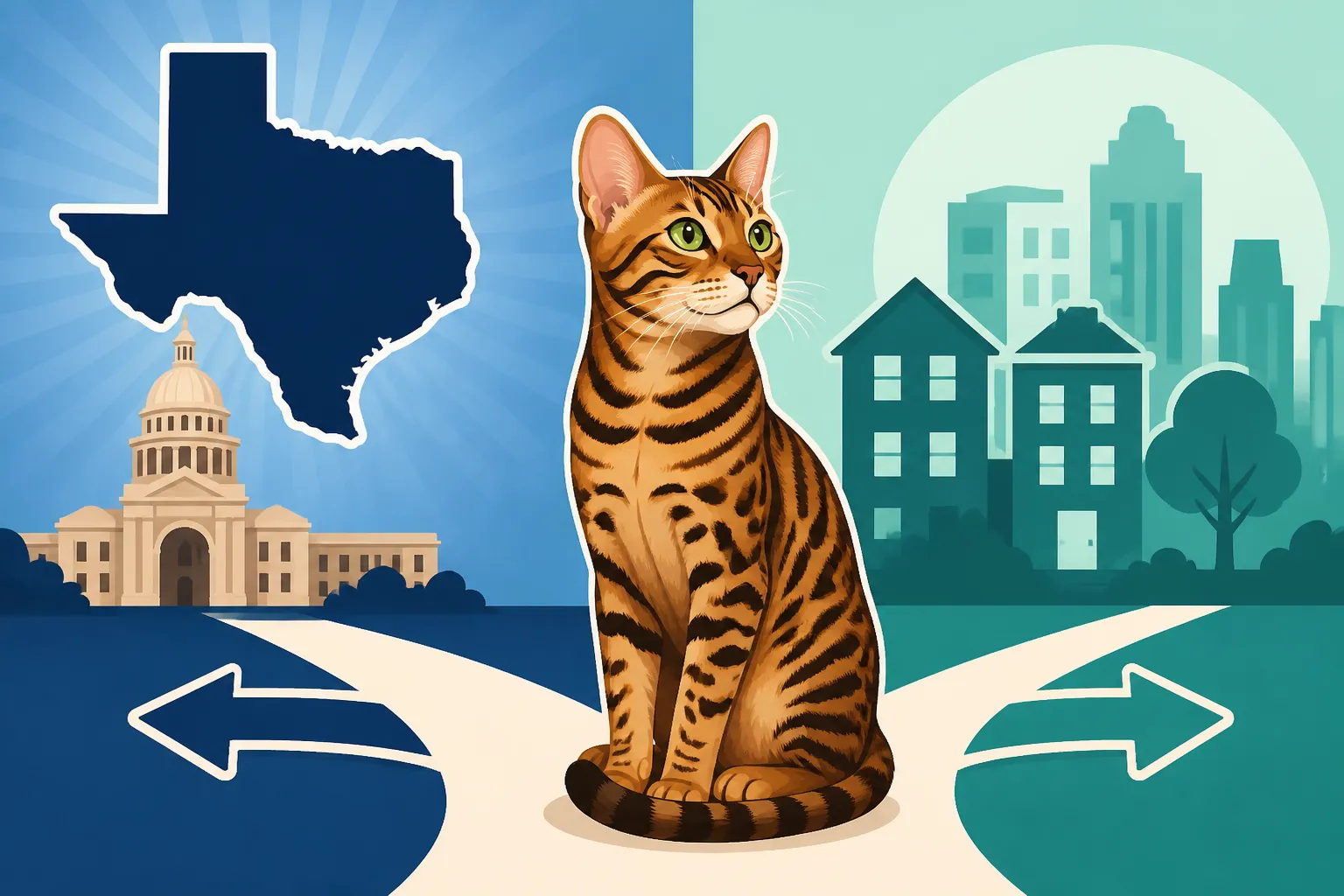
Since the state of Texas largely defers to local authorities on the specifics of pet ownership, your city or county becomes the primary authority for whether you can own a Bengal cat, and under what conditions. This localized approach is common across many states for various types of pets, and it creates a highly variable landscape for Bengal owners. One town might welcome them with open arms, while a neighboring community might demand permits or even outright ban certain generations.
City Ordinances: The Real Gatekeepers
When it comes to Bengal cats, city ordinances are truly the real gatekeepers. While the state may not have specific legislation, virtually every city and county has animal control ordinances that cover everything from leash laws and vaccination requirements to definitions of "dangerous animals" or "exotic pets." It's within these local codes that you'll typically find any restrictions or special requirements for Bengal cats. These ordinances are often passed by city councils or county commissioners to address specific local concerns, which could range from public safety perceptions to potential impacts on local wildlife or simply the desire to regulate unusual pets.
The problem for Bengal owners is that these definitions can be incredibly broad or even outdated. A city ordinance might define "wild animal" or "exotic pet" in a way that inadvertently (or intentionally) sweeps in earlier generation Bengal cats. For instance, an ordinance might state that any animal with "wild ancestry" within X number of generations requires a permit, or is outright prohibited. Since Bengal cats, by definition, have wild ancestry, this can immediately create a legal headache, even if your specific cat is many generations removed and behaves no differently than a domestic tabby. This can be a huge source of frustration, as you know your cat is a loving companion, but the letter of the law in your town might not see it that way. You might find yourself needing to demonstrate that your pet is truly domesticated, often by presenting detailed pedigree papers or TICA registration.
Common City Restrictions You Might Encounter
So, what kind of restrictions might you actually face at the city level in Texas? It varies dramatically, but here are some common scenarios that pop up:
- Permit Requirements: This is perhaps the most frequent type of restriction, especially for early generation Bengal cats (F1-F3). A city might require a special permit to own an "exotic" or "hybrid" animal. Obtaining such a permit usually involves an application process, a fee, and often proof of secure containment, such as a sturdy enclosure or a safe outdoor space. You might even face an inspection of your property by animal control to ensure your setup meets their safety standards. This can be a significant hurdle, as the requirements can be quite strict and costly, reflecting a cautious approach to animals perceived as having wild tendencies. It's not uncommon for these permits to have annual renewal fees, adding to the ongoing cost of ownership. How to Apply for an Early Generation Bengal Cat Permit can be a complex process.
- Outright Bans: While less common for SBT Bengal cats, some cities might have outright bans on any hybrid feline or specifically on F1-F3 generations. These bans are often rooted in public perception, fear, or a misunderstanding of the breed's temperament and domestication level. If you live in a city with such a ban, owning a restricted Bengal cat could lead to severe consequences, including confiscation and heavy fines. It's a stark reminder that even if your state is permissive, your immediate locality holds significant power.
- Containment and Leash Laws: Even if your Bengal is legal, cities might have stricter rules regarding containment, especially if they view them as a "higher risk" pet. This could mean specific requirements for catios or outdoor enclosures, or even how they are walked. While most domestic cats are rarely leash-walked, Bengal cats often are, and a city might have specific requirements for harnesses and leashes that go beyond standard pet regulations, again due to their wild appearance or energy levels. You might be asked to prove secure housing that prevents escape and protects your Bengal from local wildlife or vice versa.
- Insurance Requirements: Though less common for cats than for dogs, some city ordinances might require owners of "exotic" or "dangerous" animals to carry specific liability insurance policies. This would be in addition to any general pet insurance you might carry from a provider like Healthy Paws for health-related issues. The city wants assurance that if your cat causes damage or injury, there's a financial safety net. It’s another layer of cost and complexity that traditional cat owners rarely face.
The bottom line is that simply checking state law is not enough. You absolutely must delve into your specific city or county's municipal code. Neglecting to do so could lead to heartbreaking consequences, like losing your beloved pet or facing significant legal trouble.
The "F" Word: How Generation Matters at the Local Level
When discussing Bengal cats and their legality, you'll inevitably hear talk of "F numbers" – F1, F2, F3, and so on. This refers to the filial generation, indicating how many generations removed a Bengal cat is from its wild ancestor, the Asian Leopard Cat (ALC). This distinction is incredibly important because it's often the dividing line in local ordinances when deciding whether a Bengal is a "domestic cat" or something more "exotic."
The F1-F3 Gray Area for Cities
The F1, F2, and F3 generations of Bengal cats often fall into a regulatory gray area, and this is where most city-level restrictions tend to focus. An F1 Bengal is a direct cross between an Asian Leopard Cat and a domestic cat. An F2 has one ALC grandparent, and an F3 has one ALC great-grandparent. While these cats are undeniably beautiful and can be affectionate, they typically retain more of their wild ancestors' traits in terms of temperament, energy, and sometimes, even size and vocalization. This closer genetic link to a wild animal is precisely what makes local governments wary.
Many city ordinances, especially those concerned with public safety or the regulation of "exotic" animals, will draw a line at these early generations. They might classify F1-F3 Bengal cats as "wild hybrids" or "exotic pets" that require special permits, extensive containment measures, or are simply prohibited within city limits. The rationale often stems from a perceived higher risk of unpredictable behavior, difficulty in handling, or concerns about their potential impact if they escape. Even if your F2 Bengal is the sweetest creature on earth, a city official might be bound by an ordinance that broadly defines "hybrid cat with wild ancestry within three generations" as something requiring strict control. This means that even if the state of Texas doesn't care about your F2, your city of Dallas or Houston very well might. For a deeper dive, understanding What an F Number on a Bengal Cat Means Legally is paramount.
SBT Bengal Cats: Generally Safer, But Not Always Guaranteed
SBT stands for "Studbook Tradition" and refers to Bengal cats that are F4 or later generations. By the time a Bengal cat reaches the F4 generation, it is considered fully domesticated by major cat registries like TICA (The International Cat Association). At this point, the cat is many generations removed from its wild ancestor, and its temperament and characteristics are generally consistent with those of other domestic cat breeds. This is why SBT Bengals are typically the ones allowed in most homes without special permits and are the only generations eligible to be shown in cat shows. For the vast majority of cities in Texas, an SBT Bengal cat will be treated just like any other domestic shorthair – no special permits, no bans, just standard pet ownership rules.
However, and this is a big "however," it's not always guaranteed. While rare, a few municipalities might have overly broad or outdated ordinances that could still lump an SBT Bengal into a category requiring scrutiny. Perhaps their definition of "wild hybrid" doesn't specify a generation, or it's simply left up to interpretation by local animal control officials. This is less common today as awareness of the Bengal breed has grown, and most local governments have updated their codes to align with TICA's definitions. But it serves as a crucial reminder: always check your specific city's rules. While Whether an SBT Bengal Cat Is Legal Everywhere is generally a "yes," local nuances can always create exceptions. Proving your cat is an SBT through registration papers is your best defense against any potential misunderstandings.
Practical Steps for Texas Bengal Cat Owners (and Future Owners)
Given the potential for varied local regulations in Texas, a proactive approach is absolutely essential if you own a Bengal cat or are considering bringing one into your home. Don't assume anything, because ignorance of the law is rarely an acceptable defense. Taking these practical steps can save you a lot of heartache, stress, and potential legal issues down the road.
Researching Your Local City Ordinances
This is the most critical first step. Before you even think about bringing a Bengal cat home, or if you already have one and are unsure, you need to dive deep into your local municipal code. Don't rely on what a friend of a friend said, or even what you read on a general forum.
Start by visiting your city or county's official government website. Look for sections on "Animal Control," "Municipal Code," "Ordinances," or "Public Health and Safety." You'll want to search for terms like "hybrid cat," "exotic animal," "wild animal," "Bengal cat," or "feline." Pay close attention to definitions, as a broad definition of "wild animal" could unintentionally include your Bengal, especially if it's an early generation. If the online code is difficult to navigate (and let's be honest, they often are), don't hesitate to call your city clerk's office or the local animal services department directly. They are the ones who enforce these rules and should be able to provide clear guidance. It's often a good idea to get any definitive information in writing, whether it's an email or a printed excerpt of the relevant ordinance. This way, you have a record to refer back to. This due diligence is the best way to avoid a stressful encounter later. Knowing How to Read Your City Code for a Bengal Cat can save you a lot of trouble.
Understanding Permits, Fees, and Inspections
If your local research reveals that your city or county does have specific requirements for Bengal cats, particularly for early generations, be prepared for potential permits, fees, and even home inspections.
A permit application will likely ask for detailed information about your cat, including its generation (F1, F2, F3, SBT), its source (breeder information), and often vet records proving vaccinations and spay/neuter status. You'll almost certainly need to pay a fee, which can vary widely from a nominal sum to several hundred dollars, sometimes on an annual basis. These fees are designed to cover the administrative costs of processing permits and enforcing regulations. Perhaps the most significant requirement for some early-generation permits is proof of secure containment. This means demonstrating that you have an escape-proof enclosure, especially if your cat will spend time outdoors. This might involve building a secure catio or reinforcing existing fencing. Animal control officers may conduct a home inspection to verify that your setup meets their safety and welfare standards. This could be intimidating, but it's part of the process to ensure public safety and the well-being of the animal. It's crucial to be fully compliant, as failure to do so could result in fines, permit revocation, or even confiscation of your cat. Remember, What Happens to a Confiscated Bengal Cat is a scenario no owner ever wants to face.
Documenting Your Bengal Cat's Pedigree
In situations where local ordinances draw a line based on generation, having solid documentation of your Bengal cat's pedigree is absolutely vital. This isn't just a "nice to have" for show cats; it's a legal necessity.
Your breeder should provide you with official registration papers from a reputable cat registry like TICA. These papers clearly state the cat's generation. For example, if your cat is an SBT Bengal, the papers will confirm this. This official documentation is usually the strongest evidence you can present to an animal control officer or city official to prove your cat's classification. If you're adopting a rescue Bengal or one from an unknown background, obtaining pedigree papers might be more challenging, but some specialized DNA tests can help determine the percentage of wild cat ancestry, which can then be used to infer generation, though this is a less direct route. Without clear documentation, you might find yourself in a difficult position, unable to prove that your cat meets the "domestic" criteria in a restrictive ordinance. Always ask a breeder for proof of their cats' generations and registrations. Knowing How to Prove Your Bengal Cat's Generation is your first line of defense. Reputable breeders understand this and will gladly provide the necessary paperwork, often alongside health clearances.
A Quick Look at State vs. City Rules for Bengal Cats
Here's a simplified overview of how regulations often stack up:
| Aspect | Texas State Level (General) | Texas City/County Level (Variable) |
|---|---|---|
| Bengal Cat Legality | No blanket ban on Bengal cats (SBTs generally domestic) | Varies by ordinance: may have bans, restrictions, or permits |
| F1-F3 Generations | Generally not specifically addressed | Often classified as "exotic" or "hybrid"; common for permits/bans |
| SBT Generations (F4+) | Treated as domestic cats | Generally treated as domestic cats, but always check for specifics |
| Permit Requirements | No state-level permit for Bengal cats | Common for early generations; may involve fees, inspections |
| Containment Rules | General animal welfare; no specific hybrid rules | Often specific for early generations (e.g., catios, secure enclosures) |
| Enforcement Authority | State agencies (e.g., Parks & Wildlife for true exotics) | Local Animal Control, Police Department, City Clerk |
The Final Word: Be Prepared, Be Informed
Ultimately, owning a Bengal cat in Texas means accepting that your local city or county has the primary say in specific regulations. While the state offers a broad "no explicit ban" stance, the nuanced definitions and requirements often come from your local municipal code. This can feel overwhelming, especially if you move or live in an area with particularly strict rules.
The best defense is always a good offense: research your specific city's ordinances thoroughly, obtain and keep meticulous records of your Bengal's generation and health (a good pet insurance plan from a provider like Healthy Paws can help manage health costs, but won't solve legality!), and be prepared to meet any permit or containment requirements. Don't be afraid to engage with your local animal control department; they are often the best resource for accurate information.
Bengal cats are amazing, unique companions, and responsible ownership means understanding not just their care needs, but also the legal landscape you're navigating. By doing your homework, you can ensure a long, happy, and legal life with your beautiful feline friend.
Disclaimer
This article is for general informational purposes only and does not constitute professional advice. Laws, prices and regulations vary by location and change over time. Consult a qualified professional for guidance on your specific situation.