What Centerwall Was Trying to Learn From Bengal Cat Hybrids
A spotted hybrid cat may look like the start of a breed story, but Willard Centerwall’s Bengal crosses began as part of a medical research question. At Loma Linda University in California, he investigated whether the Asian leopard cat’s apparent resistance to feline leukemia could be inherited by domestic cats. This guide explains what researchers hoped to learn, what the work did and did not establish, and how the research cats later became connected to the Bengal breed.
Why Centerwall studied Bengal cat hybrids
Feline leukemia was the central question
Centerwall’s project was not initially a plan to create a new companion-cat breed. It was a research effort focused on feline leukemia, a serious infectious disease caused by feline leukemia virus, usually shortened to FeLV. In cats, FeLV can damage immune function and contribute to anemia, some cancers, and other severe health problems.
The scientific question concerned the Asian leopard cat, a small wild cat native to parts of Asia. Researchers had reason to believe this species was less susceptible to feline leukemia virus than domestic cats. If that difference had a genetic basis, studying crosses between the two species might help researchers understand how susceptibility was inherited.
That was the purpose behind the hybrid cats: they offered a way to examine whether traits associated with the wild species might appear in descendants with domestic-cat ancestry. Centerwall’s work was therefore about disease resistance and inheritance, not simply about producing cats with striking coats. For background on the wild species involved, see What the Asian Leopard Cat Is Behind Every Bengal Cat.
A cross could help separate inherited traits from assumptions
Observing that one species seems less affected by a disease does not, by itself, explain why. The difference might involve genes, exposure, biology, or several factors together. Breeding hybrids offered a way to ask whether a relevant characteristic could be passed from one generation to another.
A hybrid population can be useful in genetic research because its members inherit combinations of traits from both parental species. Researchers can compare animals with different ancestry and look for patterns. In Centerwall’s case, the broad interest was whether the Asian leopard cat’s apparent resistance might be reflected in its hybrid offspring, and what that could reveal about feline leukemia susceptibility.
That is a more cautious claim than saying the experiment proved a particular gene made cats immune. Disease resistance is not always a simple on-or-off trait. A cat can have some protection without being completely unable to become infected, and a trait that appears in one hybrid does not necessarily behave the same way in every descendant. The project’s purpose was to investigate the question, not to establish that Bengal cats as a breed could not get FeLV.
The research setting mattered
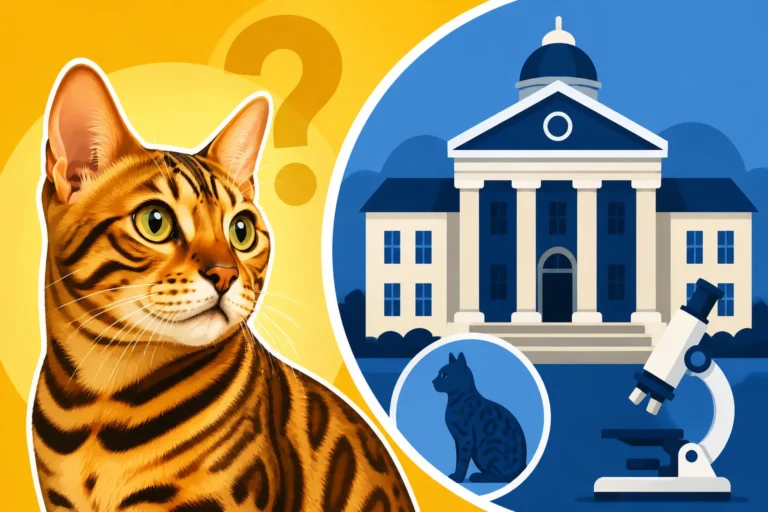
The work took place at Loma Linda University in Loma Linda, California, where a colony of hybrid cats was maintained for research. This setting is important because it helps explain why the early cats existed at all: they were part of a university research program, not the result of an ordinary domestic breeding project.
The colony also became an unusual bridge between medical research and cat breeding. Some cats from Centerwall’s program later entered the history of the Bengal breed. That connection can make it sound as if the Bengal was created specifically to investigate leukemia, or as if the breed was designed around a confirmed disease-resistance trait. Neither conclusion follows from the fact that research hybrids later contributed to breed development.
For more about the institutional background, see Which University Ran the Bengal Cat Research Colony and The Leukemia Research Colony That Founded the Bengal Cat.
What researchers hoped to learn from the hybrids
Could resistance be inherited?
The core question was whether the Asian leopard cat’s apparent resistance to feline leukemia might be inherited by hybrid offspring. If offspring showed differences in their response to infection, those differences could help researchers investigate how susceptibility was passed on.
In simplified terms, the study asked whether crossing a wild cat with a domestic cat could reveal a heritable difference relevant to disease. A pattern across related animals might offer clues about inheritance that researchers could not get from studying unrelated cats alone.
But a hybrid population is not a shortcut to a neat answer. Each animal inherits a different mix of genetic material, and health outcomes can be shaped by more than ancestry. Interpreting results requires careful attention to the animals’ backgrounds and the conditions of the research. The important point is that Centerwall was exploring a biological question, not testing whether a future pet would be protected from illness.
What the work could not establish by itself
Even if a hybrid appears less susceptible than a domestic cat, that observation does not prove that all descendants share the same protection. Nor does it tell an owner that a modern Bengal cat is immune to FeLV. A breed’s appearance and ancestry cannot be used as a substitute for veterinary testing or vaccination decisions.
It is also important to distinguish research into resistance from a claim of immunity. Resistance can mean a reduced likelihood of infection or a different response to a pathogen; immunity implies a stronger and more specific protection. Those terms are not interchangeable. Without a clearly demonstrated mechanism and evidence that applies to the population in question, broad claims about a breed’s disease protection are unwarranted.
This distinction still matters to Bengal owners. A Bengal should be assessed as an individual cat, with health decisions made alongside a veterinarian. Its breed history does not remove the need to discuss FeLV exposure, testing, or vaccination based on its lifestyle and circumstances.
The research question was bigger than one breed
Centerwall’s hybrids belonged to a wider scientific effort to understand why different feline species might respond differently to the same infectious disease. The potential value was not limited to producing a distinctive domestic cat. Researchers hoped that studying the biology of resistance could contribute to a better understanding of FeLV and, ultimately, how to protect cats from it.
| Research question | What hybrid cats could help examine | What the question does not prove |
|---|---|---|
| Did the Asian leopard cat respond differently to FeLV? | Whether the species showed a meaningful difference in susceptibility | That every Asian leopard cat is completely immune |
| Could a relevant trait be inherited? | Whether offspring showed patterns associated with ancestry | That all hybrids inherit the same protection |
| Could this inform disease research? | How inherited biology might relate to infection | That Bengal cats cannot get FeLV |
| Could research animals contribute to breed history? | How some hybrids later became connected with Bengal breeding | That creating the Bengal was the original research goal |
The table separates the project’s scientific aims from claims that are sometimes attached to the breed’s origin story. For a related account of the research program, see Why a Medical Lab Bred Bengal Cat Hybrids.
How the research cats became part of Bengal history
Medical hybrids and breed development were connected later
Centerwall’s research cats became relevant to Bengal history because some of the hybrids were later made available to breeders. Jean Mill, who played a major role in developing the Bengal breed, received cats connected to the research program. The research colony and the breed program therefore overlap in the breed’s history, but they were not the same undertaking.
This chronology can be easy to muddle. A reader might hear that the first Bengal cats came from a university colony and assume the university was trying to create a pet breed. The more accurate distinction is that the hybrids were developed for research, and cats from that work later became part of the lineage from which Bengal breeding developed.
That link helps explain why accounts of the Bengal’s beginnings often mention both a medical laboratory and a breeder. They describe separate stages in the story: research into feline leukemia resistance, followed by the use of some research cats in a domestic breeding program. Read more in What Happened to Centerwall's Bengal Cat Hybrids and Who Willard Centerwall Was to the Bengal Cat.
The coat pattern is not evidence of disease protection
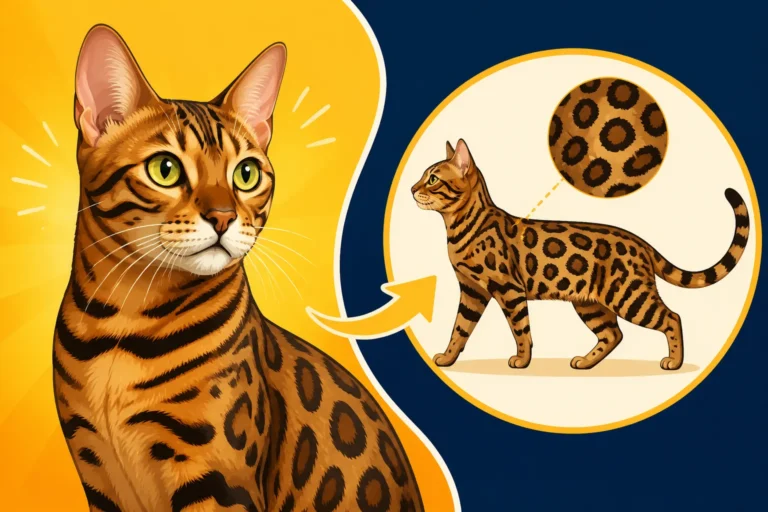
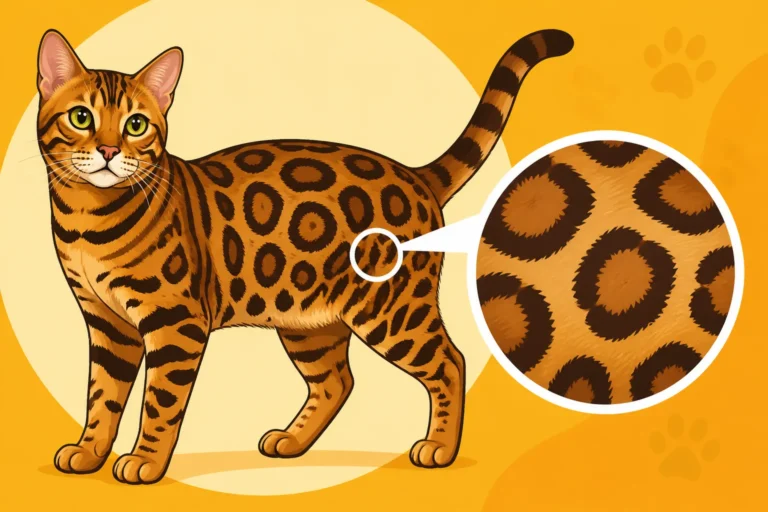
The Bengal’s spotted or marbled coat is visually memorable, and that can make the breed’s origins feel like a single story about wild ancestry. But coat appearance does not tell you whether an individual cat carries a particular health trait. A spotted Bengal is not more or less protected from FeLV simply because its pattern recalls a wild cat.
This is a useful distinction whenever a breed’s history involves hybridization. Ancestry can help explain how a breed developed, but it does not make every inherited feature predictable or uniform. Even within a breed, cats differ genetically and medically. Claims about a health benefit need evidence that directly supports the claim, rather than an assumption based on appearance or a distant ancestor.
The Asian leopard cat’s role in the Bengal story is important, but it should not be treated as proof that domestic Bengals retain all the biological features of their wild ancestor. For more context, see Why the Bengal Cat's Ancestor Resists Feline Leukemia and Whether the Asian Leopard Cat Behind the Bengal Cat Is Endangered.
The breed’s origin story should not be mistaken for a health guarantee
Centerwall’s work is a fascinating part of Bengal history because it joins genetics, infectious disease research, and the development of a popular domestic breed. Yet the connection can be overstated when it is reduced to “Bengals are resistant to feline leukemia.” A research program exploring a possible inherited difference is not the same as establishing a dependable protective trait in the modern breed.
A responsible way to understand the history is to keep its parts separate. Centerwall studied hybrids to investigate a disease-related question. Some research cats later entered the lineage associated with Bengal development. The modern Bengal became a domestic breed with its own varied family lines. Those facts can all be true without making a claim of immunity.
If a Bengal’s exposure risk is a concern, talk with a veterinarian about testing and prevention based on the cat’s situation. A cat’s hybrid ancestry, coat, or breed label should not be used to skip ordinary health care.
What Centerwall’s work means for Bengal owners today
Use the history as context, not as a diagnosis
For current owners, the practical takeaway is straightforward: Centerwall’s research explains one part of the Bengal’s origin, but it does not diagnose an individual cat or predict its health with certainty. A Bengal can still need routine veterinary care, and its risk of infectious disease depends on real-world factors such as contact with other cats and its medical history.
If you are adopting a Bengal or taking one to a new home, share what you know about its vaccination and testing history with your veterinarian. If that information is incomplete, ask what steps make sense for the cat rather than relying on stories about ancestral resistance. This is especially valuable for newly adopted cats, cats with unknown backgrounds, or cats that may have contact with animals outside the household.
It also helps to ask breeders or rescues clear, specific questions. What health records are available? Has the cat been tested for relevant infections? What does the veterinarian recommend for this cat’s living situation? Those questions are more useful than asking whether the breed is “immune,” because they focus on the individual animal and documented care.
Keep the story’s claims in proportion
Centerwall’s hybrids mattered because they gave researchers a way to explore whether a difference in disease susceptibility could be inherited. They also became part of the historical path that eventually led to Bengal breeding. But the purpose of the original work was scientific investigation, not a promise that Bengal cats would be protected from feline leukemia.
When you encounter a claim about the Bengal’s wild ancestry, look for the specific evidence behind it. Does the claim refer to the Asian leopard cat, early hybrids, or modern Bengals? Is it describing a research question, a measured finding, or a proven health guarantee? Keeping those categories distinct makes the breed’s history easier to understand and helps prevent an intriguing origin story from becoming misleading medical advice.
Centerwall’s work is best remembered as an investigation into feline leukemia resistance and inheritance. Its legacy is both scientific and historical: it connected a medical research colony in California with the development of a domestic cat breed, while leaving an important lesson for owners—ancestry can explain where a breed came from, but it cannot replace evidence-based care for the cat in front of you.
Disclaimer
This article is for general informational purposes only and does not constitute professional advice. Laws, prices and regulations vary by location and change over time. Consult a qualified professional for guidance on your specific situation.