Whether F1 Bengal Cat Females Are Fertile
An F1 Bengal female can often be fertile, but “often” is not a promise that a particular cat can conceive or safely raise a litter. Early-generation breeding brings practical, genetic, welfare, and legal questions that are easy to underestimate. This guide explains what F1 means, how female fertility differs from male fertility, and what responsible planning involves.
What F1 means for a Bengal cat
The first generation is a direct hybrid cross
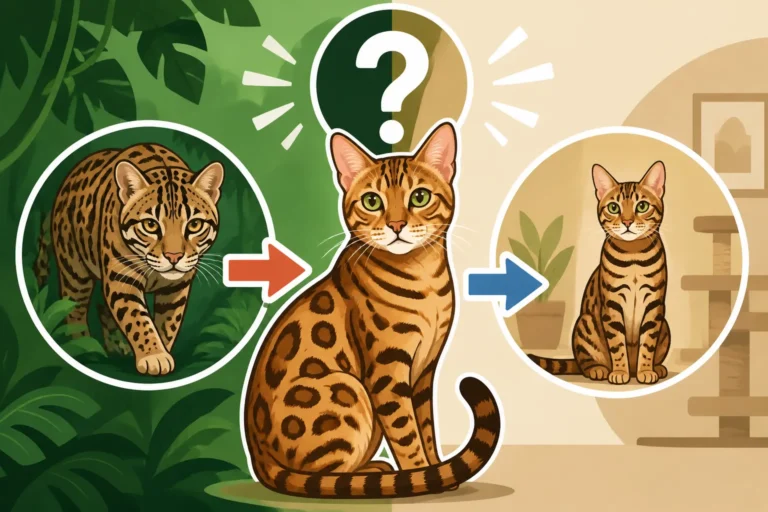
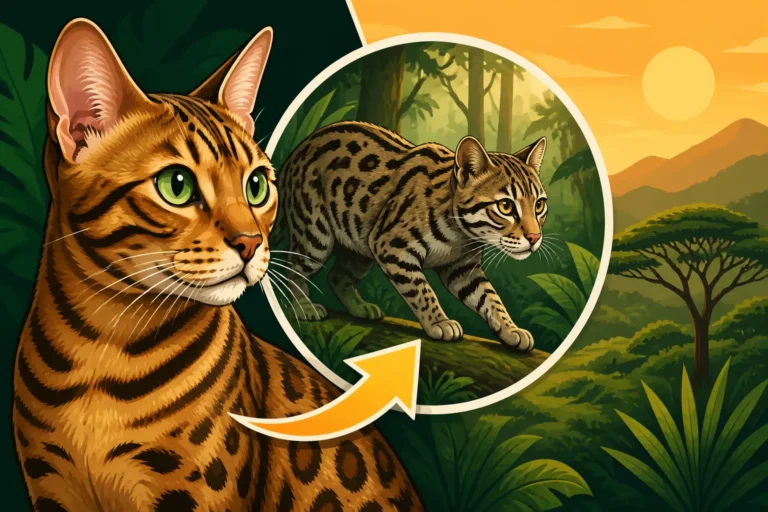
An F1 Bengal is the first filial generation: the kitten has an Asian leopard cat as one parent and a domestic cat as the other. In the traditional Bengal breeding program, the Asian leopard cat is the mother and the domestic cat is the father. An F1 is therefore not simply a Bengal with an especially “wild” appearance; it is a first-generation hybrid with a recent wild ancestor.
That ancestry matters when people ask whether an F1 female is fertile. Fertility is not determined by how striking her markings look or how domestic she seems at home. It relates to her individual biology, her ancestry, and the reproductive compatibility of the cats involved. For an introduction to the generation terminology, see What F1 Means in a Bengal Cat and How a Bengal Cat's Generation Is Counted.
The term can also be confusing because people sometimes use “F1 Bengal” loosely in advertisements or conversation. A pedigree and documented parentage are more useful than a seller’s label. If the generation is important for breeding, registration, or local rules, ask for the records behind the claim. Whether a Breeder Can Fake a Bengal Cat's Generation explains why it is worth checking rather than relying on appearance alone.
An F1 female’s offspring are generally called F2
If an F1 female is bred to a domestic cat, her offspring are generally described as F2 Bengals. The exact terminology and registration conventions can depend on the breeding program and registry, so confirm how a particular pedigree is recorded rather than assuming that every breeder uses shorthand identically. The next generation is not simply a visual category; it describes a relationship to the original wild ancestor.
The potential mate also matters. An F1 female bred to a domestic cat and an F1 female bred to a Bengal of a later generation may produce kittens with different pedigrees and different practical considerations. A breeder should be able to explain the proposed pairing, the expected generation, and the records that will accompany the litter. For more detail on later generations, see What F2 and F3 Mean in a Bengal Cat.
Generation labels can affect more than breeding decisions. They may influence registration options, ownership rules, housing arrangements, and the pool of veterinarians or reproductive specialists familiar with the cat. Before making plans, check the applicable registry requirements and the rules where the cat will live. Which Generation a Bengal Cat Breeder Works With offers additional context on how generation fits into breeding decisions.
Are F1 Bengal females fertile
Many F1 females can reproduce, but individual outcomes vary
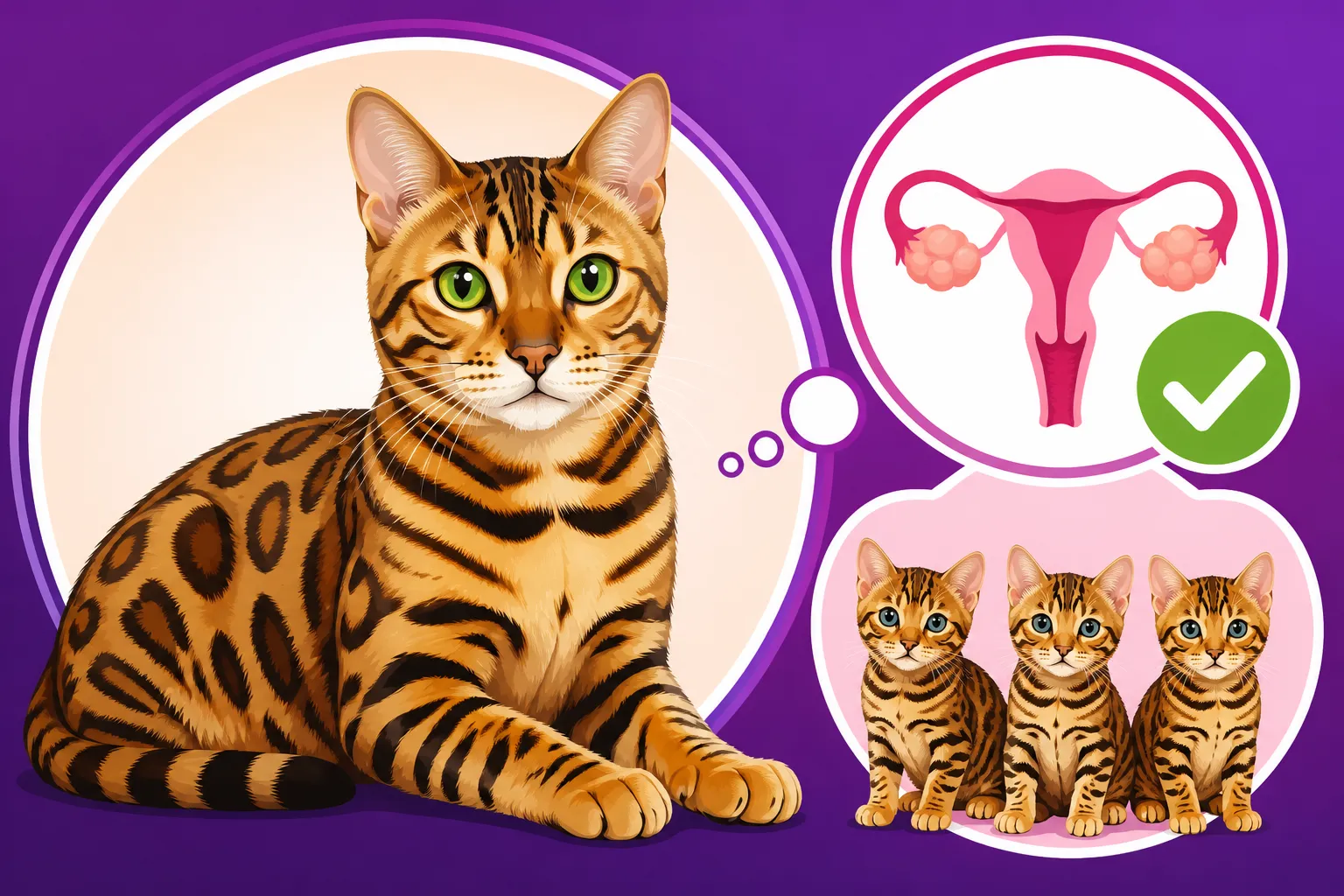
Female F1 Bengals are commonly considered capable of fertility, unlike early-generation Bengal males, whose fertility is often substantially reduced. That broad distinction is useful, but it should not be turned into a guarantee. A particular female may not ovulate normally, may not conceive, may lose a pregnancy, or may have a health issue unrelated to her generation.
A cat’s reproductive history is not proof of future fertility, either. A female that has had one litter may have difficulty conceiving later, while a female with no previous litter may still be capable of becoming pregnant. Age, body condition, general health, reproductive anatomy, timing, and compatibility with the male can all play a part. A veterinarian with feline reproduction experience is the right person to assess an individual cat.
It also helps to separate “fertile” from “easy to breed.” A female may be biologically capable of pregnancy while still being a poor candidate for a particular pairing or living situation. Breeding involves far more than arranging a mating: it requires health planning, appropriate housing, monitoring, emergency preparation, and a reliable plan for every kitten.
Male fertility is a separate issue
People often hear that early-generation Bengal males may be sterile and mistakenly extend that statement to the females. These are different questions. Female F1 Bengals can be fertile even though fertility in early-generation males is commonly reduced. The phrase “F1 Bengals are sterile” is therefore too broad and can create serious confusion.
The background biology is often discussed in relation to hybrid sterility and Haldane’s rule, which describes a general pattern in some hybrids where the sex with unlike sex chromosomes is more likely to be affected. That concept helps explain why male fertility can be especially limited in early generations, but it does not diagnose a specific cat or establish an individual female’s reproductive status.
Do not assume that an F1 male is fertile because he shows mating behavior, or that an F1 female is infertile because a mating did not produce kittens. Fertility needs to be considered individually, with appropriate veterinary guidance. The related article Why F1 to F3 Bengal Cat Males Cannot Breed covers the male-fertility question, while Whether F1 Bengal Cat Females Are Fertile focuses on the female side.
A failed mating does not give a complete fertility diagnosis
A female that does not become pregnant after one mating may have encountered a timing issue, an incompatible or infertile male, stress, an underlying reproductive problem, or another factor. Repeatedly pairing cats without investigating the cause can put the female through unnecessary stress and delay proper care.
If a breeding attempt does not go as expected, record the dates, observed behavior, veterinary findings, and any relevant health history. Then speak with a veterinarian rather than escalating to more matings on guesswork. Depending on the situation, the vet may recommend a reproductive examination or other testing. The appropriate assessment varies by cat; there is no single home observation that can confirm fertility.
What responsible breeding requires
Start with health, temperament, and veterinary assessment
Before considering a litter, arrange a thorough pre-breeding veterinary assessment. Discuss the female’s age, body condition, vaccination and parasite-prevention plan, medical history, and any screening appropriate to her pedigree. Ask specifically whether the veterinarian has experience with feline reproduction and early-generation Bengals. If not, request a referral to a suitable specialist.
Health planning should also include the proposed male. A female’s fertility does not make a pairing responsible by itself. Both cats need suitable health and temperament, and the breeder should understand the risks associated with the relevant family lines. A genetic test, where available for a specific condition, is not a substitute for veterinary examination or the health history of the cats.
Temperament deserves equal attention. An F1 cat may have needs and behaviors that make daily care, handling, mating, pregnancy, or kitten rearing more demanding than an inexperienced owner expects. A cat that is fearful, highly stressed, or difficult to manage should not be pushed into breeding because her pedigree seems valuable. For broader ethical considerations, see Whether Breeding Hybrids Like the Bengal Cat Is Ethical.
Plan for pregnancy, birth, and kitten care before mating
A responsible breeder needs a practical plan for the whole process, not just the mating. That means identifying a veterinarian who can provide pregnancy and birth care, knowing where emergency help is available, and preparing a safe, quiet space where the female can settle. It also means deciding in advance what will happen if she needs veterinary intervention or cannot care for her kittens.
Kittens require close observation and appropriate nutrition, warmth, and veterinary attention. A breeder should know how to recognize when a kitten is not thriving and should have a clear route to professional help. Basic supplies—such as a secure carrier, washable bedding, and a reliable way to monitor kitten weight—can be gathered from a local pet shop or retailers such as Chewy, but shopping is only one small part of preparation. Ask the veterinarian which supplies and feeding products are suitable for the specific situation.
It is also important to plan for the kittens’ long-term homes. That includes careful screening of prospective owners, complete and honest documentation, and a commitment to taking responsibility if a placement does not work out. The breeder should be prepared for the possibility that kittens may need to stay longer than expected or require extra care.
| Question | What to keep in mind |
|---|---|
| Can an F1 female be fertile? | Yes, many can be, but an individual cat’s fertility is not guaranteed. |
| Does male infertility mean female infertility? | No. Early-generation male fertility and female fertility are separate issues. |
| Does one unsuccessful mating prove infertility? | No. Timing, the male, health, and other factors may be involved. |
| Is a fertile female automatically a suitable breeding cat? | No. Health, temperament, welfare, pairing, and placement plans matter too. |
| Who should assess an individual cat? | A veterinarian, ideally one experienced in feline reproduction and early-generation Bengals. |
Keep legal and pedigree questions separate from biology
A female may be fertile but still not be legally or practically suitable for breeding where you live. Laws and restrictions can depend on location and generation, and rules may differ between national, state, provincial, and municipal authorities. Confirm the requirements that apply to the cat’s home and any place she might be transported or bred.
Pedigree and registry rules are separate again. A generation label on a document does not automatically answer every legal question, and a legal classification does not establish reproductive health. Check the official requirements that apply to your circumstances and retain accurate records for the cat and any litter.
Before taking a deposit, arranging a mating, or making a long-term breeding commitment, confirm the female’s documented generation, the proposed sire’s background, and the relevant restrictions. For additional background, see Which Countries Restrict New Bengal Cat Wild Crosses and How an Early Generation Bengal Cat Behaves Differently.
When an F1 female may be better kept as a pet
Breeding is not the only meaningful outcome
A cat does not need to produce kittens to justify her place in a household. If an F1 female has a health concern, is easily distressed, or simply does not suit a breeding environment, keeping her as a companion may be the kinder choice. Her value is not measured by whether she can reproduce.
That decision can be emotionally difficult for someone who purchased a cat with breeding hopes. It is still better to reconsider early than to continue with repeated pairings that cause stress or expose the female to avoidable risk. A veterinarian can help distinguish between a treatable medical issue and a situation where breeding is not advisable.
A pet home also needs to be prepared for the individual cat’s needs. Early-generation cats can require thoughtful planning around handling, secure housing, enrichment, and access to experienced veterinary care. It is worth learning about the cat’s likely behavior and practical needs before deciding that breeding is the right path.
Make a decision from evidence, not assumptions
If the question is about a specific female, begin with her pedigree and health record, then arrange a veterinary consultation. Explain whether you are asking about her ability to conceive, the safety of a proposed mating, or the suitability of breeding her at all. Those questions overlap, but they are not identical.
Avoid relying on a seller’s assurance, a single unsuccessful mating, or a general statement about F1 cats. Breed generation can provide context, but it cannot predict every reproductive outcome. The most responsible decision is the one based on the individual cat’s welfare, professional assessment, and a realistic plan for the kittens and their future homes.
Disclaimer
This article is for general informational purposes only and does not constitute professional advice. Laws, prices and regulations vary by location and change over time. Consult a qualified professional for guidance on your specific situation.