Which University Ran the Bengal Cat Research Colony
The Bengal cat’s early history is often boiled down to a simple story: a university crossed a wild Asian leopard cat with a domestic cat, and the Bengal breed followed. The real story is more layered. This guide identifies the university behind the research colony, explains what the researchers were investigating, and shows how some of those cats later became part of Bengal breeding history.
The university behind the Bengal research colony
Loma Linda University in Southern California
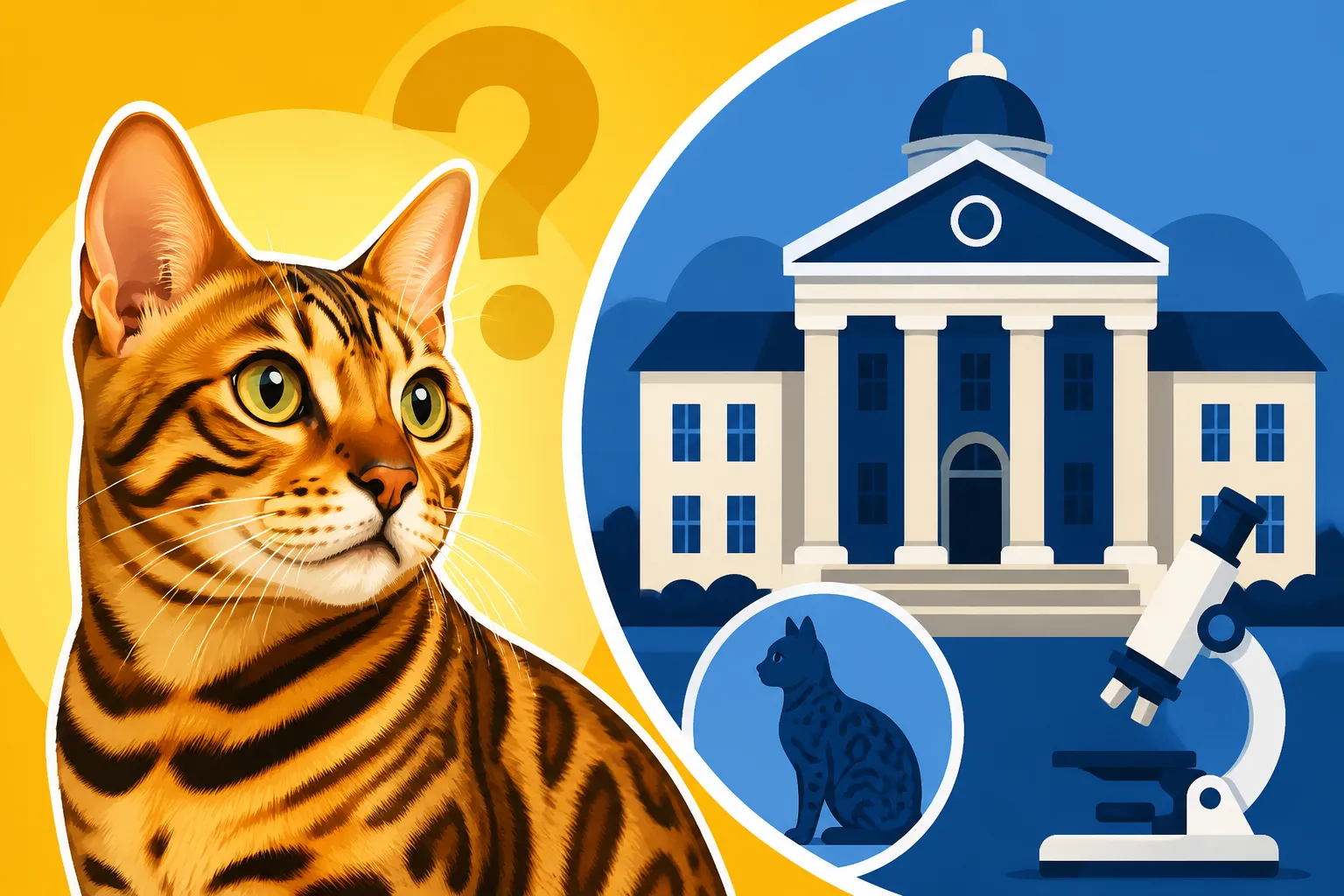
The research colony associated with the early Bengal story was at Loma Linda University, in Loma Linda, California. The university is in San Bernardino County, in Southern California. The work was associated with Willard Centerwall, a physician and researcher whose studies involved Asian leopard cats and domestic cats.
This distinction matters because the colony is sometimes described as though it were founded to create a new pet-cat breed. It was not. The research involved crossing Asian leopard cats with domestic cats to investigate questions about feline disease, including whether Asian leopard cats might have a different response to feline leukemia virus. The hybrids were part of a research program—not simply an early Bengal breeding project.
For a broader look at how the research intersects with Bengal history, see The Leukemia Research Colony That Founded the Bengal Cat and Why a Medical Lab Bred Bengal Cat Hybrids.
The role of Willard Centerwall
Centerwall’s name appears in Bengal histories because he was connected to the university research program and its hybrid cats. His scientific interest was not the same as the goal of establishing a recognized domestic breed. The colony provided an opportunity to study the offspring of Asian leopard cats and domestic cats in a research setting.
It is easy to see why the histories become tangled: the same unusual hybrid cats could be relevant to both scientific research and later breeding. But those are different chapters. Centerwall’s work helped create and maintain cats that later attracted attention from breeders; it does not mean that the university set out to establish the Bengal as a companion-cat breed.
If you want to separate the person from the institution, Who Willard Centerwall Was to the Bengal Cat provides the related background. The university is the answer to the question of where the research colony was associated; Centerwall helps explain who was involved and why the colony mattered.
What the research colony was studying
Why researchers crossed Asian leopard cats with domestic cats
The Asian leopard cat is a small wild feline species, distinct from the domestic cat. In the research context, crossing the species created hybrid offspring that could be studied in relation to inherited traits and disease responses. The work is often discussed in connection with feline leukemia virus, commonly abbreviated as FeLV.
The core research question concerned whether Asian leopard cats might show a different response to the virus than domestic cats, and what a hybrid cross could reveal about that difference. That is a more careful way to describe the project than saying the university simply “bred Bengal cats to cure leukemia.” The cats were part of an investigation; the breed that later developed was not the research project’s original purpose.
Research involving animals can also raise understandable questions about what happened to them afterward. In this case, the history is relevant not only because of the medical questions, but because some cats from the colony later entered the hands of people interested in developing Bengal lines. For more about the scientific aims, see What Centerwall Was Trying to Learn From Bengal Cat Hybrids.
Research hybrids were not the same thing as a finished breed
An early-generation hybrid is not automatically a settled domestic breed. The offspring may differ in temperament, fertility, appearance, and ease of living in a household. Establishing a breed takes more than producing a striking first-generation cross: it involves repeated, planned breeding and selection over generations, along with the development of consistent characteristics.
That difference helps explain why the university’s colony should not be treated as the moment the Bengal breed was completed. The colony produced cats with a connection to later Bengal history, but a research population and a recognized domestic breed are not interchangeable. The Bengal’s later development involved breeders working with subsequent generations and pursuing a different goal: creating domestic cats with a distinctive spotted or marbled appearance.
The generation terminology can add to the confusion. F1 describes a first-generation cross, while later generations reflect further breeding away from the original wild ancestor. For a clearer explanation, see What F1 Means in a Bengal Cat and How a Bengal Cat's Generation Is Counted.
| Question | What the historical record points to |
|---|---|
| Which university was associated with the research colony? | Loma Linda University in Southern California |
| Who is closely associated with the research? | Willard Centerwall |
| What was the research context? | Studies involving Asian leopard cats, domestic cats, hybrids, and feline disease questions |
| Was the colony created as a Bengal cattery? | No; the research was not originally a breed-development program |
| Why is the colony part of Bengal history? | Some research cats later became relevant to breeders developing Bengal lines |
How the colony became connected to Bengal breed history
Cats from the research program later reached breeders
The research colony’s place in Bengal history comes partly from what happened after the cats were no longer needed for the work. Cats associated with the program were rehomed, and some became available to breeders. Jean Mill is commonly linked to this later transition: she worked to develop Bengal cats as a domestic breed and used cats connected to the Loma Linda research story in her breeding efforts.
This is where a university research history and a breed history meet. The colony did not set out to build a household pet breed, but cats from that setting could still contribute to later breeding. Their role was part of a longer process, not a single moment when a finished Bengal breed appeared.
The details are sometimes compressed into a line such as “Loma Linda gave Jean Mill the first Bengals.” That phrasing can blur the distinction between research hybrids and the domestic Bengal cats developed over time. A more precise description is that cats associated with the colony contributed to the history of later breeding. See Which Bengal Cats Jean Mill Received From Loma Linda and What Happened to Centerwall's Bengal Cat Hybrids for more on that transition.
Centerwall’s work and Jean Mill’s breeding goals were different
It helps to think of the history as two related but separate efforts. Centerwall’s university work centered on research questions. Mill’s breeding work focused on developing a domestic cat with a particular appearance and a temperament suited to life with people. The people, purpose, and setting were different, even though some of the cats linked the stories.
This distinction is useful when you encounter claims that make the Bengal sound like a direct product of a university breeding program. That description gives the institution too much credit for a later breed-development effort and leaves out the breeders who worked across generations. It also risks implying that the research colony’s purpose was to supply pet cats, which is not the right way to frame the original scientific context.
The modern Bengal is the result of sustained breeding and selection, rather than a simple one-step cross. For additional context on the founder and the breed’s development, see Where the Bengal Cat Comes From and Who Jean Mill Was to the Bengal Cat.
Common misunderstandings about the Loma Linda colony
“The university invented the Bengal cat”
This is an understandable shorthand, but it is not quite accurate. Loma Linda University was associated with research involving Asian leopard cat and domestic cat hybrids. Some cats from that story later became relevant to Bengal breeding. The university was not simply running a project whose stated purpose was to create the domestic Bengal breed people know today.
A useful way to phrase it is: Loma Linda University was associated with an important research colony whose cats later intersected with Bengal breed development. That gives the institution its proper place without confusing scientific research with the later work of establishing a breed.
When reading breed histories, look for whether they distinguish between the research colony, early hybrids, and later-generation domestic Bengals. If a summary treats all three as the same thing, it is probably oversimplifying the story.
“The research proved that Asian leopard cats were immune to feline leukemia”
The colony is often discussed alongside research on feline leukemia virus, but a simple claim of total immunity can go further than the history supports. Research into disease response is not the same as proving that an entire species is immune in every circumstance. A careful account should describe the question being investigated without turning it into an absolute conclusion.
The distinction matters because disease resistance can be complex. Responses may differ between individuals, and a result from a particular research setting does not automatically tell us what will happen in every animal or in every later hybrid generation. It is better to treat the FeLV connection as part of the colony’s research context than as a sweeping guarantee about Asian leopard cats or Bengals.
The same caution applies to stories that imply the Bengal breed inherited a special medical protection simply because wild and domestic cats were crossed. Breed ancestry alone does not establish an individual cat’s health status. For present-day health questions, a cat’s veterinary care and appropriate testing matter more than an oversimplified account of its historical ancestry.
“Every Bengal traces directly to the research cats”
The research colony is an important part of the breed’s history, but that does not mean every Bengal today can be described as a direct descendant of a particular cat from the colony. Breed histories involve multiple cats, breeders, and generations, and lineages are not accurately reduced to one institution or one original cross.
This is another reason to distinguish historical influence from a complete pedigree claim. A research program can shape a breed’s early history without being the sole source of every modern cat. Likewise, a cat’s spotted coat does not prove Bengal ancestry. Appearance alone cannot reliably establish a pedigree.
If you are trying to understand a particular cat’s background, pedigree documentation and a breeder’s records are more relevant than a general historical story. The colony tells us something meaningful about how Bengal development intersected with university research, but it cannot identify the ancestry of an individual cat without supporting records.
Why the university’s role still matters
Loma Linda University matters to Bengal history because the research colony helped create a point of contact between scientific study and later breed development. The colony’s hybrids were produced in a research context, and some cats associated with that work later became part of the broader story of Bengal breeding. That makes the university a significant setting in the history, even though it was not a Bengal cattery in the modern sense.
The clearest answer is therefore straightforward: the research colony was associated with Loma Linda University in Loma Linda, California, and Willard Centerwall was closely connected to the work. The fuller answer adds that the university research was not originally designed to create the Bengal breed. The connection to modern Bengals came through the later movement of research cats into breeding histories and the work of breeders such as Jean Mill.
Understanding that distinction makes the origin story more accurate—and more interesting. It recognizes the university’s role without confusing medical research, early hybrid cats, and the deliberate development of a domestic breed.
Disclaimer
This article is for general informational purposes only and does not constitute professional advice. Laws, prices and regulations vary by location and change over time. Consult a qualified professional for guidance on your specific situation.