What Happens If You Move With an Illegal Bengal Cat
Moving across state lines or into a new city is already a chaotic, exhausting process, but packing up with a hybrid cat adds a terrifying layer of legal complexity. If you unknowingly transport your cat into a jurisdiction where the breed is banned or strictly regulated, you face steep fines, forced quarantine, eviction, or even permanent confiscation by local animal control. This guide walks you through the legal consequences of moving with a restricted Bengal cat, how local authorities enforce these laws, and the exact steps you must take to protect your pet.
Legal Frameworks and How Bengal Cat Bans Are Enforced
The Patchwork of State and Municipal Laws
Understanding hybrid pet laws in North America can feel like trying to solve a puzzle where the rules change every time you cross a county line. Wildlife regulations, department of agriculture codes, and city municipal codes all overlap to create a confusing landscape for pet owners. In some regions, the state government allows exotic feline hybrids as long as they are several generations removed from the wild, yet individual cities within that same state maintain total bans. To understand the root of these restrictions, owners must examine Where a Bengal Cat Is Illegal in the United States before signing a lease or putting a down payment on a home.
Local governments often draft these restrictions out of concern for native wildlife, public safety, or an inability of local animal shelters to manage exotic traits. While an standard domestic shorthair faces basic licensing rules, a Bengal carries the genetic legacy of the Asian Leopard Cat (Prionailurus bengalensis). Because of this heritage, lawmakers frequently categorize early-generation felines as wild animals or exotic pets rather than domestic companions. When you pack up your moving truck and drive into a new town, you step directly into whatever legal definitions that specific town hall has written into its books.
The real danger for relocating owners lies in these sudden legislative shifts over short distances. You might live perfectly legally in a suburban county, only to find that moving five miles down the road into city limits places you in direct violation of municipal code. Local animal control officers do not usually grant grace periods for newcomers who claim ignorance of the law. Once your pet steps foot inside a jurisdiction that outlaws the breed, you are technically committing a violation from day one.
How Authorities Discover Non-Compliant Pets
Many owners assume that if they keep their cat strictly indoors, no one will ever know they brought a restricted pet into town. In reality, local authorities discover non-compliant animals through ordinary, everyday interactions. The most common trigger is an offhand comment to a neighbor or an unexpected visit from a apartment maintenance technician who notices the cat’s distinct pelt, high activity level, or loud voice. A single complaint about vocalization or a loose cat escaping into a hallway can bring animal control straight to your front door.
Routine administrative tasks also expose undocumented pets. When you register for local utilities, apply for a residential parking permit, or try to license your pet with the new city clerk, you are often asked to declare your pet’s breed. Veterinary visits in a new city represent another common point of discovery. While veterinarians are bound by professional ethics and vary in their reporting habits, some municipal health codes require vet clinics to report unlicensed or illegal exotic animals to local health departments or environmental control boards.
Finally, social media postings and digital footprints frequently tip off local law enforcement or regional wildlife officials. Local wildlife officers and animal control personnel do periodically monitor public community groups and online lost-and-found pet boards. If your cat gets out of the house and you post a picture on a neighborhood social app begging for help, local animal control officers may quickly identify the cat as a hybrid and cross-reference your address against permitted animal registers.
The Legal Definition of Hybrid Generations
Legislation governing hybrid felines relies heavily on the concept of filial generations, often abbreviated as the “F number.” Understanding Why the Generation Number Decides Whether You Can Own a Bengal Cat is essential because law enforcement and wildlife agencies distinguish sharply between early-generation hybrids and fully domestic lines. An F1 cat represents the direct offspring of an Asian Leopard Cat and a domestic cat, carrying a high percentage of wild ancestry. Successive generations—F2, F3, and F4—gradually dilute that wild heritage.
For a broader overview of how these animals are defined legally, consult What an F Number on a Bengal Cat Means Legally. Most jurisdictions that permit Bengals require the cat to be at least an SBT (Stud Book Tradition) or F5 generation, meaning the cat is at least five generations removed from its wild ancestor. At this point, international registries like TICA (The International Cat Association) consider the feline fully domestic. However, restrictive municipalities rarely care about registry titles if their local code simply bans “all felines possessing wild hybrid ancestry.”
When an officer inspects your cat, the burden of proof rests entirely on your shoulders. You must prove that your cat meets the generation threshold permitted by local law. Without certified documentation, authorities typically default to assuming the animal is an illegal hybrid. This leaves owners scrambling to contact original breeders or genetic registries while their pet sits in a county impound facility.
Immediate Consequences of Crossing Lines with an Illegal Bengal
Confiscation and Animal Control Impoundment
The most heartbreaking outcome of moving into a restricted area with a non-compliant cat is physical seizure. If local animal control determines that your pet violates exotic animal ordinances, they hold the legal authority to enter your property—often accompanied by a warrant or local police—and confiscate the animal. To prepare yourself for the stark reality of this scenario, read What Happens to a Confiscated Bengal Cat to understand how municipal impoundment procedures operate.
Once seized, your cat is placed in a municipal shelter or an exotic animal holding facility. These environments are intensely stressful for any domestic pet, but for a high-energy, sensitive breed, prolonged confinement in a sterile metal cage can cause severe psychological and physical distress. Standard municipal shelters are rarely equipped with specialized enclosures, high vertical spaces, or the intense daily activity items that these active felines require to stay sane.
During impoundment, you will generally be prohibited from visiting your cat. The shelter holds the animal as evidence or contraband while the legal system processes your case. If the court rules against you, or if you cannot prove the cat’s domestic status within a strict, narrow timeframe—often as short as 72 hours to ten days—the municipality may seize ownership permanently. From there, the cat may be sent to an out-of-state sanctuary or, in tragic circumstances where sanctuary placement fails, humanely euthanized.
Fines, Penalties, and Criminal Infractions
Bringing an illegal pet into a restricted jurisdiction is not merely a civil nuisance; in many counties and cities, it is classified as a misdemeanor criminal offense. Initial discovery often results in an immediate administrative citation carrying substantial fines. These fines compound daily for every 24-hour period the animal remains within municipal boundaries after notification.
Beyond basic administrative fines, owners often face civil court assessments to cover the government’s operational costs. You will be billed for every day your cat spends in animal control custody, including:
* Mandatory daily boarding fees
* Exotic animal intake and assessment surcharges
* Veterinary evaluations and diagnostic testing performed by state contractors
* Court costs and county legal filing fees
If an owner attempts to hide the cat, resist confiscation, or provide falsified pedigree documents to law enforcement, charges can escalate quickly. What began as an honest moving mistake can snowball into criminal charges for harboring illegal wildlife or obstructing law enforcement officers, leaving you with a permanent criminal record alongside the potential loss of your beloved companion.
Forced Relocation and Eviction Notices
If you live in a rented apartment, condo, or leased single-family home, bringing an illegal Bengal onto the property exposes you to immediate housing instability. Property managers routinely include clauses in lease agreements stating that all pets must comply strictly with state, county, and municipal laws. If a landlord receives a notice from the city regarding an illegal animal on the premises, they will issue a formal curable lease violation notice or an emergency notice to quit.
For tenant rights and rental realities, check Whether a Landlord Can Ban a Bengal Cat. When faced with a municipal citation, property managers will almost always choose to protect their business license and property standing over keeping a tenant. You will typically be given a very short window—frequently between three to seven days—to completely remove the illegal animal from the premises or face formal eviction proceedings on your public record.
This leaves owners in a panic, forced to choose between abandoning their lease, moving out on short notice, or sending their cat to live with friends or family in a legal jurisdiction. Finding temporary shelter for a high-needs feline under extreme time pressure is financially draining and emotionally devastating, turning what should have been a fresh start in a new home into a living nightmare.
| Jurisdiction Level | Typical Bengal Status | Common Legal Requirements | Primary Risk to Owner |
|---|---|---|---|
| Strict States (e.g., HI) | Total Ban (All Generations) | N/A – Immediate Seizure | Confiscation at border, heavy fines |
| Moderate States | F1-F4 Banned; SBT/F5 Allowed | Certified TICA/CFA Pedigree | Seizure if pedigree is missing |
| Restrictive Cities | Total Ban within City Limits | N/A – Municipal Code Ban | Eviction, daily compound fines |
| Permit-Required Regions | Early Generations Permitted | Exotic Pet Permit, Enclosure Check | Fines for unpermitted ownership |
Navigating Landlord Regulations, Housing Authorities, and Insurance
Lease Agreements and Property Restrictions
Even if a city technically permits domestic Bengal cats, individual housing communities, landlords, and Homeowners Associations (HOAs) reserve the legal right to enforce far stricter rules than the surrounding city. Landlords often maintain restrictive pet policies that explicitly bar exotic felines, wild hybrids, or pets over a specific weight limit. When moving, never assume that a generic “cats allowed” clause in your lease automatically covers your Bengal.
When filling out rental applications, property managers often demand detailed pet profiles. If you write “Bengal” on the form, property management software may automatically flag the application for review or decline it outright due to liability insurance carrier restrictions. Attempting to skirt this rule by misrepresenting your cat as a domestic shorthair on a lease contract is considered fraud. If the landlord later discovers the cat’s true breed, they can immediately break your lease, keep your security deposit, and initiate eviction proceedings.
Furthermore, HOAs in master-planned communities often pass covenants, conditions, and restrictions (CC&Rs) that limit exotic pets. An HOA board holds the legal power to issue escalating fines against the property owner, attach liens to the house, and seek court injunctions to force the permanent removal of the cat from the neighborhood.
Pet Insurance Coverage and Legal Jurisdictions
Relocating across state or county lines directly impacts your pet insurance coverage. Insurance companies operate under state-specific regulations and underwrite policies based on the legal risks associated with specific zip codes. If you move into an area where your cat’s breed is illegal, your insurance policy may become completely null and void.
Companies offering pet insurance, such as Healthy Paws, explicitly stipulate in their policy agreements that coverage only applies to legally owned pets kept in compliance with all local, state, and federal laws. If your cat suffers an sudden illness or injury while living in a jurisdiction where it is banned, the insurer can deny your claim entirely. They may argue that the animal was kept illegally, leaving you personally responsible for thousands of dollars in veterinary bills.
To maintain continuous medical protection and protect your financial stability, you must update your insurer with your new address immediately upon moving. Check your carrier’s policy guidelines regarding breed restrictions and wild hybrid exclusions before completing your relocation.
Veterinary Care and Mandatory Reporting Risks
Establishing care with a new veterinarian is one of the first things you should do after moving, but in restricted zones, it carries unexpected risks. Veterinarians are licensed by state boards and must adhere to local public health mandates. In cities where exotic hybrids are illegal, veterinary clinics may be mandated by public health codes to report any confirmed exotic or hybrid animal brought into their facility.
This creates a agonizing dilemma for owners of illegal pets. If your cat falls ill or experiences a gastrointestinal emergency, taking them to a local vet could trigger an administrative notification to municipal animal control. Conversely, avoiding veterinary care out of fear of getting caught is a severe violation of animal welfare standards that puts your cat’s life in immediate jeopardy.
Even routine preventive care becomes complicated. When ordering special diets, prescription items, or specialized enrichment supplies through online retailers like Chewy, you must often provide a valid veterinary prescription linked to a local clinic address. If you cannot establish a legal, transparent relationship with a licensed veterinarian in your new city due to hybrid bans, maintaining your cat’s health routine becomes nearly impossible.
Steps to Take Before and During a Move to Protect Your Bengal
Researching Local Ordinances and Permits
The only way to ensure your cat’s safety is to perform deep, thorough legal research months before your scheduled move date. Do not rely on general pet advice forums, real estate agents, or social media groups. You must directly review municipal codes, state department of agriculture regulations, and local wildlife conservation statutes.
Start by checking state-level statutes regarding exotic pets, then drill down into county and city municipal codes. Look specifically for terms like “wildlife hybrids,” “exotic felines,” “wild-domestic crosses,” or “felidae restrictions.” If the law permits your cat subject to local conditions, you must apply for and secure an exotic pet permit before physically moving your pet across the border.
To help evaluate specific municipal and regional rules before booking a moving truck, consult these dedicated guides:
* Which States Ban the Bengal Cat Outright
* Which Cities Ban the Bengal Cat
* What Permit an Early Generation Bengal Cat Needs
If you find that your target city bans the breed entirely, you must alter your housing search to look outside city limits or target adjacent counties where domestic feline hybrids are fully recognized and welcomed.
Gathering Proper Pedigree Documentation
If you are confronted by animal control or a landlord in your new city, your absolute best defense is official, ironclad paperwork. Authorities will not take your word that your cat is a domestic pet. You must present physical, certified documentation that proves your cat’s filial generation and domestic registration status.
Before packing up your house, compile a dedicated legal folder containing:
1. Certified TICA or CFA pedigree certificates showing a minimum five-generation domestic lineage (SBT status).
2. A clear bill of sale from a recognized, professional breeder detailing the cat’s registration numbers and parentage.
3. Official veterinary health records stating the cat’s microchip number, spay/neuter status, and certified domestic breed classification.
4. Genetic test results confirming the cat’s lineage if requested by local wildlife officers.
To learn how to organize these records and verify your cat’s pedigree officially, consult our resource on How to Prove Your Bengal Cat’s Generation. Store these documents in an easily accessible folder during your trip—never pack them away in the back of a moving truck where they cannot be retrieved in an emergency.
Safe Transportation and Emergency Planning
Moving day is intensely stressful for animals, and high-energy felines react to disruptions in their environment with extreme anxiety. If your cat senses moving stress, they may become vocal, agitated, or attempt to escape. Maintaining a predictable, calming routine during travel is critical to prevent dangerous escapes during transit through unfamiliar towns.
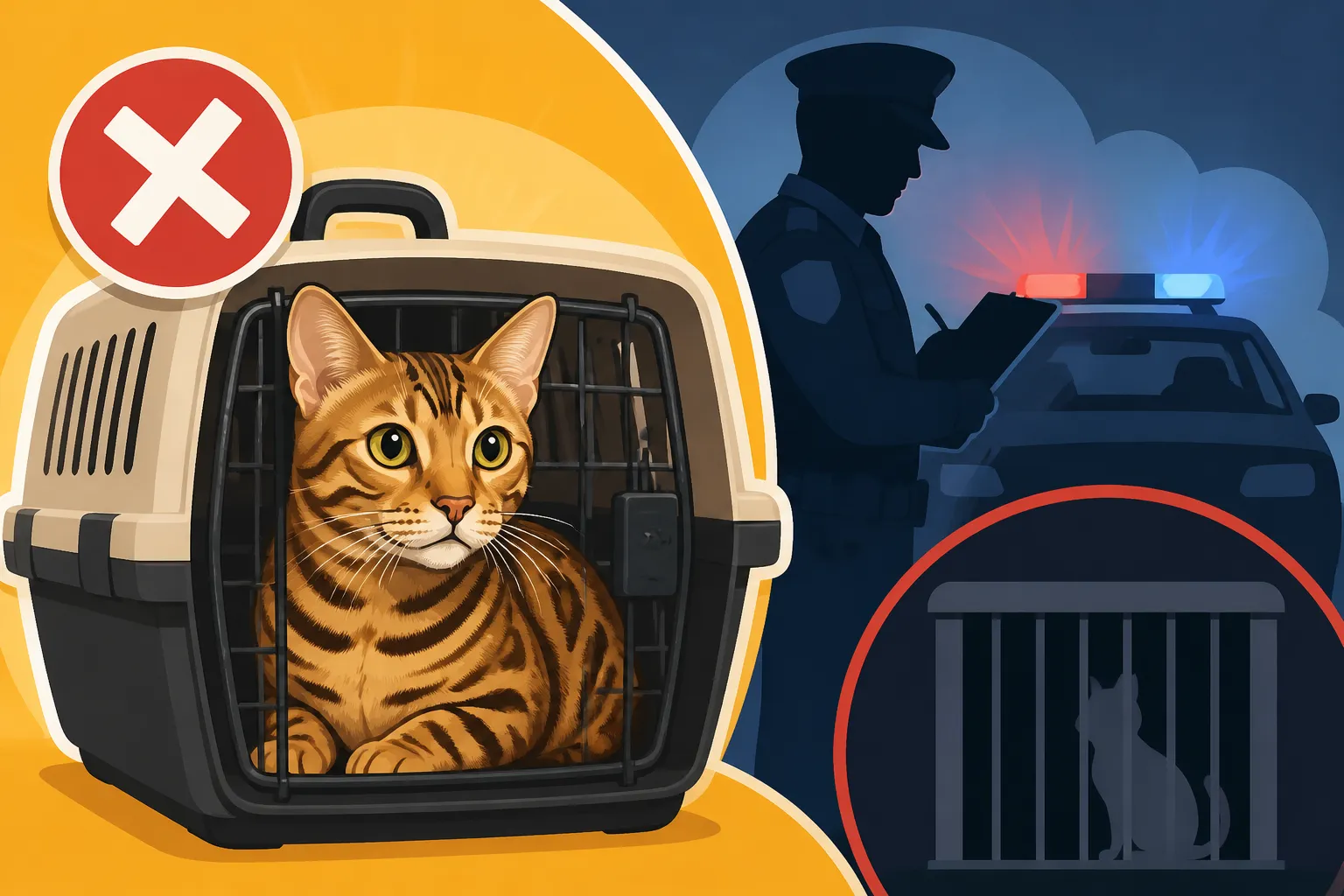
During long drives, keep your cat secured in an approved, heavy-duty carrier padded with familiar blankets. Keep their regular diet steady to avoid sudden stomach upset on the road. High-stress moves frequently trigger loose stools in sensitive breeds. If your cat eats specialized fresh food to keep their digestive system stable, ensure you pack enough insulated coolers and fresh supplies to maintain their feeding schedule through the trip.
Always prepare a contingency plan in case you are stopped by authorities or denied entry into temporary housing during travel. Identify safe, hybrid-friendly veterinary clinics and professional boarding facilities along your route ahead of time. Having a pre-planned safety net guarantees that if a legal complication arises during your journey, your cat has a safe, comfortable place to stay while you resolve the issue with local officials.
| Moving Stage | Critical Safety Action | Primary Documentation Required |
|---|---|---|
| 60 Days Before Move | Research state, county, and city codes | Written municipal confirmation of legal status |
| 30 Days Before Move | Secure permits or adjust housing search location | Exotic pet permit application approval |
| 14 Days Before Move | Compile official health and registration files | Certified TICA/CFA 5-generation pedigree |
| Moving Day | Secure cat in safe transport enclosure | Microchip records and travel health certificate |
Comparing Regional Restrictions and Legal Statuses
State vs City Level Rules
The contrast between state legal frameworks and city ordinances creates immense confusion for relocating pet owners. A state government may decide that all cats five generations removed from the Asian Leopard Cat are domestic pets, granting total freedom of ownership statewide. However, home-rule cities within that state maintain local authority to pass stricter health and safety ordinances, overriding state permissions within city boundaries.
For example, a state might permit all SBT domestic hybrids, but its largest metropolitan city might enforce a strict ban on any feline possessing wild ancestry regardless of generation. If you move into a downtown high-rise in that city, state law will not protect you from municipal animal control officers enforcing local city codes.
Conversely, some states enforce strict statewide bans or require expensive, heavy-duty wildlife permits regardless of what local cities want. In these regions, a city clerk cannot issue you a valid local pet license if state environmental conservation officers deem the animal illegal contraband. You must verify compliance at both the state and local levels before making binding moving commitments.
Comparative Analysis Table of Regional Bengal Restrictions
To help navigate the vast differences in how jurisdictions treat domestic hybrid cats, the following table breaks down standard regulatory models used across various regions:
| Regulatory Category | Target Feline Generations | Permit Requirements | Inspection Needs | Overall Risk Level |
|---|---|---|---|---|
| Outright Jurisdiction Ban | All F-generations & SBT | Permits Never Issued | Immediate Confiscation | Extreme |
| Wild Ancestry Restriction | F1, F2, F3, F4 Banned | Permit required for F1-F4 | Enclosure check for early generations | High for early generations |
| Standard Hybrid Regulation | F1-F4 Restricted; SBT Free | No permit needed for SBT | Pedigree check on demand | Moderate (Requires Paperwork) |
| Fully Unrestricted Region | All Generations Allowed | Standard domestic registration | Standard domestic rules | Minimal |
Navigating these regulatory tiers demands constant vigilance. If you find yourself relocating to a region categorized as high-risk or banned, do not take chances with your pet’s life. Choose housing in a neighboring, unrestricted town, or work with legal experts to secure valid permits before your move date. Your cat relies entirely on you to make safe, informed legal decisions that keep your family together.
Disclaimer
This article is for general informational purposes only and does not constitute professional advice. Laws, prices and regulations vary by location and change over time. Consult a qualified professional for guidance on your specific situation.