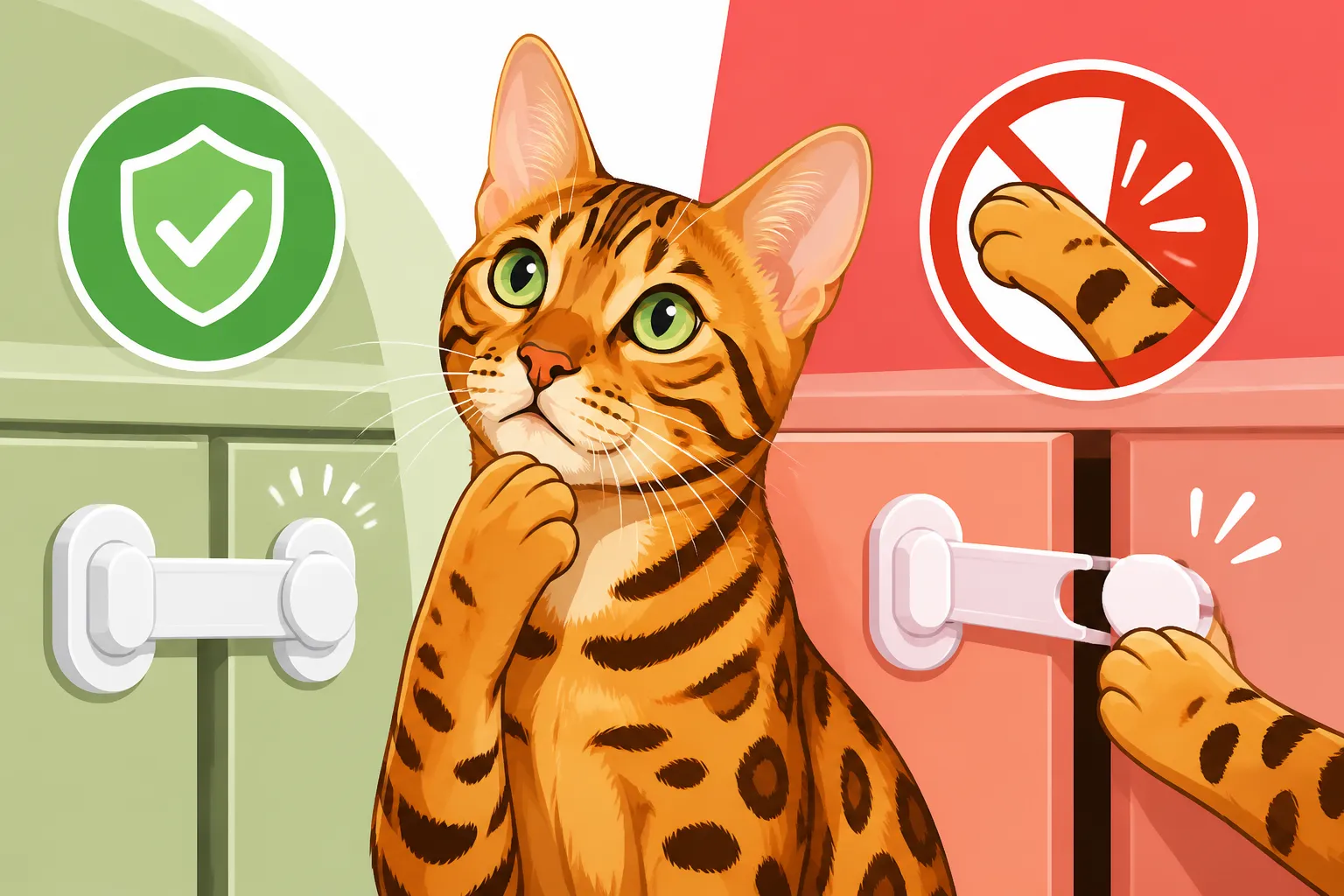
Whether Child Locks Work on a Bengal Cat
If you’ve ever come home to your kitchen cabinets flung wide open, pantry shelves rearranged, or bathroom drawers emptied onto the floor, you know the unique frustration of living with a Bengal cat. They are incredibly clever, and what works for a toddler often doesn't stand a chance against their relentless curiosity and dexterity. This guide is all about whether those child locks you're eyeing can truly hold up against your brilliant Bengal, and what other strategies you might need to employ to keep your home – and your sanity – intact.
The Bengal Cat's Clever Paws and Problem-Solving Mind
Bengal cats aren't just pretty faces; they possess an extraordinary level of intelligence and a relentless drive to explore. This combination often leads them to become master manipulators of household objects, including your cabinet doors and drawers. It’s not just mischief; it’s a deep-seated instinct.
Why Bengals are Master Escapists
Your Bengal's lineage traces back to the wild Asian Leopard Cat, an animal that thrives on hunting, exploring, and solving environmental challenges. This wild ancestry imbues Bengals with a problem-solving intellect that far surpasses many domestic breeds. They aren't content with passive observation; they need to interact, to understand how things work, and to figure out how to get to where they want to be. If they see a cabinet they believe might hold something interesting – whether it's food, toys, or just a dark, intriguing space – they will dedicate themselves to finding a way in. Their persistence is legendary; they don't give up after one failed attempt, they learn from it and try a new angle. This is why a simple latch, designed for a human toddler's less developed motor skills and attention span, often proves to be merely a temporary inconvenience for a determined Bengal.
They learn by watching us. Every time you open a cabinet, even if you think they aren't paying attention, they very well might be observing your grip, the motion of the latch, the sound it makes. They connect cause and effect with incredible speed. It’s part of How Clever a Bengal Cat Is, and it certainly keeps us on our toes!
Beyond Simple Latches: The Dexterity Factor
It's not just their brains; it's their paws. A Bengal cat's paws are not just for walking or scratching; they are incredibly agile tools. They can bat, hook, pull, push, and even twist with remarkable precision. Think of it less like a clumsy child trying to open a door and more like a tiny, focused raccoon with highly developed manual dexterity. They can use their claws to hook onto small gaps, pry open seams, and apply pressure in just the right spot.
Many standard child locks rely on a simple pushing or pulling motion, or a small lever that requires a certain grip. A Bengal, with its slender paws and sharp claws, can often find a way to get a purchase on these mechanisms that a human child, with fatter fingers, simply couldn't. This makes a huge difference in the effectiveness of various locking solutions.
The "How-To" of Bengal Break-Ins
Bengals employ a surprisingly sophisticated range of tactics to get into places they shouldn’t. It often starts with a curious nudge, but quickly escalates. They might stand on their hind legs and use their body weight to pull down on a handle or lever, or they might repeatedly bat at a cabinet door, hoping it will eventually give way. Some will patiently work a latch, pawing and scratching until they figure out the exact angle or pressure needed to release it.
I've heard stories of Bengals figuring out complex push-and-slide mechanisms, even those with multiple steps. They don't just brute force; they analyze. If they can't open a drawer directly, they might try to pull on a nearby cabinet door to create leverage or instability in the entire unit. It’s a testament to Why a Bengal Cat Opens Cabinets, Doors and Drawers, and a constant reminder that we’re dealing with a truly intelligent creature.
Types of Child Locks and Their Bengal Cat Resistance
When you're trying to keep your Bengal out of trouble, not all child locks are created equal. Many are designed with a human child's cognitive and physical abilities in mind, which, as we've discussed, are quite different from those of a super-smart cat.
Magnetic Cabinet Locks: The Hidden Defense
Magnetic cabinet locks are often considered the gold standard for childproofing, and they tend to fare better against Bengals than many other types. These locks are installed inside the cabinet or drawer, making them invisible from the outside. To open the cabinet, you hold a special magnetic "key" to the exterior surface, which then disengages the internal latch.
The pros of these locks are significant: they're hidden, which means your Bengal can't see the mechanism to try and manipulate it. They are also usually quite strong and require a precise magnetic field to release. However, they aren't foolproof. Bengals are excellent observers. If your cat watches you intently every time you open a cabinet, they might begin to associate the action with the specific spot where you hold the key. While they can't replicate the magnetic force, a very persistent Bengal might still try to paw at that spot, or the edges of the cabinet door, to see if they can create a tiny gap. The biggest con for owners, however, is often misplacing the magnetic key! Finding a robust set of these on Amazon with good reviews for durability and magnetic strength is crucial.
Adhesive Strap Locks: The Visible Deterrent
Adhesive strap locks are those flexible plastic or fabric straps that stick to the exterior of cabinets, drawers, toilets, or even appliances. They usually have a button or squeeze mechanism to release the strap, allowing the cabinet to open. They are very visible, which can be both a pro and a con.
On the positive side, they are incredibly easy to install, often requiring no tools, and they are versatile, working on various surfaces and angles. However, their visibility is precisely why many Bengals can learn to defeat them. Your cat will see the strap, and their curiosity will immediately be piqued. They might try to chew through the strap itself, which is often made of plastic. If the adhesive isn't strong enough, or if your Bengal applies enough leverage, they might even manage to pry the entire lock off the surface. Some Bengals learn to squeeze the release buttons with their paws, mimicking the motion they've observed you make. While they might deter a casual poke, for a truly determined Bengal, these are often just another puzzle to solve, and one that might not last long.
Spring-Loaded Latches and Sliding Locks: A Question of Persistence
These are the more traditional child locks. Spring-loaded latches are typically installed inside cabinets and catch when the door closes, requiring you to push down on a lever inside the door to release it. Sliding locks, often U-shaped, slide over two cabinet handles or knobs, preventing them from being opened.
Spring-loaded latches face a similar challenge to magnetic ones in that the mechanism is hidden, but often they are less robust. A Bengal might still manage to pry open a slight gap at the top or bottom of the cabinet door and then use a paw to reach in and manipulate the latch. They rely on the door staying completely flush, which isn't always the case with an active cat constantly testing it. Sliding locks, while seemingly straightforward, can be a joke to a Bengal. If your cabinet handles are thin enough, a clever cat can sometimes learn to slide the lock off by pushing it with their nose or paw, using the natural give of the plastic. Even if they can't slide it off, a strong Bengal can sometimes simply pull and twist hard enough to snap cheaper plastic versions. These types of locks are usually the first casualty in a Bengal vs. Cabinet war.
| Child Lock Type | How It Works | Pros (against Bengals) | Cons (against Bengals) | Bengal Resistance Estimate |
|---|---|---|---|---|
| Magnetic Cabinet Locks | Internal latch, released by external magnetic key | Hidden mechanism, strong hold, no visible parts to chew | Requires precise key, can be observed by clever cats | High |
| Adhesive Strap Locks | External strap, adhesive base, squeeze release | Easy install, versatile, covers gaps | Visible target, chewable material, adhesive can fail | Low to Medium |
| Spring-Loaded Latches | Internal latch, push-down release mechanism | Hidden mechanism, keeps doors flush | Can be manipulated if gap is created, less robust | Medium |
| Sliding Locks | U-shaped lock slides over handles/knobs | Simple, quick to apply | Easily removed by pushing/pulling, chewable, brittle | Low |
Strategies Beyond Just Child Locks for Bengal-Proofing
Relying solely on one type of child lock is often a recipe for disappointment when you have a Bengal cat. Their intelligence and agility mean you often need a multi-faceted approach to truly keep them out of trouble.
Layering Security: More Than One Lock
If you have a particularly persistent or clever Bengal, a single lock might not be enough. Consider combining different types of locks on the same cabinet or drawer. For example, you might install magnetic locks for the primary security, but then add an external strap lock as a secondary deterrent, especially if the cabinet holds something particularly enticing or dangerous. This creates multiple layers of challenge, requiring different types of manipulation to defeat. The more obstacles you place in their path, the more likely they are to eventually give up – or at least take a very long time to succeed.
Think about the most critical areas first. Is there a cabinet with cleaning supplies, medications, or human foods that are toxic to cats? These are the prime candidates for a double-lock strategy. For less critical areas, a single, robust magnetic lock might suffice. This layering approach acknowledges their intelligence and forces them to work harder, buying you time and peace of mind.
Redirection and Enrichment: Distraction as a Tool
Often, a Bengal cat's relentless pursuit of opening cabinets stems from boredom or a lack of appropriate outlets for their natural instincts. They are incredibly active and intelligent creatures who need constant mental and physical stimulation. If your Bengal is constantly trying to break into forbidden zones, it might be a sign they need more enrichment. Providing them with engaging alternatives can be a highly effective long-term strategy.
Invest in sturdy cat trees that offer plenty of vertical climbing space, like the ones you can find at Amazon. Puzzle feeders that require them to work for their food can keep their minds busy for extended periods. Interactive toys, regular play sessions with wand toys, and even a cat wheel can burn off excess energy and satisfy their hunting instincts. A dedicated catio, where they can safely explore the outdoors, can also work wonders. "A Bengal Cat Needs Almost No Grooming" but they do need plenty of stimulating activity to keep their minds and bodies busy. Giving them appropriate "jobs" can significantly reduce their inclination to find mischief.
Training and Consistency: Teaching Boundaries
While you might not be able to teach a Bengal cat to never open a cabinet, you can certainly try to teach them that certain areas are off-limits. This requires patience, consistency, and positive reinforcement. When you see your Bengal attempting to open a cabinet, gently redirect them with a firm "no" or a clap. Immediately follow up by engaging them with an appropriate toy or directing them to a permitted climbing structure. The key is to make the forbidden activity less rewarding than the desired behavior.
You won't break their natural curiosity, but you can channel it. Consistency from every family member is crucial. If one person allows them to nose around a cabinet while another shoos them away, your Bengal will get mixed signals and continue to test boundaries. It's a long game, but over time, they can learn to respect certain no-go zones, especially if they associate those zones with immediate redirection to more fun activities.
Realistic Expectations and Long-Term Solutions
Living with a Bengal cat is an adventure, and part of that adventure is continuously adapting your home to their boundless energy and intellect. While child locks can be a valuable tool, it's important to approach them with realistic expectations.
The Ongoing Battle: A Bengal's Intelligence vs. Your Ingenuity
Remember, your Bengal cat is always learning, always observing, and always problem-solving. What works as a deterrent today might become a new challenge for them to overcome tomorrow. This isn't a one-and-done fix; it's an ongoing process of adaptation and ingenuity on your part. Think of it as a game of wits!
You might find yourself upgrading locks periodically as your Bengal grows older and more experienced. It's a testament to How Clever a Bengal Cat Is, but it also means you need to be one step ahead. Be prepared to reassess your home security every few months, especially if you notice new attempts at breaking into previously secured areas. Don't get discouraged if a lock fails; simply see it as a sign to innovate.
When All Else Fails: Securing Problem Areas
For some particularly determined Bengals, even the most robust child locks might not be enough for certain high-stakes areas. If you have a cabinet containing dangerous chemicals, sharp objects, or irreplaceable items, you might need to consider more extreme measures. This could involve installing traditional metal latches with a padlock, using strong bungee cords, or even physically blocking access to a particular cabinet with furniture or decorative screens.
Another option is to simply relocate dangerous items to higher shelves or rooms that your Bengal cannot access at all. Sometimes, the easiest solution isn't to fight their nature, but to remove the temptation entirely. It’s all about creating a safe and stimulating environment for them, while keeping your valuables and their safety protected. Don't forget that How to Cat Proof Cabinets From a Bengal Cat offers even more solutions for these persistent feline engineers.
The Cost of Cleverness: Investing in Robust Solutions
While it might be tempting to grab the cheapest pack of child locks you find, with a Bengal cat, you truly get what you pay for. Flimsy plastic locks or those with weak adhesive won't stand a chance against their strength and persistence. Investing in high-quality, durable child locks is usually a smarter long-term decision. Look for products made from robust materials, with strong adhesive if applicable, and secure locking mechanisms. Reading reviews from other pet owners (not just parents) on platforms like Amazon can provide valuable insight into which locks truly hold up against curious critters.
Consider it an investment in your peace of mind and the safety of your home. A one-time purchase of a slightly more expensive, but significantly more effective, locking system can save you countless headaches, potential vet bills from ingested toxins, or the cost of replacing damaged belongings. After all, the joy and companionship a Bengal brings are priceless, but protecting them (and your stuff) does require a bit of strategic spending!
Disclaimer
This article is for general informational purposes only and does not constitute professional advice. Laws, prices and regulations vary by location and change over time. Consult a qualified professional for guidance on your specific situation.