What an Arrowhead Rosette Is on a Bengal Cat
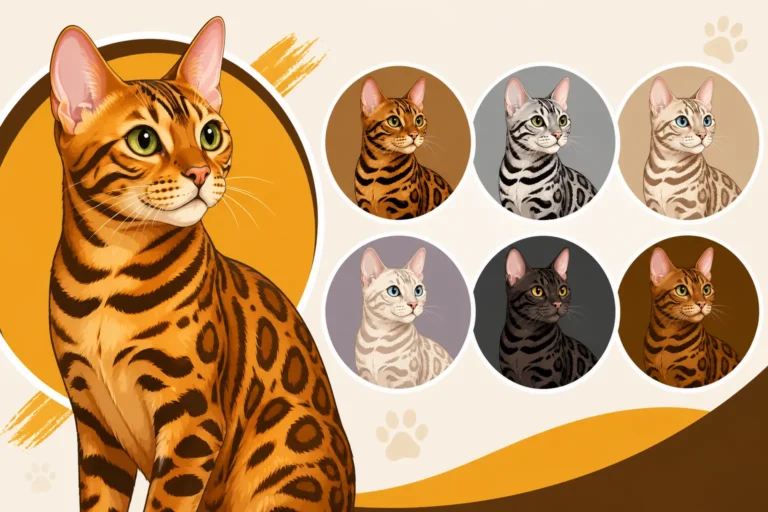
A Bengal cat’s coat can look like a field of tiny arrows, especially where pointed markings sit along the shoulders and flanks. Those markings may be arrowhead rosettes, but it is easy to confuse them with ordinary spots or other rosette shapes. This guide explains what an arrowhead rosette looks like, how it differs from similar patterns, and what to keep in mind when assessing a kitten or adult Bengal.
What an arrowhead rosette looks like
A pointed marking with a lighter center
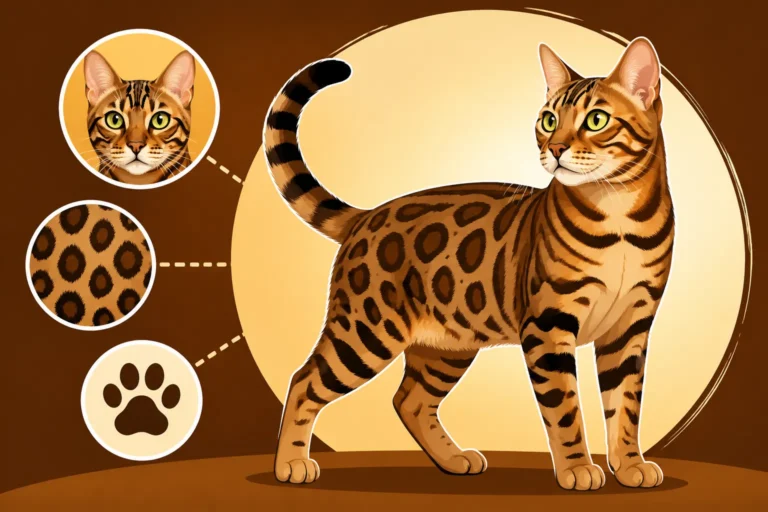
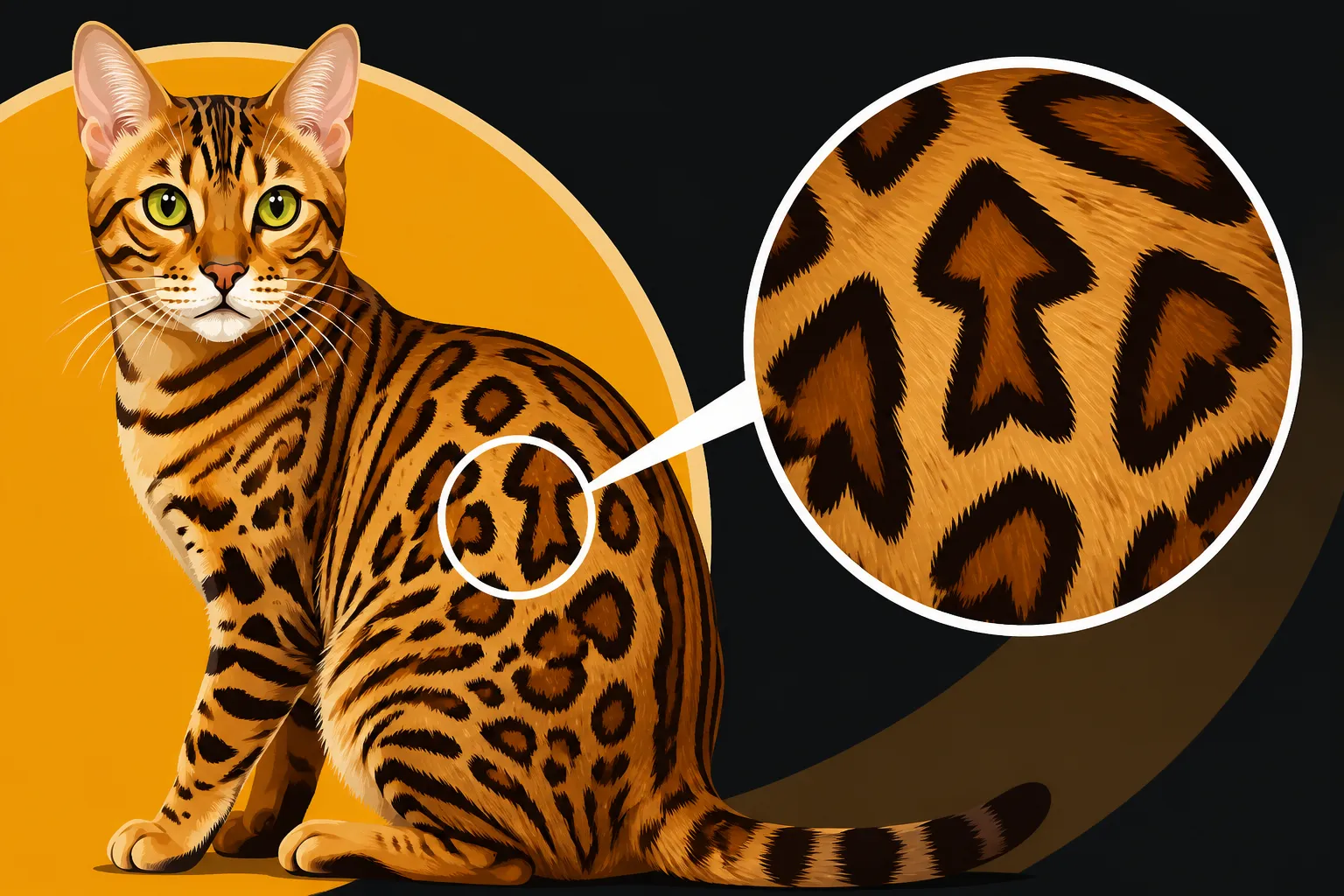
An arrowhead rosette is a Bengal coat marking with a distinctly triangular or pointed outline. Like other rosettes, it usually has a darker border surrounding a lighter center, so it reads as a two-tone marking rather than one solid spot. The outline may be crisp and clearly pointed, or softer and less regular.
The name describes the marking’s shape, not a literal arrow printed on the cat. Some arrowhead rosettes are broad and open, while others are narrow and elongated. Their tips can also vary in how pronounced they appear. Viewed from across a room, the pattern may look like rows of angled spots; close up, the lighter interior and darker edge are easier to make out.
A Bengal does not need to have perfectly identical markings on both sides. One side might show several sharply defined arrowheads while the other has rosettes with rounder, less distinct outlines. That variation is normal in a coat pattern. If you are comparing kittens, look at the overall pattern and contrast rather than expecting every marking to match its neighbor.
How the pattern sits on the body
Arrowhead rosettes are often easiest to notice along the sides, where markings can form a flowing arrangement across the coat. Their pointed shape can contribute to a sense of movement, especially when the markings are elongated and arranged in roughly horizontal lines. The pattern may look different across the shoulders, back, sides, and legs because the coat’s markings change in shape and size from one area to another.
There is no requirement that every arrowhead point in the same direction or form a perfectly aligned row. Coat patterns are organic, and a Bengal’s rosettes may angle, stretch, or overlap visually depending on their location. A cat’s posture also changes what you see: a curled-up cat, for instance, may make a flowing arrangement appear jumbled.
It can help to view a cat in natural, even light and from more than one angle. Strong shadows, phone-camera processing, or a very close crop can make the dark outline appear heavier than it is or hide the lighter center. If you are looking at breeder photos, try to compare clear full-body images rather than judging the pattern from a single dramatic close-up.
For a broader description of the breed’s appearance, see What a Bengal Cat Looks Like by the Standard. The full coat includes more than rosettes, and an arrowhead shape is just one feature in the larger pattern.
Arrowhead rosettes compared with other Bengal markings
Arrowheads, paw prints, and donut rosettes
Arrowhead, paw-print, and donut rosettes all refer to shapes within the broader family of Bengal rosettes. A paw-print rosette often resembles a partial ring or curved marking with one or more darker spots near its edge. A donut rosette tends to look more rounded, with a darker outline enclosing a lighter center. An arrowhead rosette is distinguished by its pointed or triangular silhouette.
Real coats do not always fit neatly into one label. A rosette can be asymmetrical, partly open, or shaped in a way that seems halfway between two categories. One observer might call it an arrowhead, while another might describe it as an elongated rosette. These names are useful for describing visible pattern features, but they are not a promise that every marking will look like a textbook example.
| Marking type | Common visual impression | What to look for |
|---|---|---|
| Arrowhead rosette | Pointed or triangular | A tapered shape with a darker border and lighter interior |
| Paw-print rosette | Curved or partly open | A crescent-like outline that may have darker spots near the edge |
| Donut rosette | Rounded or ring-like | A more enclosed dark outline around a lighter center |
| Single spot | Solid and separate | One color within the marking rather than a distinct darker border and lighter center |
For comparisons with other recognized rosette shapes, see What a Paw Print Rosette Is on a Bengal Cat and What a Donut Rosette Is on a Bengal Cat. These labels can help you describe a cat’s coat, but they should not be treated as rigid categories for every spot.
Arrowheads compared with single spots and marbling
A single spot is generally a solid marking rather than a two-tone rosette with a darker outer edge and lighter middle. From a distance, a small rosette can look like a single spot, particularly if the center is dark or the contrast is subtle. Looking closely at several markings can help: a rosetted coat usually shows recurring differences between the outline and the center.
Marbling is different in overall structure. Instead of separate, individual spots or rosettes, a marbled Bengal has larger flowing shapes and swirls across the coat. The pattern may still include areas of contrast, but it does not appear as a series of distinct arrowhead-shaped markings. The distinction is easier to see when you compare the cat’s whole body rather than one small patch.
A Bengal can also have a mixture of marking shapes across its body. That does not automatically mean the cat is a different pattern type; markings vary in size and form from one part of the coat to another. For a fuller pattern comparison, read Rosetted Against Marbled: The Two Bengal Cat Patterns, What a Single Spotted Bengal Cat Is, and How Marbling Differs From Rosetting in a Bengal Cat.
How arrowhead rosettes develop and appear
A kitten’s coat may change as it matures
A Bengal kitten’s pattern is not always easy to assess in its first weeks or months. Young kittens can have a soft, muted appearance known as fuzzies, which can make the coat seem less clear or less contrasted. As the kitten matures, the coat often becomes easier to read, and rosette outlines and centers may stand out more distinctly.
This can be frustrating for someone choosing a kitten from early photos. A small marking that seems sharply pointed in one image may look softer as the coat changes, while a low-contrast pattern may become more apparent in different lighting or as the kitten grows. It is sensible to ask for updated photos and, if possible, to see the kitten in person rather than assuming its adult coat will look exactly like a single early snapshot.
The pattern generally becomes more recognizable with age, but no one can guarantee that every individual rosette will retain a particular sharpness or shape. The coat is a living, visible trait—not a set of identical stamps. For more about coat development, see When a Bengal Cat's Adult Pattern Comes Through and What Fuzzies Are on a Bengal Cat Kitten.
Contrast, lighting, and coat color affect what you see
The outline and center of an arrowhead rosette need enough contrast to be visible. A dark border against a lighter center makes the shape easier to distinguish; lower contrast can make the same kind of marking look like a simple spot. Coat color and individual variation influence how pronounced the pattern seems.
Lighting matters, too. Direct flash can flatten the appearance of the coat or make highlights look unusually bright. Dim indoor lighting can swallow the difference between a rosette’s outline and its center. In everyday life, the pattern may look subtly different from one room to another, which is why a carefully lit photograph is helpful but not always a perfect representation.
When assessing a coat, avoid making a decision based on one close-up, one filter-heavy image, or a photo taken in dramatic lighting. Look for consistent features across multiple clear views. A useful description includes the pattern’s overall arrangement, contrast, and definition—not just the presence of a single striking marking.
What arrowhead rosettes do and do not tell you
They describe coat appearance, not health or temperament
An arrowhead rosette is a description of coat pattern. It does not, by itself, tell you whether a Bengal is healthy, calm, energetic, suitable for a household, or likely to have a particular personality. Two cats with similar-looking rosettes can have very different temperaments and needs.
If you are choosing a Bengal kitten, consider the breeder’s care practices, the kitten’s socialization, and the information available about the parents alongside the coat. Ask to see relevant health documentation and discuss how the kittens are raised. Pattern appearance can be exciting, but it should not be the only factor guiding a long-term decision.
It is also worth remembering that attractive markings do not replace a proper understanding of the breed. Bengal cats need thoughtful care and enrichment, and a striking coat does not make an individual cat automatically well suited to every home. For descriptions of related markings, see What a Clouded Rosette Is on a Bengal Cat and Which Rosette Type Judges Prefer in a Bengal Cat.
There is no single perfect arrowhead
People may have personal preferences for bold, open, well-defined markings, and show evaluations consider the whole cat rather than one isolated rosette. The exact coat qualities valued can depend on the registry’s written standard and the context in which a cat is being assessed. It is not accurate to assume that every judge or Bengal enthusiast will prefer the same arrowhead shape.
If a breeder describes a kitten as having arrowhead rosettes, ask what they mean by the term and request clear photos of the coat. A reputable description should help you understand what is visible without suggesting that a particular marking guarantees show success, health, or a particular price or future appearance.
Ultimately, an arrowhead rosette is simply a pointed, often two-tone coat marking that contributes to the Bengal’s distinctive look. Its edges may be sharp or soft, its shape may vary, and its appearance can change with age, angle, and lighting. Seeing the full coat in context is the best way to decide whether the pattern is truly arrowhead-shaped.
Disclaimer
This article is for general informational purposes only and does not constitute professional advice. Laws, prices and regulations vary by location and change over time. Consult a qualified professional for guidance on your specific situation.