Which Bengal Cat Generation New York State Allows
It’s a common scenario: you’ve fallen head over heels for the striking beauty and vivacious personality of a Bengal cat, but then the whispers start – "Are they even legal here?" Navigating the labyrinth of laws surrounding hybrid cat breeds can feel incredibly frustrating and confusing, especially when you’re trying to understand what’s allowed in a specific place like New York State. This guide is here to untangle that knot for you, breaking down the regulations and what they mean for prospective and current Bengal cat owners in the Empire State.
Understanding Bengal Cat Generations and Their Importance
Before we can dive into the specifics of New York's laws, we first need to get a handle on what exactly a Bengal cat "generation" means. This isn't just a fancy term; it's the fundamental piece of information that dictates a Bengal's legal status, temperament, and even some aspects of their care. It’s all about how close your particular feline friend is to their wild ancestors.
The Wild Ancestor: Asian Leopard Cat
At the heart of every single Bengal cat pedigree is the beautiful and elusive Asian Leopard Cat (ALC). This small wild feline, native to Southeast Asia, is where the Bengal gets its iconic spotted coat, athletic build, and often, its boundless energy. The entire Bengal breed began by carefully crossing these wild cats with domestic house cats. This initial pairing, and the subsequent generations, are what we refer to as filial generations, denoted by an "F" number. If you're curious about the very beginning, you might want to read more about A Leopard Cat and a Housecat Made the First Bengal Cat.
Understanding the ALC is key because the laws restricting Bengal cats are primarily concerned with how much "wild" a cat retains, or is perceived to retain, based on its lineage. The closer a Bengal is to its wild ancestor, the more likely it is to be subject to stricter regulations, or even outright bans, in certain areas. It's not about how "wild" any individual cat acts, but rather a blanket legal classification based on their generational distance.
Deciphering the Filial Generations: F1, F2, F3
When you see a Bengal cat described as F1, F2, or F3, it directly refers to their generational distance from the Asian Leopard Cat. These are often called "early generation" Bengals, and they are typically the most scrutinized by animal control and wildlife authorities.
An F1 Bengal is a direct first-generation cross between a domestic cat and a pure Asian Leopard Cat. Think of it as having one wild parent. These cats often exhibit many traits of their wild ancestors, both in appearance and behavior. They can be more challenging to manage, less predictable, and their wild instincts are much stronger. Due to their direct wild parentage, F1 Bengals are frequently classified as "wild animals" or "dangerous animals" by various jurisdictions, making them illegal to own in many places without special permits. To learn more about this specific generation, check out What F1 Means in a Bengal Cat.
An F2 Bengal is the second generation, meaning one of their grandparents was an Asian Leopard Cat. While still very wild in appearance and often in temperament, they are generally a bit more predictable than F1s. They still carry a significant amount of wild blood, and as such, are often grouped with F1s under strict regulations.
An F3 Bengal is the third generation, with an ALC as one of their great-grandparents. These cats are further removed from their wild heritage, but they can still exhibit some strong wild traits and may still be subject to similar restrictions as F1s and F2s in many areas. For more details on these earlier generations, you might find What F2 and F3 Mean in a Bengal Cat helpful.
The legal frameworks tend to draw a line somewhere within these early generations. The reasoning is often rooted in public safety concerns, the difficulty of caring for such animals, and a desire to prevent the keeping of undomesticated species as pets.
The SBT Bengal: A Fully Domesticated Companion
This is where the distinction becomes incredibly important for most aspiring Bengal cat owners. SBT stands for "Stud Book Traditional," and it signifies a Bengal cat that is at least four generations (F4 or higher) removed from its Asian Leopard Cat ancestor. This means an SBT Bengal has only other Bengal cats in its pedigree for at least three generations back from both parents.
SBT Bengals are considered fully domesticated and typically behave much like other domestic cat breeds. While they retain the stunning wild look, their temperament is generally much more suitable for a household pet. They are playful, intelligent, and affectionate, much like a typical house cat, albeit with a unique level of energy and curiosity. Because of their domesticated nature, SBT Bengals are the generation that is widely accepted and legal to own in most places where Bengal cats are permitted. They are registered by cat associations like TICA (The International Cat Association) and are eligible for championship status in cat shows. Understanding this designation is crucial, as it’s the key to legal ownership in many regions. Dive deeper into this topic by reading What SBT Means in a Bengal Cat.
New York State's Specific Stance on Bengal Cats
Now, let's get to the heart of the matter for New Yorkers. The question of legality in New York State isn't as straightforward as a simple "yes" or "no" for all Bengals; it hinges entirely on that generation number we just discussed.
The General Rule for New York State
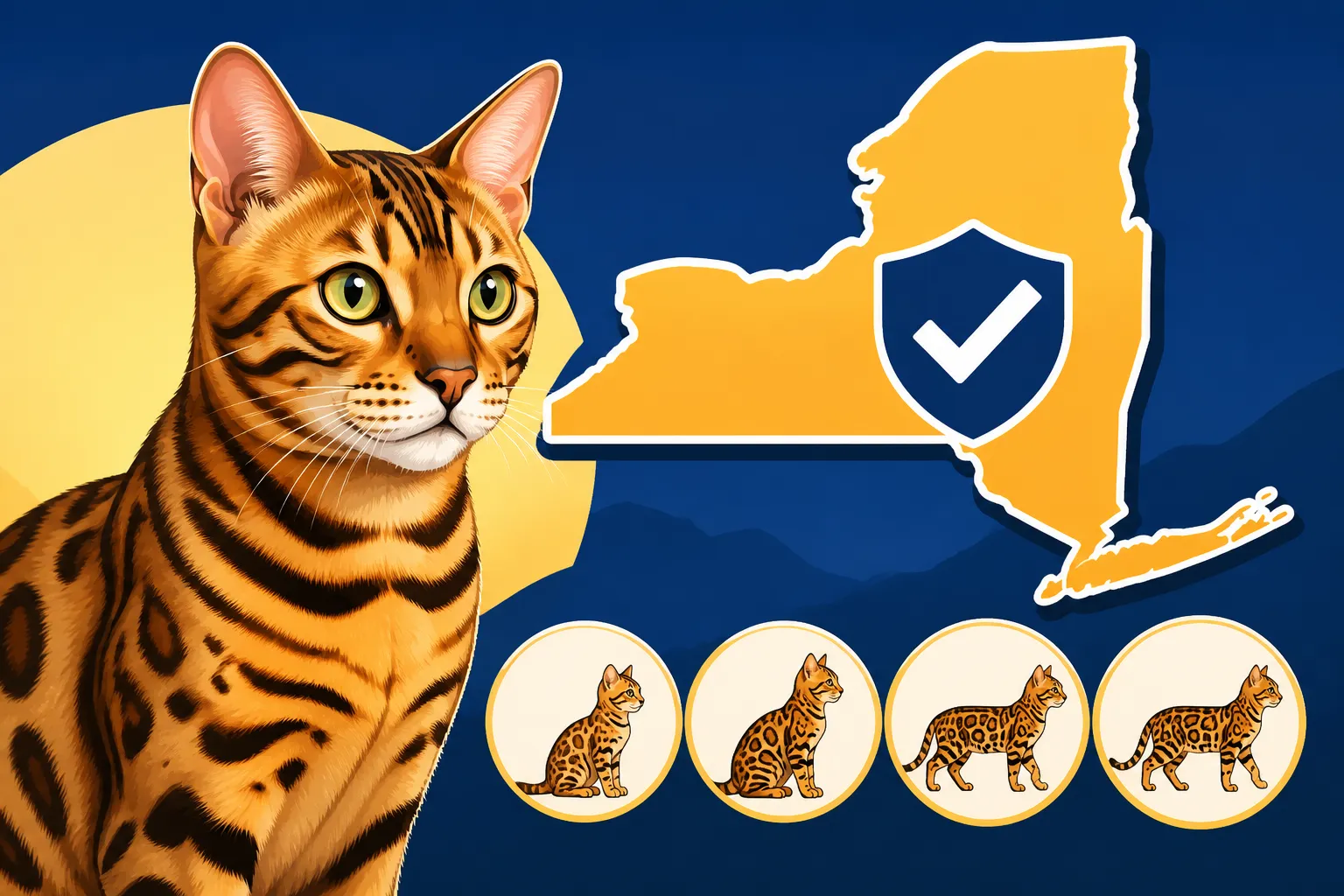
Here’s the good news for most prospective Bengal cat owners in New York State: SBT (Stud Book Traditional) Bengal cats are generally allowed and considered legal to own. This means any Bengal that is F4 or further removed from its Asian Leopard Cat ancestor falls within the state's definition of a domestic animal. The state sees these cats as sufficiently domesticated, much like a Siamese or a Maine Coon, despite their exotic appearance.
The reason for this distinction is that New York State's environmental conservation law prohibits the private ownership of certain "dangerous animals" without a license. This list includes specific wild cat species and hybrid crosses that are less than four generations removed from their wild ancestors. Therefore, F1, F2, and F3 Bengal cats are typically restricted or banned outright in New York State without a specific permit, which is extremely difficult for a private citizen to obtain and is usually reserved for zoos or accredited sanctuaries. This is in line with many other states that draw a similar line in the sand, as discussed in Which States Restrict Early Generation Bengal Cats.
So, if you're looking to bring a Bengal into your New York home, your focus should be squarely on finding an SBT Bengal. Reputable breeders will always be able to provide the necessary documentation to prove the cat's generation.
Permits and Restrictions for Early Generations
While SBT Bengals are generally accepted, owning an F1, F2, or F3 Bengal in New York State typically falls under the category of owning a "wild animal" or "exotic animal," which is heavily regulated. As mentioned, private ownership of these early generations is usually prohibited, or requires permits that are rarely issued to individuals for pet purposes.
If, by some unusual circumstance, you were considering an early generation Bengal, you would need to contact the New York State Department of Environmental Conservation (DEC) for precise details and to understand if any permits could even theoretically be obtained. This isn't a route most pet owners pursue, nor is it often feasible. The state's intent is clear: to prevent individuals from keeping animals that retain significant wild characteristics and could pose a risk to public safety or animal welfare if not managed by trained professionals.
Why New York City Has Different Rules
This is a critical point that trips up many people: state law does not always supersede local ordinances. While New York State generally permits SBT Bengal cats, municipalities within the state can (and often do) enact their own, stricter regulations. The most famous example, and one that is highly relevant to Bengal owners, is New York City.
New York City has a long-standing ban on all generations of Bengal cats, classifying them as wild animals or hybrids regardless of their generational distance from the Asian Leopard Cat. This means that even an F4 or SBT Bengal, which is legal in many other parts of New York State, is prohibited within the five boroughs of New York City (Manhattan, Brooklyn, Queens, The Bronx, Staten Island). This is a unique and important distinction that often catches people by surprise.
The city's stance is unequivocal: if it's a Bengal cat, it's not allowed. For residents of New York City, this can be a real heartache. You can learn more about this specific local regulation in New York City Bans the Bengal Cat the State Allows and further understand the reasons behind it in Why New York City Bans Every Bengal Cat.
Therefore, before acquiring a Bengal cat, it is absolutely essential to not only understand the state law but also to check the specific ordinances of your city, town, or county within New York. What's legal in upstate New York might be completely illegal just an hour's drive away in a different jurisdiction.
Here's a quick overview to help clarify the situation:
| Bengal Cat Generation | Proximity to ALC | New York State Legality (General) | New York City Legality |
|---|---|---|---|
| F1 | Direct Offspring | Generally restricted/banned | Banned |
| F2 | Second Generation | Generally restricted/banned | Banned |
| F3 | Third Generation | Generally restricted/banned | Banned |
| SBT (F4+) | Fourth+ Generation | Generally allowed | Banned |
Note: This table provides a general overview for informational purposes. Always consult local municipal codes and relevant authorities for the most current and specific legal requirements.
Navigating the Legal Landscape as a Bengal Cat Owner
So, you've decided a Bengal is the cat for you, and you live in a part of New York State where SBTs are permitted. Fantastic! But your journey doesn't end there. Responsible ownership means being able to navigate any legal questions that might arise and ensuring you have all your bases covered.
Verifying Your Bengal Cat's Generation
The most crucial step in ensuring your Bengal cat is legal in your part of New York is verifying its generation. This isn't something you can eyeball; it requires proper documentation. A reputable breeder will provide you with a detailed pedigree, which is essentially your cat's family tree. This pedigree will clearly show the generational numbering (F1, F2, F3, SBT) for several generations back, proving that your cat is indeed an SBT and therefore legally considered a domestic cat in most of New York State.
Never rely solely on a breeder's word. Always ask for the official registration papers from a recognized cat association like TICA, which will confirm the cat’s generation. This paperwork is your proof if you ever encounter questions from landlords, veterinarians, or local authorities. Understanding how to interpret these documents is vital for responsible ownership. More information on this can be found in How to Prove Your Bengal Cat's Generation.
The Importance of Breeder Documentation
A responsible and ethical Bengal breeder understands the legal nuances of their breed. Beyond proving the generation, they will provide a wealth of documentation that goes beyond just the pedigree. This includes health records, vaccination history, and often, copies of genetic health test results for the parents. These tests are incredibly important for the overall health of the breed. For example, a breeder should be transparent about genetic screenings for conditions like HCM (Hypertrophic Cardiomyopathy) and PRA-b (Progressive Retinal Atrophy). What a Bengal cat breeder should test for is outlined in What a Bengal Cat Breeder Should Have Tested.
This documentation not only gives you peace of mind about your cat's health but also serves as proof of their legitimate origins from a recognized breeding program. It demonstrates that you've acquired your Bengal through legal and ethical channels, rather than from a dubious source that might not adhere to breed standards or local laws.
What to Do If You're Unsure About Legality
If you are ever in doubt about the specific laws governing Bengal cats in your precise location within New York State, the absolute best course of action is to contact your local animal control or municipal clerk's office. These offices can provide the most accurate and up-to-date information regarding local ordinances. You might also consider consulting with a local attorney who specializes in animal law for definitive guidance on your particular situation. While I can provide general information, only official sources can give you legally binding answers for your specific address. It’s always better to be proactive and informed rather than face potential issues down the line.
Responsible Ownership Beyond Legality
Even after you've confirmed your Bengal is legal in your New York location, responsible ownership extends far beyond just checking boxes. Bengal cats are a unique and active breed, and providing them with the right environment and care is crucial for their well-being and your enjoyment of them.
Ensuring Your Bengal Cat's Well-being
Bengal cats are not for the faint of heart or the couch potato. They are incredibly active, intelligent, and curious creatures. They thrive on interaction, play, and mental stimulation. If you're considering a Bengal, be prepared for a cat that demands attention and engagement. They will climb, explore, and get into everything. This active nature is part of their charm but also a significant commitment. You'll need plenty of vertical space, sturdy scratching posts, and engaging toys to keep them happy and out of mischief. They are truly The Bengal Cat Is the Most Active Cat You Can Own.
Their sleek, pelt-like coat, which feels incredibly soft and luxurious, requires surprisingly little grooming. They are fastidious self-groomers, so while you won't be spending hours brushing them, regular interaction and health checks are still important. If you’re curious about their unique coat, you can learn that A Bengal Cat Needs Almost No Grooming. Ensuring they have a stimulating environment means they are less likely to act out due to boredom.
Financial Considerations for Bengal Cat Ownership
Bringing a Bengal cat into your life is a significant financial commitment, well beyond the initial purchase price. These active, sometimes rambunctious, felines have particular needs that can add up over their lifespan, which can easily be 15 years or more. Think about the long game when it comes to budgeting.
You'll need to factor in high-quality food, as their active metabolism often benefits from a high-protein diet. Fresh, human-grade foods might be a good fit for their dietary needs, though you should always consult with your vet. Beyond food, consider robust cat trees that can withstand their climbing prowess, durable toys that survive their intense play, and potentially a catio or cat wheel to burn off energy.
Routine veterinary care, including annual check-ups and vaccinations, is a given for any pet. However, with the Bengal breed, there's always the consideration of genetic health screenings or potential issues like chronic diarrhea. Pet insurance can be a lifesaver in these situations. Companies like Healthy Paws offer coverage that can help mitigate the costs of unexpected illnesses or accidents. It's a smart investment, especially for a breed known for its energy and occasional antics.
Finally, think about the long-term. From What a Bengal Cat Costs Over Its Lifetime to Fifteen Years of a Bengal Cat, Priced Out, the expenses accumulate. Be prepared for things like annual vet visits, flea and tick prevention, and potentially specialized diets or medications as they age. Planning for these costs upfront will ensure you and your Bengal enjoy many happy, healthy years together in your New York home.
Disclaimer
This article is for general informational purposes only and does not constitute professional advice. Laws, prices and regulations vary by location and change over time. Consult a qualified professional for guidance on your specific situation.