Whether Contrast Changes a Bengal Cat’s Price
One of the most common questions prospective Bengal cat owners grapple with is, "Why do some Bengals cost so much more than others?" Beyond the obvious factors like generation or breeder reputation, the visual appeal of a Bengal's coat — particularly its contrast — plays a significant role in its valuation. This guide will delve into what "contrast" truly means for a Bengal cat's pattern, how it's evaluated, and precisely how this striking aesthetic quality can influence the final price tag you might see from a reputable breeder.
Understanding Bengal Cat Pricing Fundamentals
Before we dive deep into the nuances of coat contrast, it's important to understand that a Bengal cat's price isn't determined by a single factor. It's a complex equation involving lineage, health, temperament, and, yes, aesthetics. Think of it like buying a piece of art; rarity, condition, and visual impact all contribute to its worth. With Bengals, these elements converge to create a spectrum of prices that can leave many new to the breed feeling a bit overwhelmed.
The Core Drivers of Bengal Cat Value
At its heart, the price of a Bengal cat is first and foremost driven by its generation. The closer a Bengal is to its wild Asian Leopard Cat ancestor, the higher the price tends to be, largely due to the rarity and specialized care required for these early generations (F1, F2, F3). These cats are often not considered "pets" in the traditional sense and have different legal restrictions too. For most prospective owners, the focus is on SBT (Stud Book Traditional) Bengals, which are at least four generations removed from their wild ancestor and are fully domesticated. You can read more about The F1 to F5 Price Ladder for a Bengal Cat to get a clearer picture of this foundational aspect.
Beyond generation, the overall health and temperament of the kitten are paramount. A responsible breeder invests heavily in health testing, proper nutrition, and early socialization, all of which contribute to the kitten's well-being and, consequently, its price. You’re not just buying a pretty face; you’re investing in a healthy, happy companion. This is why it’s so crucial to find a breeder who prioritizes these aspects, even if it means a higher initial outlay.
Beyond the "Basic" Bengal
Once you're looking at SBT Bengals (which are the most common pet Bengals), other factors come into play. Show quality versus pet quality is a significant differentiator. A show-quality Bengal adheres very closely to the breed standard set by organizations like The International Cat Association (TICA), featuring specific head shape, ear set, body type, and, of course, coat characteristics. A pet-quality Bengal, while still a purebred Bengal, might have slight deviations from the ideal standard that make it less competitive in the show ring, but no less wonderful as a companion. Understanding What a Bengal Cat Costs to Buy in 2026 gives a good overview of the general price ranges you might encounter.
It's within this discussion of show versus pet quality that contrast really begins to shine as a major price influencer. A Bengal cat's coat is its defining feature, and the visual impact of that coat is heavily dependent on how sharply its markings stand out against its background color. A truly breathtaking coat often translates to a higher price point, reflecting the breeder's dedication to producing aesthetically superior lines.
The Role of Contrast in Bengal Cat Appearance
When we talk about a Bengal cat's coat, most people immediately think of their stunning spots or rosettes. But what truly makes those markings pop, giving the cat that captivating "wild" look, is something called contrast. It's not just about having spots; it's about how those spots are presented on the canvas of their fur.
Defining "Contrast" in Bengal Coat Patterns
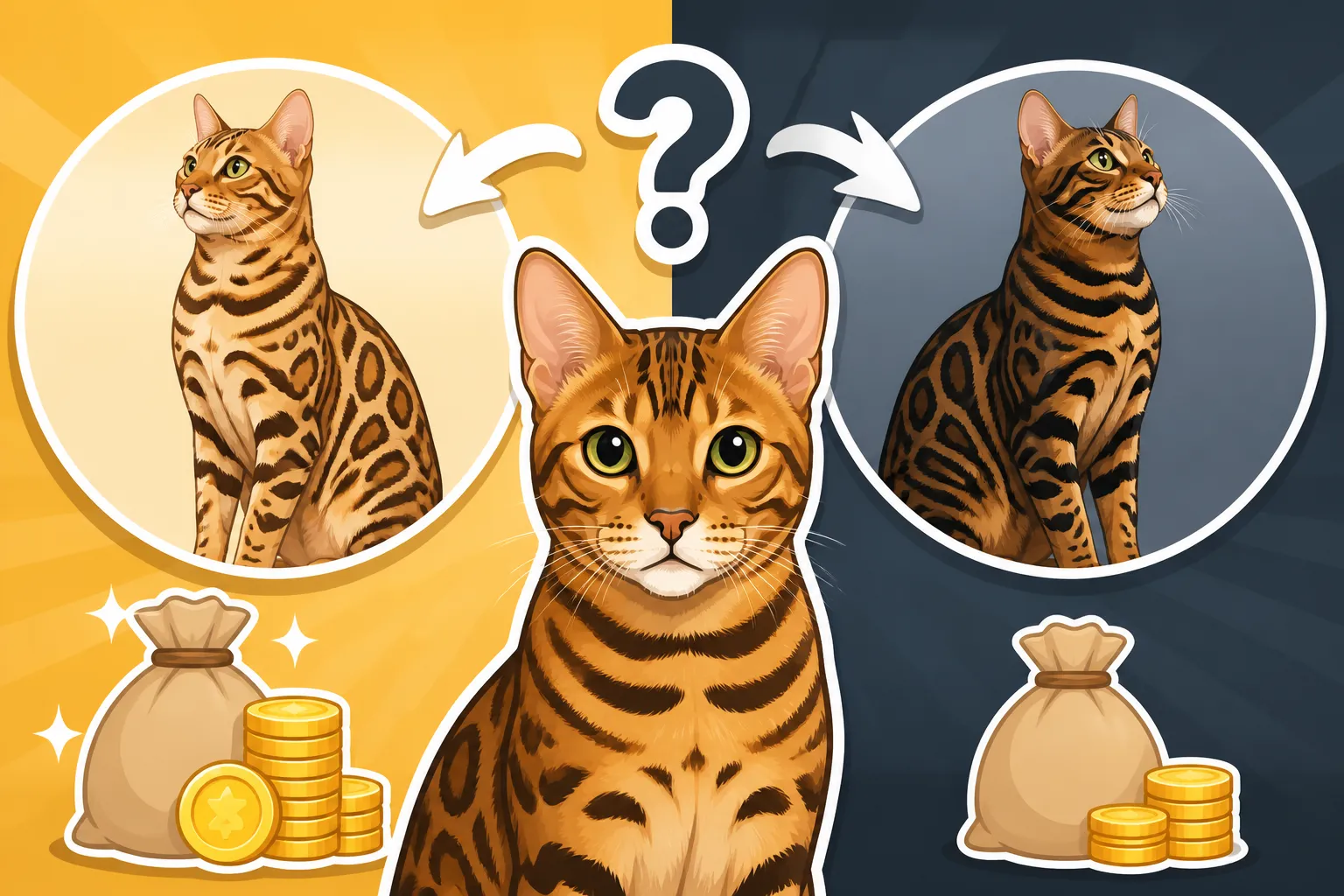
In the world of Bengal cats, contrast refers to the distinct difference in color and tone between the markings (spots, rosettes, marbling) and the background color of the coat. Imagine a stark black spot on a bright, clear orange-brown background – that's high contrast. Now imagine a dark brown spot on a medium brown background – that's lower contrast. The higher the contrast, generally, the more vivid and striking the pattern appears. This sharp definition is what makes the pattern "pop" and contributes significantly to the cat's exotic, wild appearance.
A truly high-contrast Bengal will have clearly defined, crisp markings that don't blur or fade into the ground color. This is especially important for rosetted patterns, where the individual rosettes (which are spots with a lighter center) need to be clearly outlined against the lighter base coat. Without good contrast, even beautifully shaped rosettes can lose their impact, appearing muddy or indistinct. This visual clarity is a key component of what makes a Bengal's coat so unique and sought after.
How Contrast Enhances Visual Appeal
The level of contrast directly correlates with the "wild look" that Bengal cat enthusiasts cherish. A Bengal with excellent contrast looks like a miniature leopard or jungle cat, a living piece of art. This isn't just a subjective preference; it's explicitly mentioned in the breed standards. Judges in cat shows are looking for that strong contrast, because it emphasizes the boldness and clarity of the pattern, which are hallmarks of the breed.
Think about it this way: a painting with vibrant, distinct colors has a different impact than one with muted, blended tones. For Bengals, contrast is that vibrancy. It’s what draws the eye and holds attention, making the cat's pattern stand out. This aesthetic quality isn't just for show cats; pet owners often desire this striking appearance too, as it embodies the essence of the Bengal breed. It's part of the allure, the "wow" factor that sets these cats apart from other domestic felines.
How Contrast Impacts a Bengal Cat's Price
Now for the million-dollar question: does contrast really change a Bengal cat's price? The answer is a resounding yes, though not always as an isolated factor. It's often intertwined with show quality, overall pattern excellence, and the breeder's success in producing these highly desirable traits consistently.
Show Quality vs. Pet Quality Contrast
For a show-quality Bengal, exceptional contrast is practically non-negotiable. Breeders meticulously select their breeding cats to improve and maintain this trait, among others. A kitten with pristine, high-contrast rosettes or marbling that meets or exceeds the breed standard will naturally command a higher price. These kittens are considered prime examples of the breed and have the potential to do well in competitions, which adds to their value. You might find a detailed breakdown of what judges look for in How a Bengal Cat's Pelt Is Judged in the Ring.
On the other hand, a pet-quality Bengal might have slightly less contrast, or perhaps contrast that doesn't hold up as perfectly across their entire body. While still beautiful and clearly a Bengal, these minor aesthetic differences mean they won't be competing for titles. Their price will reflect this, often being lower than a show-quality kitten. However, even within the pet category, a Bengal with good, clear contrast will typically be priced higher than one with a very muted or blurry pattern, simply because the visual appeal is stronger.
The Demand for High-Contrast Bengals
There’s a high demand for Bengals that truly embody that wild, exotic look, and high contrast is a massive part of achieving it. People are often willing to pay a premium for a cat whose spots look like they've been painted on with precision. This demand creates a market where breeders who consistently produce high-contrast kittens can justify their pricing. It’s not just about the difficulty of breeding for this trait, but also about what buyers are looking for when they decide to bring a Bengal into their homes.
When you're browsing kittens, you'll instantly notice the difference. A photo of a high-contrast Bengal practically leaps off the screen. This visual impact, combined with the perception of a more "authentic" wild look, drives up desirability. Breeders know this, and the time, effort, and lineage required to produce such striking animals are reflected in their asking prices. This isn't to say low-contrast Bengals aren't wonderful, but if you're set on that intense, jungle-cat appearance, expect to pay more.
Different Contrast Levels Across Colors and Patterns
Contrast isn't uniform across all Bengal colors and patterns. For example, a traditional brown rosetted Bengal often exhibits the most dramatic contrast, with rich black or dark brown markings on a clear, warm background. Snow Bengals (Lynx, Mink, or Sepia) also display beautiful contrast, though their markings are shades of brown against a creamier or ivory base, which can appear softer but still very distinct. What a Snow Bengal Cat Costs might explore how these differences manifest in pricing.
Marbled Bengals, which have flowing, swirled patterns rather than spots, also benefit immensely from high contrast. A well-contrasted marbled Bengal will have clear, distinct swirls of color against a lighter ground, creating a dynamic, almost liquid appearance. Without good contrast, the marbled pattern can look muddled or simply like a blotch, losing its intricate beauty. The specific color genetics can influence how easily high contrast is achieved, with some combinations naturally yielding more striking results than others.
Factors Beyond Contrast That Influence Price
While contrast is undeniably a significant factor, it's never the only consideration in a Bengal cat's price. Many other elements come into play, forming a comprehensive picture of value. Ignoring these other aspects would be like judging a book solely by its cover.
Generation and Legality
As mentioned earlier, the filial generation (F1, F2, F3, SBT) is the primary determinant of a Bengal cat's price. F1, F2, and F3 Bengals, being closer to their wild ancestor, are considerably more expensive due to their rarity, the specialized care they require, and often, legal restrictions. Most states and cities have specific laws about owning early-generation Bengals, which can add to the complexity and cost. For example, Where a Bengal Cat Is Illegal in the United States highlights the legal landscape. An SBT Bengal, being fully domesticated, is generally more affordable and widely accepted, but still far from a "cheap" cat.
The generation also dictates certain behavioral traits. Early generation Bengals can be more challenging and require experienced owners, another factor influencing their market. When considering the overall financial commitment, remember that a pet insurance like Healthy Paws might have different coverage options or premiums for early-generation hybrids compared to fully domesticated SBT Bengals.
Pattern Type and Clarity
Beyond contrast, the specific type and clarity of the pattern itself are crucial. Rosetted Bengals, particularly those with "donut" or "arrowhead" rosettes (which are multi-colored spots with a darker outline and lighter center), tend to be more expensive than single-spotted Bengals. This is because rosettes are a highly desired trait that mimics the patterns of wild leopards and jaguars, and they are more challenging to consistently produce. What Rosettes and Glitter Add to a Bengal Cat's Price provides more insight into this.
The clarity of the pattern refers not just to contrast, but also to how well-defined and aesthetically pleasing the individual spots or rosettes are. Are they randomly scattered, forming an appealing flow, or are they clustered in an undefined mass? Do they break up the horizontal flow of the coat? A clear, well-structured pattern, combined with high contrast, will always command a higher price.
Breeder Reputation and Health Testing
A reputable breeder invests significant time, money, and expertise into their breeding program. This includes extensive health testing for genetic diseases common in Bengals, such as HCM (Hypertrophic Cardiomyopathy), PRA-b (Progressive Retinal Atrophy), and PK Deficiency (Pyruvate Kinase Deficiency). These tests are not cheap, but they are essential for ensuring the health of the kittens and the long-term well-being of the breed. You can learn more about What a Bengal Cat Breeder Should Have Tested.
A breeder with a strong reputation for producing healthy, well-socialized, and beautiful kittens will naturally have higher prices. They also provide ongoing support, comprehensive contracts, and often microchip and vaccinate their kittens before they go to their new homes. This comprehensive care adds to the overall value and price. Never compromise on a reputable breeder to save a few dollars upfront; it could cost you far more in vet bills and heartache down the line.
Other Aesthetic Traits
While contrast is a big player, other visual characteristics contribute to a Bengal's price. "Glitter," for instance, is a unique trait where the tips of the guard hairs are translucent, creating a shimmering, iridescent effect in the light. This adds another layer of wild beauty and can increase the price. Eye color, especially vivid green or deep blue eyes (in the case of Lynx Point Snow Bengals), can also add to the desirability.
The overall conformation to the breed standard, including head shape, ear size and placement, body musculature, and tail length, all contribute to a "show quality" look. A Bengal that ticks all these boxes, along with having excellent contrast and a desirable pattern, represents the pinnacle of the breed's aesthetics and will be priced accordingly.
Comparing Factors Influencing Bengal Cat Price
To give you a clearer picture, here's a table summarizing how various factors, including contrast, typically influence the price of a Bengal cat. This isn't exhaustive, but it highlights the major elements at play.
| Factor | Impact on Price (General Trend) | Explanation |
|---|---|---|
| Generation (F1-F3) | Highest Price Tier | Closest to wild ancestor; rare, specialized care, legal restrictions. |
| Generation (SBT/F4+) | Moderate to High Price Tier | Fully domesticated, most common for pets; price varies widely based on other factors. |
| High Contrast | Significant Price Increase (within generation) | Sharp, clear markings that pop; highly desired for "wild look" and show quality. |
| Low/Muted Contrast | Moderate Price (within generation) | Markings blend more into background; still beautiful but less visually striking, often pet quality. |
| Show Quality | Highest Price (within SBT) | Meets breed standard perfectly, including exceptional contrast, pattern, and conformation. Potential for titles. |
| Pet Quality | Standard Price (within SBT) | Minor aesthetic flaws (e.g., slightly lower contrast, less perfect pattern) that don't meet show standards but are perfect for a companion. |
| Rosetted Pattern | Higher Price | Multi-colored spots (donut, paw print, arrowhead) are more challenging to breed and highly desired. |
| Spotted Pattern | Standard Price | Single, clear spots. Still beautiful, but rosettes are generally more sought after. |
| Marbled Pattern | Variable Price | Price depends heavily on clarity, flow, and contrast of the marble pattern. |
| Glitter | Moderate Price Increase | Translucent hair tips create a shimmering effect, enhancing the coat's exotic appeal. |
| Breeder Health Testing | Included in Price / Justifies Higher Price | Responsible breeders invest in genetic and cardiac screening, ensuring healthier kittens. |
| Temperament/Socialization | Included in Price / Justifies Higher Price | Well-socialized, confident kittens result from dedicated breeder efforts. |
The Final Takeaway on Contrast and Price
So, does contrast change a Bengal cat's price? Absolutely. It’s a crucial aesthetic element that defines the breed's wild beauty and is highly valued by both judges and pet owners alike. A Bengal with stunning, high-contrast markings will almost certainly come with a higher price tag than one with a more muted pattern, assuming all other factors like generation, health, and temperament are equal. This premium reflects the desirability of the trait, the difficulty in consistently breeding for it, and the breeder's dedication to producing top-tier examples of the breed.
However, it's vital to remember that contrast is just one piece of a much larger puzzle. When evaluating a Bengal kitten, consider the whole picture: its generation, the breeder's reputation and health screening practices, the overall pattern clarity, and the kitten's health and temperament. A truly reputable breeder will be transparent about all these factors and help you understand why their kittens are priced as they are. This holistic approach ensures you're not just getting a pretty face, but a healthy, well-adjusted, and stunning companion. And remember, good care doesn't end with the purchase price. Future costs include things like quality food or specialized raw diets, and, of course, vet bills, which is where good pet insurance becomes invaluable.
Ultimately, whether you choose a Bengal with breathtaking contrast or one with a softer, more subtle pattern, the true value lies in the joy and companionship they bring into your life. But if that fierce, wild look is what you’re dreaming of, be prepared to invest in a kitten whose contrast makes its pattern truly sing.
Disclaimer
This article is for general informational purposes only and does not constitute professional advice. Laws, prices and regulations vary by location and change over time. Consult a qualified professional for guidance on your specific situation.