How a Bengal Cat Opens a Door
If you're reading this, chances are you've either witnessed your seemingly innocent Bengal cat defy the laws of physics by opening a door, or you've heard the ominous click of a latch and then the quiet thump of paws where they absolutely shouldn't be. It's a frustrating, often hilarious, but sometimes genuinely concerning problem for many Bengal owners. This guide is here to shed some light on how these clever felines manage their Houdini acts and, more importantly, what you can do to keep your home (and sanity) intact.
The Inquisitive Mind: Why Bengal Cats Are Master Escapologists
Bengal cats are not your average couch potatoes; their intelligence is often compared to that of dogs, and sometimes, well, even higher! This isn't just a charming trait; it's a driving force behind many of their "naughty" behaviors, including their uncanny ability to operate doors. Understanding the root of this curiosity and problem-solving drive is the first step to outsmarting them.
Boundless Curiosity and Exploration
From the moment they wake up, Bengal cats are driven by an insatiable need to explore every nook and cranny of their environment. Unlike many domestic breeds that might be content with their familiar territories, a Bengal sees every closed door as a challenge, an unsolved mystery, or a potential new adventure waiting to happen. This isn't born out of malice or disobedience; it's pure, unadulterated feline inquisitiveness. They simply must know what's on the other side, what's inside that cabinet, or why you get to go into that room while they don't. This curiosity means they'll relentlessly experiment with any mechanism that stands between them and their next discovery.
Think about it: a closed door is a visual barrier, but it also creates an auditory and olfactory puzzle. They can hear muffled sounds, smell enticing aromas, or simply sense that there's something different happening on the other side. This drives them to investigate, to push, to pull, and to prod until they find a weakness. This instinct harks back to their wild ancestry, where exploring new territories was essential for survival and finding food. Even though your Bengal has a cozy bed and a full food bowl, that primal drive to explore is still very much alive.
Advanced Problem-Solving Skills
Another key factor in their door-opening prowess is their remarkable problem-solving ability. Bengals aren't just randomly batting at things; they're actively observing and learning. They watch you, their human, operate handles and latches. They see the cause-and-effect: you push down, twist, or pull, and the door opens. They then try to mimic these actions, sometimes with surprising success. It's not uncommon for a Bengal to methodically try different angles and techniques until they hit upon the right combination. This might take minutes, or it might take days, but their persistence is legendary.
This isn't just about simple observation, either. Bengals are capable of complex cognitive mapping, remembering which actions led to which results. If pushing down on a lever handle granted them access to the pantry once, you can bet they'll try it again. This is why consistency in your own actions and in your cat-proofing efforts is so crucial. Once they've "solved" a door, that knowledge is pretty much ingrained. Their intelligence means that what might seem like a complex lock to another cat is just another puzzle waiting to be unraveled by a determined Bengal. Many owners have shared stories of their Bengals staring intently at them manipulating a lock, almost as if they're taking mental notes for later.
Incredible Physical Dexterity
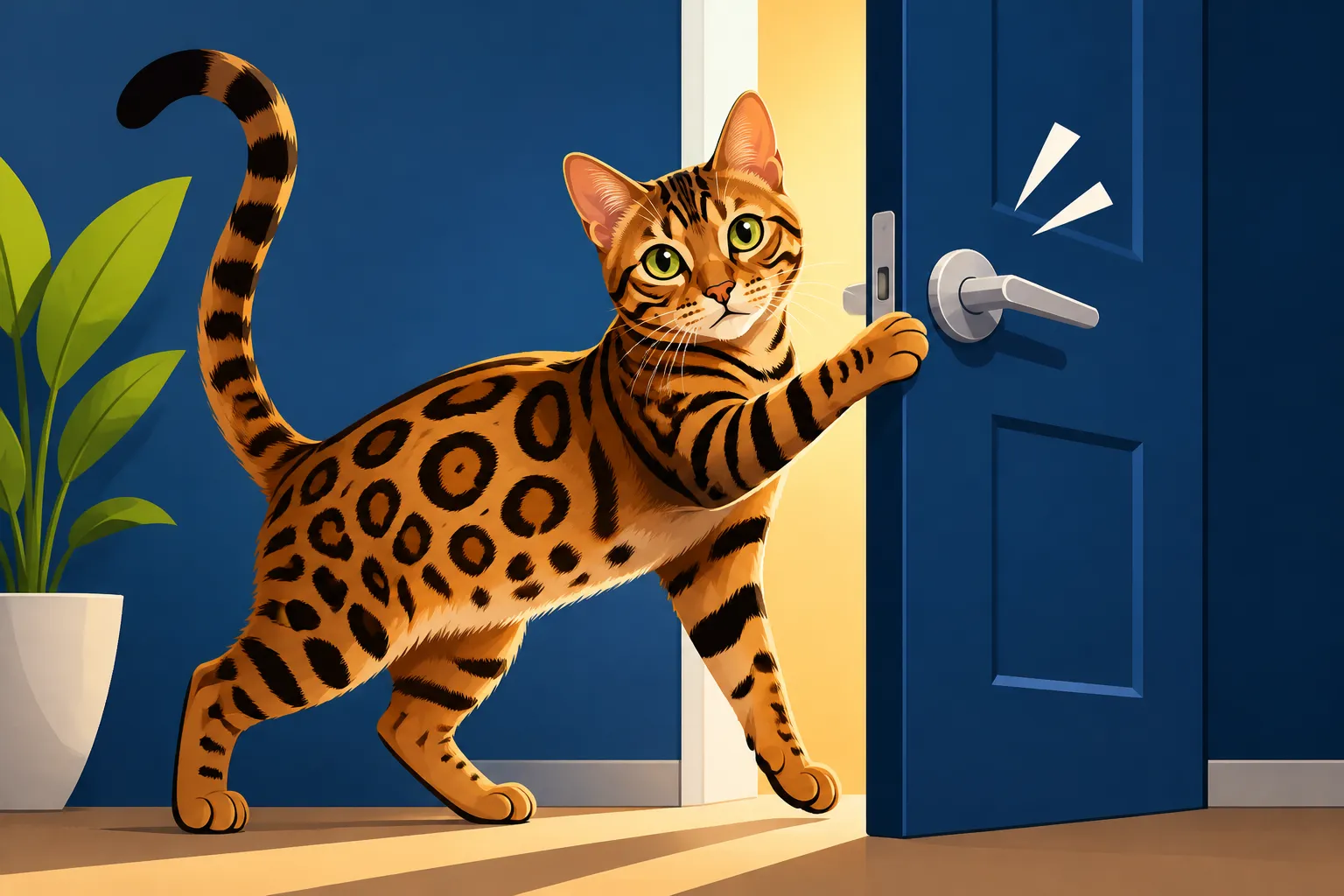
Beyond their mental capabilities, Bengal cats possess an exceptional degree of physical dexterity. Their paws are incredibly agile, capable of manipulating objects with a precision that belies their size. Unlike many cats who might just bat at a door handle, a Bengal will use its paws like hands, gripping, twisting, and pulling. Their strong, athletic bodies also allow them to jump and hang from doorknobs or lever handles, using their body weight to engage the mechanism. How High a Bengal Cat Can Jump is truly impressive, and they use this vertical advantage to their full potential when confronted with a door.
Their claws, too, play a role. While you might be worried about them scratching your furniture, those sharp claws are also excellent tools for gripping smooth surfaces like doorknobs or for getting purchase on a lever. They can dig their claws into the gap around a doorframe or under a sliding door, prying it open bit by bit. This combination of powerful hind legs for jumping, strong front paws for gripping, and sharp claws for leverage makes them formidable opponents to any standard door lock. They're not just trying to push; they're trying to undo what you've done.
The Mechanics of Door Opening: Their Signature Moves
So, how exactly do these feline masterminds pull off their architectural feats? It usually comes down to understanding the basic mechanics of how different types of doors and their hardware operate. Once you know their preferred techniques, you can start to think about countermeasures.
Lever Handles: The Bengal's Favorite Target
Lever handles are, without a doubt, a Bengal cat's dream come true. Their design, which requires only downward pressure to operate, is perfectly suited to a cat's abilities. A Bengal can easily jump up, hook a paw over the lever, and hang from it, using its body weight to push the handle down. The satisfying click of the latch releasing is immediate positive reinforcement, encouraging them to repeat the action. Some even learn to push the door open with their head or another paw simultaneously as they depress the handle.
I've heard countless tales from owners who installed these stylish handles, only to quickly learn their mistake. My own Bengal, Luna, figured out the lever handle to the laundry room in about three days flat. We thought it was cute until she started "helping" with the laundry by redistributing the clothes. The flat surface of the lever also provides a better grip for their paws than a rounded knob, making it easier for them to apply consistent pressure. It's almost as if these handles were designed for intelligent, agile felines.
Knob Handles: A Greater Challenge, But Not Impossible
Traditional round doorknobs present a slightly tougher challenge, but don't underestimate a determined Bengal. While they can't simply depress a knob, they can learn to bat, twist, or even hang from them to achieve their goal. Some Bengals will repeatedly bat at the knob, trying to generate enough rotational force to turn the mechanism. Others, with exceptional strength and agility, might jump and hang, attempting to twist the knob with their paws and body weight.
While it's less common for a Bengal to master a traditional knob than a lever, it absolutely happens. It often requires more effort and perhaps a certain type of knob (some are smoother or offer more grip than others). I remember a friend's Bengal who would launch himself at the guest bathroom door, grip the porcelain knob with all four paws, and twist with his entire body, eventually flinging the door open with a triumphant meow. It was a sight to behold, even if it did mean their guests occasionally got an uninvited audience. The secret here is often persistent trial and error combined with incredible grip strength.
Sliding Doors: A Matter of Leverage and Force
Sliding doors, whether for a closet, a patio, or even internal room dividers, seem sturdy, but they often have a fatal flaw from a Bengal's perspective: a gap. Bengals are incredibly adept at finding purchase in these gaps. They might wedge a paw, a claw, or even their nose into the crack between the door and the frame, then use their powerful body to push or pull, inching the door open. Once a small gap is created, their curiosity takes over, and they'll continue to work at it until the opening is wide enough for them to squeeze through.
This applies not just to sliding glass doors, but also to bifold closet doors or pocket doors. Any door that slides along a track and has even a tiny bit of play can become a target. I've personally seen a Bengal meticulously work its way along a closet door, digging its claws into the seam until it could pull it open just enough to sneak inside for a "nap" among the sweaters. They understand the concept of momentum and leverage, pushing against one part of the door to get the other part to move. For many Bengals, a sliding door is less about a complex mechanism and more about applying brute force and patience.
Types of Doors and Bengal Tactics: Beyond the Basic Entry Points
When we think about cat-proofing, our minds often go straight to exterior doors, but a Bengal's mischief extends to nearly every barrier in your home. Their intelligence means no door is truly safe from their inquisitive paws.
Interior Doors: The Most Common Battleground
Interior doors are, without a doubt, the front lines in the war against Bengal door-opening. These are the doors to your bedroom, bathroom, pantry, or home office – all places a Bengal typically wants to be. As discussed, lever handles make these particularly vulnerable. But even with knob handles, the sheer persistence of a Bengal can lead to breakthroughs. They might scratch at the door, vocalize loudly, or jump at the handle repeatedly, often at the most inconvenient hours. Why a Bengal Cat Yowls at Night is often because they're demanding access to a room they've decided they need to explore.
The motivation for opening interior doors can vary. Sometimes it's sheer curiosity. Other times, it's a desire to be with their human, or perhaps to access a favorite sunbathing spot. They also might be seeking out a particular toy or object they've seen you take into that room. The constant battle with interior doors can be exhausting for owners. You might find yourself accidentally locking yourself out of a room, or waking up to discover your Bengal has joined you in bed after you swore you closed the door tightly. It's a continuous game of cat and mouse, where the cat is often one step ahead.
Cabinet Doors: A Treasure Trove of Delights
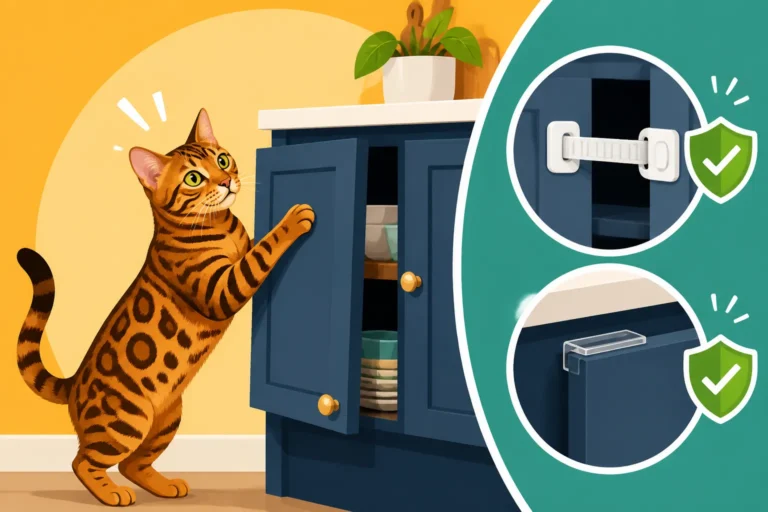
Cabinet doors, especially those in kitchens and bathrooms, are irresistible magnets for Bengals. The promise of hidden treats, interesting textures, or even just climbing opportunities makes them prime targets. They'll often try to pry open cabinet doors by hooking a claw under the edge and pulling. For cabinets with two doors, they might learn to pull one open just enough to create a gap, then use their nose or another paw to push it further. Magnetic latches or simple tension catches are often no match for a persistent Bengal.
Think about the sheer joy a Bengal must experience when they finally open a cabinet to reveal a collection of plastic containers, crinkly bags, or even toilet paper rolls – all potential toys! I've had owners tell me stories of their Bengals systematically emptying every kitchen cabinet, leaving a trail of spice jars and pasta boxes in their wake. It's not about being destructive; it's about the thrill of discovery and the opportunity for new forms of play. How a Bengal Cat Learns to Open a Cabinet is often a process of patient experimentation and observation, slowly chipping away at the barrier until success.
Refrigerator Doors: The Ultimate Culinary Heist
This might sound like something out of a cartoon, but yes, some highly intelligent and persistent Bengals do learn to open refrigerator doors. This is usually achieved by jumping onto the handle and using their weight to pull it down, or by prying at the magnetic seal with their claws until they can get enough leverage to pop it open. The motivation here is almost always food. The smells emanating from a refrigerator are far too enticing for a cat with a superior sense of smell and a penchant for scavenging.
While it's less common than opening regular doors or cabinets, a refrigerator-opening Bengal can lead to a messy (and potentially dangerous) situation, especially if they get into human food that's harmful to them. Imagine coming home to a refrigerator door ajar, contents spilled, and a very satisfied Bengal licking its chops. This level of cunning and determination highlights just how far these cats will go to satisfy their curiosity and their appetites. Preventing this usually requires specialized locking mechanisms, as standard child locks might not be robust enough for a determined Bengal.
| Door Type | Common Bengal Tactics | Vulnerabilities |
|---|---|---|
| Lever Handle Doors | Jumping and depressing handle with paw/body weight. | Easy to operate with downward pressure, good paw grip. |
| Knob Handle Doors | Batting, twisting, jumping and hanging to turn. | Requires rotation; can be harder but not impossible. |
| Sliding Doors | Prying edges with claws/paws, pushing with body weight. | Gaps in tracks, lack of strong locking mechanism. |
| Cabinet Doors | Hooking claws under edge, pulling, prying apart double doors. | Simple latches, magnetic closures, small gaps. |
| Refrigerator Doors | Jumping on handle, prying at seals, using weight to open. | Leverage on handle, magnetic seal weakness. |
Cat-Proofing Your Home: Strategies and Solutions
The good news is that you're not helpless against your Bengal's impressive door-opening skills. There are many strategies and products available to help you reclaim your privacy and keep your cat safe from areas they shouldn't access.
Physical Barriers and Locks
When it comes to keeping a Bengal out of a particular room or cabinet, physical barriers are often the most effective solution. For lever handles, you can find covers specifically designed to prevent downward pressure. These usually enclose the lever, making it impossible for a paw to depress it. For traditional doorknobs, childproof covers that spin freely are a good option, as they prevent the cat from getting a grip to twist the knob. You can find many robust options on Amazon that are designed for toddlers but work just as well for clever felines.
For sliding doors, simple slide locks or security bars can be installed to prevent them from being pushed open. These typically require human dexterity to operate, which is beyond a Bengal's capabilities. For cabinet doors, magnetic child locks that install on the inside of the cabinet are highly effective, as they are completely invisible and require a special magnetic key to open. Alternatively, strong hook-and-eye latches or even heavy-duty drawer slides can be installed on the outside. Remember, a Bengal will test any weakness, so opt for the most robust solutions you can find. Which Locks Stop a Bengal Cat vary in effectiveness, so be prepared to experiment.
Training and Redirection Techniques
While physical barriers are great for immediate security, training can also play a role, especially in conjunction with other methods. Clicker training, for example, can be used to teach your Bengal to not jump on doors or scratch at them. Rewarding them for calm behavior near doors or for engaging with appropriate toys instead of the door can help redirect their energy. Consistency is absolutely key here; every time you give in to their door demands, you're reinforcing the unwanted behavior.
Another effective technique is redirection. If your Bengal is trying to open a door because they're bored or seeking attention, immediately redirect them to an appropriate activity. This could be a vigorous play session with a wand toy, a puzzle feeder that requires mental effort, or a tall, engaging cat tree that offers vertical exploration. The goal is to make the desired activity more rewarding than the door-opening endeavor. This won't "cure" their intelligence, but it can channel it into more acceptable behaviors. Sometimes, they just want attention, and any attention, even negative, can be a reward.
Deterrents and Environmental Enrichment
Sometimes, a little deterrence can go a long way. Motion-activated air cans, for instance, can be placed near a problem door to provide a harmless but startling burst of air if the cat approaches. Sticky Paws tape applied to the doorframe or the bottom of the door can also be a deterrent, as cats generally dislike the feeling of sticky surfaces on their paws. These methods aren't meant to be punishments but rather gentle signals that this particular area is off-limits.
Equally important is providing ample environmental enrichment to address the underlying reasons for their curiosity. A bored Bengal is a destructive Bengal. Ensure your home offers plenty of vertical space, such as How to Build Shelves for a Bengal Cat or tall cat trees, to satisfy their climbing instincts. Daily interactive play sessions, puzzle feeders, and a variety of rotating toys can keep their active minds and bodies engaged. A well-exercised and mentally stimulated Bengal is less likely to feel the overwhelming urge to break into the pantry. How Much Enrichment a Bengal Cat Actually Needs is often far more than what a typical housecat requires.
Living with a Door-Opening Bengal: Management and Understanding
Even with the best cat-proofing efforts, you might occasionally find yourself outsmarted. Living with a Bengal means accepting their unique intelligence and finding ways to coexist peacefully with their wilder instincts.
Accepting the Inevitable (Sometimes)
Let's be realistic: a Bengal cat's intelligence and athleticism mean that sometimes, despite your best efforts, they will find a way. You might install the most robust child lock on your cabinet, only to find your Bengal has figured out how to wedge its paw into an impossibly small gap to release it. Or perhaps they learn to stand on the toilet seat to get leverage on the high bathroom door handle. There will be moments where you simply have to laugh, marvel at their ingenuity, and then try another solution. It's part of the unique challenge and joy of owning this incredible breed.
This acceptance isn't about giving up; it's about managing expectations and understanding that your Bengal isn't trying to spite you. They're simply being a Bengal. Their relentless curiosity and physical prowess are ingrained in their DNA. Instead of getting frustrated, try to see it as a testament to their amazing abilities. Acknowledge that you might not win every battle, but you can certainly influence the overall war. Sometimes, the best strategy is to put truly important or dangerous items behind multiple layers of security and allow them to "win" a few less critical battles.
Redirection and Consistent Attention
As mentioned in the training section, redirection is a powerful tool. When you see your Bengal focusing on a door, immediately engage them with something else. A laser pointer chase, a vigorous session with a feather wand (many strong options can be found on Amazon), or even a quick game of fetch can divert their attention. The key is to be consistent. Every time you redirect successfully, you're reinforcing the idea that their energy is better spent elsewhere.
Consistency also applies to your own reactions. If you yell or get visibly frustrated when they're at a door, that's still attention, and for some Bengals, negative attention is better than no attention. Try to remain calm, redirect, and reward positive behavior. Remember, a Bengal often craves interaction. If they feel neglected or bored, they're more likely to invent their own entertainment, and opening doors is a highly engaging activity for them. How Long a Bengal Cat Can Be Left Alone without adequate stimulation can directly correlate to their mischievous behaviors.
Utilizing Their Intelligence Positively
Instead of fighting against their intelligence, harness it! Bengals thrive on mental stimulation. Provide them with puzzle feeders that make them work for their food. Teach them tricks using clicker training – they're incredibly fast learners and love the mental challenge. You can teach a Bengal to sit, stay, fetch, or even high-five. This kind of engagement satisfies their need to problem-solve and bond with you, often reducing the urge to explore forbidden zones.
Consider dedicating a "safe" room or a catio that's specifically designed for their intense exploratory needs. A catio provides them with a secure outdoor space where they can climb, observe wildlife, and get fresh air without the risks of free-roaming. Inside, a room with vertical climbing structures, tunnels, and interactive toys can become their personal adventure zone. This way, they have appropriate outlets for their energy and curiosity, making them less likely to try and open the door to your fragile china cabinet. They genuinely want to engage their brains, and it's our job as owners to provide stimulating, safe activities.
Disclaimer
This article is for general informational purposes only and does not constitute professional advice. Laws, prices and regulations vary by location and change over time. Consult a qualified professional for guidance on your specific situation.