What Toys a Bengal Cat Actually Destroys
It's a familiar scene for any Bengal cat owner: you eagerly unwrap a brand-new, seemingly sturdy cat toy, only for your energetic feline friend to decimate it within minutes. The frustration is real – you want to provide stimulating play, but it feels like you're just throwing money at a shredding machine. This guide is here to shed some light on the kinds of toys that actually stand a chance against your Bengal's formidable play drive, and why some toys are simply destined for immediate destruction.
The Bengal Cat's Play Style: A Force of Nature
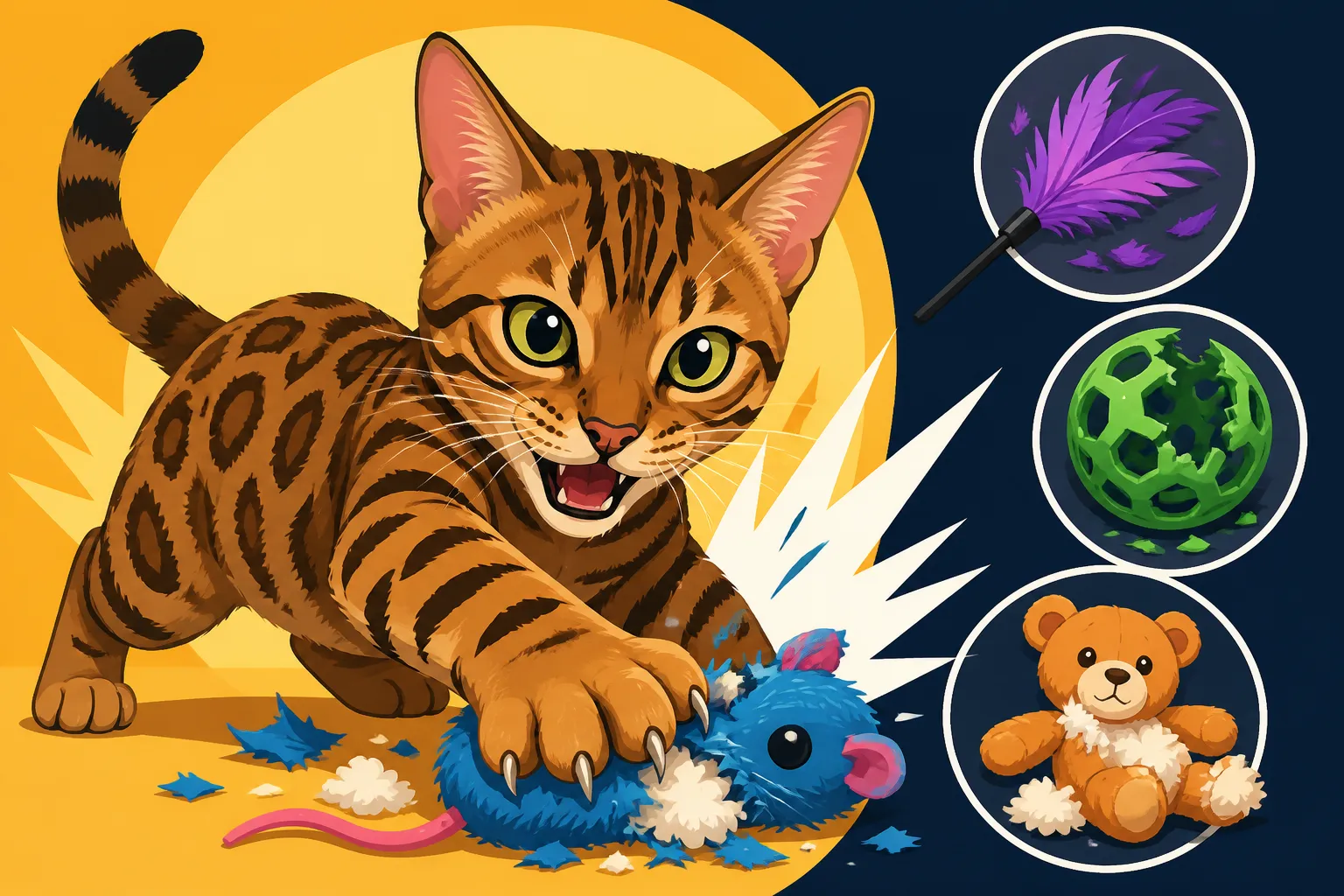
Let's be honest, a Bengal isn't just "a cat." They're a whirlwind of energy, intelligence, and primal instinct, all wrapped up in a stunning, spotted package. Their play isn't just batting at a dangling string; it's a full-on hunting simulation, complete with stalking, pouncing, grappling, and a powerful "kill bite." Understanding this inherent intensity is the first step to choosing toys that won't end up as litter box confetti.
Why "Normal" Cat Toys Don't Stand a Chance
Many mass-produced cat toys are designed for your average, mild-mannered housecat who might give a little fluffy mouse a gentle tap. Your Bengal, however, has different plans. Their wild ancestry, stemming from the Asian Leopard Cat, means they possess an incredible strength, agility, and a deeply ingrained predatory drive. When a Bengal engages with a toy, they aren't just playing; they're practicing hunting skills. This involves strong jaws clamping down, razor-sharp claws raking and tearing, and powerful hind legs delivering a "bunny kick" that can dismantle lesser toys in seconds.
The typical weak stitching on plush toys, the thin plastic of cheap balls, or the delicate feathers on many wands simply aren't engineered to withstand this kind of assault. Your Bengal will quickly expose any structural weakness, often within the first few minutes of vigorous play. They aren't trying to be destructive; they're just playing naturally, but their "natural" is far more intense than most toy manufacturers anticipate.
Beyond sheer physical power, Bengal cats are also incredibly intelligent. They'll quickly learn how a toy is constructed, how to get at the stuffing, or how to pull apart a flimsy component. What might challenge another cat for a week could be solved and dismantled by a Bengal in an afternoon. This combination of brains and brawn means that a truly durable toy needs to be exceptionally well-made to even stand a fighting chance. If you want to understand just how much energy they have, consider How Active a Bengal Cat Is – it's a lot!
The Importance of Durable Materials
When you're constantly replacing shredded toys, it’s not just frustrating; it can also become surprisingly expensive. More importantly, it can pose a safety risk to your Bengal. Small pieces of plastic, ingested stuffing, or broken-off feathers can lead to choking hazards or internal obstructions, which can mean an emergency vet visit. This is where pet insurance, like a policy from Healthy Paws, can be invaluable, covering unexpected accidents that might arise from an overly enthusiastic play session.
Therefore, the choice of material is paramount. Look for toys made from tough, natural fibers like thick wool felt, durable leather, or even robust rubber. Hard plastics are acceptable if they are solid and thick, without small pieces that can snap off. Some innovative companies are starting to use materials like Kevlar-reinforced fabric or industrial-grade stitching, specifically for "power chewers." These materials might seem like overkill for a housecat, but for a Bengal, they're often the bare minimum required for a toy to survive more than a single play session.
Consider the construction as much as the material. Are seams double-stitched? Are feathers securely attached, or are they designed to be replaceable? Is the toy a single, solid piece, or are there small components that could be chewed off? A well-made toy, even if it costs a bit more upfront, will save you money and worry in the long run by providing safe, lasting entertainment. It’s an investment in both your Bengal's enrichment and their well-being.
Categories of Toys and What Survives the Bengal Gauntlet
Navigating the vast world of cat toys can be overwhelming, especially when you know your Bengal is a super-shredder. Let's break down different types of toys and what attributes help them survive a Bengal's intense attention.
Interactive Wand Toys: The Battle for the Feather
Interactive wand toys are arguably one of the most crucial tools for exercising and bonding with your Bengal. These cats thrive on "hunt, catch, kill" cycles, and a good wand toy allows you to simulate prey movement, engaging their full predatory sequence. However, this also means they bear the brunt of your Bengal's pouncing and biting power. Many owners quickly learn Which Wand Toy a Bengal Cat Destroys Fastest – it's usually the one with the most delicate feathers or flimsy attachments.
For a wand toy to survive, focus on the attachment itself. Ditch the wands with delicate turkey feathers or wispy plastic strands right away; they'll be gone in seconds. Instead, look for attachments made of sturdy, natural materials like thick leather strips, rabbit fur (ethically sourced, of course), or durable wool felt. Some brands offer attachments made from tough, braided fabric or even solid rubber shapes. The key is that the material should be able to withstand repeated biting, tearing, and tugging without falling apart. Even better, invest in a wand with a robust, flexible rod and quick-release attachments so you can swap out pieces as they wear down or your Bengal gets bored. This strategy ensures the wand itself lasts, and you only need to replace the "prey."
Another critical aspect is the connection point between the attachment and the string. Many common toys use a thin loop or a weak knot that quickly frays or breaks. Look for metal clips or reinforced loops that can handle significant force. When your Bengal clamps onto their "prey" and digs in with their bunny kicks, that connection point is under immense stress. A truly durable wand toy anticipates this and uses strong hardware. Remember, the goal is to exhaust your Bengal's energy, not your wallet on endless replacements! They have so much energy, it often feels like Why a Bengal Cat Never Seems to Tire.
Solo Play Toys: Tough Enough to Tangle With
While interactive play with you is vital, Bengals also need toys they can bat around, chase, and "kill" on their own. This is where solo play toys come in, but again, durability is the name of the game. Cheap plastic balls with bells inside are often crushed or torn open in no time, presenting a choking hazard. Fluffy mice often get their tails ripped off, stuffing pulled out, or plastic eyes ingested.
When choosing solo toys, opt for solid rubber balls or toys made from durable, thick silicone that can withstand vigorous chewing. Interactive treat-dispensing balls made from hard, non-toxic plastic can also be great, as they engage both physical play and mental problem-solving. Look for seamless designs or toys with minimal protrusions that could be chewed off. Large, tightly woven felt balls or kickers made from heavy-duty canvas with strong stitching are also good contenders, as they can endure repeated bunny kicks and powerful bites. The goal is to find something that gives them the satisfaction of tearing at "prey" without actually coming apart. You might find a good selection of these kinds of robust toys available on platforms like Chewy, which often have customer reviews specifically mentioning durability.
For a Bengal, the more robust a toy feels in your hand, the better its chances of survival. Think about toys designed for tough dog chewers, scaled down for cats – that's the kind of resilience you're looking for. These toys should also be easy to clean, as a Bengal's enthusiastic play can quickly cover them in slobber and dirt. Consider Whether a Puzzle Feeder Tires a Bengal Cat as part of their solo play routine, as mental stimulation is just as important as physical exertion.
Enrichment Toys: The Brainy Bengal's Challenge
Bengal cats are incredibly intelligent and need mental stimulation just as much as physical exercise. Enrichment toys, particularly puzzle feeders, are fantastic for this, making your Bengal "work" for their treats or kibble. However, a clever Bengal will quickly figure out how to bypass flimsy construction or break into a puzzle that's not robust enough.
The best puzzle feeders for Bengals are often made from hard, durable plastic, ceramic, or even wood. They should have multiple levels of difficulty and require manipulation, batting, or problem-solving to release the reward. Avoid anything with easily pried-open compartments or thin, breakable plastic parts. A Bengal will use their paws, teeth, and sheer determination to get what they want, and a weak toy will quickly become an open-source treat dispenser, losing its enrichment value. Some advanced puzzle feeders have suction cups or heavy bases to prevent them from being flipped over or dragged away.
Beyond food puzzles, consider foraging mats or "snuffle mats" made from thick, densely woven fabric where you can hide treats. The fabric needs to be strong enough to withstand digging and nudging without unraveling or tearing. Interactive tracks with balls inside, if they are made from heavy-duty plastic and securely assembled, can also provide ongoing solo entertainment, forcing your Bengal to use their paws to get the balls moving. The key is to find toys that challenge their minds without being easily dismantled. When choosing these, remember that Which Puzzle Feeder Beats a Bengal Cat is often the one made from the most indestructible materials.
Toys That Are Almost Guaranteed to Be Annihilated (and Why)
While every Bengal is an individual, there are certain categories of cat toys that almost universally meet their demise quickly when confronted with a Bengal's enthusiasm. Knowing these can save you money and prevent potential safety issues.
Soft Plush Toys and Stuffed Animals
This one might seem obvious, but it's worth reiterating. Those adorable little plush mice, fluffy balls, or cute stuffed animals designed for other cats simply do not stand a chance against a Bengal. Their predatory instincts compel them to "kill" their prey, and with a soft toy, this means tearing it open, pulling out the stuffing, and often attempting to chew on the fabric or internal components.
The danger here isn't just the mess of stuffing strewn across your floor. Many plush toys have small plastic eyes, noses, or other accessories sewn on, which can easily be chewed off and swallowed. The stuffing itself, if ingested in sufficient quantities, can cause gastrointestinal blockages. For a Bengal, a soft toy isn't for cuddling; it's a target for demolition. If you absolutely want to offer a plush toy, look for those specifically made for tough dogs – no small parts, very dense, durable fabric, and industrial-strength stitching. Even then, supervise playtime closely and discard it at the first sign of damage.
Laser Pointers and Their Shortcomings
While not physically destroyed by your Bengal, laser pointers can mentally "destroy" them if not used properly, leading to frustration and behavioral issues. A Bengal's hunting sequence is hardwired: stalk, chase, catch, kill, and consume. A laser pointer allows for the stalk and chase, but never the satisfying "catch" or "kill." This constant stimulation without resolution can leave your Bengal feeling deeply frustrated, anxious, or even aggressive.
Imagine endlessly chasing something you can never quite capture or feel in your paws. Over time, this can manifest as redirected aggression, obsessive behavior, or simply heightened stress levels. Many Bengals become incredibly fixated on the laser dot, to the point of ignoring other toys or becoming agitated when they can't find it. If you do use a laser pointer, it's crucial to end the session by directing the laser onto a physical toy (like a kicker or a treat) that your Bengal can actually "catch" and "kill" to complete the hunting cycle. This helps to alleviate some of the frustration. Consider reading more about How a Bengal Cat Reacts to a Laser to understand the nuances of this popular but often misused toy.
Cheap Plastic Balls and Small, Flimsy Items
Any toy made from thin, brittle plastic, or small, easily breakable materials, is practically pre-destined for the trash bin when in the paws of a Bengal. These might include hollow plastic balls, small plastic rings, or any toy with delicate protrusions. A Bengal's strong jaws can easily crush hollow items, leading to sharp edges. Their powerful paws can tear apart flimsy structures, leaving small pieces scattered that can be ingested.
The problem with these toys is twofold: they offer very little stimulation before they break, and they quickly become unsafe. A Bengal needs toys that provide resistance and challenge, not something that gives way immediately. If a toy can be easily broken into fragments, it ceases to be a toy and becomes a potential hazard. Always opt for solid, thick plastics, or durable rubber for anything your Bengal will be batting around or carrying in their mouth. For toys that involve water play, the same durability rule applies; you'll want to choose items that can withstand enthusiastic splashing, like Which Water Fountain Survives a Bengal Cat.
Strategies for Toy Longevity and Safety
Since Bengals are such powerful and intelligent players, simply buying the "toughest" toy isn't always enough. You need a strategy to keep them engaged, safe, and prevent your home from becoming a graveyard of mangled cat toys.
Regular Inspection and Rotation
One of the simplest yet most effective ways to make your toys last longer and ensure your Bengal's safety is to implement a strict routine of inspection and rotation. Before and after every play session, especially with highly destructive toys or interactive wands, take a moment to examine the toy carefully. Look for any signs of wear and tear:
- Fraying seams: These are often the first point of failure on fabric toys.
- Cracks or chips: On plastic or hard rubber toys, these can create sharp edges.
- Loose parts: Any small piece that could detach and be swallowed.
- Exposed stuffing or wires: A clear sign the toy is compromised.
If you find any damage, no matter how minor, it's usually best to discard the toy immediately. It's not worth the risk of an ingestion incident. Beyond safety, rotating toys can also extend their lifespan and keep your Bengal from getting bored. Instead of leaving all toys out all the time, divide them into groups and only offer one group at a time. After a few days or a week, swap them out for another set. This makes old favorites feel new again and prevents any single toy from being subjected to constant assault. It also ensures you're providing variety for their discerning minds.
DIY and Natural Alternatives
Sometimes, the best toys are the simplest and cheapest ones you can make or find around the house. These are fantastic because if (or when) they get destroyed, it's no great loss, and you can easily replace them.
- Cardboard boxes: A classic for a reason. Bengals love to hide, pounce from, and chew on cardboard boxes. When it's shredded, simply recycle it and get a new one. You can cut holes, create tunnels, or even build multi-level structures.
- Paper balls: Crumbled-up paper (ensure it's non-toxic and doesn't have staples or tape) makes a surprisingly engaging and chase-worthy toy. It's light, makes a crinkly sound, and is satisfying to shred.
- Toilet paper rolls: These can be stuffed with treats and folded at the ends for a simple, disposable puzzle. Your Bengal will enjoy tearing it apart to get the reward.
- Natural chew sticks: Some cats enjoy silvervine sticks or catnip-infused wooden chews. These can be quite durable and provide a safe outlet for chewing. Always supervise to ensure they don't splinter into dangerous pieces.
- Wool felt balls: If you're crafty, thick wool felt can be tightly felted into dense, durable balls that are safe to chew and kick. Just make sure they're large enough not to be swallowed whole.
These DIY options not only save money but also allow for a constant refresh of your Bengal's toy collection, ensuring they always have something new and safe to play with. This kind of varied engagement is crucial to preventing boredom and destructive behavior. After all, What a Bored Bengal Cat Destroys can often be your furniture!
Investing in Quality (and Knowing When to Splurge)
While the appeal of inexpensive novelty toys is strong, with a Bengal cat, you truly get what you pay for. Investing in higher-quality, more durable toys from the outset can actually save you money in the long run by reducing the frequency of replacements. Think of it as a quality-over-quantity approach.
When considering a splurge, look for brands that specifically market their products for "power chewers," "active cats," or "tough players." Read reviews from other Bengal or highly active cat owners. Pay attention to the materials, the construction methods (like double-stitching or solid molding), and any guarantees offered by the manufacturer. These premium toys often feature stronger fabrics, thicker plastics, and more secure attachments that are designed to withstand significant abuse. You might find a wider selection of such specialized, durable toys on online pet supply stores like Chewy, where you can often filter by customer reviews and product features.
It's also important to recognize that some categories of toys inherently need to be replaced more often than others. For instance, wand toy attachments will always be consumables for a Bengal, no matter how well-made. However, the wand handle itself, or a sturdy puzzle feeder, should be a long-term investment. Knowing when to choose a disposable DIY item and when to splurge on a truly resilient piece of equipment is key to maintaining a happy, engaged, and safe play environment for your Bengal. And remember, the more active they are, the more playtime they need. Consider How Many Play Sessions a Bengal Cat Needs daily to keep them well-exercised.
Bengal Cat Toy Durability and Engagement Comparison
| Toy Type | Durability for Bengal Cats | Engagement Level for Bengal Cats | Common Downfalls | Recommended Materials/Features |
|---|---|---|---|---|
| Interactive Wand Toys | Low (attachments) to High (wands) | Very High | Flimsy feathers, weak string/attachment points | Thick leather, rabbit fur, robust wool felt, metal clips |
| Plush/Stuffed Toys | Very Low | Medium (initially) | Easy to tear, stuffing/small parts ingestion risk | Avoid unless designed for "power chewers" (e.g., tough dog toys) |
| Small Plastic Balls | Very Low | Medium | Easily crushed, sharp edges, can be lost | Solid rubber, thick silicone, hard durable plastic (seamless) |
| Puzzle Feeders | Medium to High | High | Flimsy construction, easily bypassed | Hard plastic, ceramic, wood, multiple difficulty levels |
| Kickers/Chasers | Medium to High | High | Weak stitching, thin fabric | Heavy-duty canvas, dense wool felt, strong seams |
| Spring/Bouncy Toys | Low to Medium | Medium | Thin wire, weak bases, easily detached springs | Thick, sturdy springs, heavy bases, solid attachments |
| Cardboard Boxes/Paper | Low (designed to be destroyed) | High | Messy, short lifespan | Any safe, non-toxic cardboard or paper |
Disclaimer
This article is for general informational purposes only and does not constitute professional advice. Laws, prices and regulations vary by location and change over time. Consult a qualified professional for guidance on your specific situation.