Why the Research Bengal Cats Were Rehomed
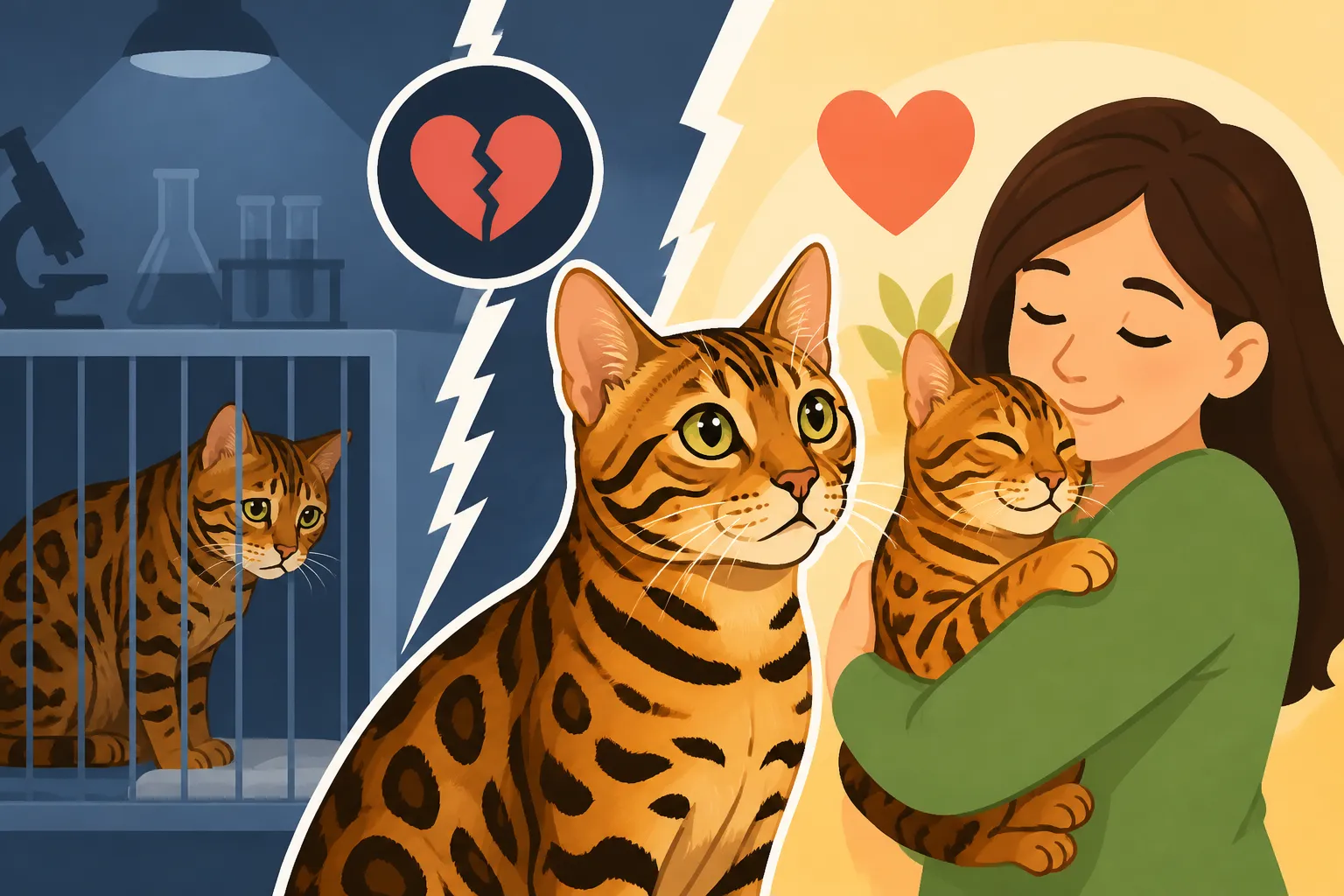
A research colony can end when its scientific purpose is complete, leaving animals who still need stable homes. That is the practical backdrop to the Bengal’s early history: some hybrid cats bred for research at Loma Linda University later entered Jean Mill’s breeding program. Here’s what the research was about, why the cats were no longer needed in the lab, and what their rehoming did—and did not—mean.
Why a medical research program bred Bengal hybrids
The research question involved feline leukemia
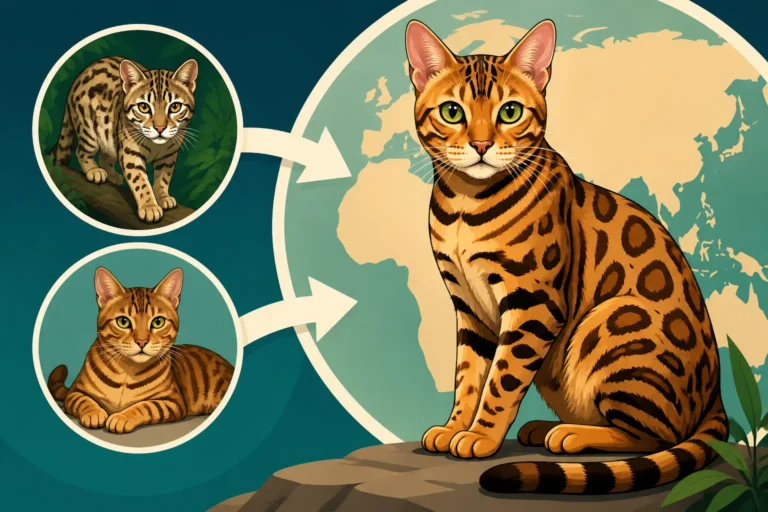
The early hybrid cats were not created simply to produce a striking new pet breed. Researchers, including Willard Centerwall at Loma Linda University, were studying feline leukemia and the apparent resistance of the Asian leopard cat to the virus. To investigate whether that resistance might have a genetic basis, researchers needed to examine inheritance across generations, which meant crossing Asian leopard cats with domestic cats and studying the resulting offspring.
That work placed the cats in a very different setting from a modern home. They were part of a research colony, bred and managed to answer scientific questions. Their lives were shaped by the needs of the study, not by the goals of a cat-breeding program focused on temperament, appearance, and suitability as a companion. For more background, see Why a Medical Lab Bred Bengal Cat Hybrids and What Centerwall Was Trying to Learn From Bengal Cat Hybrids.
The scientific question also needs a little nuance. A finding that one species appears resistant to a particular infection does not mean every individual is completely immune, nor does it automatically explain which genes are responsible. Hybrid animals can help researchers explore such questions, but the research history should not be simplified into “wild cats are immune, so their descendants are too.” The Bengal’s modern health and inherited traits are separate subjects from the original experiment.
Who Centerwall was in the Bengal’s early history
Willard Centerwall is connected to the breed because his research colony included domestic-cat and Asian-leopard-cat hybrids. Some of those cats later became part of Jean Mill’s efforts to establish a domestic breed with a spotted, wild-looking coat. To understand the handoff, it helps to distinguish Centerwall’s scientific project from Mill’s breeding work: they had different purposes, even though some of the same cats connect their stories.
Centerwall’s role is part of a larger history, rather than the whole story of how the Bengal developed. The cats from the research colony were among the early foundation animals associated with the breed, but the Bengal was subsequently shaped through generations of selective breeding. The modern Bengal is not simply a laboratory hybrid kept unchanged; it is the result of a longer breeding history. Who Willard Centerwall Was to the Bengal Cat offers more context about his place in that history.
This distinction matters because the phrase “research Bengal” can sound as though the cats were already the same as today’s registered Bengals. They were early hybrids with a particular scientific background. Their descendants, and later breeding choices, helped form a domestic breed over time. The transition from lab animal to breeding foundation was a chapter in the breed’s development, not an instant change in identity.
Why the research cats were rehomed
When animals are no longer needed for a study
Research colonies are maintained for a defined purpose. If a project ends, changes direction, or no longer requires particular animals, those animals may need another plan for their care. A colony cannot continue indefinitely just because it once supported useful research. Housing, veterinary care, staffing, and the purpose of keeping the animals all have to be considered.
That is the broad context for the rehoming of some cats from Centerwall’s colony. The cats were no longer needed in the same way for the research program, and some were transferred out rather than remaining indefinitely in a laboratory setting. Historical accounts often describe Jean Mill receiving hybrid cats from Loma Linda as research activity wound down. The exact details of each cat’s path should not be blurred into a single claim that every animal was handled identically.
It is also worth avoiding an easy but unsupported conclusion: the cats were not necessarily rehomed because they had failed as research subjects, were unsuitable as pets, or had some particular behavioral problem. Their presence in a research facility reflected the purpose for which they had been bred and kept. When that purpose changed, their future care had to change too. For a broader look at the colony’s history, see Which University Ran the Bengal Cat Research Colony.
Rehoming was a transition, not a single event
The phrase “the research Bengal cats were rehomed” can make the process sound like one organized move involving every cat at the same moment. In reality, it is safer to think of it as a transition: some cats left the research setting, and a portion of the hybrids became available to people involved in developing the Bengal breed. The available historical account connects Centerwall’s colony with cats that Jean Mill received, but that does not establish that all colony animals went to her or that every animal entered breeding.
Jean Mill’s involvement is important because she saw potential in the cats as the basis for a domestic breed. Still, the research colony did not simply become her cattery. The original purpose, the university’s management of the animals, and the later selective breeding program were distinct parts of the story. Which Bengal Cats Jean Mill Received From Loma Linda explores that connection in more detail.
This careful wording helps explain why accounts of the Bengal’s origins sometimes differ in emphasis. One telling may focus on the laboratory research, another on Mill’s role, and another on the cats’ transfer out of the colony. Those perspectives can all describe parts of the history without proving that every detail of every animal’s placement is known. What is clear is that some hybrids from the research setting contributed to the early domestic Bengal breeding story.
What rehoming meant for the breed
Some cats became foundation animals, but not every cat became a Bengal
The transfer of some hybrids out of the research colony mattered because it gave certain cats a role beyond the original scientific work. Jean Mill used some of the cats she received in breeding efforts that helped establish the Bengal. That connection is why the Centerwall colony appears in accounts of the breed’s origins.
But it would be misleading to say that every cat leaving the university became a breeding animal, or that every Bengal descends directly from a specific research cat in the same way. Breed development involves multiple animals and generations, and a cat’s presence in a historical colony does not by itself prove a particular place in every modern pedigree. What Happened to Centerwall's Bengal Cat Hybrids looks more closely at what is known about the cats after the colony.
The change also did not mean the cats instantly became ordinary household pets in the modern sense. Early-generation hybrids can differ from established domestic Bengals in behavior and care needs. Over generations, breeders worked toward cats that could live as companion animals while retaining a distinctive spotted or marbled appearance. For more on that broader shift, read Whether Bengal Cats Are Still Bred From Wild Cats.
| Part of the history | What it means | What it does not automatically mean |
|---|---|---|
| Centerwall’s research colony | Hybrid cats were kept as part of a scientific study | The cats were bred primarily to create a pet breed |
| The research program wound down | Some animals no longer had the same role in the study | Every cat followed the same path out of the colony |
| Jean Mill received some hybrids | Some cats became connected to early Bengal breeding | Every research cat became a foundation breeder |
| Later selective breeding | The domestic Bengal developed over generations | A modern Bengal is simply a laboratory hybrid |
The research story is not a shortcut to a pet’s health profile
The original research involved feline leukemia, but the Bengal’s history should not be used as a promise that today’s Bengals are protected from disease. A breed’s ancestry does not replace routine veterinary care, vaccination discussions, or testing based on an individual cat’s health and circumstances. If you are choosing a Bengal kitten or adopting an adult, ask for veterinary records and discuss preventive care with your veterinarian rather than relying on a story about an ancestor’s resistance.
It is also sensible to separate breed history from the health information a responsible breeder or rescue can provide about a particular cat. The research colony is relevant to the breed’s origins, but it cannot tell you whether a specific Bengal has an inherited condition, a current infection, or a particular care need. The cat’s own records, examination, and family history matter more for those decisions.
That distinction is useful for prospective owners because dramatic origin stories can be repeated as if they were guarantees. They are not. A Bengal is a domestic companion with individual health needs, and the responsible next step is ordinary, careful pet care—not assuming that hybrid ancestry makes a cat unusually resistant or immune.
What the story means to Bengal owners today
Rehoming history should not be confused with rescue adoption
A research transfer from decades ago is not the same thing as adopting a Bengal from a present-day shelter or rescue. The historical cats moved from a research environment into a new role during the breed’s early development. A modern rescue cat has its own background, medical history, and temperament, which may be known in detail or partly unknown.
If you are adopting, ask what the organization knows about the cat’s age, veterinary care, diet, and behavior. A calm transition matters more than the label attached to the cat. Set up a quiet room, provide familiar bedding if available, and keep food and litter routines consistent while the cat settles in. If supplies are missing, a pet retailer such as Chewy may be one option for finding familiar food or basic household items; check with the rescue before changing the cat’s diet.
A Bengal’s energy and curiosity can also make the home setup important. Secure doors and windows, offer appropriate climbing and scratching areas, and introduce new rooms gradually. Shopping for toys or feeding equipment through a retailer such as Chewy can help fill practical gaps, but the most useful choices are the ones suited to the individual cat—not products chosen because the cat has an unusual breed history.
Remember the people and animals behind the origin story
The research cats were living animals, not just a footnote in a breed timeline. Their story reflects a shift from scientific use to new homes and, for some, a role in early Bengal breeding. That history can be told without pretending that every detail is documented or turning the cats into a simple origin myth.
For owners, the humane takeaway is straightforward: an animal’s needs do not disappear when the purpose for which it was bred or kept comes to an end. Whether a cat is entering a home from a research setting, a breeder, or a rescue, it needs appropriate care, patient adjustment, and respect for its individual temperament. If you are preparing for a new Bengal, you might use a retailer such as Chewy to source routine supplies, but a gradual transition and veterinary guidance are what help make the home feel safe.
The research colony’s legacy is therefore twofold. It contributed to scientific inquiry into feline leukemia, and some of its hybrid cats later contributed to the early development of the Bengal breed. Keeping those two parts separate makes the history clearer: the cats were first connected to research, then some were rehomed, and a portion became part of a much longer story of selective breeding.
Disclaimer
This article is for general informational purposes only and does not constitute professional advice. Laws, prices and regulations vary by location and change over time. Consult a qualified professional for guidance on your specific situation.