How a Bengal Cat’s Generation Is Counted
A Bengal’s generation is counted by tracing its pedigree back to the Asian leopard cat, the wild ancestor used in the breed’s early development. The labels F1, F2, F3 and later generations describe that family-tree distance, not how wild a cat looks or behaves. This guide explains how the count works, what it can and cannot tell you, and how to check a breeder’s paperwork.
What a Bengal cat generation number means
The count starts with an Asian leopard cat ancestor
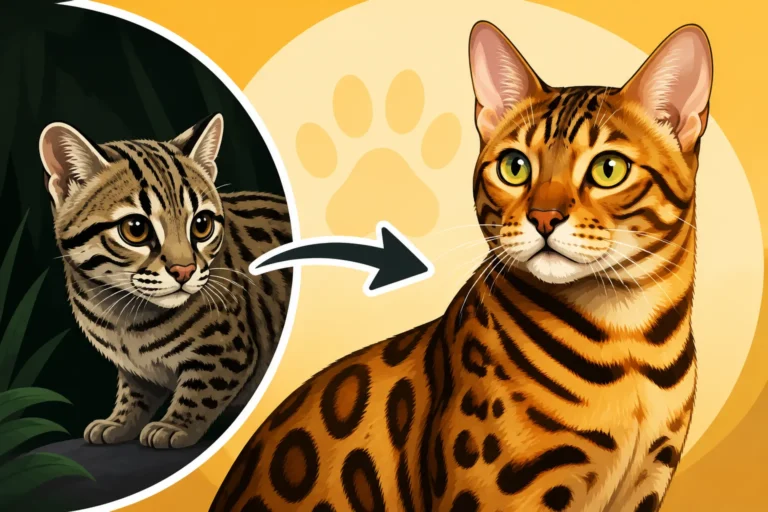
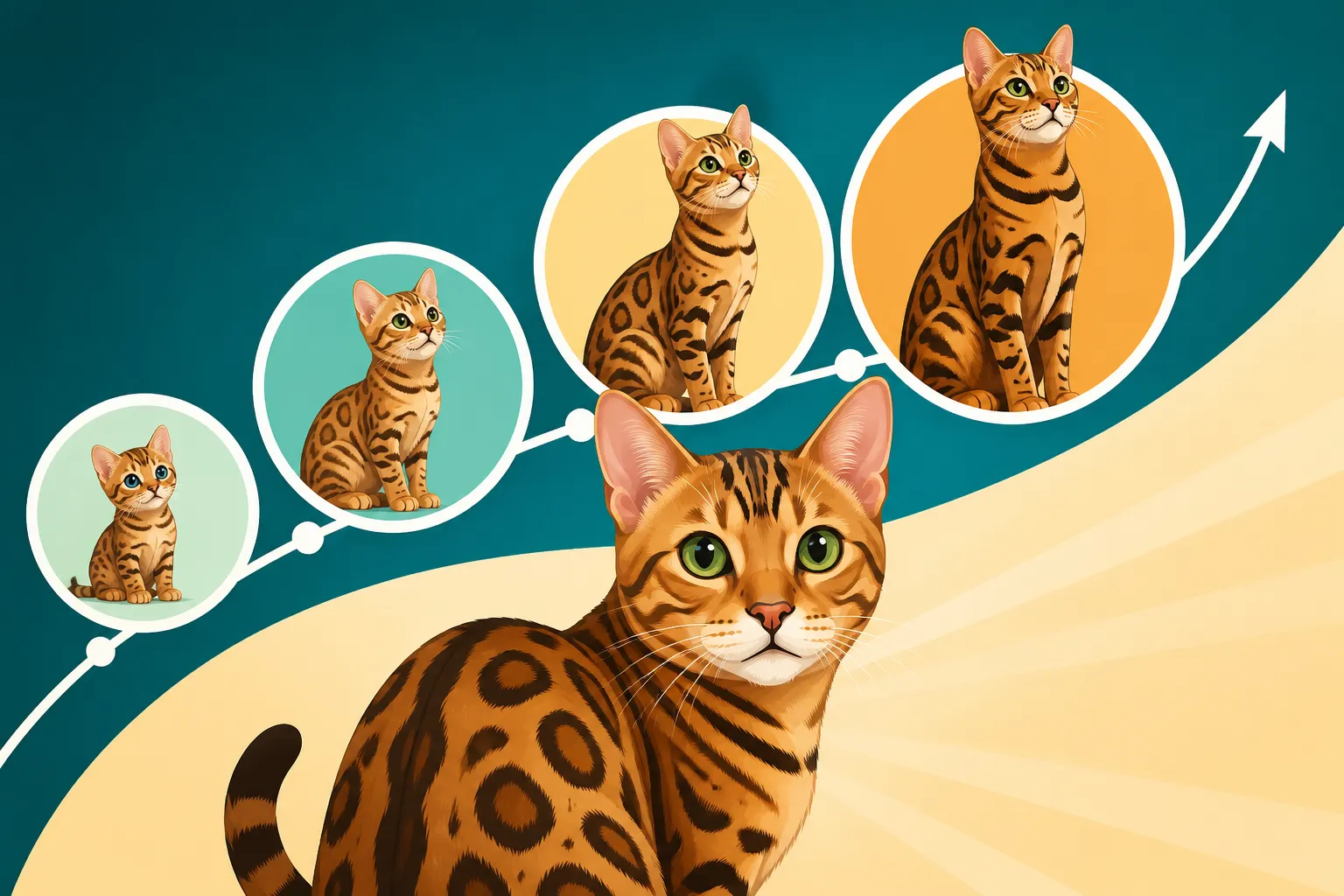
The “F” in an F-number stands for filial generation. It describes how many breeding steps separate a Bengal from an Asian leopard cat ancestor in its pedigree. An F1 Bengal is the first-generation offspring of an Asian leopard cat and a domestic cat. An F2 is one generation farther away, and the count continues as descendants are bred.
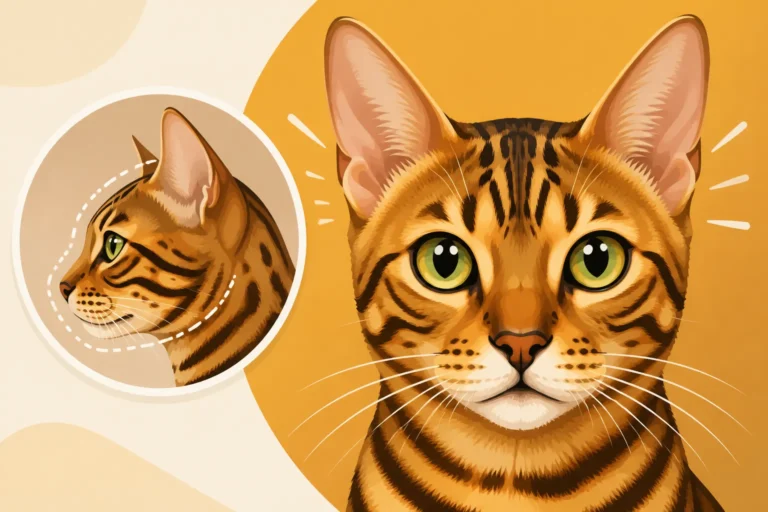
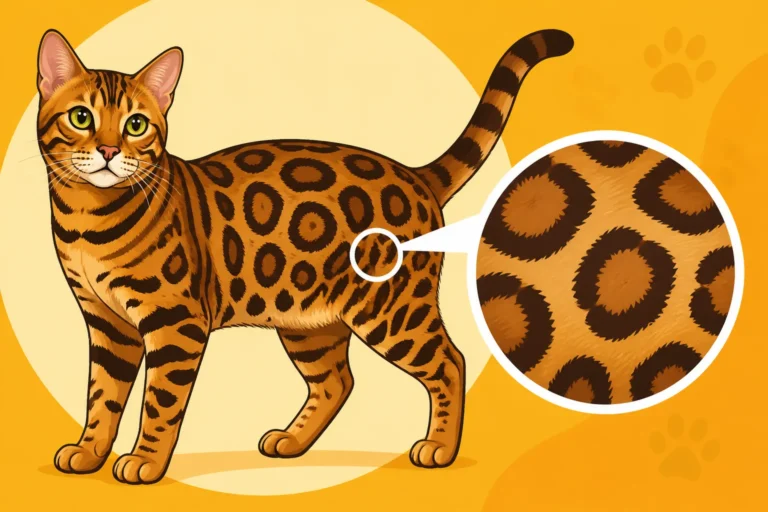
That number is about ancestry, not a visual score. A Bengal with especially dramatic rosettes is not automatically an early-generation cat, and a cat with a more ordinary-looking coat is not necessarily many generations removed. Coat pattern, body shape, personality and generation are different things, even when people casually use the word “wild” to describe all of them.
For a closer look at the terminology, see What Filial Generation Means for a Bengal Cat. The key point is that a generation label is meaningful only when it is tied to a documented family tree. A photo, a breeder’s verbal description or a cat’s appearance cannot establish the number on its own.
Each step follows the pedigree
In a simplified example, an F1 produced by an Asian leopard cat and a domestic cat is bred to a domestic cat. Their offspring are F2. If an F2 is bred to a domestic cat, the kittens are F3; another such step produces F4. This is the basic logic behind the sequence, although a real pedigree can include more complicated branches and breeding choices.
| Label | Simplified relationship to the Asian leopard cat | What the label generally indicates |
|---|---|---|
| F1 | First-generation offspring of an Asian leopard cat and a domestic cat | The closest filial generation in this simple sequence |
| F2 | Offspring one generation farther removed | A descendant of an F1 |
| F3 | Offspring one step farther removed again | A descendant of an F2 |
| F4 and later | Further generations down the pedigree | Increasing distance from the original wild ancestor |
| SBT | A registry pedigree designation, not simply another F-number | A Bengal-to-Bengal breeding history that meets registry criteria |
This simplified table is a guide to the idea, not a substitute for a pedigree. Breeding histories can differ, and registry terms have their own definitions. A breeder should be able to explain the specific lineage behind a cat rather than relying on the label alone.
The number is not a precise wild-DNA percentage
People sometimes try to translate an F-number into an exact percentage of Asian leopard cat DNA. A simple family-tree calculation can suggest an expected average contribution at each step, but that is not a precise measurement of an individual cat’s genetic makeup. Inheritance is not a perfectly even handoff of every ancestor’s DNA, and a generation label is not a genetic test result.
So an F4 does not mean that a cat has a guaranteed, exact fraction of wild ancestry. Nor does a higher number mean that a cat is “more Bengal” in appearance, health or personality. The label tells you about pedigree distance according to the breeding history; it does not quantify every inherited trait.
This distinction matters when comparing kittens. If one breeder describes a kitten as “mostly wild” based on its F-number, ask what they mean and request the pedigree details. The phrase can sound precise while leaving out what the number actually documents.
How F1, F2, F3 and later generations differ
F1 is the first filial generation
An F1 Bengal is the first generation in a cross between an Asian leopard cat and a domestic cat. It is not the same thing as a typical later-generation pet Bengal simply because it has the Bengal name or a spotted coat. Early-generation cats may have different management needs and may be subject to additional rules, depending on where they live.
The number is also not a guarantee of temperament. Individual behavior is shaped by many things, including socialization, environment, health and the particular breeding line. It is sensible to ask detailed questions about a specific cat rather than assuming its F-number predicts whether it will be easy to handle, quiet or suited to a particular home.
For more detail on the first label, read What F1 Means in a Bengal Cat. If you are considering an early-generation cat, discuss the practical realities with an experienced breeder and a veterinarian familiar with hybrid cats before making a decision.
F2 and F3 are further down the family tree
F2 and F3 mean that the cat is one or more generations farther from the Asian leopard cat than an F1. In the simplified sequence, an F2 descends from an F1, and an F3 descends from an F2. For details on those labels, see What F2 and F3 Mean in a Bengal Cat.
There is no reason to assume that every F2 or F3 has the same temperament, care needs or household suitability. Two cats with the same generation label can come from different parents, breeding programs and living environments. Their F-number helps describe ancestry, but it cannot replace a conversation about the individual cat.
Early-generation males are often infertile, which is one reason breeding histories can differ from a simple, uninterrupted sequence. This does not change the basic meaning of the F-number; it does mean that a buyer should ask how a particular pedigree was developed. Why F1 to F3 Bengal Cat Males Cannot Breed explains the issue further.
F4 and later do not automatically mean the cat is SBT
F4 and later labels indicate greater distance from the original Asian leopard cat ancestor in the simplified filial count. But an F-number and the registry term SBT are not interchangeable. SBT describes a pedigree status under a registry’s rules, while F1, F2 and similar labels describe filial generation.
A Bengal can be several generations removed and still need its precise pedigree checked before anyone assigns a registry designation. The best way to understand the difference is to look at the documented parentage and the registry’s terminology together. What SBT Means in a Bengal Cat covers that designation in more detail.
This distinction can be useful when a seller uses several labels at once. Ask what each one means, which registry records it, and whether the label refers to the cat’s filial generation, its registration code or a casual description. A clear answer should not require you to guess.
How to verify a Bengal cat’s generation
Read the pedigree rather than relying on a listing
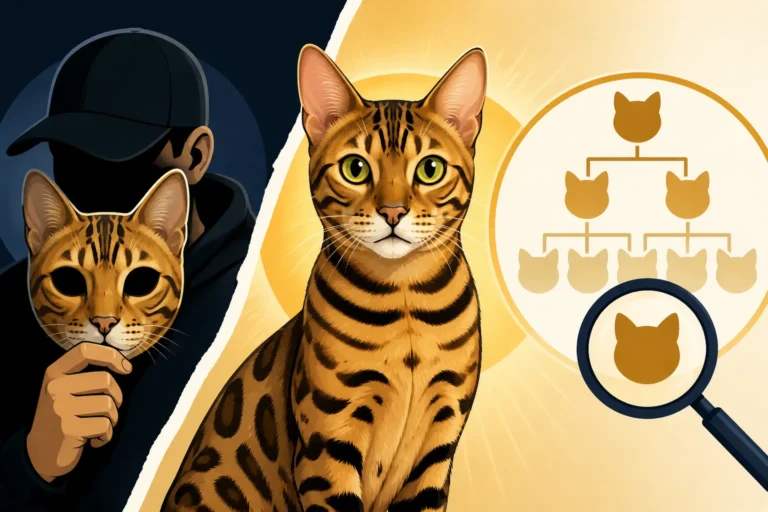
A pedigree is the family tree that lets you trace a Bengal’s recorded parents and earlier ancestors. Start with the cat’s registered name or identifying details, then follow the listed generations back through the parents and grandparents. If the lineage includes an Asian leopard cat ancestor, the placement in the tree helps explain the filial label.
When checking the paperwork, make sure it belongs to the kitten or adult cat being discussed. Names, dates of birth, registration information and parent details should make sense as a connected record. If a breeder tells you the cat is F3, for example, ask them to show how the listed parents and ancestors support that description.
For a practical walkthrough, see How to Find a Bengal Cat's Generation on Its Pedigree. A pedigree can be unfamiliar at first, so it is reasonable to ask the breeder to point out the relevant ancestors and explain the calculation in plain language.
Registration papers are helpful but not the whole explanation
Registration papers can support a cat’s identity and recorded lineage, but a piece of paperwork should not be treated as proof of every claim a seller makes. Check what the document actually states and whether the generation label appears there or is being supplied separately by the breeder. Whether a Registration Paper Proves a Bengal Cat's Generation explores that distinction.
If the document uses a registry code rather than an F-number, ask the breeder to explain how that code relates to the cat’s pedigree. Do not assume that a registration category and a filial label mean the same thing. A careful breeder should be comfortable showing the relevant records and explaining any limits or ambiguities.
A useful habit is to keep copies of the pedigree, purchase or adoption paperwork, and any health records together. Whether you organize those files digitally or in a folder, having them handy can make it easier to answer questions later about the cat’s identity and history.
DNA testing does not replace pedigree tracing
A DNA test may provide information about particular inherited traits or health risks, depending on the test. That is different from establishing an exact filial generation. A test that reports breed-related markers or ancestry estimates should not be confused with a documented pedigree calculation.
If someone claims a DNA result proves a Bengal is a precise F-number or has an exact percentage of Asian leopard cat ancestry, ask which test supports that conclusion and what it actually measures. Whether a DNA Test Shows a Bengal Cat's Wild Percentage is useful background on why these claims need careful interpretation.
The most reliable approach is to use the pedigree for lineage and genetic testing for the specific traits the test is designed to assess. Neither a dramatic coat pattern nor a broad ancestry estimate should be used as a substitute for clear breeding records.
What the generation number can and cannot tell you
It can describe ancestry and help frame questions
A verified generation label gives you a starting point for understanding a Bengal’s place in its family tree. It can prompt useful questions about parentage, registration, breeding history and any rules that apply where you live. If a breeder works with particular generations, ask why that choice suits the goals of their program. Which Generation a Bengal Cat Breeder Works With offers further context.
The number may also matter for local regulations. Some places distinguish between early-generation hybrids and later-generation Bengals, while others use different definitions or restrictions. Never assume that a label makes a cat legal everywhere. Check the relevant local rules and confirm that the documents you have meet the requirements.
Generation can also help you interpret what a breeder is telling you, but it should not be the only factor in choosing a cat. Ask about the kitten’s socialization, veterinary care, parents, health screening and the support available after adoption. Those details offer a much fuller picture of what life with that particular cat may involve.
It cannot predict personality, care needs or value by itself
An F-number does not tell you whether a Bengal will be affectionate, active, vocal or comfortable around children. It does not guarantee a particular size, coat quality or health outcome either. A cat’s daily needs are best understood through its individual behavior, medical history and environment—not through generation alone.
The generation label also does not tell you what supplies a cat needs. A new owner should ask what food the cat already eats, what litter it uses and what routine helps it settle in. If you source ordinary supplies from a local pet shop, a veterinary clinic or Chewy, those choices do not verify a pedigree or change the generation count. When possible, keep the cat on its familiar food during the transition and ask the breeder or rescue about gradual changes.
Most importantly, avoid treating “early generation” as a shortcut for “more exotic,” or “later generation” as a guarantee that a cat will be easy. Ask about the real animal in front of you. A calm explanation supported by records is more useful than a dramatic label.
A straightforward checklist for buyers
Before agreeing to take home a Bengal, ask the breeder or seller for the cat’s pedigree and a clear explanation of the generation label. Confirm that the records match the cat, and ask whether the label is an F-number or a registry designation such as SBT. If the answer is vague, take time to clarify it before making a decision.
Then check practical details separately: the cat’s health records, vaccination and parasite-care history, current diet, socialization, and any local ownership rules. A generation number is only one part of the picture. It should not distract from the everyday questions that help you prepare a safe, comfortable home.
For example, a family comparing two kittens may find that both have well-documented pedigrees but very different temperaments and care histories. The right choice depends on the household’s expectations and the individual cats—not simply on which number sounds closer to the wild ancestor. Chewy or another retailer may help with ordinary setup items, but the breeder’s records remain the place to verify lineage.
When in doubt, request time to review the paperwork and ask a knowledgeable Bengal breeder or relevant registry to explain terminology you do not understand. Good documentation should make the family tree clearer, not leave you relying on sales language.
Disclaimer
This article is for general informational purposes only and does not constitute professional advice. Laws, prices and regulations vary by location and change over time. Consult a qualified professional for guidance on your specific situation.