What Filial Generation Means for a Bengal Cat
A Bengal kitten’s F number can look like a simple label, but it describes ancestry—not a guaranteed percentage of wild DNA, a personality, or a measure of quality. That distinction matters when you’re choosing a cat, checking paperwork, or finding out whether local rules apply. This guide explains what filial generation means, how the numbers work, and what to verify before bringing a Bengal home.
What filial generation means in a Bengal cat
The basic meaning of an F number
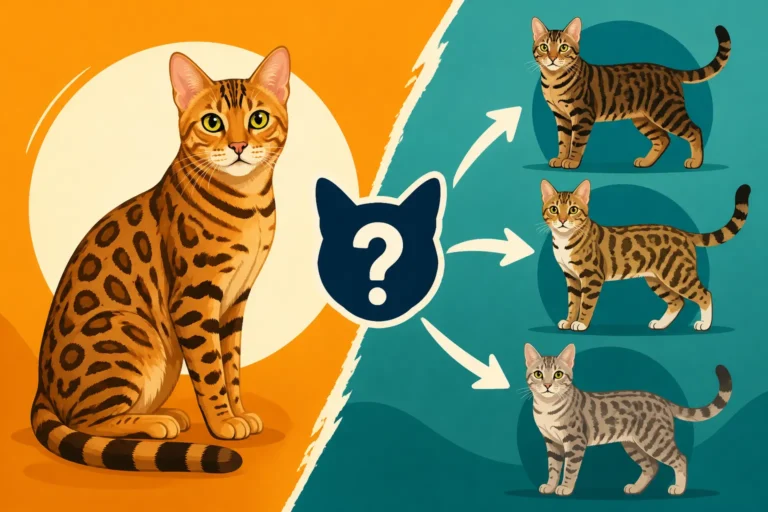
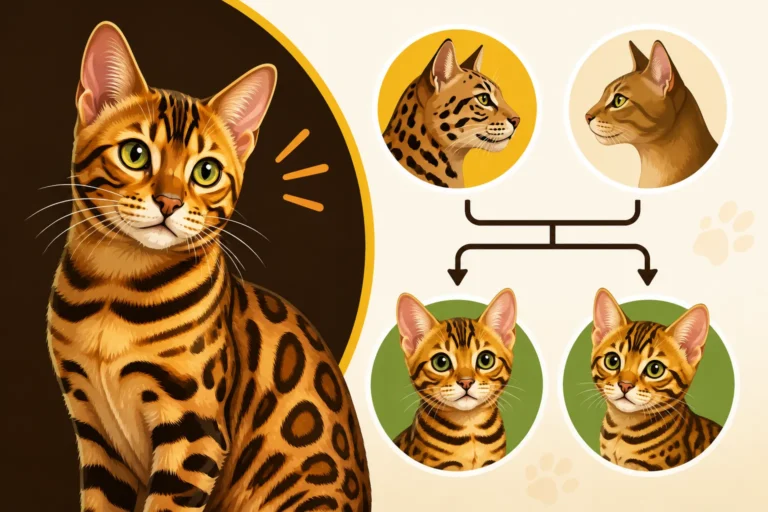
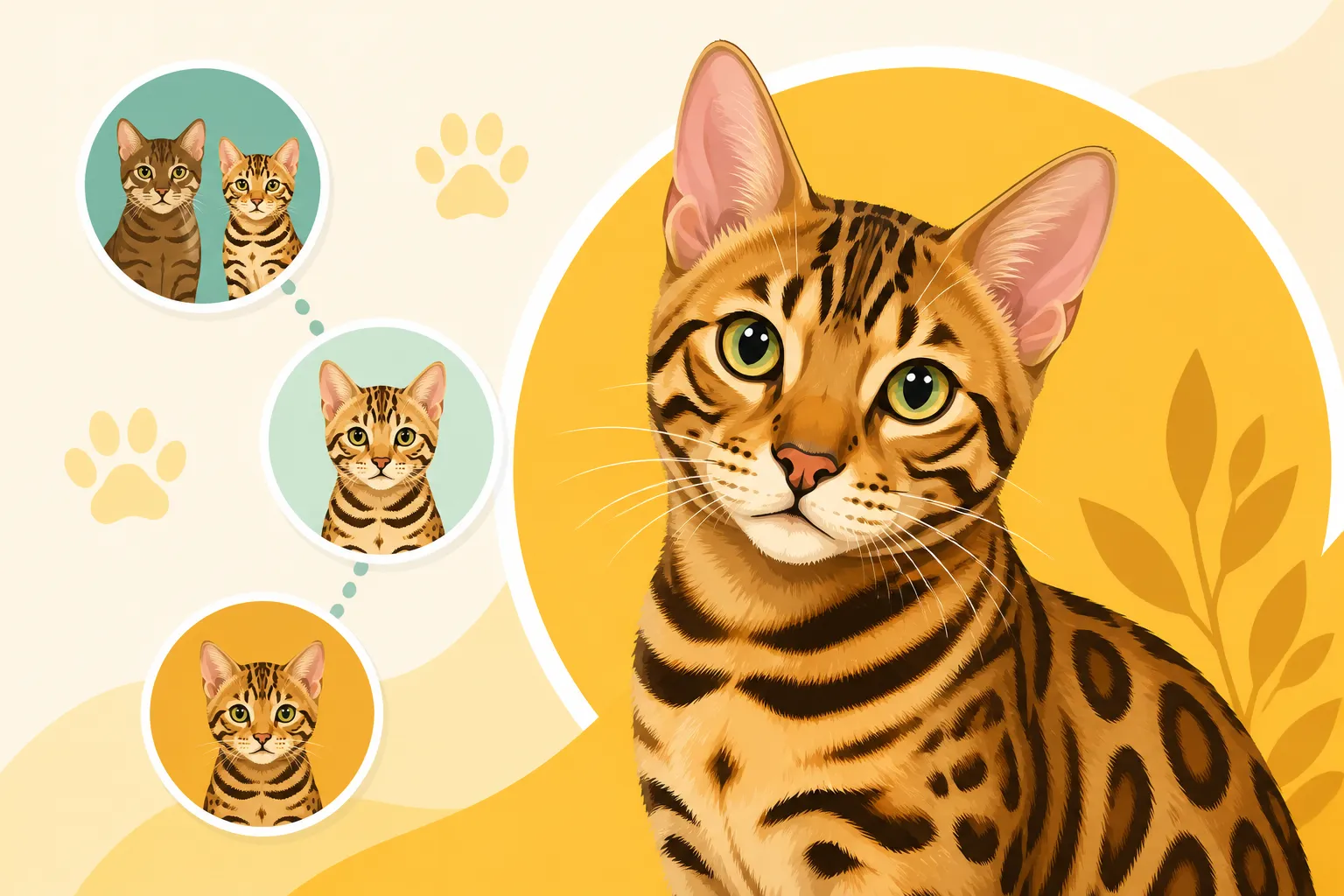
“Filial generation” refers to how many generations a cat is removed from an original cross between an Asian leopard cat and a domestic cat. The letter F stands for filial, a term used for offspring generations. In Bengal pedigrees, F1 is commonly used for the first generation from that cross, F2 for the next, and so on.
The number is about ancestry. It is not a breed-quality score, a size category, or a guarantee that a cat will act a particular way. Two cats with the same F number may have different temperaments, appearances, and individual needs. Their upbringing, health, socialization, and the rest of their pedigree all matter.
This can be confusing because people sometimes use “early generation” and “high filial generation” loosely. Generally, F1, F2, and F3 cats are described as early-generation Bengals. Later-generation Bengals are further removed from the original wild-domestic cross. For a broader explanation of how the labels fit together, see F1 to SBT: How a Bengal Cat's Generation Is Counted.
How F1, F2, and F3 are usually understood
In simplified terms, an F1 Bengal is the direct offspring of an Asian leopard cat and a domestic cat. An F2 is one generation further along, and an F3 is further along again. The exact parentage matters: the number should be supported by a pedigree, not guessed from a cat’s coat or appearance. What F1 Means in a Bengal Cat and What F2 and F3 Mean in a Bengal Cat explain those early-generation labels in more detail.
A common shorthand estimates the Asian leopard cat contribution as halving with each domestic-cat backcross: roughly one-half for an F1, one-quarter for an F2, and one-eighth for an F3. Treat that as a simplified illustration, not an exact DNA result for an individual. Inherited DNA does not divide into perfectly predictable fractions in every kitten, and a label alone cannot tell you the cat’s precise genetic makeup.
The family tree can also become harder to interpret when people discuss generations without explaining the mating behind them. Ask the breeder how the cat’s generation was determined and request the pedigree. A clear answer should connect the F label to documented parentage rather than relying on phrases such as “almost domestic” or “mostly wild-looking.”
Filial generation is not the same as SBT
SBT is a separate pedigree designation used in Bengal registration. It generally indicates that the cat has reached a later stage of Bengal-to-Bengal breeding and meets the registry’s requirements for that designation. It does not simply mean “F4,” and it is not interchangeable with every breeder’s use of “fourth generation.” Registry rules and pedigree notation matter. See What SBT Means in a Bengal Cat for the distinction.
This is where buyers can understandably get tangled: a breeder might talk about an F number, while registration paperwork uses another designation. Those terms answer related but different questions. The F number describes a cat’s filial place in the lineage; SBT is a registry-related label tied to the recorded pedigree and breeding history.
When a seller uses both terms, ask them to explain each one separately. You should be able to follow the cat’s ancestry through the documents, rather than having to take a verbal interpretation on trust.
What an F number tells you and what it does not
It describes ancestry, not a personality
An F number can help you understand where a cat sits in relation to the Asian leopard cat ancestor. It cannot tell you whether that individual will be cuddly, vocal, confident with visitors, or comfortable living with children. Even within the same litter, kittens can differ in their responses to handling, noise, and new situations.
Early-generation ancestry may be relevant when you’re considering practical needs, but it is not a substitute for asking about the individual cat. Ask how the kitten has been raised, what handling and household experiences it has had, and how the breeder assesses temperament. How an Early Generation Bengal Cat Behaves Differently discusses why early-generation cats may differ in practical ways.
It is also a mistake to assume that a higher F number automatically means an easier pet. A well-socialized, carefully matched cat is a better basis for a household decision than the number alone. Think about your routine, other pets, living space, and ability to provide enrichment before deciding which Bengal suits you. Which Bengal Cat Generation Suits a Family offers more context for that decision.
It does not prove an exact wild-DNA percentage
The shorthand percentages often repeated online can make the F number sound more precise than it is. A pedigree label represents a documented generational relationship; it is not a lab report giving a cat’s exact share of Asian leopard cat DNA. Even a genetic test should not be assumed to give a simple, reliable “wild percentage” unless the test is specifically designed and validated for that purpose. Read Whether a DNA Test Shows a Bengal Cat's Wild Percentage before treating a DNA result as a generation certificate.
Appearance is not a dependable shortcut either. A striking rosette pattern does not prove that a cat is an early generation, and a less dramatic coat does not rule one out. Many later-generation Bengals retain the breed’s distinctive markings, while individual cats can vary widely.
If someone is selling a cat based on a claimed F number, ask for the actual pedigree and the registry information that supports the claim. If the documents are missing, incomplete, or inconsistent, be cautious about treating the number as established fact.
It does not settle breeding or health questions
Generation can be relevant to breeding history, but it cannot replace health screening or veterinary care. A breeder’s claims about generation do not tell you whether the parents have been appropriately assessed for inherited conditions, or whether a kitten has received routine veterinary attention. Ask for the health records and test results relevant to the breeding program, and have your own veterinarian review the kitten’s care history.
Some early-generation Bengal males may have fertility limitations, but this is not a reason to make assumptions about a particular cat’s reproductive status. Breeding decisions depend on the animal and its veterinary assessment. For more detail, see Why F1 to F3 Bengal Cat Males Cannot Breed.
For a pet buyer, the practical question is not just “What F number is this cat?” It is also “What do the records show about health, socialization, and care?” A responsible breeder should be comfortable discussing all of these separately.
How to check a Bengal cat’s generation
Read the pedigree, not just the advertisement
Start by asking for the kitten’s pedigree or registration documentation and the names or identifiers of its parents. Check that the generations shown on the paperwork match the seller’s description. If the breeder says a cat is SBT, ask which registry designation they mean and how the recorded ancestry meets that registry’s rules. How to Find a Bengal Cat's Generation on Its Pedigree can help you understand what to look for.
Do not feel awkward about asking for clarification. It is reasonable to want a plain-language explanation of a technical label, especially when the information may affect your decision or your ability to own the cat. A careful breeder should be able to walk you through the family tree without pressuring you to pay a deposit first.
If the seller cannot provide records, be clear with yourself about what is known and what is only claimed. A cat may still be a wonderful companion without verified pedigree details, but you should not pay or make legal decisions on the assumption that an undocumented F number is confirmed.
Check registry and local ownership rules
Bengal registration and local ownership laws are not the same thing. A registry designation does not automatically establish that a cat is permitted in every city, county, state, or housing situation. Rules can distinguish between early-generation cats and later generations, and definitions may not match a breeder’s casual use of F numbers.
Before committing, check the relevant law with the appropriate local authority and review your lease or housing rules. If you travel or move, check requirements at the destination as well. Where an ordinance uses a specific definition, ask which documents it accepts as proof of generation. Which Generation TICA Registers as a Bengal Cat explains a registry question, while Which Bengal Cat Generation Most States Draw the Line At addresses why legal cutoffs deserve separate checking.
Do not assume a seller’s assurance that “this generation is legal everywhere” is enough. Laws can be local, and a registry certificate may not answer the exact question an authority or landlord asks. Keep copies of the pedigree and registration documents in a place where you can find them later.
Separate generation records from everyday supplies
Once the paperwork is clear, make a practical plan for the cat’s day-to-day needs. Choose a secure carrier, litter setup, scratching surfaces, climbing options, and toys suited to the individual cat. A retailer such as Chewy can be one place to compare ordinary supplies, but a product listing cannot confirm a Bengal’s generation or replace pedigree documents.
If you use Chewy to prepare before pickup, focus on the basics and ask the breeder what the kitten already eats and uses. A sudden food change or unfamiliar litter can add stress during a move, so matching the kitten’s current routine at first may make the transition easier. Chewy may also help you restock familiar food or litter, but keep veterinary and health questions with your veterinarian.
Most importantly, do not confuse a purchase record with proof of lineage. Buying a carrier, food, or litter through Chewy is entirely separate from establishing the cat’s pedigree. Keep those records for household organization; keep the breeder’s documents for ancestry and registration questions.
Questions to ask before choosing a Bengal
Ask the breeder to explain the label
A useful conversation can be straightforward. Ask: “What does this F number mean in this kitten’s pedigree?” “Can I see the parent information?” and “Is the cat also registered under a separate designation such as SBT?” Listen for an explanation tied to records, rather than vague assurances about how wild or domestic the cat looks.
You can also ask whether the breeder’s generation terminology follows a particular registry’s conventions. Since terms may be used differently in casual conversation, knowing the convention prevents misunderstandings. The breeder should be able to tell you what the documents do and do not establish.
If a seller dismisses reasonable questions, changes the explanation, or treats an F number as proof of temperament or legality, slow down. You are not being difficult by checking information before making a long-term commitment.
Match the cat to your home, not just the number
Consider the household you can realistically offer. Think about how much time you can give to play and interaction, whether there are other animals, how you will manage introductions, and whether your home has safe places for climbing and resting. The number on a pedigree does not tell you whether your schedule and the cat’s needs will be a good fit.
Ask about the kitten’s behavior in familiar situations: how it responds to being handled, whether it has met different people, and how it reacts to common household sounds. No breeder can promise exactly how a cat will behave in a new home, but thoughtful observations are more useful than broad claims based on ancestry.
Finally, take time to understand the records, local rules, and care plan before bringing the cat home. A clear F number is one small piece of the picture. A well-documented background, an honest conversation, and a realistic match for your household give you a much stronger foundation.
Disclaimer
This article is for general informational purposes only and does not constitute professional advice. Laws, prices and regulations vary by location and change over time. Consult a qualified professional for guidance on your specific situation.