How Much Wild DNA an F2 Bengal Cat Has
An F2 Bengal is commonly described as having about 25% Asian leopard cat ancestry, but that figure is a pedigree expectation, not a precise DNA reading for every individual cat. The distinction matters if you are trying to understand a cat’s generation, likely needs, or legal status. This guide explains where the estimate comes from, what it does and does not tell you, and how to check a cat’s background.
How much wild DNA an F2 Bengal cat is expected to have
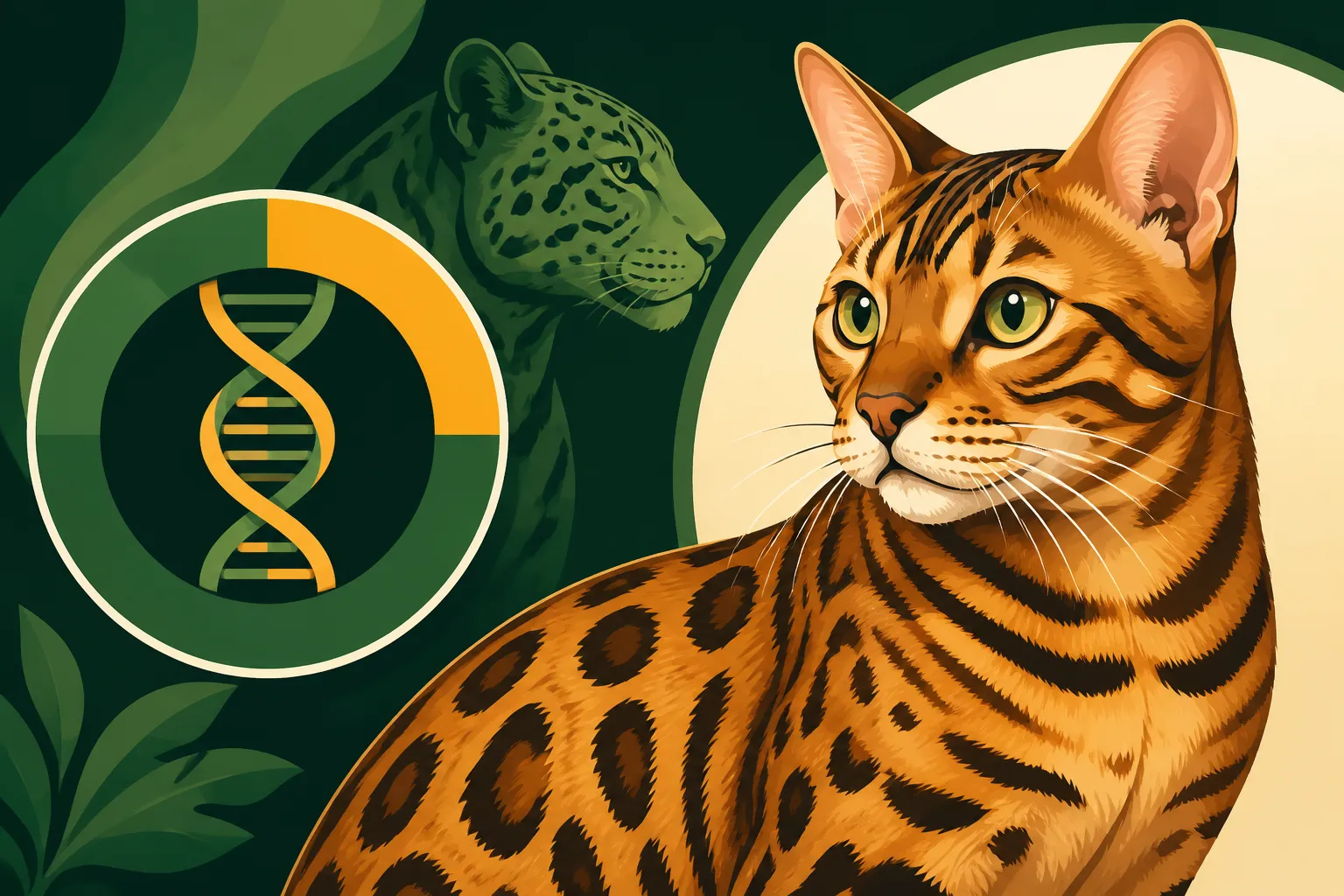
The simple answer is about 25%
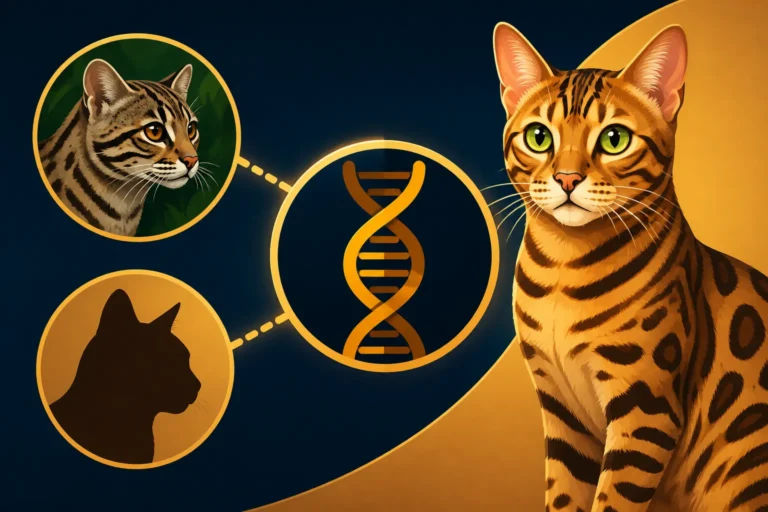
In a simplified pedigree, an F1 Bengal is the offspring of an Asian leopard cat and a domestic cat. That first-generation cross is expected to inherit roughly half of its ancestry from each parent. An F2 Bengal is then commonly produced by breeding an F1 female to a domestic male. On average, the F2 kitten is expected to have about one quarter Asian leopard cat ancestry.
The arithmetic is straightforward: the F1 parent contributes, on average, half wild ancestry, while the domestic parent contributes none. The kitten receives half its inherited material from each parent, so its expected wild ancestry is about half of the F1 parent’s share. That gives the familiar estimate of 25%.
It is a useful way to understand the generations, but it should not be mistaken for a laboratory measurement of an individual cat. “F2” describes a position in a pedigree. It is not a promise that a test will find precisely 25% of the cat’s DNA came from an Asian leopard cat.
The fraction changes with each generation
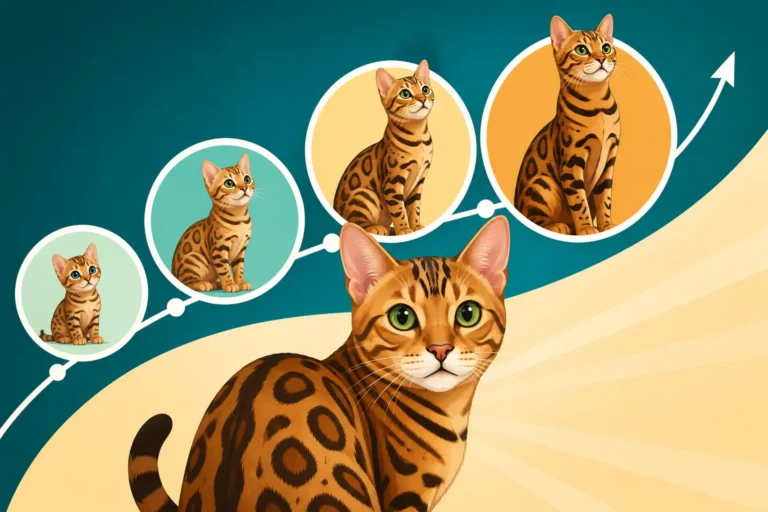
The usual simplified sequence halves the expected Asian leopard cat ancestry each time an early-generation Bengal is bred back to a domestic cat. These figures are best understood as averages in a particular pedigree pattern, not exact readings for every cat.
| Bengal generation | Simplified breeding pattern | Expected Asian leopard cat ancestry |
|---|---|---|
| F1 | Asian leopard cat crossed with a domestic cat | About 50% |
| F2 | F1 crossed with a domestic cat | About 25% |
| F3 | F2 crossed with a domestic cat | About 12.5% |
| F4 | F3 crossed with a domestic cat | About 6.25% |
The percentages help explain why an F2 is considered an early-generation Bengal, but they do not tell you everything about the cat. Temperament, socialization, health, and home suitability depend on many influences, including the individual animal’s parents and the conditions in which it was raised. An ancestry fraction alone cannot predict how a particular Bengal will behave.
For a wider explanation of the family-tree terms, see What F1 Means in a Bengal Cat and What F2 and F3 Mean in a Bengal Cat.
Why an F2’s actual DNA may not equal the estimate
Pedigree percentages are averages
A kitten does not inherit a perfectly measured, evenly divided sample of every ancestor’s DNA. Inheritance is a reshuffling process: each parent passes on a combination of genetic material, and siblings can receive different combinations. As a result, cats with the same generation label may not have identical ancestry proportions at the level of their inherited DNA.
The 25% figure is therefore a practical estimate based on the expected contribution from the parents in a simplified pedigree. It does not mean every F2 cat has exactly one quarter of its genome from an Asian leopard cat. Nor does a visible feature—such as a spotted coat, athletic build, or striking facial markings—reveal an exact ancestry percentage. Domestic cats can share some of these traits without having recent Asian leopard cat ancestry.
Generation labels also rely on accurate parentage records. If a pedigree is incomplete, the recorded generation may not reflect the true breeding history. That is why a breeder’s documentation and the cat’s pedigree matter more than an appearance-based guess. How a Bengal Cat's Generation Is Counted explains the broader way generation is traced.
A commercial DNA test is not the same as a pedigree
People often hope a DNA kit will settle the question with a single percentage. In practice, a test’s ability to identify breed relationships or particular inherited traits is not necessarily the same as proving a Bengal’s exact filial generation or its legal classification. Test results depend on the service, the reference populations used, and the question the test is designed to answer.
If a breeder or seller claims that a test proves a precise wild-ancestry percentage, ask what the test measures and whether the result is accepted for the purpose you care about. A test that identifies certain genetic variants does not automatically verify the full pedigree. For a discussion of what ancestry tests can establish, see Whether a DNA Test Shows a Bengal Cat's Wild Percentage and Whether a DNA Test Confirms a Bengal Cat.
A retailer such as Chewy may be useful for ordinary cat supplies, but buying a DNA kit or supplies from a pet retailer is not a substitute for breeder records or a reliable pedigree. Keep the questions separate: one is about a cat’s family history, while the other is about caring for the cat you have.
What an F2 label means for behavior and ownership
Ancestry is not a temperament forecast
A common mistake is to treat “25% wild ancestry” as a precise guide to how an F2 Bengal will act. A percentage cannot tell you whether a cat will be comfortable with visitors, enjoy being handled, tolerate other pets, or settle into an indoor home. Early-generation cats may differ from later-generation Bengals in important ways, but there is variation among individuals, and upbringing and socialization matter.
If you are considering an F2, ask the breeder about the individual cat rather than relying on the generation label alone. Ask how the kitten was raised, what household sounds and handling it has experienced, how it responds to people, and what its parents are like. A responsible breeder should be able to discuss the cat’s needs honestly, not just point to a dramatic ancestry percentage.
An F2 may also need a carefully planned home and consistent enrichment. That does not mean every F2 will be difficult to live with, or that a particular behavior is caused by a specific percentage of Asian leopard cat ancestry. It means you should assess the cat’s actual temperament and daily needs before deciding. How an Early Generation Bengal Cat Behaves Differently offers more context on early generations.
Check the law before relying on a generation number
Some places regulate Bengal cats by generation, while rules may differ between national, state, provincial, and local authorities. A cat described as F2 can fall under stricter rules than a later-generation Bengal in some jurisdictions. Do not assume that a breeder’s description, registration document, or a DNA result settles the legal question where you live.
Before bringing an early-generation Bengal home, check the rules that apply in your exact location and ask what documents authorities require. A landlord, insurer, airline, or local animal-control office may also have its own requirements. The relevant distinction may be the documented generation in a pedigree rather than a calculated DNA percentage. For an overview, see Which Bengal Cat Generation Most States Draw the Line At and How to Check Your State's Bengal Cat Law.
If you already have an F2, keep copies of the pedigree and sale documents somewhere easy to find. Chewy can help with routine supplies such as litter or food, but a shopping receipt cannot establish generation or replace ownership paperwork. When the legal status is uncertain, get clarification from the appropriate local authority before making travel or housing plans.
How to verify an F2 Bengal’s background
Ask for a documented pedigree and parent details
Start with the breeder or previous owner. Ask for the kitten’s pedigree, the registered names or identifying details of its parents, and the documents that support the stated generation. A clear explanation of how the parents were bred is more useful than an unsupported claim that the kitten is “25% wild.”
It is also reasonable to ask what the breeder means by “F2.” Generation terminology is useful only when it is tied to a traceable family tree. If the answer is vague, the paperwork is missing, or the seller relies mainly on the cat’s appearance, treat the generation claim cautiously. A spotted coat does not confirm an F2 pedigree.
You can also ask whether the breeder’s registration organization recognizes the cat’s generation and what records are available. Registration papers can help document pedigree, though you should understand what the specific paperwork does and does not establish. How to Find a Bengal Cat's Generation on Its Pedigree and Whether a Registration Paper Proves a Bengal Cat's Generation provide related guidance.
Match the evidence to the reason you need it
The right evidence depends on why you are asking about wild ancestry. If you are curious about the cat’s background, a well-documented pedigree may be enough. If you are checking whether you can legally own or travel with the cat, look for the exact documents required by the relevant authority rather than assuming that a commercial test will be accepted. If you are assessing a breeder, ask for the parentage records and the health information relevant to the kitten as well.
For a pet owner, it is easy to get stuck on the percentage because it sounds definitive. In day-to-day life, the more useful questions are whether the cat is healthy, well socialized, and a good match for your home. Buy everyday supplies from a retailer such as Chewy if that is convenient, but keep those purchase records separate from pedigree and legal documents.
The clearest takeaway is that an F2 Bengal is generally expected to have about 25% Asian leopard cat ancestry under the standard simplified breeding pattern. That estimate describes the pedigree’s expected contribution; it is not a guaranteed exact DNA percentage or a complete guide to the cat’s behavior, needs, or legal status.
Disclaimer
This article is for general informational purposes only and does not constitute professional advice. Laws, prices and regulations vary by location and change over time. Consult a qualified professional for guidance on your specific situation.