Which States Ban the Bengal Cat Outright
The thought of bringing a gorgeous Bengal cat into your home is incredibly exciting, but many prospective owners get tangled up in a web of confusion when it comes to legality. It’s frustrating to fall in love with a breed only to discover that your state or even your city might have strict rules, or an outright ban, on owning one. This guide will walk you through the specific states that have completely banned Bengal cats, and help you understand the nuances of these laws, ensuring you can make an informed decision and avoid future heartache or legal trouble.
Understanding the Legal Landscape of Bengal Cat Ownership
It’s easy to assume that if a cat breed is recognized by major registries like TICA, it must be legal everywhere in the United States. Unfortunately, that’s just not the case, especially with hybrid breeds like the Bengal. The breed's wild ancestry, stemming from the Asian Leopard Cat, creates a unique legal classification that differs from typical domestic cats, leading to a patchwork of laws across the country. This isn't just about owning an exotic pet; it’s about navigating laws designed for wild animals, even if your Bengal is many generations removed.
Why the Confusion Exists for Hybrid Cats
The primary source of confusion lies in the "hybrid" nature of the Bengal cat. Unlike breeds developed solely from domestic stock, Bengals have a direct, albeit distant, wild ancestor. Lawmakers often struggle with where to draw the line between a fully domesticated animal and one that retains enough "wildness" to warrant special regulations. They often default to classifying early generations (F1, F2, F3) as wild animals, and some even extend this classification to later generations, or the entire breed. This means you can't just check a general pet ownership law; you need to look specifically for hybrid cat regulations, or even laws explicitly naming the Bengal cat.
Adding to the complexity, laws aren't always clear-cut. Some states have blanket bans, while others impose generation-specific restrictions, demanding permits for early generations but allowing later generations. Still others defer to county or city ordinances, leaving you to do a deep dive into hyper-local rules. It’s not uncommon for someone to think their state is fine, only to find their specific city has a ban. This kind of legal labyrinth can be incredibly frustrating for hopeful Bengal owners.
The Dynamic Nature of Pet Ownership Laws
Another factor contributing to the uncertainty is that these laws aren't static. Regulations around exotic and hybrid pet ownership can change. What was legal five years ago might not be today, or vice-versa. New legislation can be introduced based on perceived public safety concerns, animal welfare arguments, or even the actions of irresponsible owners. This means that even if you confirm legality today, it's wise to stay informed about potential legislative changes in your area.
For example, a state might suddenly decide that even a fully domesticated "SBT" Bengal cat (meaning Studbook Tradition, typically F4 and beyond) still possesses enough traits from its wild heritage to be deemed a public risk, leading to new restrictions or bans. Always verify the most current laws, perhaps even contacting local animal control or wildlife agencies, to ensure your information is up-to-date before making any commitments. You can never be too careful when it comes to pet ownership, especially with a breed that often finds itself in legal grey areas.
States with Outright Bans on Bengal Cats
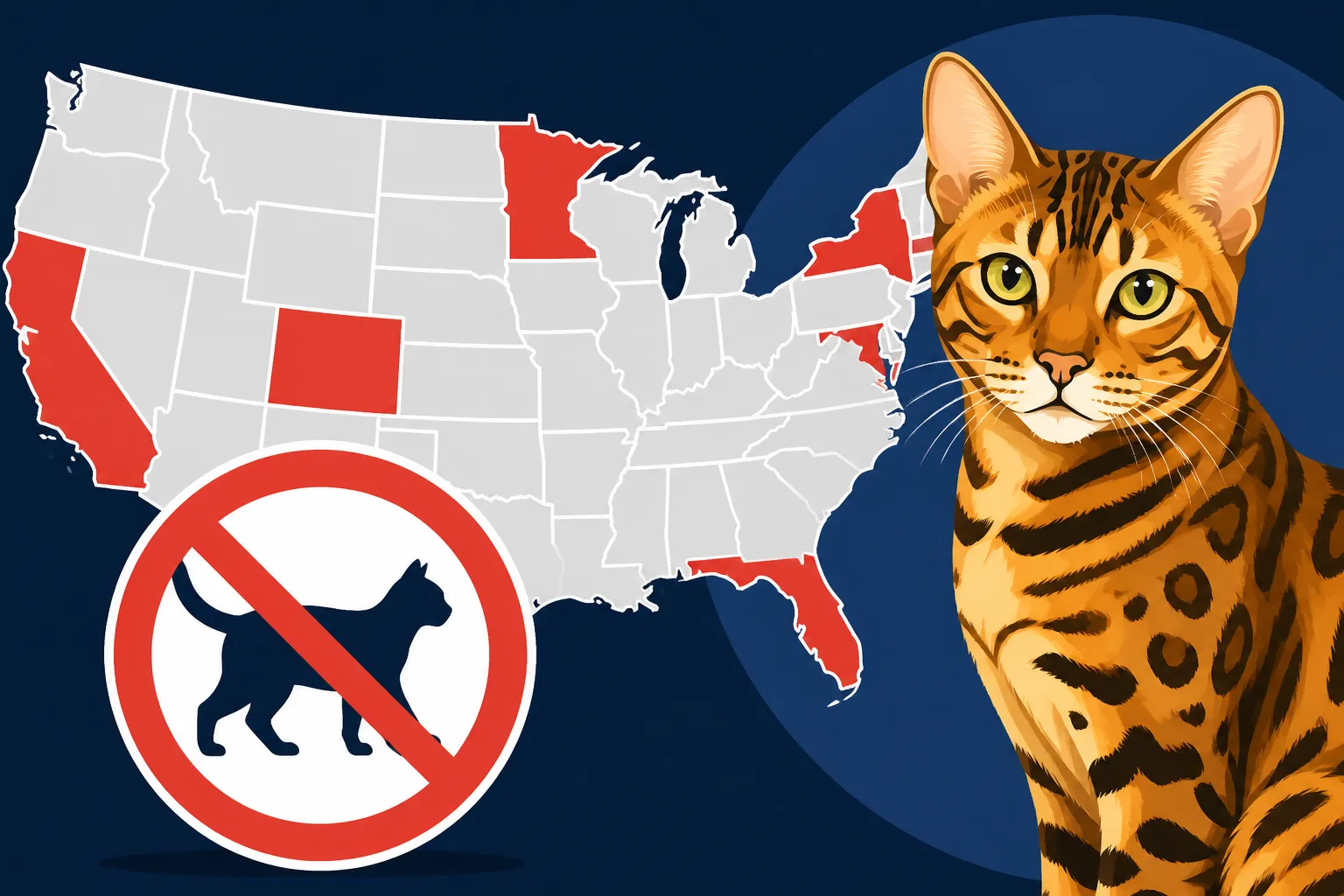
When we talk about outright bans, we mean states where, regardless of the Bengal cat's generation, you are simply not permitted to own one. These states typically classify all Bengal cats, from the early F1 generation right through to the fully domesticated SBT, as "wild animals" or "dangerous hybrids." This means there’s no permit, no paperwork, and no special enclosure that will make ownership legal.
Hawaii: The Blanket Prohibition
Hawaii stands as the most prominent example of a state with a complete, unequivocal ban on all Bengal cats, regardless of their generation. The reason behind this strict stance is rooted in Hawaii's unique ecosystem and its rigorous efforts to protect native species from invasive ones. The state has an exceptionally delicate natural balance, and any animal perceived as a potential threat to local wildlife, or one that could introduce diseases, faces extreme scrutiny.
The concern is that a Bengal cat, even many generations removed from its wild ancestor, might retain some hunting instincts or physical prowess that could pose a risk to Hawaii's vulnerable bird and animal populations. Importing or possessing a Bengal cat in Hawaii is strictly prohibited, and authorities are very diligent in enforcing these laws. If you are considering a move to the islands, or live there currently, understand that a Bengal cat simply cannot be part of your household there. This prohibition is unwavering, and there are no exceptions for pet Bengals. You can read more about this specific situation in Hawaii Bans Every Bengal Cat, Whatever the Generation.
New York City: A City-Specific Outright Ban
While New York State has a more nuanced approach, allowing later generations of Bengal cats with proper documentation, New York City has its own set of rules that include an outright ban on all Bengal cats. This is a crucial distinction, as state laws don't always override city ordinances, especially when local governments decide to impose stricter regulations based on their specific urban environments and population density.
The rationale in New York City often centers on public safety and the challenges of managing "exotic" pets in a densely populated area. The concern is that an active, intelligent, and sometimes vocal breed like the Bengal cat might not be suitable for apartment living, or could pose a risk if it were to escape into the urban environment. This means that even if you're looking at a well-socialized, F4 or higher generation Bengal, ownership within the five boroughs is simply not an option. It's a stark reminder that you need to check not just state law, but also your local city and county ordinances carefully. You might find a detailed exploration of this in New York City Bans the Bengal Cat the State Allows.
States with Restrictions, Not Bans: Important Distinctions
Many states don't have an outright ban on Bengal cats, but they do have significant restrictions that potential owners need to be aware of. These restrictions almost always revolve around the "filial generation" or "F-number" of the Bengal cat. Understanding what an F1, F2, F3, and SBT Bengal cat means is crucial to navigating these laws, as the legal definition of "domestic" often begins at a specific generation.
The Filial Generation: F1 to SBT Explained
The generation number of a Bengal cat indicates how many generations removed it is from its wild Asian Leopard Cat ancestor.
- F1 (First Filial Generation): This is a direct cross between a domestic cat and an Asian Leopard Cat. F1 Bengals are considered the closest to their wild ancestors and typically retain many wild traits.
- F2 (Second Filial Generation): One parent is an F1 Bengal, and the other is a domestic cat.
- F3 (Third Filial Generation): One parent is an F2 Bengal, and the other is a domestic cat.
- SBT (Studbook Tradition): These are Bengals that are at least four generations (F4 or beyond) removed from their Asian Leopard Cat ancestor, with both parents being Bengal cats. They are generally considered fully domesticated for showing and breeding purposes.
Most states that restrict Bengal cats draw the line at F4 or SBT. This means F1, F2, and F3 Bengals are often classified as "wild animals" or "exotic hybrids" requiring special permits, enclosures, or being outright prohibited. However, SBT Bengals are generally considered domestic and allowed without special permits. You can delve deeper into this topic by reading Why the Generation Number Decides Whether You Can Own a Bengal Cat.
Examples of States with Generation-Based Restrictions
Several states fall into this category, where early-generation Bengals are restricted or banned, but later generations (SBT) are permitted. For instance, states like Georgia and Massachusetts typically permit SBT Bengals but require special permits or outright ban F1-F3 generations. These laws are designed to balance public interest in exotic-looking pets with concerns about managing animals that might retain more "wild" behaviors.
It's vital to remember that "permitted with restrictions" doesn't mean "easy to own." Obtaining a permit for an F1, F2, or F3 Bengal often involves demonstrating that you have specialized knowledge, secure containment facilities (think zoo-quality enclosures, not just a standard catio), and the financial resources to care for a truly exotic animal. Many people mistakenly think these permits are a simple formality, but they are often rigorous and expensive, reflecting the serious commitment required for these animals. You might find more specific information on these distinctions in Which States Restrict Early Generation Bengal Cats.
The Nuance of Ownership: Permits, Enclosures, and More
Even in states where early generation Bengal cats are technically allowed with a permit, the requirements can be so stringent that they effectively act as a soft ban for the average pet owner. Imagine needing to build an outdoor enclosure that's not only escape-proof but also predator-proof, meeting specific square footage requirements, and being inspected regularly by state officials. This is often the reality for F1-F3 ownership.
Furthermore, many insurance companies, even providers like Healthy Paws, might hesitate to cover hybrid animals classified as "exotic" or "wild," potentially leaving you with astronomical vet bills if something goes wrong. This added layer of responsibility means that an F1 or F2 Bengal isn't just a pet; it's a significant undertaking that most casual owners aren't prepared for. Always check with your state's Department of Natural Resources or equivalent wildlife agency for precise permit requirements and any grandfather clauses that might exist for animals owned before a law changed.
Navigating the Labyrinth: Beyond State Law
It’s tempting to stop your research once you've checked state law, but that would be a mistake. The legal landscape for Bengal cats is a multi-layered cake, and local ordinances – at the county, city, or even homeowner association level – can add additional restrictions or outright bans, even if your state allows them. This is where many prospective owners get caught out, believing they’re in the clear only to find their local jurisdiction has different ideas.
The Importance of Checking Local City and County Ordinances
Local governments have the authority to implement their own animal control laws, which can be more restrictive than state law. A state might, for example, permit all SBT (F4 and beyond) Bengal cats, but your city could have an ordinance that defines any hybrid cat as an exotic animal and bans them outright. This is precisely what happens in New York City, which we discussed earlier, even though New York State has a different approach.
To avoid this pitfall, you absolutely must contact your local animal control office or city clerk's office. Ask specific questions about hybrid cats, and ideally, mention "Bengal cat" by name to ensure you get the most accurate information. Don't rely solely on what a breeder tells you, as their information might be outdated or focused on state law rather than your precise locality. This due diligence is crucial before you bring a Bengal cat home. A great resource for understanding how to approach this is How to Read Your City Code for a Bengal Cat.
Homeowner Associations and Rental Agreements
Beyond government regulations, many homeowner associations (HOAs) and rental agreements have their own rules regarding pet ownership. These often include restrictions on breed, size, or even "exotic" animals. Even if your state and city allow Bengal cats, your HOA might have a clause prohibiting any animal that is a "hybrid" or "part wild." Some HOAs even have weight or height restrictions that might accidentally catch a larger Bengal cat.
Before signing a lease or committing to a home in an HOA, scrutinize the pet policy. If it's ambiguous, get clarification in writing. It's far better to know upfront than to face eviction or fines down the line. A landlord or HOA can refuse a Bengal cat even if it's perfectly legal under state and city law, purely based on their own rules. You might be interested in reading Whether a Landlord Can Ban a Bengal Cat for more insights.
Potential Consequences of Non-Compliance
The consequences of owning a Bengal cat in an area where it's prohibited can be severe. At best, you might face fines and be required to rehome your beloved pet. At worst, your Bengal cat could be confiscated by animal control, placed in a shelter or rescue, and you could face significant legal penalties. These situations are traumatic for both the owner and the cat, highlighting the critical importance of verifying legality.
Confiscated animals often endure stress and uncertainty, and the process of trying to reclaim them can be lengthy, expensive, and ultimately unsuccessful. Imagine the heartbreak of having to say goodbye to your Bengal because of a law you weren't aware of. This scenario is a powerful reminder that ignorance of the law is not an excuse. For more information on what can happen, check out What Happens to a Confiscated Bengal Cat.
The Generation Number's Role in Legal Status
The "generation number" is probably the single most critical factor determining the legal status of a Bengal cat in most jurisdictions that don't have a blanket ban. This number, often represented as F1, F2, F3, or SBT, directly reflects how many generations removed the cat is from its wild ancestor, the Asian Leopard Cat. The closer to the wild ancestor, the more likely the cat is to be considered "exotic" or "wild" by legal standards, even if it's been raised in a domestic setting.
How an F Number Defines Legal Standing
When a state or city specifies restrictions, they almost invariably refer to the F-number. An F1 Bengal, being a direct cross, is almost universally treated as a wild animal, often requiring specialized permits that are extremely difficult for a private individual to obtain, if available at all. As you move further down the generations to F2 and F3, the wild percentage decreases, and some jurisdictions might begin to offer permits, albeit with very strict conditions.
However, the major turning point is usually the F4 generation, which is the first generation considered an SBT (Studbook Tradition) Bengal. By the time a Bengal cat reaches F4, it is at least four generations removed from its wild ancestor and is generally accepted as a fully domestic cat by major cat registries. Most states and cities that do allow Bengal cats will typically only allow F4 (SBT) and subsequent generations (F5, F6, etc.) without requiring special permits, as they are deemed to have sufficiently diluted the "wild" traits. Understanding What an F Number on a Bengal Cat Means Legally is truly key.
Proving Your Bengal Cat's Generation
This brings up a crucial point: how do you prove your Bengal cat's generation? A reputable breeder will provide official registration papers from an organization like TICA (The International Cat Association). These papers explicitly state the cat's generation. Without these documents, you might find yourself in a difficult position if challenged by authorities. A bill of sale or a vet record stating "Bengal mix" isn't usually enough to satisfy legal requirements regarding generation.
When considering a Bengal cat, especially if you're in a state with generation-based laws, always insist on seeing the TICA registration papers. This is your primary proof of the cat's lineage and, therefore, its legal status. If a breeder is hesitant or cannot provide these documents, it's a major red flag, and you should walk away. It's not just about knowing your cat's background; it's about protecting yourself legally. This is detailed further in How to Prove Your Bengal Cat's Generation.
The Ethical Considerations of Early Generations
Beyond legality, there are ethical considerations when it comes to early-generation Bengals. F1, F2, and even F3 Bengals often retain significant behavioral traits from their wild ancestors. They can be more challenging to litter train, more vocal, more prone to spraying, and have higher demands for enrichment and space. While magnificent animals, they are not typically suitable as household pets for the average owner.
Most reputable breeders focus on producing SBT Bengals because these are the generations that consistently exhibit the wonderful, intelligent, and affectionate traits associated with the breed, combined with a truly domestic temperament. If you are a first-time Bengal owner, or simply seeking a loving companion, an SBT Bengal is almost always the most appropriate and legally straightforward choice.
What to Do If You Live in a Banned State or Area
Discovering your state or even your city bans Bengal cats outright can be disheartening. It feels like a door has been slammed shut on your dreams of owning one of these magnificent creatures. However, it's crucial to approach this situation with realism and responsibility, understanding your options and the serious implications of non-compliance.
No Exceptions: Rehoming or Avoiding Purchase
If you live in a state like Hawaii, or a city like New York City, where Bengal cats are completely banned, there are generally no exceptions. No permit, no special license, and no amount of advocacy will make it legal for you to own one. The law is clear, and the enforcement is often strict. In such cases, your options are stark: either you do not acquire a Bengal cat, or if you already own one and move to such a location, you must rehome your pet to a legal area.
Attempting to "hide" your Bengal or sneak it into a banned jurisdiction is not only illegal but also incredibly risky for your cat. If discovered, the animal will likely be confiscated, and you could face fines, legal charges, and the emotional distress of losing your pet. It's a situation to be avoided at all costs. This is why thorough research on Where a Bengal Cat Is Illegal in the United States is so important before you even begin looking for a kitten.
Considering Relocation for Your Pet
For some deeply committed owners, the love for their Bengal cat is so strong that they might consider relocating to a state or area where the breed is legal. This is a massive life decision, not to be taken lightly. It involves researching new places to live, understanding different job markets, and uprooting your entire life, all for the sake of your furry family member.
If you are considering this extreme step, ensure you've done your homework on your new potential location. Verify not only state laws but also city and county ordinances in the new area. Remember, laws can change, so what's legal today might have restrictions tomorrow. This decision highlights the profound bond owners have with their Bengals, but it requires immense planning and a full understanding of What Happens If You Move With an Illegal Bengal Cat.
Alternative Breeds and Engagement with the Breed Community
If relocation isn't an option and your area has an outright ban, it might be time to consider other cat breeds that share some of the Bengal's fantastic traits without the legal complications. Breeds like the Ocicat or even some highly active domestic shorthairs can offer a similar energetic, playful, and intelligent companionship, often with striking spotted or marbled coats.
Another route is to engage with the Bengal cat community through online forums, social media groups, or even cat shows in nearby legal states. You can learn more about the breed, appreciate their beauty, and connect with other owners without directly owning one yourself. This allows you to indulge your passion for Bengal cats while respecting the laws of your locality. You can also explore options like volunteering with a Bengal rescue in a legal area to get your “Bengal fix.”
Practical Steps to Verify Legality
The process of determining Bengal cat legality can feel overwhelming, but breaking it down into manageable steps makes it much clearer. Don't rely on assumptions or hearsay; direct verification is your best friend here.
Start with State Law
Your first step should always be to research your state's laws regarding hybrid animals or specific cat breeds. Look for official government websites, such as your state's Department of Natural Resources, Fish and Wildlife Department, or Animal Control agency. Many states publish lists of prohibited or regulated animals. Be prepared to read through legal jargon, as laws aren't always written in plain English.
Look for terms like "wild cat hybrids," "exotic animals," "controlled species," or "dangerous animals." If a state explicitly mentions Felis catus x Prionailurus bengalensis (the scientific name for a Bengal cat hybrid), pay close attention. Often, these laws will differentiate between generations, allowing SBT Bengals while banning or restricting F1-F3. If your state law is unclear, consider reaching out to the relevant state agency for clarification.
Dive into Local Ordinances
Once you understand your state's position, the next critical step is to investigate your local county and city ordinances. This is where many people make a mistake, assuming state law is the final word. As discussed, local laws can be stricter. Contact your city or county clerk's office, animal control department, or even your local police department (they often handle animal control inquiries).
When you call, be specific: "I am researching the legality of owning a Bengal cat, specifically an SBT (F4 and beyond) Bengal, in [Your City/County Name]. Are there any local ordinances that restrict or ban these cats, even if they are permitted by state law?" Getting a clear, concise answer is important. If possible, ask for a reference to the specific ordinance or code section so you can read it yourself.
Consult a Reputable Breeder and Veterinarian
While their word isn't the final legal authority, a reputable Bengal cat breeder in your region should be well-versed in local laws. They have a vested interest in ensuring their kittens go to legal homes. Ask them what they know about the laws in your specific area. A good breeder will be transparent and encourage you to do your own due diligence.
Similarly, contact a local veterinarian. Vets often have practical experience with local animal laws, especially concerning breed restrictions. They may have encountered situations where clients faced issues with legally ambiguous pets. A vet’s perspective can offer valuable real-world insight, but again, consider it supplementary information to your direct legal research. This can also be a good opportunity to ask about estimated costs of care and preventative measures for The Twelve to Sixteen Years a Bengal Cat Gets or even Fifteen Years of a Bengal Cat, Priced Out.
Document Everything
As you conduct your research, keep a detailed record. Note down the dates you called various offices, the names of the people you spoke with, and what information they provided. If you find relevant sections of state or local code online, print them out or save them. This documentation can be invaluable if any questions or challenges arise in the future.
This thorough process will ensure you have the most accurate and up-to-date information, allowing you to confidently move forward with acquiring a Bengal cat, or gracefully accept that it might not be the right pet for your current living situation.
| State/Area | Outright Ban (All Generations) | Generation-Based Restrictions (F1-F3 Banned/Permit Required, SBT Allowed) | City-Specific Ban (State Allows) | Notes |
|---|---|---|---|---|
| Hawaii | Yes | No | No | Strict ban due to protecting native ecosystems. |
| New York City | No (City only) | No | Yes | New York State allows SBT Bengals, but NYC bans all generations. |
| Massachusetts | No | Yes (F1-F3 restricted; SBT permitted) | No | State permits SBT Bengals without a permit. Check local city/county for additional rules. |
| Georgia | No | Yes (F1-F3 restricted; SBT permitted) | No | Early generations typically require permits. |
| Connecticut | No | Yes (F1-F3 restricted; SBT permitted) | No | Specific regulations apply to hybrid cats; generally F4+ considered domestic. |
| Rhode Island | No | Yes (F1-F3 restricted; SBT permitted) | No | Early generations fall under "wild animal" regulations. |
| Alaska | No | Yes (F1-F3 restricted; SBT permitted) | No | Requires permits for early generations. |
| Delaware | No | Yes (F1-F3 restricted; SBT permitted) | No | Consult Fish & Wildlife for hybrid cat regulations. |
| Iowa | No | Yes (F1-F3 restricted; SBT permitted) | No | Check specific county laws as well. |
| Colorado | No | Yes (F1-F3 restricted; SBT permitted) | No | Varies by county; F4+ generally allowed. |
| Texas | No | Depends (Some cities ban, others restrict F1-F3) | Varies | State law often defers to local ordinances; extreme variation. Check your specific city/county! |
| California | No | Yes (F1-F3 restricted; SBT permitted) | No | F1-F3 require permits as "restricted species." |
| Washington | No | Yes (F1-3 restricted; SBT permitted) | No | Early generations are often classified as "wild." |
Note: This table provides a general overview. Laws can be complex and are subject to change. Always verify with official local and state authorities for the most current information.
Disclaimer
This article is for general informational purposes only and does not constitute professional advice. Laws, prices and regulations vary by location and change over time. Consult a qualified professional for guidance on your specific situation.