How to Check Your State’s Bengal Cat Law
Trying to figure out the legalities of owning a Bengal cat can feel like navigating a dense, confusing jungle. You’ve fallen in love with these magnificent, intelligent creatures, only to discover that their unique heritage means they're not treated like every other housecat in the eyes of the law. It's frustrating when you just want to provide a loving home but are met with a patchwork of rules that seem to change from one city limit to the next. This comprehensive guide will walk you through the process of understanding and checking your state’s specific Bengal cat laws, helping you cut through the confusion and ensure you're a responsible, compliant owner.
The Maze of Hybrid Cat Laws: Why Bengal Cats Are Different
It’s easy to assume a cat is just a cat, right? But with Bengal cats, things get a little more complicated. Their wild ancestry, stemming from the Asian Leopard Cat (ALC), places them in a unique legal category in many places. This isn't just about their stunning looks; it's about a legal framework designed to regulate exotic animals, and sometimes, Bengals get caught in that net.
Understanding "Generation" in Bengal Cat Law
The key to understanding most Bengal cat laws lies in their "generation" number. This number, often prefixed with an "F" (for filial generation), indicates how many generations removed your Bengal is from its wild Asian Leopard Cat ancestor.
- F1 Bengals: These are direct offspring of an ALC and a domestic cat. They have the most wild blood.
- F2 Bengals: One parent is an F1 Bengal, meaning they are two generations removed from the ALC.
- F3 Bengals: One parent is an F2 Bengal, making them three generations removed.
- SBT Bengals (Stud Book Traditional): These are F4 Bengals and beyond. Both parents must be Bengals, and they are considered "fully domestic" by most breed registries, like The International Cat Association (TICA).
Many states and municipalities draw their legal lines based on these generations. For example, a state might ban F1 through F3 Bengals outright, while allowing SBTs without any special permits. It’s crucial to understand what an F number on a Bengal cat means legally, because it directly impacts whether you can even own one.
The Rationale Behind Restrictions
You might wonder why these laws exist in the first place. The primary reasons often cited revolve around public safety, environmental concerns, and animal welfare. Early-generation Bengals, especially F1s, can retain more of their wild instincts. They might be harder to litter train, have different dietary needs, and possess a stronger prey drive than a typical domestic cat.
Governments, trying to err on the side of caution, implement laws to prevent potential issues like escapes, harm to local wildlife, or challenges in providing appropriate care in a standard home environment. While many Bengal owners will tell you their cats are sweet, playful, and loving, the legal system often looks at the potential for behavior associated with their wild roots. This is why the conversation often boils down to How a Bengal Cat's Generation Is Counted and why authorities care so much about it.
The Frustration of Inconsistent Regulations
One of the biggest headaches for prospective Bengal owners is the sheer inconsistency of these laws. What's perfectly legal in one county might be banned just across the state line, or even in the next town over. This can lead to immense frustration and confusion. You could be living in a state that allows all generations, but your specific city or homeowner's association has its own, more restrictive ordinance.
This patchwork approach means there’s no single, easy answer, and relying on general knowledge can lead you astray. It means you absolutely cannot make assumptions based on what your friend in another state owns, or even what someone a few towns over has. The onus is entirely on you, the potential owner, to do the diligent research for your specific address.
Starting Your Search: Where to Look for State-Specific Information
Since there’s no universal rule, you need to become a bit of a detective. Don't rely on forum posts or old blog articles alone. Go straight to the source. It’s a process, but a necessary one to ensure you’re compliant and your beloved Bengal won't face any legal issues down the line.
State Wildlife and Agricultural Departments
Your first stop should typically be your state's wildlife or agricultural department websites. These agencies are usually responsible for regulating exotic and hybrid animals. Look for sections on "wildlife permits," "exotic pet ownership," or "hybrid cat regulations." Some states list specific breeds that are regulated or banned. For instance, Which States Ban the Bengal Cat Outright will be clearly stated, or you'll find language that classifies Bengals as "regulated hybrids."
Be prepared to read through legal jargon. Sometimes, Bengals aren't explicitly named, but rather fall under broader categories like "hybrid wild cats" or "cats with wild ancestry." The generation number is almost always a deciding factor here. If you're looking at a specific generation, say an F3, you'll want to search for regulations pertaining to that particular filial generation.
Municipal and County Ordinances: The Local Layer
This is where things can get truly tricky. Even if your state allows Bengal cats, your county or city might have stricter rules. It's not uncommon for cities to ban animals that the state permits. For example, New York City Bans the Bengal Cat the State Allows is a classic case of local rules overriding state allowances. You'll need to check your city and county clerk's offices, often accessible online, for their local ordinances.
Look for codes related to "animal control," "exotic animals," or "restricted breeds." These can be surprisingly detailed, sometimes specifying everything from enclosure requirements to microchipping mandates. A quick phone call to your local animal control department can sometimes clear up ambiguities, but always follow up with official documentation if possible. Remember, what a local authority tells you over the phone is not legally binding in the same way a written ordinance is.
Navigating Online Legal Resources
While going directly to government websites is paramount, some reputable online legal databases or animal law sites can provide a good starting point or help decipher complex legalese. Websites from organizations dedicated to pet advocacy or specific breeds (like TICA for Bengals) often compile state-by-state summaries, but always cross-reference with official government sources. These summaries can be a great way to quickly get an overview, but they are not the definitive legal text.
When you're searching, use specific keywords like "Bengal cat law [your state]," "hybrid cat regulations [your county]," or "exotic pet permit [your city]." Be wary of outdated information, as laws can change. Always look for the most current version of any ordinance you find. This thoroughness is especially important if you are trying to understand Why the Generation Number Decides Whether You Can Own a Bengal Cat in your area.
What to Look For in Your State's Regulations
Once you start sifting through the legal documents, certain key elements will jump out. These are the aspects that directly impact your ability to own a Bengal cat and the responsibilities that come with it.
Permit Requirements and Fees
Many states or municipalities that allow early generation Bengals (F1-F3) will require you to obtain a special permit. This isn't just a formality; it often involves an application process, a fee, and sometimes even a home inspection. The permit might need annual renewal, and you'll have to demonstrate that you can provide a safe and suitable environment for your cat.
These permits can be quite costly, adding to What an Early Generation Bengal Cat Permit Costs. They ensure that only owners truly prepared for the unique needs of an early generation hybrid can keep them. For instance, some permits might ask for proof of adequate containment, such as a secure outdoor catio, or emergency plans in case of an escape.
Specific Generation Restrictions
As mentioned earlier, the generation number is critical. The law will often specify which generations are allowed, restricted, or outright banned.
- F1-F3 Bans: Many areas outright prohibit owning F1, F2, or F3 Bengals. These are considered to have too much wild DNA to be safely kept by the average pet owner. In such places, you would only be able to legally own an SBT Bengal or later generation. Which States Restrict Early Generation Bengal Cats often fall into this category, requiring careful research.
- SBT Allowance: In most places, SBT (F4 and beyond) Bengals are treated as domestic cats and face no special restrictions beyond standard pet ownership laws. This is because by the SBT generation, the temperament is generally considered fully domestic. However, you should still verify Whether an SBT Bengal Cat Is Legal Everywhere for your specific location.
This table provides a generalized overview of how different generations are often perceived legally. However, always consult your local and state laws, as this is a simplification.
| Bengal Cat Generation | Common Legal Status | Typical Requirements |
|---|---|---|
| F1 | Banned/Highly Regulated | Specialized Permits, Strict Enclosure Rules, Significant Fees |
| F2 | Banned/Regulated | Similar to F1, but sometimes slightly less stringent permit requirements |
| F3 | Banned/Regulated | Often the "borderline" generation; may require permits or be banned |
| SBT (F4+) | Generally Permitted | Standard domestic pet laws apply; usually no special permits |
Housing and Containment Requirements
For early generation Bengals, laws might specify particular housing requirements. This isn't just a suggestion; it can be a legal mandate. For example, an F1 or F2 Bengal might require an escape-proof enclosure, like a large, secure catio with specific dimensions and materials. These requirements are in place to prevent escapes, which could pose a risk to local wildlife or the public.
Even for SBTs, while typically treated as domestic, some local ordinances might encourage or even require specific containment if you're keeping them outdoors. This goes back to the active and intelligent nature of Bengals. While not always legally mandated for SBTs, providing a secure outdoor space, like a catio, is strongly recommended for their enrichment and safety. A Bengal cat will likely destroy cheap cat furniture and will appreciate a tall cat tree indoors, but for outdoor access, a catio is ideal.
Common State Approaches to Bengal Cat Ownership
While laws are varied, some patterns emerge across states regarding Bengal cat ownership. Knowing these general categories can help you narrow down your initial search.
States with Outright Bans
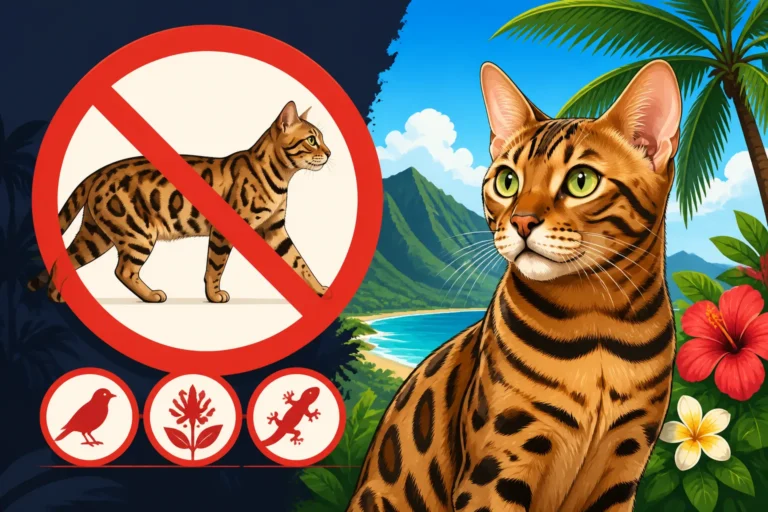
Some states have taken a clear stance: no Bengal cats, regardless of generation. These bans often stem from broad definitions of "wild animals" or "hybrid animals" that encompass any cat with recent wild ancestry. States like Hawaii are well-known for their strict prohibitions on all hybrid animals, including all Bengal cats, Why Hawaii Bans Every Bengal Cat. The concern here often includes potential ecological impact if an exotic animal were to establish a wild population.
If you live in a state with an outright ban, your options are limited to either moving to a more permissive area or choosing a different breed. Attempting to circumvent these laws can lead to severe penalties, including fines and the confiscation of your beloved pet. It's a heartbreaking situation, but vital to respect.
States with Early Generation Restrictions
This is the most common approach. Many states will draw a line, typically at F4 (SBT) or F5. This means that F1, F2, and F3 Bengals are either banned, heavily regulated, or require special permits, while SBTs are generally permitted as domestic cats. Which States Restrict Early Generation Bengal Cats outlines some of these areas.
For example, a state might classify F1-F3 as "dangerous wild animals" requiring a permit, which could come with stringent requirements like specialized caging, significant insurance policies, and regular inspections. The rationale here is to allow the unique beauty of the breed while mitigating perceived risks associated with higher percentages of wild blood. If you're considering an early generation Bengal, you'll need to prepare for a potentially complex and costly compliance process. This is where researching What a Bengal Cat Costs to Buy in 2026 really starts to include the legal overhead.
States Where SBT Bengal Cats Are Generally Permitted
In a significant number of states, once a Bengal cat reaches the SBT (F4) generation, it is treated legally like any other domestic cat. This means no special permits, no specific enclosure requirements beyond what applies to all cats, and generally, an easier path to ownership. For many aspiring Bengal owners, this makes SBT Bengals the most accessible option. For example, Whether an SBT Bengal Cat Is Legal Everywhere is a common question, and the answer is usually "yes" with the caveat of checking local ordinances.
This doesn't mean you're entirely off the hook, though. You'll still need to ensure your Bengal cat's pedigree clearly indicates its SBT status, usually through TICA or other registry papers, as this is how to prove your Bengal cat's generation. Also, remember that city or county laws can always add an extra layer of regulation, even if the state is permissive. Always check those local codes!
Proving Your Bengal Cat's Legality
It's one thing to know the laws; it's another to prove your cat meets them. This is especially important for Bengal cats due to their unique generation-based legal status. Without proper documentation, you could face legal challenges even if your cat is technically compliant.
The Importance of Pedigree and Registration
Your Bengal cat's pedigree papers are its birth certificate and family tree rolled into one. These documents, usually issued by recognized registries like TICA (The International Cat Association), clearly state the cat's generation (F1, F2, F3, SBT). For legal purposes, this is often the primary proof of your cat's generation.
When you purchase a Bengal cat, particularly an SBT, ensure your breeder provides these registration papers. A reputable breeder will always provide you with a full pedigree. These documents are your legal defense should anyone question your cat's legality. Without them, it can be incredibly difficult to argue that your F4 Bengal isn't an F2 when challenged by authorities. Ask your breeder Which Questions to Ask a Bengal Cat Breeder to ensure you get all necessary documentation.
What to Do if You Inherit or Rescue a Bengal
Sometimes, a Bengal cat comes into your life unexpectedly, perhaps through a rescue situation or inheritance. If you find yourself in this position without clear pedigree papers, proving its generation can be a challenge. In such cases, a DNA test might be an option to determine the percentage of wild cat ancestry, which can indirectly help in estimating its generation, though not all jurisdictions accept this as primary proof.
If you adopt a Bengal from a rescue organization, they should ideally provide any available documentation. However, many rescue Bengals lack full pedigrees. In these scenarios, it's prudent to assume the strictest local laws apply or consult with an animal law attorney to understand your risks and options. Organizations like Bengal Cat Rescues often do their best to verify lineage but aren't always successful.
Moving States with a Bengal Cat
Moving can be a nightmare for Bengal owners, as laws shift across state lines. What was legal in your old home might be illegal in your new one. Before you even pack a box, research the laws of your destination state, county, and city. It's crucial to understand Whether a Bengal Cat Can Cross a State Line legally.
If your Bengal cat is an early generation (F1-F3) and your new location bans them, you have a difficult choice: find a new home for your cat or choose a different place to live. If permits are required, start the application process well in advance of your move, as these can take time. Don't risk moving first and asking questions later; the consequences can be dire. Many pet owners consider pet insurance from providers like Healthy Paws for peace of mind, especially when navigating complex situations like interstate moves where unexpected vet visits or legal fees might arise. For all your pet supply needs, from specialty diets to enrichment toys, Chewy offers a wide selection that can make transitioning your Bengal to a new home a bit smoother.
Disclaimer
This article is for general informational purposes only and does not constitute professional advice. Laws, prices and regulations vary by location and change over time. Consult a qualified professional for guidance on your specific situation.