How Much a Male Bengal Cat Weighs
A male Bengal can look surprisingly heavy because he is long, athletic, and muscular, but a number on the scale cannot tell you by itself whether he is healthy. This guide explains the typical adult weight range, why males vary, how to judge body condition, and how to track your cat’s growth without mistaking a solid frame for excess fat.
Typical weight of a male Bengal cat
Many adult male Bengal cats weigh roughly 10 to 15 pounds, or about 4.5 to 6.8 kilograms. Some healthy males fall outside that range. A larger-framed cat may weigh more, while a smaller or more lightly built male may weigh less.
The range is a general reference, not a pass-or-fail standard. Your cat’s ideal weight depends on his frame, age, muscle, and body condition. For context on the breed overall, see What a Bengal Cat Weighs and What a Healthy Bengal Cat Weighs.
Why male Bengals may weigh more than females
Male Bengals are often larger and more muscular than females, though there is plenty of overlap. A male with broad shoulders and a substantial frame can weigh more than a female without being overweight. Even two brothers from the same litter can grow into noticeably different sizes.
The breed’s athletic appearance can make weight comparisons confusing. Bengals are typically lean, powerful cats, and their long bodies and strong hindquarters may make them look bigger than a similarly heavy, more compact cat. A weight that is suitable for one male may be too much for another with a smaller frame.
That is why it helps to compare your Bengal with his own healthy baseline, rather than with another cat, a photo online, or a single number. Why a Male Bengal Cat Carries More Muscle explains one reason males can feel especially solid when you lift them.
Weight by age and growth stage
A kitten’s weight changes quickly, so an adult range is not useful for judging a young Bengal. Kittens grow at different rates, and their development can be affected by genetics, nutrition, health, and whether they were the largest or smallest kitten in the litter. If your kitten’s weight stalls, drops, or rises sharply, discuss the trend with a veterinarian rather than trying to correct it with extra food or restriction.
Bengals may continue filling out after they have reached much of their adult height and length. Some take around 18 months to two years to mature fully, and a young male can gain muscle as he grows. The timing varies, so a cat who looks lanky at one stage may gradually become more substantial. For more on development, see When a Bengal Cat Reaches Full Size.
| Life stage | What to keep in mind |
|---|---|
| Kitten | Growth is rapid and varies between individuals; track the trend with veterinary guidance. |
| Adolescent | A young Bengal may look lean or long-legged while still developing. |
| Adult | Judge weight alongside body condition, frame, and muscle rather than using a range alone. |
| Older cat | Watch for unexpected weight loss or gain, which can warrant a veterinary check. |
A male Bengal’s recorded weight is most useful when it is paired with his age and body condition. A kitten’s healthy growth pattern is different from an adult’s maintenance weight, and an older cat’s weight changes should be taken seriously even if the number still looks ordinary.
How to tell whether your Bengal is a healthy weight
A scale is a useful tool, but it cannot show where a cat is carrying fat or whether he has lost muscle. Vets commonly assess body condition by looking at the cat’s outline and gently feeling his ribs and waist. At home, you can use the same basic observations between appointments, but they do not replace a hands-on veterinary assessment.
Check his body shape and feel for his ribs
Looking down at your Bengal from above, you should usually be able to see a slight waist behind the ribs. From the side, the abdomen may tuck upward gently toward the hind legs. These outlines can be subtle in a large, muscular cat, so use them as clues rather than rigid rules.
With your cat standing calmly, run your hands along his sides. You should be able to feel his ribs under a light layer of tissue, without pressing hard. If the ribs are difficult to feel, or if there is a thick layer of padding around the waist and belly, he may be carrying excess fat. If ribs, spine, or hip bones are prominent, or he seems to be losing muscle, that also deserves attention.
Coat, posture, and personality can disguise gradual changes. A Bengal who is constantly moving may still gain weight if he eats more calories than he uses. Conversely, a naturally angular young cat may look slender even while gaining appropriately. The practical question is not whether he looks like a particular photo, but whether his shape and weight are stable and appropriate for him.
For a more detailed comparison, see How to Tell Muscle From Fat on a Bengal Cat. If you are unsure, ask your vet to assess his body condition and show you what a healthy feel is for his particular build.
Why a single number can mislead
A scale reading does not distinguish muscle from fat. A broad, active male may weigh more than a smaller cat while having a trim waist and ribs that are easy to feel. On the other hand, a cat whose weight falls within the typical range can still be overweight if he has a small frame or has lost muscle while gaining fat.
Compare measurements taken under similar conditions. Weighing at roughly the same time of day, using the same scale, and recording the result makes trends easier to interpret. A single reading can be affected by a recent meal, a full bladder, or differences between scales; a consistent rise or fall over several readings is more informative.
If you buy your cat’s food through Chewy or another retailer, keep the exact food name and feeding directions with your weight notes. Recipes can differ in calorie density, so “one cup” or “one pouch” does not mean the same thing for every food. The package guide is a starting point, not a personalized prescription.
How to weigh a male Bengal at home
Regular weigh-ins can help you catch gradual changes that are easy to miss when you see your cat every day. They are especially useful for growing kittens, cats on a weight-management plan, and older cats whose appetite or body condition has changed. The goal is a calm, repeatable measurement—not a wrestling match.
Use a consistent method
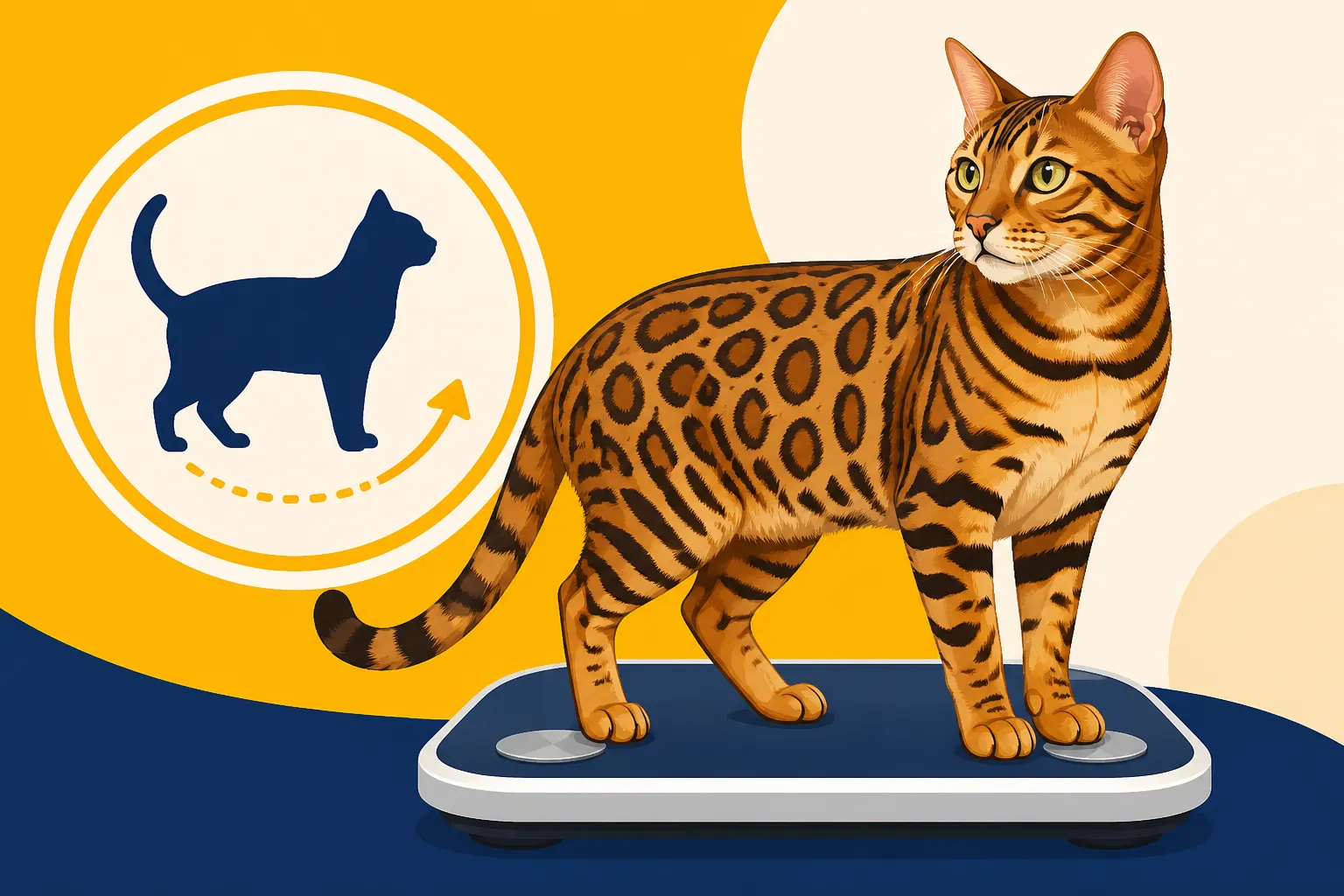
If your Bengal will stand still on a household scale, weigh yourself first and then weigh yourself while holding him. Subtract your weight from the combined reading. This method may be less precise than a pet scale, but it can be helpful for tracking broad trends when you use the same scale each time.
For a small kitten, a stable kitchen or baby scale may be easier to use, as long as the surface is secure and your kitten cannot jump or slip. Place a towel or shallow container on the scale and account for its weight if needed. Never leave a kitten unattended on an elevated or unstable surface.
Try to weigh your cat at a similar time and under similar conditions each time. If he is anxious, do not force him onto the scale. You can make the scale part of a positive routine by placing it on the floor, letting him investigate, and rewarding calm behavior. Keep a simple record with the date, weight, age, food, and any relevant health changes. If Chewy is where you usually reorder his food, noting the exact recipe beside the weight can make it easier to spot whether a diet change coincided with a trend.
Know when a weight change needs a vet
A slow, expected increase during kittenhood is different from unexplained weight gain in an adult. Similarly, a gradual change associated with a vet-approved feeding plan is different from an unplanned drop in weight. If your cat’s weight changes noticeably, persists in moving in one direction, or comes with reduced appetite, vomiting, diarrhea, increased thirst, or low energy, contact your veterinarian.
Avoid putting a cat on a sudden diet. Sharp food restriction can be dangerous for cats, and weight loss should be planned with veterinary guidance. If your male Bengal needs to lose weight, your vet can help set a suitable goal and decide how to adjust food while keeping an eye on muscle and overall health. See How Easily a Bengal Cat Becomes Overweight and How to Slim an Overweight Bengal Cat for more on the issues behind weight gain and safe weight management.
A food label can help you understand the calories in a meal, but it cannot diagnose why a cat is gaining or losing weight. If you shop at Chewy, as with any retailer, use the package information to identify the product and serving details you are feeding, then take those details to your vet if you need a tailored plan.
What affects a male Bengal’s weight
Even cats of the same sex and age can have different healthy weights. Genetics and frame are part of the picture, but activity, food portions, health, and life stage matter too. Understanding those factors makes it easier to respond thoughtfully instead of assuming that a heavier cat needs less food or that an active one cannot gain weight.
Frame, genetics, and muscle
A Bengal’s build is inherited in part from his parents. Some males are longer or broader, and some develop more visible muscle. That variation is normal; the breed does not come with one exact weight that every cat should match.
Muscle can make a cat feel dense when picked up. It may also make the scale number seem high compared with a smaller, less muscular cat. Look at the whole body: waist, ribs, abdomen, and movement. A cat who is fit should move comfortably and maintain a proportionate shape, not simply meet a certain weight target.
For breed development and size context, How Big a Bengal Cat Gets may also help. If you are choosing a kitten, remember that adult size cannot be predicted perfectly from one early weigh-in or appearance. Your breeder may be able to share the parents’ size and growth information, but your cat’s eventual condition still depends on his individual development and care.
Food, activity, and age
A Bengal’s energetic reputation does not guarantee that he will burn off every extra calorie. Indoor routines, reduced activity after neutering, access to unattended food, and generous treats can all contribute to weight gain. Conversely, a very active cat may need more energy than a quieter cat of the same size, though portions should still be adjusted to his condition rather than activity stereotypes.
Measure meals instead of estimating them by eye. If multiple people feed your cat, agree on portions and keep a simple record so meals are not accidentally doubled. Food packaging directions provide a broad starting point, but your veterinarian can help tailor the amount to your cat’s age, body condition, health, and daily routine.
Older Bengals may become less active or lose muscle, and a change in weight can be easier to overlook when it happens slowly. If your cat’s waist thickens, his ribs become harder to feel, or he loses weight without an obvious reason, arrange a checkup. Weight is one useful clue about health, not a diagnosis by itself.
When to seek an individual target
Ask your veterinarian for an ideal weight range or body-condition goal rather than relying on a generic chart. Bring your cat’s recent weights, food details, and notes about appetite and activity. If you buy food through Chewy, the product label or order details can help identify the exact formula you are feeding; the important part is sharing accurate information, not following a retailer’s general guidance as if it were a medical plan.
The vet can assess whether your Bengal is carrying excess fat, building muscle, or losing condition, and can recommend how often to recheck him. That advice is especially helpful if he has a chronic health issue, is still growing, or needs a structured weight-loss plan. A target that fits his frame and health is far more useful than trying to make him match the average male Bengal.
Disclaimer
This article is for general informational purposes only and does not constitute professional advice. Laws, prices and regulations vary by location and change over time. Consult a qualified professional for guidance on your specific situation.