How the Toyger Came From the Bengal Cat
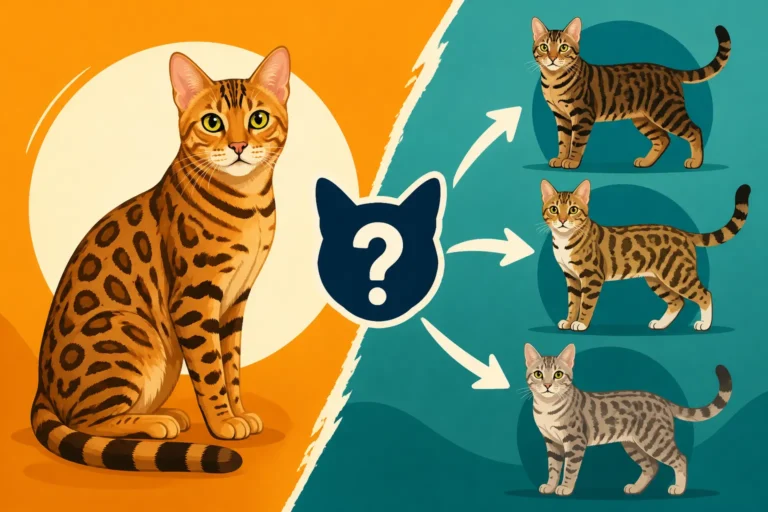
A striped cat with a tiger-like coat may look as though it has a wild ancestor, but the Toyger was created through selective breeding of domestic cats. Its story connects closely to the Bengal: a Bengal was among the cats used in the early Toyger program, but the Toyger was developed as a separate breed with a different coat pattern and goal.
How the Toyger breed began
Judy Sugden set out to create a tiger-like domestic cat
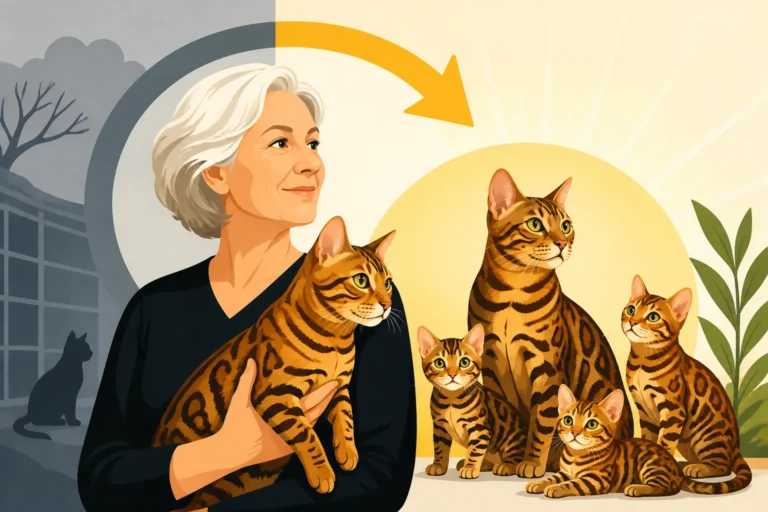
The Toyger’s development is associated with American breeder Judy Sugden, who began working toward a domestic cat with the look of a miniature tiger. The aim was not simply to produce another spotted cat. She wanted a longer, more flowing pattern of dark, vertical stripes, along with physical features that would suggest a tiger without compromising a domestic cat’s character.
Sugden’s project drew on cats with different backgrounds and coat patterns. One important early cat was Millwood Rumpled Spotskin, a Bengal. Another was Scrapmetal, a domestic shorthair. A cat called Jammu Blu, brought from India, is also often mentioned in accounts of the early breeding work because of markings on its face that caught Sugden’s attention.
Those cats were not a ready-made Toyger line. They were starting points in a selective breeding program, and their traits had to be combined and developed over generations. Bengal ancestry mattered to the Toyger’s early history, but it is only one part of that history.
The Bengal was a contributor, not the whole recipe
The Bengal was already known for its striking coat, muscular build, and high-contrast markings. To understand why a Bengal could be useful in a project focused on a dramatic patterned cat, it helps to know What a Bengal Cat Looks Like by the Standard and how its rosettes and marbling differ from the Toyger’s desired stripes.
The Bengal’s own history is distinctive. The breed developed through crosses involving domestic cats and the Asian leopard cat, followed by generations of selective breeding. That background is covered in Where the Bengal Cat Comes From and What a Bengal Cat's Wild Ancestor Is Like. But the early Toyger program’s use of a Bengal does not make the Toyger a tiger hybrid, nor does it mean today’s Toygers are simply Bengals with different markings.
Sugden’s vision was a domestic cat whose appearance echoed a tiger more closely than the typical spotted or rosetted coat. The Bengal helped supply useful qualities and patterning in the early work, while additional domestic cats and careful selection helped shape the developing Toyger. That distinction is easy to miss when a Toyger’s bold coat is the first thing you notice.
Toyger and Bengal are separate breeds
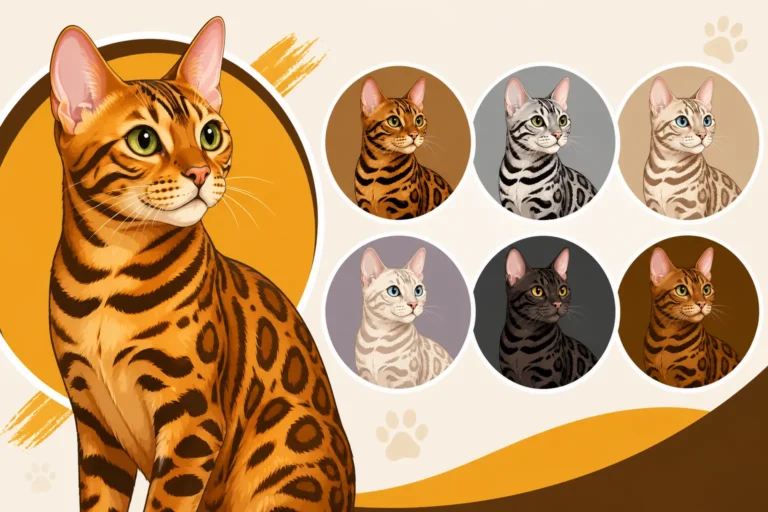
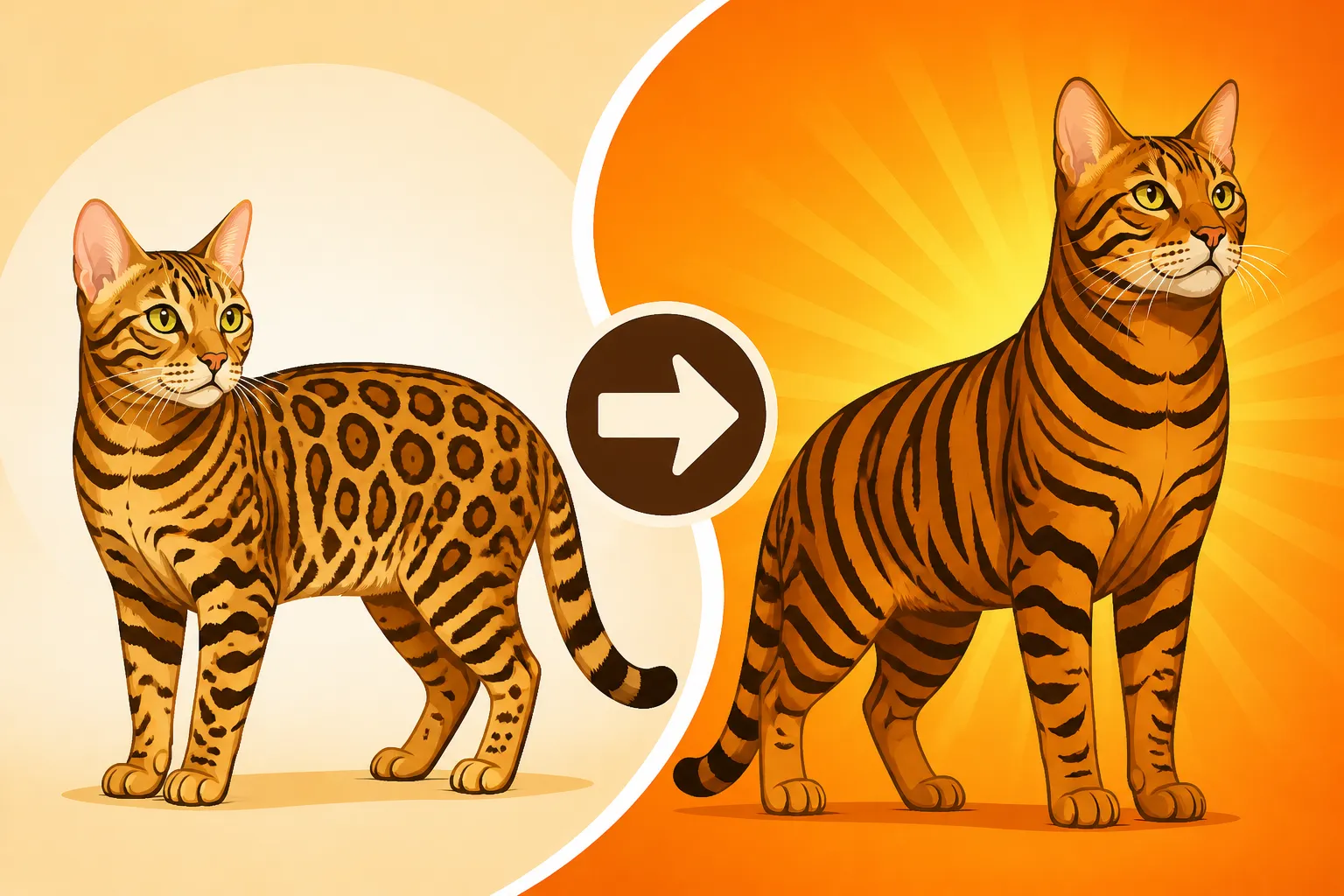
A Toyger and a Bengal can both have athletic bodies and dramatic coats, but they were developed toward different visual goals. Bengals are associated with spots, rosettes, and marbled patterns. Toygers are bred for a striped look, including dark, vertical markings that flow across the body.
| Feature | Bengal | Toyger |
|---|---|---|
| Main coat goal | Spotted, rosetted, or marbled pattern | Bold, tiger-like vertical stripes |
| Early breeding connection | One Bengal contributed to early Toyger development | Developed as a distinct domestic breed |
| Wild-cat implication | The Bengal breed has historical ancestry involving the Asian leopard cat | Not a tiger hybrid and not a domestic tiger |
| Breed identity | Its own established breed with its own standard | A separate breed with a standard focused on the tiger-like appearance |
The Bengal’s patterns are described in more detail in Rosetted Against Marbled: The Two Bengal Cat Patterns. A Toyger’s stripes may remind someone of a Bengal’s markings at a glance, but resemblance is not the same as breed identity. Each breed has its own development, pedigree, and judging standard.
How the Bengal’s influence fits into Toyger development
Early breeding used traits, not a finished breed
When breeders create a new domestic breed, they are working with variation among individual cats. A particular cat may contribute a desirable coat feature, body shape, or other quality, but that does not mean every kitten will inherit the feature in the same way. Breeders select cats over successive generations and assess whether the traits they want are becoming more consistent.
That is the useful way to think about Millwood Rumpled Spotskin’s place in Toyger history. The Bengal was part of the foundation, but the Toyger’s recognizable striped appearance did not simply arrive fully formed from one Bengal parent. It emerged through continued selective breeding.
This is also why the Toyger should not be described as a Bengal cross in the everyday sense of a current-generation pet. A breed’s early foundation is not the same as the ancestry of every cat born into that breed today. The Bengal’s own generation terminology can be confusing, so F1 to SBT: How a Bengal Cat's Generation Is Counted explains how Bengal generations are described without implying that every Bengal is equally close to its wild ancestor.
The Toyger’s target pattern is different
The Toyger’s defining visual aim is a striped coat that evokes a tiger. Breeders have selected for markings that are broad, distinct, and arranged in a pattern that reads as vertical or branched stripes across the body. The desired overall effect is not the same as a Bengal’s familiar rosettes or flowing marble pattern.
Coat appearance also depends on more than whether a cat has spots or stripes. Contrast, pattern placement, body shape, and the way markings appear from different angles all contribute to the impression. A Toyger may have a dramatic pattern, but it is still a domestic cat with individual variation; no coat makes one cat a perfect miniature version of a tiger.
A Bengal’s wild-looking coat can lead people to assume that the Bengal and Toyger share the same purpose or close modern ancestry. Their histories overlap, but their breed goals differ. To understand the Bengal side of that overlap, What Jean Mill Was to the Bengal Cat provides useful context about the breed’s development.
A Bengal’s history does not make the Toyger wild
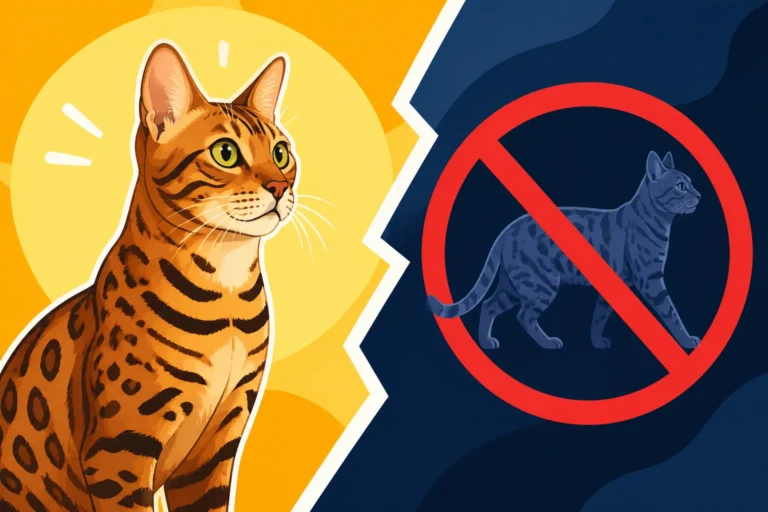
The Bengal’s ancestry is often part of conversations about the Toyger, and that can create confusion. Some people hear that a Bengal was used in early Toyger development and conclude that Toygers must be part wild. That is not what the connection means. The Toyger was developed from domestic cats through selective breeding; it is not a cross with a tiger.
Similarly, the Bengal’s historical relationship to the Asian leopard cat does not make every modern Bengal a wild animal. Bengal generations and pedigrees matter when discussing that breed’s background. The distinction between early-generation cats and later domestic Bengals is explored in What F1 Means in a Bengal Cat and What SBT Means in a Bengal Cat.
For a prospective owner, the practical point is simple: evaluate a Toyger as a domestic breed, not as a small tiger or a wild-cat hybrid. Its coat is the result of breeding choices, not evidence that it needs wild-animal handling or a special “tiger” diet.
How to tell a Toyger’s story apart from a Bengal’s
Look at the breed goal, not just the dramatic coat
A glossy, high-contrast coat can make the two breeds seem more alike than they are. If you are trying to identify a cat, start by looking at the overall pattern. A Bengal commonly has spots, rosettes, or marbling. A Toyger’s pattern is intended to resemble tiger stripes, with dark markings that run across the body in a more vertical, flowing arrangement.
Appearance alone cannot reliably establish a cat’s breed. Domestic shorthairs and mixed-breed cats can also have striking stripes or spots, and a photograph may hide details that matter in person. Pedigree information from a responsible breeder is more useful than a visual guess. A breed’s name should be supported by records, not just by a seller’s description or a dramatic coat.
If the main question is whether a spotted rescue cat might be a Bengal, Whether a Spotted Domestic Shorthair Is a Bengal Cat explains why markings by themselves are not proof of breed. The same caution applies to any cat marketed as a Toyger: appearance can suggest a pattern, but it cannot confirm pedigree.
Ask about ancestry and documentation
When speaking with a breeder, ask what registry the cats are recorded with, what documentation is available, and how the breeder describes the line’s development. A thoughtful breeder should be able to explain the breed’s history without claiming that a Toyger is part tiger or that every Toyger is directly descended from a Bengal in a recent generation.
It is also reasonable to ask what the breeder prioritizes beyond appearance. Health, temperament, socialization, and the cats’ living conditions matter as much as stripes. If a conversation focuses entirely on the “wild” look, or uses tiger ancestry as a selling point, pause and ask for clear, verifiable details about the cat’s pedigree.
For anyone comparing the two breeds as companions, temperament and daily needs should be part of the decision. What a Bengal Cat's Temperament Is Really Like offers a starting point for understanding the Bengal, but do not assume that every individual Toyger or Bengal behaves identically. Meet the cat, ask about its habits, and consider whether its activity level fits your home.
What the Toyger’s Bengal connection means for owners
A dramatic coat does not tell you how to care for the cat
The Toyger’s tiger-like appearance is the result of selective breeding, not a sign that it needs care modeled on a wild feline. Like other domestic cats, a Toyger needs routine veterinary care, a safe indoor environment, daily interaction, suitable scratching surfaces, and play that lets it stalk, chase, and pounce.
If you are preparing for a cat, build a practical supply list around the individual animal rather than its appearance. A stable carrier, litter setup, scratching options, and engaging toys are more useful than products marketed around a “wild” identity. Chewy is one retailer where prospective owners can compare basic cat supplies, but the right choices depend on the cat’s size, habits, and preferences.
Play is especially important for active cats. A wand toy or puzzle feeder can create opportunities for movement and problem-solving, but toys should be rotated and used safely. Chewy’s toy selection may help owners explore different formats, though a cat’s response will matter more than a product’s breed-themed packaging.
Choose a companion, not a coat pattern
People are understandably drawn to the Toyger’s unusual stripes, just as many are drawn to the Bengal’s rosettes. But a coat pattern is only one part of living with a cat. Ask how the cat responds to people, whether it enjoys interactive play, what routines it already knows, and how it handles ordinary household activity.
A responsible breeder or rescue contact should welcome questions about the cat’s individual personality. If a cat is shy, energetic, or easily overstimulated, that information helps you plan a smoother transition. Set up a quiet starter room, give the cat time to explore, and introduce new people or pets gradually rather than expecting an immediate adjustment.
You may also need to try more than one type of enrichment before finding what your cat enjoys. One Toyger may prefer chasing a feather toy, while another may spend longer investigating food puzzles or climbing. Chewy can be a convenient place to compare general enrichment supplies, but regular play and attention are what turn those supplies into a useful routine.
Keep the history in perspective
The Toyger’s connection to the Bengal is a real part of the breed’s early development, but it is only one chapter. The Bengal contributed to a program that aimed to create a striped, tiger-inspired domestic cat. Through selective breeding, the Toyger became a distinct breed with its own appearance and identity.
That history is most helpful when it clears up misconceptions. A Toyger is not a tiger cross. It is not simply a Bengal with stripes. And its dramatic coat does not, by itself, tell you how the cat will behave or what care it needs. Understanding the Bengal’s role helps explain where the Toyger began while leaving room for the differences that define the two breeds today.
Disclaimer
This article is for general informational purposes only and does not constitute professional advice. Laws, prices and regulations vary by location and change over time. Consult a qualified professional for guidance on your specific situation.