Which Breeds Were Made From the Bengal Cat
A spotted cat can look like a miniature leopard, but that does not mean it belongs to the Bengal breed—or that every newer spotted breed has the same ancestry. Several breeds were developed using Bengals, while others only share a wild-looking pattern. This guide explains which breeds have Bengal roots, what those crosses were intended to produce, and how to tell direct ancestry from a similar appearance.
Breeds developed using Bengal cats
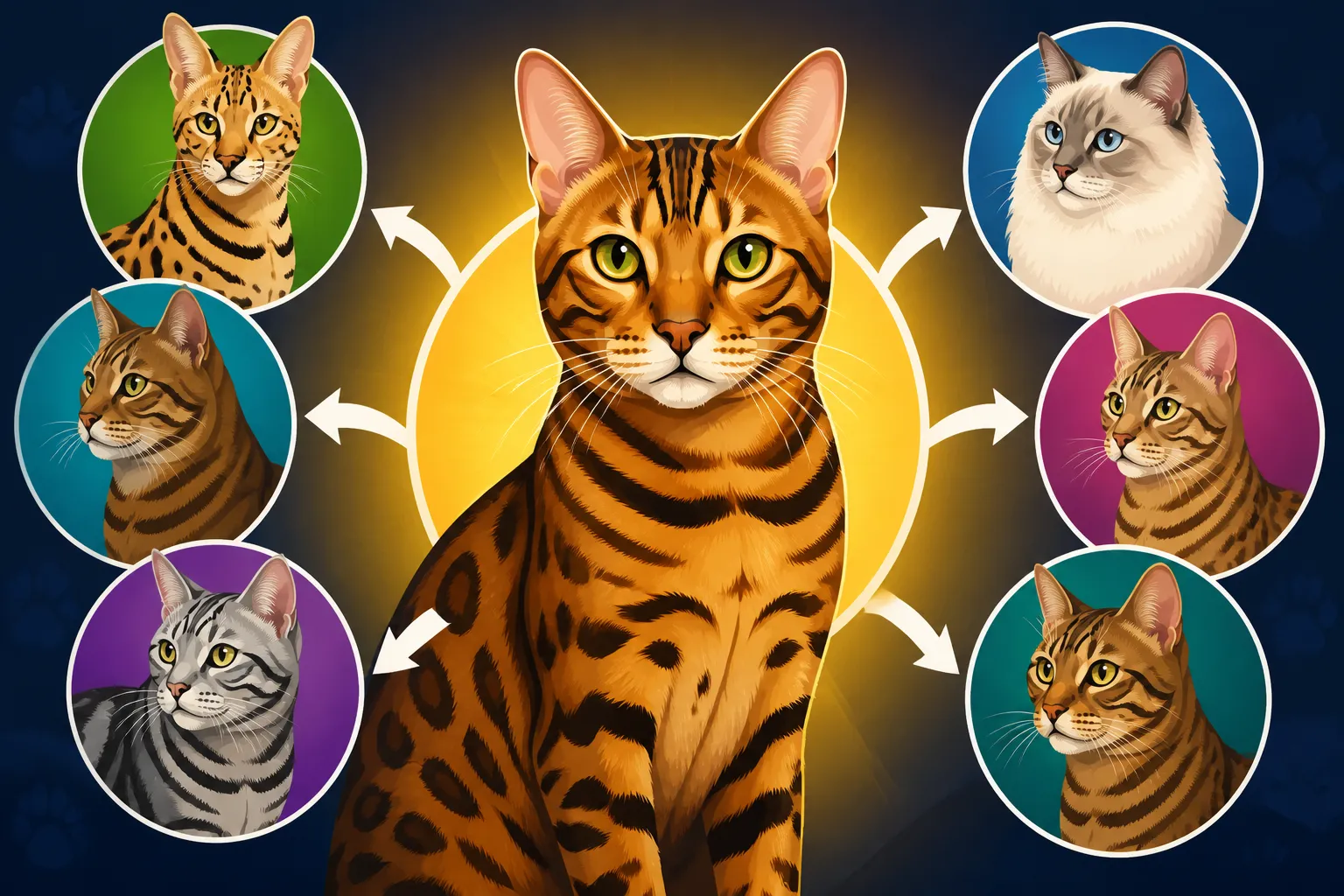
Bengals have contributed to several newer breed-development programs. The best-known examples include the Toyger, Cheetoh, Serengeti, and Genetta. They are not all recognized in the same way, and they were created for different reasons, so “made from the Bengal” does not mean one simple, standardized recipe.
| Breed | Bengal used in development | Other breed or type involved | Main goal |
|---|---|---|---|
| Toyger | Yes | Domestic shorthair tabbies and other domestic cats | A domestic cat with a tiger-like striped pattern |
| Cheetoh | Yes | Ocicat | A large, spotted cat with a wild appearance and domestic ancestry |
| Serengeti | Yes | Oriental Shorthair | A tall, spotted domestic cat resembling a serval |
| Genetta | Yes | Munchkin and other domestic breeds have been used | A short-legged cat with an exotic-looking pattern |
These descriptions cover the general development stories, not a promise that every individual cat in a breed has the exact same pedigree. Breeding programs change over time, and registry rules can differ.
The Toyger was developed for a tiger-like pattern
The Toyger was created to evoke the look of a tiger in a domestic cat. Its name combines “toy” and “tiger,” and the goal was a cat with bold, vertical markings and a recognizable striped appearance—not a smaller tiger or a wild hybrid. Bengals were among the cats used in the development of the Toyger, alongside domestic cats with suitable tabby patterns.
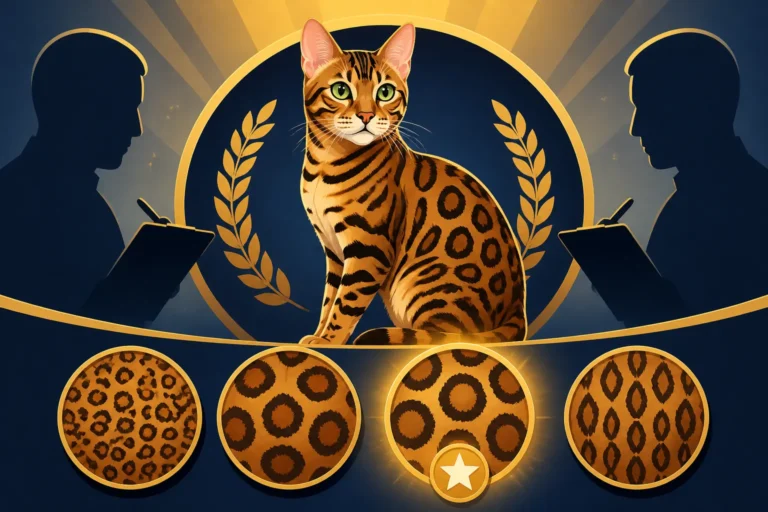
The Toyger’s pattern is different from the Bengal’s familiar rosettes and spots. A Bengal may have distinct, rounded markings or flowing marbling, while Toygers are bred for a more vertically striped look. Their bodies and coats are also selected to support that overall tiger-like impression. If you want to understand the Bengal’s own pattern vocabulary, What a Bengal Cat Standard Asks For is a useful comparison—though the exact title is What the Bengal Cat Standard Asks For.
A Toyger is still a domestic cat. Its tiger-like appearance does not mean it has tiger ancestry, and the Bengal contribution does not make the Toyger a wild-cat hybrid. For more detail on that development history, see How the Toyger Came From the Bengal Cat.
The Cheetoh combines Bengal and Ocicat ancestry
The Cheetoh was developed using Bengal cats and Ocicats. Breeders aimed for a substantial, spotted cat with an exotic appearance, while keeping the breed’s ancestry domestic. Despite the name, a Cheetoh is not a cheetah hybrid. The name refers to the spotted-cat look, not to a cross with a large wild feline.
Bengals contributed distinctive markings and a sleek, athletic impression; Ocicats brought their own spotted pattern and domestic breed background. That mix helps explain why a Cheetoh may look Bengal-like at a glance without being a Bengal. It also means that a photograph alone cannot reliably identify the breed: coat patterns overlap among many cats, including domestic shorthairs.
Breed recognition and registration can vary among organizations, and the Cheetoh is not treated identically to long-established breeds everywhere. If you are considering one, ask what registry the breeder uses, request pedigree information, and discuss health screening and temperament rather than relying on a breed label alone. How the Cheetoh Came From the Bengal Cat explores the specific cross behind the breed.
Other breeds with Bengal ancestry
Bengal ancestry also appears in some breed-development projects intended to create a wild look without bringing a wild cat into the breeding program. The Serengeti is a notable example. The Genetta is another, though its development raises separate questions about the physical traits breeders are selecting for.
It helps to distinguish between a breed that was developed using Bengals and a cat that simply resembles one. A spotted coat, athletic build, or dramatic face is not proof of Bengal ancestry. Reliable identification depends on documented lineage, not appearance alone.
The Serengeti was bred to resemble a serval
The Serengeti was developed using Bengal cats and Oriental Shorthairs. The aim was to create a tall, long-legged domestic cat with a spotted appearance reminiscent of a serval. Unlike the Savannah, the Serengeti was not created by crossing a domestic cat with a serval. Its wild look comes from selective breeding among domestic cats.
The distinction matters because “looks like a wild cat” and “has wild-cat ancestry” are not the same thing. A Serengeti’s appearance may bring to mind a serval, but its breed history is domestic. The Bengal was one part of the development process, while the Oriental Shorthair contributed other desired features, including a more elongated outline.
Names and breed standards can be confusing when several breeds are selected for an exotic appearance. If a cat is advertised as a Serengeti, ask for its pedigree and the breeder’s registration details rather than assuming the label establishes its ancestry. For a helpful contrast, How a Bengal Cat Differs From a Savannah explains why the two breeds’ histories should not be mixed up.
The Genetta uses Bengal ancestry but has a controversial trait
The Genetta is a newer breed-development project associated with Bengal ancestry and a short-legged appearance. Munchkin cats have been used in its development, along with other domestic breeds. The intended combination is an exotic-looking coat paired with shortened legs.
That short-legged trait is also why the Genetta deserves careful consideration. A distinctive look does not automatically mean a breeding practice is harmless or that a particular cat will have health problems; individual health depends on many factors. But when a breed is deliberately selected for a body structure that changes normal movement, prospective owners should ask direct questions about mobility, veterinary care, and the breeder’s approach to welfare.
Do not assume that two cats with a similar silhouette have the same ancestry or health profile. Ask for written health information, meet the cat if possible, and make sure the breeder can explain the reasoning behind the cross. For wider context on the issues involved in producing hybrid-looking breeds, read Whether Breeding Hybrids Like the Bengal Cat Is Ethical.
Bengal ancestry is not the same as a Bengal appearance
The word “Bengal” is often used loosely in listings and conversations. A cat may be a registered Bengal, a cross with Bengal ancestry, a member of a breed developed using Bengals, or simply a spotted domestic cat. Those categories are not interchangeable, even if the cats look remarkably alike.
A spotted coat does not prove Bengal ancestry
Many domestic cats have spots, stripes, or marbled markings. A spotted domestic shorthair can look strikingly similar to a Bengal, especially in a quick photo or under bright lighting. Coat appearance alone cannot establish a cat’s breed, its parentage, or whether it has Bengal ancestry.
This is especially important when adopting. A shelter may describe a cat as “Bengal-like” to help explain its appearance, but that is not necessarily a confirmed pedigree claim. If you are trying to identify an individual cat, focus on the information that can be documented: known parentage, breeder records, and registration papers. Whether a Spotted Domestic Shorthair Is a Bengal Cat and Whether a Shelter Cat Can Be a Bengal Cat cover the difference between resemblance and verified ancestry.
A DNA test may offer some breed-related clues, but it is not a substitute for a documented pedigree when you need formal proof of a cat’s breed or generation. For a Bengal itself, the generation terminology has a specific meaning; How a Bengal Cat's Generation Is Counted explains why an F-number should not be casually applied to every spotted cat.
A Bengal cross is not automatically a separate breed
A single Bengal parent does not automatically make a kitten a Toyger, Cheetoh, Serengeti, or Genetta. Those names refer to breed-development programs with their own goals and, where applicable, registration requirements. A crossbred kitten may have Bengal ancestry without meeting the criteria for any of those breeds.
The reverse is true, too: a cat can belong to a breed developed using Bengals without being a Bengal itself. A Toyger, for example, was developed with Bengal contributions, but its defining purpose and selected pattern differ from those of the Bengal. The same principle applies to the Serengeti and Cheetoh: ancestry is part of their history, not a shortcut that makes them Bengal cats.
If you are comparing pedigrees, ask whether the cat is registered as a specific breed, what the parent breeds are, and whether the breeder can provide the supporting records. What People Get Wrong About the Bengal Cat is a useful reminder that a wild-looking coat can lead people to make confident assumptions that the paperwork does not support.
Choosing a Bengal-derived or Bengal-influenced cat
Breed history is interesting, but day-to-day fit matters more when you are choosing a companion. Cats associated with Bengal-derived breeds can vary in energy, sociability, confidence, and tolerance for household routines. Even within one breed, individual temperament depends on genetics, early socialization, health, and the home environment.
Ask about temperament and practical care
Ask the breeder or rescue how the cat behaves in ordinary situations: Does it settle after play? How does it respond to visitors? Is it comfortable with handling and routine grooming? Does it cope with other pets? These questions are more useful than relying on a promise that a cat will behave like a breed stereotype.
Think through the environment you can provide, too. An active cat may benefit from regular interactive play, safe climbing options, and puzzle feeders. If you are comparing enrichment supplies, Chewy’s listings can help you browse categories such as wand toys and puzzle feeders; the useful question is whether a particular item suits your cat’s play style and is sturdy enough for regular use. A product cannot replace daily interaction, but rotating toys and offering supervised play can make a home more engaging.
For a cat with Bengal ancestry, ask whether the breeder has prioritized stable temperament alongside appearance. A responsible breeder should be willing to talk about health screening, socialization, and what support is available if the cat’s needs prove different from what you expected. If a seller focuses only on dramatic markings or an “exotic” look, slow down and ask more questions.
Plan for the individual cat, not just the breed label
A safe, stimulating home does not need to be elaborate, but it should match the cat’s habits. A tall, secure scratching post, sturdy resting spots, and a predictable play routine can make a difference for an athletic cat. Chewy can be one place to compare cat trees, scratchers, and other enrichment options, but check dimensions, stability, and materials against the specific cat’s size and behavior rather than buying based on breed marketing.
If you are introducing a new cat to a household, give it a quiet settling-in area with food, water, a litter box, and a hiding place. Let the cat explore at its own pace, then expand access gradually. This can be especially helpful for a confident, curious cat that might otherwise charge through the home before it has learned where the essentials are.
Food and litter routines also benefit from consistency during a transition. If you need to replace a familiar item or compare supplies, Chewy’s product categories can help you review options, but make changes gradually when possible and follow veterinary guidance for dietary concerns. Whatever the breed name, pay attention to the individual cat’s appetite, comfort, and behavior rather than assuming ancestry alone predicts what it needs.
Disclaimer
This article is for general informational purposes only and does not constitute professional advice. Laws, prices and regulations vary by location and change over time. Consult a qualified professional for guidance on your specific situation.