How Many Scratching Posts a Bengal Cat Household Needs
It's a common and often frustrating sight for Bengal cat parents: you invest in a beautiful new sofa, only to find it quickly becoming a scratching post, or your favorite rug turning into a shredding target. This isn't your Bengal being naughty; it's a deeply ingrained instinct, but it can wreak havoc on your home. This guide will walk you through understanding why your wild-at-heart companion needs to scratch, how many and what types of scratching posts you really need to provide, and how to place them effectively to protect your belongings and keep your Bengal happy.
The Unstoppable Urge: Why Bengal Cats Scratch So Much
Anyone who lives with a Bengal cat knows they're not your average couch potato. These magnificent felines carry a vibrant spark of their wild Asian Leopard Cat ancestors, and that wild heritage manifests in many ways, including their powerful need to scratch. It's not just a casual habit; it's a fundamental part of their feline being, and understanding this is the first step to a harmonious home.
Instinctive Behavior: More Than Just Sharpening Claws
While it might look like your Bengal is just sharpening their nails, the act of scratching serves multiple vital purposes for them. Firstly, it's a fantastic full-body stretch, elongating their strong muscles and keeping them limber. Imagine trying to stretch after a nap without fully extending your limbs – that's what a Bengal feels if they can't properly scratch! It's an essential part of their physical well-being, helping to shed the outer layers of their claws and keep them healthy.
Beyond the physical, scratching is a powerful form of communication and territorial marking. When your Bengal digs their claws into a surface, tiny scent glands in their paws release pheromones, leaving their unique signature. Visually, the shredded material also serves as a clear "I was here!" sign. In the wild, this would deter rivals; in your home, it's their way of claiming their space. Trying to stop this innate behavior completely is futile and can lead to stress for your cat and more destructive outlets. You need to channel this urge, not suppress it.
Furthermore, scratching can be a significant stress reliever for an energetic and intelligent breed like the Bengal. If they're feeling anxious, bored, or overstimulated, a good scratching session can help them work out those pent-up feelings. Providing ample, appropriate outlets for this behavior is crucial for their mental health and prevents them from inventing their own, less desirable, scratching zones. You might be surprised to learn that a Bengal cat's need to scratch is deeply connected to their overall well-being. If you've ever wondered Why a Bengal Cat Scratches So Much, it truly goes beyond just nail care.
The Damage Potential: What Happens Without Enough Outlets
Without enough appropriate scratching surfaces, your beautiful Bengal will absolutely find alternatives. And given their strength and persistence, these "alternatives" are rarely what you want them to be. Sofas, armchairs, carpets, curtains, door frames, and even wooden furniture can become casualties of their natural instincts. This isn't out of malice; it's simply a cat following its genetic programming in an environment that hasn't provided the right tools.
The frustration for owners is real. You bring home this gorgeous, energetic cat, and suddenly your living room looks like it's been through a feline war zone. It's disheartening, and it can lead to tension between you and your pet. The key is to preempt this destruction by understanding their needs. A Bengal won't just lightly scratch; they will attack a surface with vigor, tearing fabric, pulling threads, and leaving deep gouges in wood. Their powerful hind legs and strong claws mean they can inflict considerable damage very quickly.
Ignoring this need or providing insufficient options will only exacerbate the problem. A single, flimsy scratching post tucked away in a corner won't cut it for a Bengal. They need multiple, sturdy, and appealing options placed strategically around their territory. If you've ever found yourself asking How to Protect Furniture From a Bengal Cat, the answer almost always starts with providing better scratching alternatives, not just deterrents. Investing in quality scratching solutions is far more cost-effective than repeatedly repairing or replacing furniture.
Quality Over Quantity: Choosing the Right Scratching Posts for a Bengal
When it comes to scratching posts for your Bengal, it's not just about having any post; it's about having the right posts. A flimsy, short carpeted pole might work for a sedentary house cat, but a Bengal demands robust, engaging equipment that can withstand their incredible energy and strength. You're looking for solutions that can handle a mini-leopard at play, not a kitten's toy.
Height and Stability: Meeting the Bengal's Athletic Needs
One of the biggest mistakes owners make is providing scratching posts that are too short or unstable. A Bengal needs to be able to stretch their entire body length while scratching, extending fully from their hind paws to their outstretched front claws. This means a post should be at least 30-36 inches tall, if not taller, to accommodate their athletic physique. Imagine if you could only stretch halfway – it just doesn't feel good!
Stability is equally crucial. A Bengal will throw their weight into scratching. If the post wobbles or, worse, topples over, they'll be startled and quickly learn to avoid it. Look for heavy bases or posts that can be secured to a wall. Materials matter too. Sisal rope or sisal fabric are generally preferred by most Bengals because they offer excellent resistance and allow for a satisfying shred. Carpeted posts are often less effective because the texture isn't as appealing for claw shedding and can even confuse the cat into thinking carpets everywhere are fair game. If you're wondering How Tall a Scratching Post a Bengal Cat Needs, always aim for something they can truly stretch out on.
Different Textures and Angles: Offering Variety
Just like humans have preferences for different textures, so do Bengals. Some cats prefer a vertical scratch, mimicking tree trunks, while others adore a horizontal surface, like a log or a rug. Many Bengals enjoy an angled scratcher, which offers a compromise between vertical and horizontal. To truly satisfy your Bengal's diverse preferences, you should provide a variety of options.
Consider a tall, sturdy sisal rope post for vertical stretches. Then, add a corrugated cardboard scratcher that lies flat on the floor or can be placed at an angle. Some Bengals love sisal fabric panels mounted on walls. The goal is to experiment and observe which textures and orientations your cat gravitates towards. Offering choice encourages them to use the designated areas rather than your furniture. When selecting, think about Whether a Bengal Cat Prefers Sisal or Cardboard and offer both if possible, as preferences can vary!
Location, Location, Location: Where to Place Scratching Posts
You can have the best scratching posts in the world, but if they're not placed correctly, your Bengal still won't use them. Placement is critical. Think about where your cat currently scratches (or tries to scratch) and where they naturally stretch and relax. These are prime locations for a scratching post.
High-traffic areas are a must. If your Bengal spends a lot of time in the living room, there should be a prominent scratching post there. Cats often like to scratch after waking up, so placing a post near their favorite sleeping spot or cat bed is also a smart move. Most importantly, if your Bengal has already started targeting a piece of furniture, place a suitable scratching post right next to it. This provides an immediate, appealing alternative. You can even cover the "forbidden" furniture temporarily with double-sided tape or a throw to make it less attractive, while the new, enticing post sits right there waiting. For more insight into what kind of options exist, consider Which Scratching Post a Bengal Cat Needs and plan your purchases strategically.
The Magic Number: How Many Scratching Posts Does a Bengal Cat Truly Need?
It's a question every cat owner grapples with, and for Bengal owners, the stakes (and the potential furniture damage) feel even higher. The common advice often falls short when dealing with a cat breed as active and instinct-driven as a Bengal. You can't just apply a generic formula; you need to think like a Bengal.
The "Rule of Thumb" and Why it Falls Short for Bengals
Many cat care guides suggest a general rule of "one scratching post per cat, plus one more." While this might be a decent starting point for some more laid-back feline companions, it's often woefully inadequate for a Bengal cat. Bengals are not just cats; they are a breed brimming with energy, highly territorial instincts, and a deep-seated need for enrichment. Their wild heritage means their physical and behavioral needs are amplified compared to a standard domestic shorthair.
A single extra post might satisfy a cat that only scratches a couple of times a day in one spot. But a Bengal often has multiple "scratching moods" throughout the day – a big stretch after a nap, a territorial mark when entering a room, an energy release during a play session, or even a stress-buster. Each of these different motivations might require a specific type or location of scratching surface. Relying on a minimalist approach will likely lead to your Bengal finding their own solutions, which typically means your sofa, carpet, or doorframes.
Assessing Your Bengal's Specific Needs
To figure out the right number for your Bengal, you need to become a detective of their habits. Observe: Where does your Bengal tend to stretch? Which pieces of furniture do they eye with scratching intent? Do they prefer vertical surfaces, or do they try to shred the floor? Does their scratching occur mostly in one room, or do they move around the house leaving their mark? The answers to these questions will guide your placement strategy.
For a Bengal, their high activity level means they'll likely use multiple posts throughout the day. If you have a particularly energetic individual, or one that's prone to boredom, the need for varied and numerous scratching opportunities increases. Consider if your Bengal has specific "zones" in the house where they spend significant time – perhaps a sunbeam spot, a favorite window perch, or a play area. Each of these zones should ideally have its own dedicated scratching solution.
Practical Recommendations for a Single Bengal Household
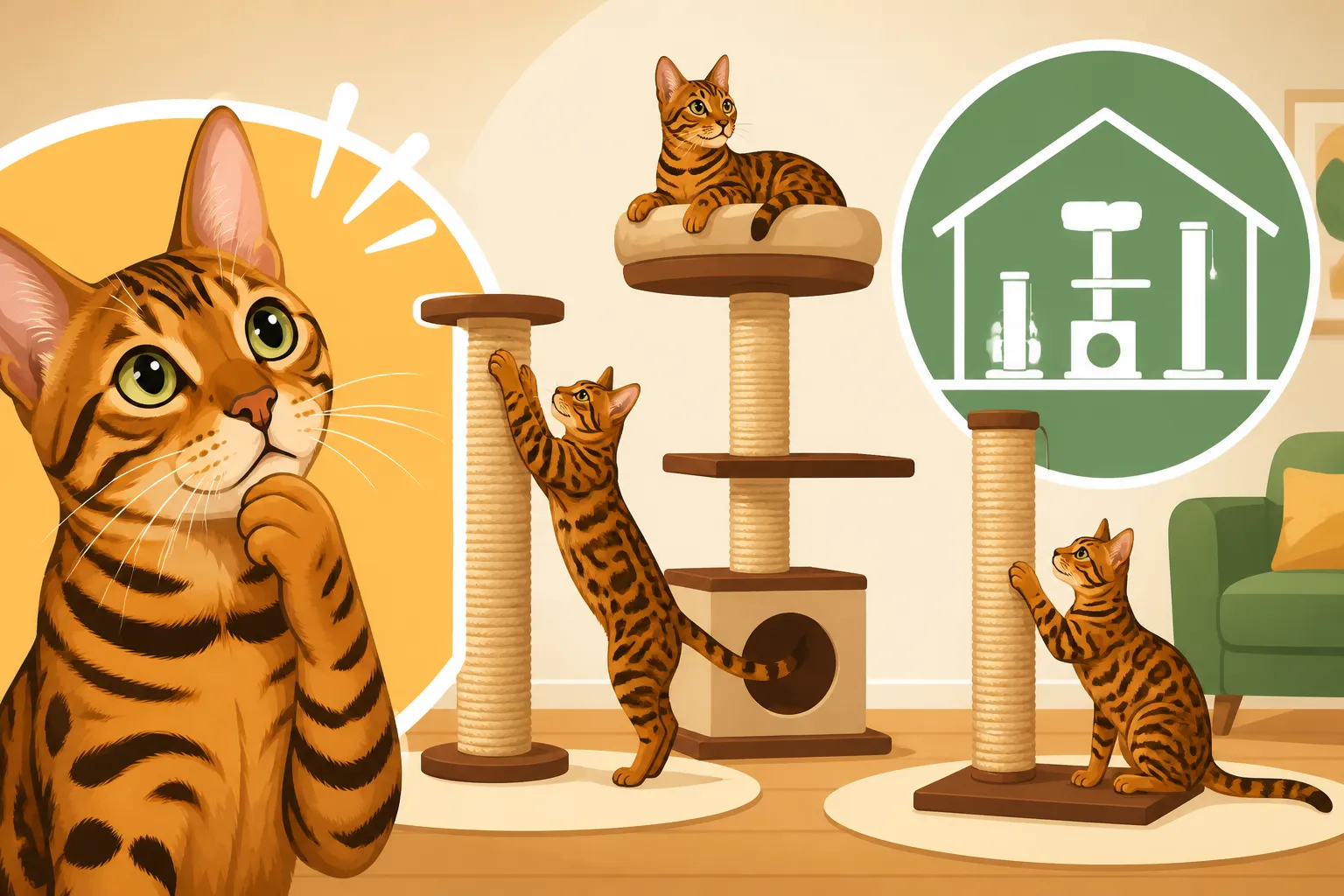
For a single Bengal cat household, I generally recommend a minimum of three to five dedicated scratching solutions. This isn't just three identical posts; it's a variety of options strategically placed.
Here’s a breakdown of what that might look like:
- One Tall, Sturdy Sisal Post: This is your primary vertical scratching station, likely placed in a main living area or near their favorite sleeping spot. It should be tall enough for a full stretch, reaching at least 32-36 inches.
- One Horizontal or Angled Cardboard Scratcher: Placed near another high-traffic area, or where they like to lounge on the floor. This provides a different angle and texture.
- One Cat Tree with Integrated Sisal Scratching Surfaces: A multi-level cat tree often includes vertical sisal-wrapped posts, offering both scratching and climbing opportunities. This can count as a significant scratching solution, especially if it has multiple sisal sections. Place this in a room where your Bengal is most active, like the living room or a dedicated play space. These tall structures also meet their need for How Much Vertical Space a Bengal Cat Needs.
- An Additional Scratching Panel or Mat: This could be a sisal wall-mounted scratcher near a doorway or a heavy-duty scratch pad by a piece of furniture they previously targeted.
This combination covers different preferences and ensures an appropriate scratching surface is almost always within easy reach, minimizing the temptation to use your furniture.
Multiple Bengals or Other Pets
If you have multiple Bengals, or a Bengal living with other cats, you absolutely need to scale up. The "number of cats + 1" rule still doesn't quite apply, but the principle of providing options for each cat's needs becomes even more critical. Each Bengal will have its preferred scratching spots and styles, and you want to minimize any potential territorial disputes over a prime scratching location.
For two Bengals, aim for five to seven distinct scratching solutions, ensuring there are multiple vertical and horizontal options available in different rooms. For example, two tall sisal posts in separate areas, two horizontal scratchers, and a large cat tree with multiple scratching surfaces. If you have a large home, you might even consider more. Remember, Bengals are territorial, and having their own designated scratching zones can help prevent conflicts. It's an investment in peace and quiet for both you and your feline family.
Integrating Scratching Solutions into Your Home
Once you have an idea of how many and what types of scratching posts your Bengal needs, the next step is seamlessly integrating them into your living space. This isn't just about functionality; it's about making them appealing to your cat and acceptable within your home's aesthetic.
Cat Trees and Activity Centers
For a Bengal, a cat tree isn't just a place to sleep; it's a vertical playground, a lookout tower, and, crucially, a scratching center. Many high-quality cat trees come equipped with sisal-wrapped posts, offering excellent vertical scratching opportunities. These multi-level structures are perfect because they cater to a Bengal's love for climbing and exploring vertical spaces, providing a natural extension of their wild instincts. A tall, sturdy cat tree with several sisal sections can effectively count as multiple scratching solutions in one, especially if placed in a central area where your Bengal spends a lot of time.
When choosing a cat tree, remember the Bengal's athletic build. They need something robust that won't sway or tip when they launch themselves up or down. Look for solid construction, heavy bases, and durable sisal. You can find excellent options on sites like Chewy or Amazon, often with reviews specifically mentioning how well they stand up to active breeds. A good cat tree can be the cornerstone of your Bengal's enrichment strategy, diverting their energy from your furniture to their designated play zones. If you've ever dealt with What a Bored Bengal Cat Destroys, you'll know that comprehensive enrichment is key, and a robust cat tree is a huge part of that.
Protecting Your Furniture: Temporary Measures and Deterrents
While providing ample scratching posts is the long-term solution, you might need some immediate tactics to protect your furniture while your Bengal learns the ropes. Temporary deterrents can be very effective in redirecting their attention. One popular method is using double-sided sticky tape specifically designed for furniture protection. Cats generally dislike the feeling of stickiness on their paws, making the area unappealing. You can apply this to the corners of your sofa or the edge of your rug where your cat has been scratching.
Another option is to cover targeted furniture with thick blankets or throws, making it less satisfying to scratch. Some people use sprays with scents that cats dislike, though effectiveness can vary widely between individual cats. The key here is "temporary." These measures are meant to buy you time while your Bengal discovers and consistently uses their new, appealing scratching posts. They are not substitutes for providing proper scratching outlets. Once your cat is reliably using the posts, you can gradually remove the deterrents. It's about making the right choice easy and the wrong choice unattractive. For more detailed advice, check out How to Protect Furniture From a Bengal Cat.
Maintenance and Replacement
Scratching posts aren't a "set it and forget it" solution. They need to be maintained and eventually replaced. Over time, sisal rope will fray, and cardboard scratchers will get shredded down to nubs. A worn-out, unstable, or unappealing post won't be used, and your Bengal will revert to seeking out your furniture.
Inspect your scratching posts regularly. When the sisal is heavily frayed and no longer offers good resistance, or when a cardboard scratcher is too thin to be satisfying, it's time for a replacement. Replacing them before they become unusable ensures a consistent positive experience for your cat. You can often find replacement parts for cat trees or purchase new cardboard inserts from retailers like Amazon. Keeping the scratching options fresh and appealing is crucial for long-term success. Remember, Why a Bengal Cat Destroys Cheap Cat Furniture often comes down to quality and durability; investing in good materials upfront will save you money and headaches in the long run.
Choosing and Placing Your Bengal Cat's Scratching Solutions
| Scratching Post Type | Ideal Placement | Primary Benefit for Bengals | Considerations |
|---|---|---|---|
| Tall Sisal Post | Main living area, near favorite sleeping spots | Full-body stretch, prominent territorial mark | Must be very sturdy and tall (30-36+ inches). |
| Horizontal Scratcher | Near lounging areas, under windows | Ground-level scratching, different muscle groups | Can be corrugated cardboard, sisal mat, or wood. Replace cardboard regularly. |
| Angled Scratcher | Between sleeping spot and play area, near targeted furniture | Versatile angle preference, easy to move | Often cardboard; good for redirection. |
| Cat Tree with Sisal | High-traffic room, by a window, play area | Vertical climbing, multiple scratching spots | Look for robust construction and multiple sisal posts. Provides elevation too. |
| Wall-Mounted Panel | Narrow hallways, near doorways, alongside furniture | Space-saving, very stable, vertical stretch | Ensure it's securely fastened to a wall stud. |
Disclaimer
This article is for general informational purposes only and does not constitute professional advice. Laws, prices and regulations vary by location and change over time. Consult a qualified professional for guidance on your specific situation.