How Many Generations Before a Bengal Cat Is Fully Domestic
A Bengal’s generation number can sound like a simple measure of how “wild” a cat is, but it is really a pedigree label. F4 is often treated as the point where Bengals are considered domestic for breed and ownership purposes, yet there is no single biological switch that makes a cat fully domestic. This guide explains what the generations mean, what F4 and SBT indicate, and what to check before choosing a Bengal.
What a Bengal generation number tells you
The F number tracks ancestry
The “F” in an F number stands for filial generation. It describes how many generations a Bengal is removed from an Asian leopard cat ancestor in its pedigree. An F1 Bengal is the first-generation offspring of an Asian leopard cat and a domestic cat; an F2 is one generation further along, and the count continues from there.
That number is useful, but it is not a complete description of a cat. It does not tell you exactly how the animal will behave, how well it has been socialized, or what its day-to-day needs will be. A generation label is a pedigree reference, not a personality test.
For a closer look at the terminology, see What Filial Generation Means for a Bengal Cat and How a Bengal Cat's Generation Is Counted. Those distinctions matter when you are comparing breeder paperwork, checking local rules, or trying to understand what a listing means by “early generation.”
F1, F2, and F3 Bengals are early generations
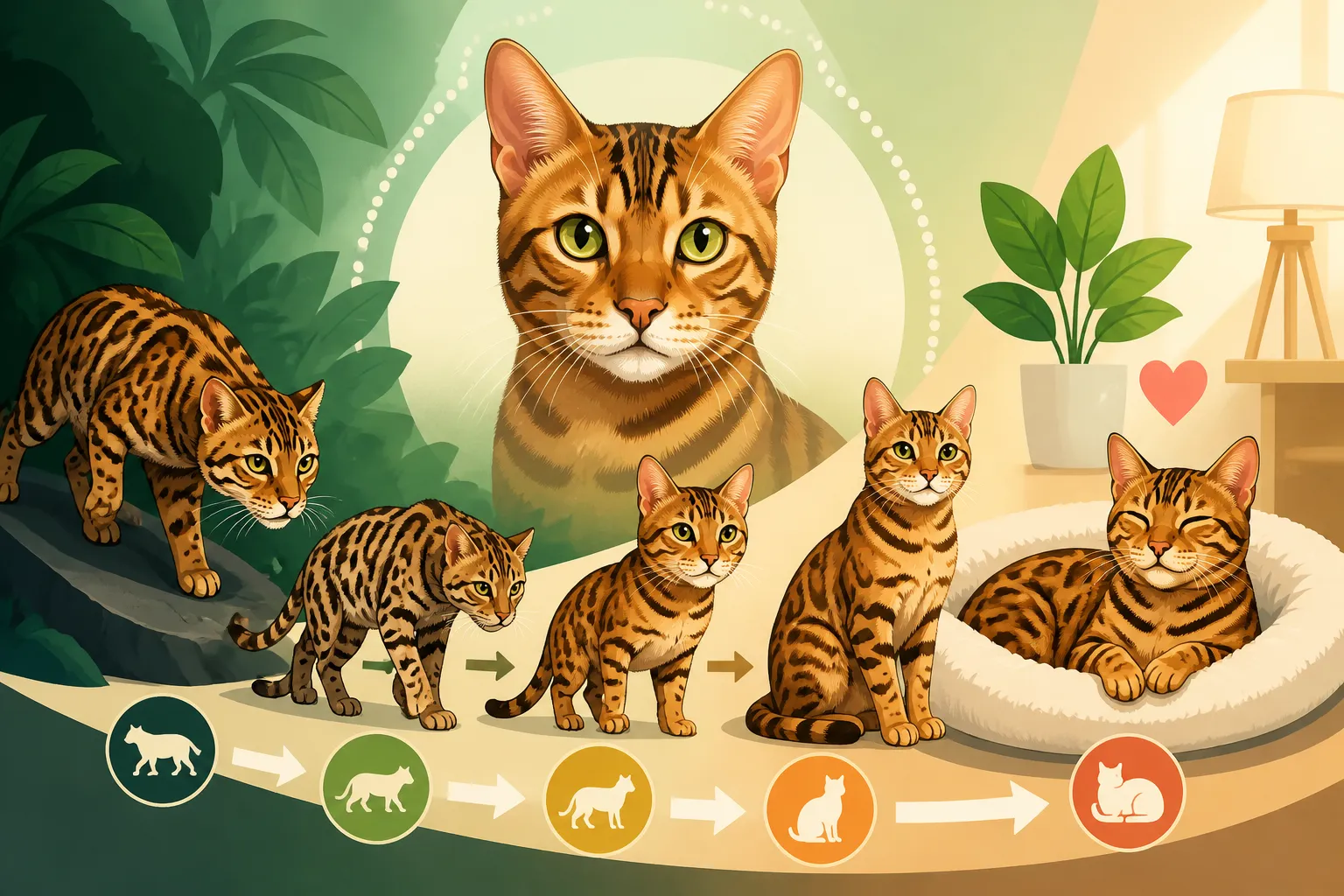
The first three generations after the Asian leopard cat are generally described as early-generation Bengals. An F1 is closest in the pedigree to the wild ancestor, while an F2 and F3 are further removed. These cats may have needs and behaviors that differ from those of a typical domestic pet, and they are not the right fit for every household.
There is no guarantee that every early-generation cat will behave in one particular way. But the closer relationship to a wild ancestor is one reason these cats may be harder to manage as household companions. Their care, breeding, and ownership can also involve restrictions that do not apply to later-generation Bengals.
It can be helpful to read What F1 Means in a Bengal Cat and What F2 and F3 Mean in a Bengal Cat before interpreting a breeder’s claims. Also, early-generation Bengal males are often infertile, a detail that affects breeding plans and pedigree progression; Why F1 to F3 Bengal Cat Males Cannot Breed explains that issue further.
Later generations are bred through domestic Bengals
As generations progress, breeders pair Bengals with other Bengals rather than making new crosses with Asian leopard cats. This is how the domestic Bengal breed is established and maintained. The cats farther along in the pedigree are generally more suitable as household pets, though individual temperament and care still matter.
A later-generation Bengal can still be energetic, inquisitive, athletic, and intensely interested in its surroundings. “Domestic” does not mean quiet, low-maintenance, or interchangeable with every other house cat. People who expect a later-generation Bengal to behave like a sleepy lap cat may be surprised by its need for interaction, climbing opportunities, and play.
The practical question is therefore not just “What generation is this cat?” but “What does this individual need, and can I provide it?” How Early Generation Bengal Cat Behaves Differently offers useful context for thinking about the gap between a pedigree label and the realities of living with a particular cat.
How many generations make a Bengal fully domestic
F4 is commonly treated as the domestic threshold
F4 is often described as the point at which a Bengal is considered domestic rather than an early-generation hybrid. That is why people asking how many generations are needed for a Bengal to be fully domestic are commonly told “four generations.” In everyday conversation, F4 can serve as shorthand for a Bengal that is far enough removed from the Asian leopard cat to be treated as a domestic pet.
However, “fully domestic” is not a universal scientific category that suddenly applies at exactly F4. It is a useful convention in breed discussions, but the exact meaning can depend on the registry, breeder terminology, local law, and the cat’s documented pedigree. A casual online listing may also use generation labels loosely, so the word “F4” alone should not be your only evidence.
For more detail on why this generation is often treated as a dividing line, see Why F4 Is the Line Between Wild and Domestic Bengal Cats. The key takeaway is that F4 is a common threshold, not a magical change in temperament or a guarantee that every ownership rule is the same everywhere.
SBT describes a breeding status, not a personality
You may also see “SBT” on Bengal pedigrees and breeder descriptions. This is a registry-related designation associated with Bengals bred within the established domestic Bengal population over multiple generations. It is often used to distinguish Bengals with a longer Bengal-to-Bengal pedigree from early-generation crosses.
SBT is not a personality rating, a promise that the cat will be easy, or a substitute for seeing the pedigree. Nor should it be treated as a universal legal answer. Registries and authorities may use different definitions and requirements, so the label needs to be understood in the context of the organization or jurisdiction using it.
If a breeder describes a kitten as SBT, ask what the term means on that kitten’s registration documents and how the pedigree supports it. What SBT Means in a Bengal Cat explains the label in more depth. You can also ask which generation the breeder works with and what documentation they provide; Which Generation a Bengal Cat Breeder Works With is a useful companion topic.
A generation label does not reveal an exact wild DNA percentage
It is tempting to translate each generation into a neat percentage of Asian leopard cat ancestry. In simplified family-tree examples, people sometimes use fractions to illustrate how ancestry is diluted over successive generations. But an individual cat’s inherited DNA does not always line up neatly with a simple percentage inferred from an F label.
The label describes a pedigree relationship, not a precise genetic measurement. The contribution an animal inherits from a particular ancestor can vary, and the way a breeder or registry counts generations also matters. Treating an F number as an exact “wild DNA meter” can create false confidence.
A DNA test may answer some ancestry questions, but it should not automatically be assumed to establish a precise percentage of wild ancestry or replace pedigree records. See Whether a DNA Test Shows a Bengal Cat's Wild Percentage if this is a concern. For a purchase or legal question, ask for the pedigree and confirm which records the relevant registry or authority accepts.
What the generation means for everyday ownership
Domestic does not mean low-energy
Even when a Bengal is a later-generation domestic cat, it may still be unusually active, clever, and persistent. A cat that can open cupboards, jump onto high shelves, and demand play at inconvenient moments may be perfectly domestic while still being a demanding companion. The generation label does not tell you how much daily enrichment the cat will need.
Before bringing one home, think through your routine. Can you make time for interactive play? Is there safe vertical space, scratching equipment, and a way to keep the cat mentally engaged? If the household is empty for long stretches, consider how you will meet the cat’s social and activity needs rather than assuming the breed will entertain itself.
People sometimes focus on whether an F4 or SBT Bengal is “safe” to own and overlook the more ordinary, practical question: is this cat a good match for my home? Which Bengal Cat Generation Suits a Family can help frame that decision around household fit rather than a number alone.
Socialization and individual temperament still count
A generation number cannot tell you whether a kitten has been handled gently, introduced to household sounds, or raised in a stable environment. Those early experiences can shape how comfortable a cat is around people and changes. A well-socialized kitten may settle into a home more smoothly than one with less appropriate early care, regardless of the label attached to the pedigree.
Ask the breeder what the kittens are used to: ordinary household activity, visitors, grooming, carriers, and brief separations from littermates. Ask how the breeder assesses temperament and what happens if a kitten proves to be a poor fit for your home. Thoughtful answers and clear records are more useful than broad promises that a particular generation is always calm or easy.
When preparing supplies, keep the transition as familiar as possible. Ask what food and litter the kitten currently uses before changing anything. If you’re gathering basics through a retailer such as Chewy, make a list of the kitten’s existing food, litter, carrier, and enrichment needs first; the goal is continuity, not a sudden overhaul. A sudden food change can be stressful, and a new home already brings plenty of unfamiliar smells and sounds.
Laws and paperwork may matter as much as the generation
Ownership rules for Bengals can vary by location, and early generations may be treated differently from later generations. Even if a breeder calls a cat domestic, that description does not necessarily settle the question for your city, county, state, landlord, or insurer. Check the rules that apply where you live before paying a deposit or arranging transport.
Ask the breeder for the kitten’s registration documents and a pedigree that clearly identifies the generations. If the paperwork uses terms such as F4 or SBT, ask the breeder to explain how the designation is supported. Keep copies of the documents rather than relying on a listing, text message, or verbal description.
When organizing your records and supplies, it can be useful to keep everything together: pedigree documents, vaccination and veterinary records, food-transition notes, and a list of household items. If you order practical supplies from Chewy, save your order details alongside your kitten’s care notes so you can easily track what you have and what needs replenishing. For a legal question, confirm the requirements with the relevant local authority rather than assuming a breeder’s paperwork answers every rule.
How to check a Bengal’s generation before choosing one
Ask for a pedigree, not just a sales description
A responsible conversation starts with documentation. Ask to see the pedigree and registration information, then check whether the generation description matches the records. A breeder should be able to explain the terminology plainly, without using “fully domestic” as a vague substitute for paperwork.
It is also reasonable to ask which registry issued the documents and what its generation terms mean. If a seller cannot provide records, gives conflicting explanations, or pressures you to decide before you can review them, take that seriously. The issue is not that every missing document proves wrongdoing; it is that you should know what you are agreeing to before bringing home a cat.
For practical guidance on reading records, see How to Find a Bengal Cat's Generation on Its Pedigree. If the breeder’s description and the pedigree appear to disagree, ask for clarification from the registry or a knowledgeable Bengal breed organization before relying on the label.
Use these questions to compare information
The following questions can help you separate the pedigree details from claims about temperament or legal status.
| Question to ask | What a useful answer should clarify |
|---|---|
| What generation is the kitten, and how is it shown on the pedigree? | The documented lineage and how the breeder counts the generation |
| Is the kitten described as SBT? | What the term means on the registration documents |
| Which registry issued the records? | Where the pedigree and designation can be checked |
| What food and litter is the kitten using now? | How to make the transition to your home less abrupt |
| What is the kitten used to in a household? | Early socialization, handling, and routine |
| Have I checked ownership rules where I live? | Whether local requirements apply to this generation |
A breeder may be friendly and experienced, but you should still feel comfortable checking documents and asking follow-up questions. If you are adopting an adult Bengal, ask the rescue or previous caregiver for any pedigree or registration records they have, while recognizing that a rescue may not know the cat’s exact lineage.
Make the decision around the whole cat
For most people seeking a companion, the more useful goal is not to find the highest generation number possible. It is to choose a cat whose documented background, needs, and temperament suit the home. A later-generation Bengal may be a better match for a typical household than an early-generation cat, but the individual animal still needs to be assessed on its own merits.
Be realistic about your home setup. A Bengal that is legally considered domestic can still be vocal, athletic, curious, and determined to investigate every cabinet. Plan for scratching, climbing, active play, and a gradual introduction to other pets. If you are buying supplies through Chewy or another retailer, prioritize sturdy, safe essentials and ask your veterinarian about appropriate food and health care rather than choosing products based only on breed marketing.
In short, F4 is commonly treated as the domestic threshold for Bengals, while SBT is a separate pedigree designation often associated with established domestic Bengal lines. Neither label replaces good records, local rule checks, or an honest look at whether you can meet the cat’s needs.
Disclaimer
This article is for general informational purposes only and does not constitute professional advice. Laws, prices and regulations vary by location and change over time. Consult a qualified professional for guidance on your specific situation.